Enter the fraction just as it looks (top box = numerator, bottom box = denominator) and press "Calculate" to see it as a decimal.
Table of Contents
-
What you can do on this page
-
What is this calculation used for?
-
How to Use
-
Formula
-
Symbols and terms
-
Good to know before you start
-
How to calculate it in Excel
-
How to calculate it in Google Sheets
-
How to calculate it in Python
-
How to write it in LaTeX and other math languages (copy and paste)
-
How to have ChatGPT do the calculation
-
DataChef Features
-
Related Features
-
NumberChef Calculators List
What you can do on this page
- Enter the numerator (top number) and denominator (bottom number) of a fraction, and you see it as a decimal right away
- A fraction that does not divide evenly, such as \(\dfrac{2}{3}\) (one that becomes a repeating decimal), is shown rounded to 14 significant digits
- The numerator and denominator can be negative numbers or decimals (for example, \(-\dfrac{5}{8}\) → -0.625, \(\dfrac{2.5}{4}\) → 0.625)
- A plain-language explanation of how to convert, and copy-and-paste formulas for Excel, Google Sheets and Python are all on this page
What is this calculation used for?
A recipe calls for \(\dfrac{1}{3}\) cup, but you only have measuring spoons. One cup is 16 tablespoons, and \(\dfrac{1}{3}\) as a decimal is \(1 \div 3 \approx 0.333\), so you need \(16 \times 0.333 \approx 5.33\) tablespoons, which is 5 tablespoons plus 1 teaspoon.
You cannot read a fraction off a scale or a measuring cup with only decimal marks, so fraction to decimal is one of the most used conversions in the kitchen.
A batting average is hits ÷ at-bats, which is the fraction \(\dfrac{10}{30}\) written as a decimal: \(10 \div 30 \approx 0.333\), shown as ".333" and read "three thirty-three".
Batting averages, win percentages, free-throw percentages and other sports stats are exactly this calculation, and players and scorekeepers use it every day.
45 points out of 60 is the fraction \(\dfrac{45}{60}\). As a decimal it is \(45 \div 60 = 0.75\), and multiplying by 100 gives 75%.
Fraction → decimal → percent is the basis of every situation where you tell others a proportion, such as grades, survey results and progress toward a sales goal.
Bolts, drill bits and lumber are sized in fractional inches such as \(\dfrac{1}{4}\) inch and \(\dfrac{3}{8}\) inch, while a digital caliper shows decimal inches. \(\dfrac{3}{8}\) inch is \(3 \div 8 = 0.375\) inch, and since 1 inch = 25.4 mm, that is \(0.375 \times 25.4 = 9.525\) mm.
Fraction to decimal is a calculation you really need when choosing parts at the hardware store or working with metric tools.
If three people split $100, each share is \(\dfrac{100}{3} = 33.333\cdots\) dollars, which does not divide evenly (a repeating decimal). In practice you round and adjust: two people pay $33.33 and one pays $33.34.
If you know that a fraction can turn into a decimal that never ends, you will not suspect a mistake when you see one. You just decide how to round.
Formula
Symbols and terms
Symbols
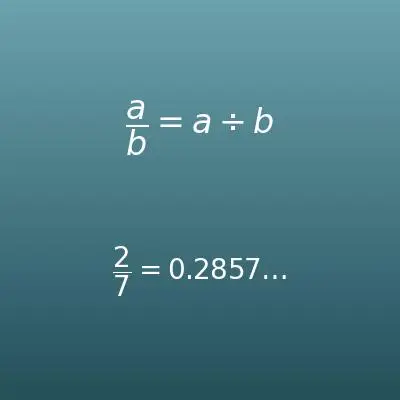
| \(a\) | a | The numerator (top number of the fraction). (Example - 2 in \(\dfrac{2}{7}\)) |
| \(b\) | b | The denominator (bottom number of the fraction). (Example - 7 in \(\dfrac{2}{7}\)) |
| \(\dfrac{a}{b}\) | a over b | A fraction. The bar means division, so it is the same number as \(a \div b\). |
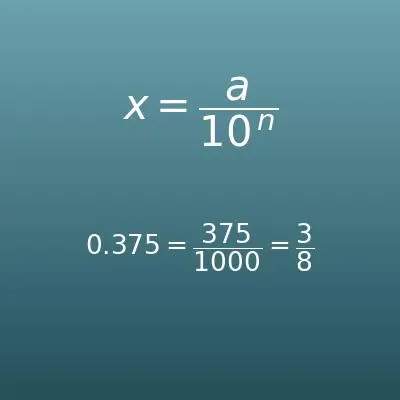
| \(x\) | x | The decimal you want to find. It is the answer (quotient) when you divide the numerator by the denominator. |
| \(10^n\) | 10 to the n | 10 multiplied by itself \(n\) times (10, 100, 1000, …). The small \(n\) at the upper right is the exponent, meaning "multiply \(n\) times", and it equals the number of zeros. |
| \(0.\overline{6}\) | zero point six repeating | Bar notation for a repeating decimal. A bar is drawn over the repeating digits (the repetend). When the repetend has two or more digits, the bar covers the whole block, as in \(0.\overline{142857}\). |
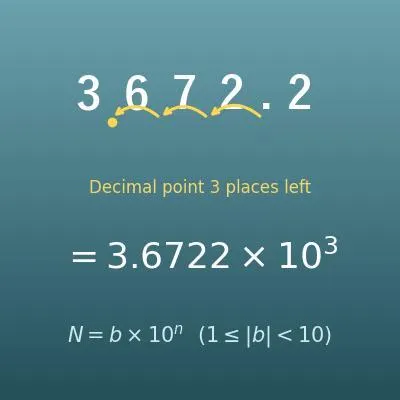
| E | E (scientific notation) | A symbol used to show very small or very large values. In "3.3333333333333E-6", E-6 means "multiply by 10 to the power of −6", that is, move the decimal point 6 places to the left (= 0.0000033333333333333). |
Terms
| numerator | The number written on top of a fraction - the 3 in "three fourths". As a division, it is the number being divided (the dividend). |
| denominator | The number written on the bottom of a fraction - the 4 in "three fourths". As a division, it is the number you divide by (the divisor), and it cannot be 0. |
| terminating decimal | A decimal whose digits come to an end, such as 0.75 (the division comes out even). If a fraction in lowest terms has a denominator made only by multiplying 2s and 5s, it becomes a terminating decimal. |
| repeating decimal | A decimal in which the same block of digits repeats forever, such as 0.333…. When a fraction does not divide evenly, its decimal is always a repeating decimal. |
| repetend | The block of digits that repeats in a repeating decimal. The repetend of \(\dfrac{1}{3}\) = 0.333… is "3", and the repetend of \(\dfrac{1}{7}\) = 0.142857142857… is "142857". |
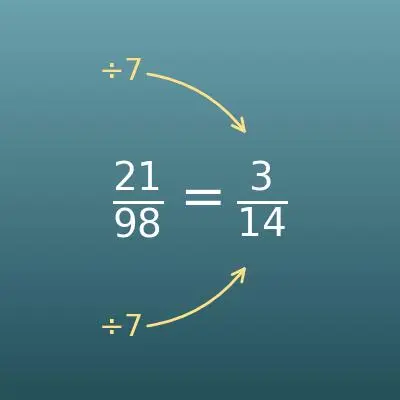
| simplifying a fraction | Dividing the numerator and denominator by the same number to make a fraction simpler (also called reducing). Multiplying both by the same number does not change the value either, and that is how you can turn the denominator into a power of 10. |
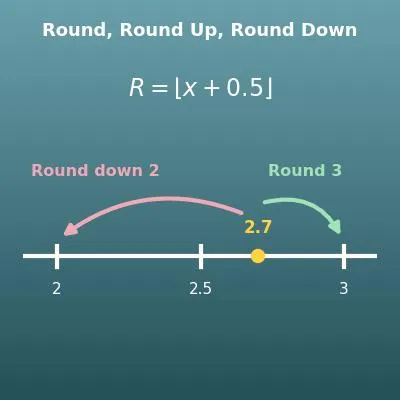
| significant digits | The digits of a number counted from the first nonzero digit (also called significant figures). "14 significant digits" in this calculator means rounding at the 14th digit counted from the first nonzero digit, as in 0.28571428571429 or 14.285714285714. Note that this is not the same as "14 decimal places". |
Good to know before you start
Here is what helps you use the calculation on this page with real understanding, not just by pressing the button.
If you get stuck, going back over these topics is the quickest way forward.
| What a fraction means (Grade 3) |
|
| Long division into decimals (Grades 5–6) |
|
| Decimal place value (Grades 4–5) |
|
| Fractions as division (Grade 5) |
|
| Repeating decimals and rational numbers (Grades 7–8) |
|
How to calculate it in Excel
| Numerator a (top number) | 2 |
| Denominator b (bottom number) | 7 |
| Decimal x | =B1/B2 |
| Numerator a | 5 |
| Number of zeros n | 2 |
| Decimal x | =B1/10^B2 |
| Numerator a | 2 |
| Denominator b | 3 |
| Decimal (rounded to 14 decimal places) | =ROUND(B1/B2,14) |
For example, the first table shows 2 ÷ 7 = 0.285714… in B3, the second shows 0.05, and the third shows 0.66666666666667. Just replace B1 and B2 with your own fraction.
How to calculate it in Google Sheets
| Numerator a (top number) | 2 |
| Denominator b (bottom number) | 7 |
| Decimal x | =B1/B2 |
| Numerator a | 5 |
| Number of zeros n | 2 |
| Decimal x | =B1/10^B2 |
| Numerator a | 2 |
| Denominator b | 3 |
| Decimal (rounded to 14 decimal places) | =ROUND(B1/B2,14) |
How to calculate it in Python
numerator = 2    # numerator (top number)
denominator = 7  # denominator (bottom number)

decimal_value = numerator / denominator  # decimal = numerator ÷ denominator
print(f"Decimal: {decimal_value}")

# Show more digits of a fraction that does not divide evenly, to see the repeating block (repetend)
from decimal import Decimal, getcontext
getcontext().prec = 50  # calculate to 50 significant digits
precise_value = Decimal(numerator) / Decimal(denominator)
print(f"To 50 digits: {precise_value}")
How to write it in LaTeX and other math languages (copy and paste)
x = a ÷ b
x = a \div b
<math xmlns="http://www.w3.org/1998/Math/MathML" display="block">
<mrow>
<mi>x</mi>
<mo>=</mo>
<mi>a</mi>
<mo>÷</mo>
<mi>b</mi>
</mrow>
</math>
x = a -: b
a/b
x := a/b;
x = a/b;
x = a ÷ b
x = a ÷ 10ⁿ
x = a \div 10^{n}
<math xmlns="http://www.w3.org/1998/Math/MathML" display="block">
<mrow>
<mi>x</mi>
<mo>=</mo>
<mi>a</mi>
<mo>÷</mo>
<msup><mn>10</mn><mi>n</mi></msup>
</mrow>
</math>
x = a -: 10^n
a/10^n
x := a/10^n;
x = a/10^n;
x = a ÷ 10^n
2/3 = 0.666… = 0.6̅
\dfrac{2}{3} = 0.666\cdots = 0.\overline{6}
<math xmlns="http://www.w3.org/1998/Math/MathML" display="block">
<mrow>
<mfrac><mn>2</mn><mn>3</mn></mfrac>
<mo>=</mo>
<mn>0.666</mn><mo>…</mo>
<mo>=</mo>
<mn>0.</mn>
<mover accent="true"><mn>6</mn><mo>¯</mo></mover>
</mrow>
</math>
2/3 = 0.666... = 0.bar(6)
N[2/3, 14]
evalf[14](2/3);
vpa(2/3, 14)
2/3 = 0.666… = 0.6̅
How to have ChatGPT do the calculation
You are a math calculation assistant. Do the following calculation by actually running Python code, and base your answer only on the numbers from the execution result (do not answer by mental math or guessing).

Convert the fraction 2/7 to a decimal.
1. The value as a decimal (if it does not divide evenly, give 30 decimal places)
2. Whether it is a terminating decimal or a repeating decimal
3. If it is a repeating decimal, the block of digits that repeats (the repetend)

Show the formulas you used and the numbers from the execution result.
How to Use
-
1Enter your numbersType the numbers you want to calculate with into the input fields
-
2CalculatePress the "Calculate" button
-
3Check the resultThe result appears on the spot. The same page also explains the idea behind the calculation and the formula
DataChef Features

No technical knowledge required.
Intuitive and user-friendly operation.

Can be used without registering personal information.

Automatic file deletion by clicking "download".

and rapid file conversion.

No attribution required.
No need to contact us for commercial use permission.
Related Features
Percentage Calculator (Percent, Part and Whole)
From two of the whole, the part and the percent, find the third
Percentage Change Calculator (Increase and Decrease)
From two of the original value, the percent change and the new value, find the third
Average Calculator (Mean)
Find the mean, median, maximum, minimum and more from a comma-separated list of numbers
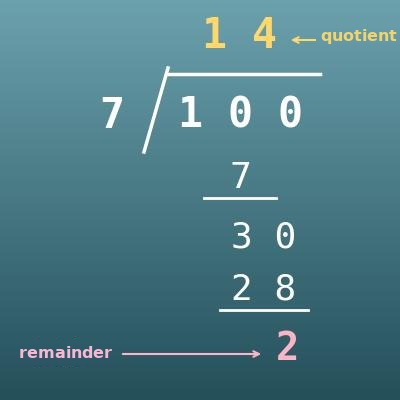
Long Division Calculator with Remainders (Step by Step)
Shows a division worked out as long division, with the divide, multiply, subtract, bring down steps explained and a check. It can also keep dividing into decimals