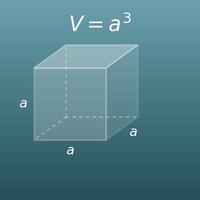
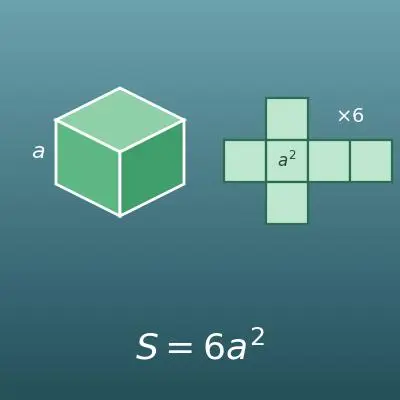
Enter the side length of the cube. You get the surface area (6 × side × side), the area of one face, and conversions between cm² and m².
Table of Contents
-
What you can do on this page
-
What is this calculation used for?
-
How to Use
-
Formulas and figures
-
Symbols and terms
-
Good to know before you start
-
How to calculate it in Excel
-
How to calculate it in Google Sheets
-
How to calculate it in Python
-
How to write it in LaTeX and other math languages (copy and paste)
-
How to have ChatGPT do the calculation
-
DataChef Features
-
Related Features
-
NumberChef Calculators List
What you can do on this page
- Enter the side length, and you get the surface area of the cube (surface area = 6 × side × side) right away
- The area of one face (a square) and unit conversions (ft² for input in inches, in² for input in feet) are shown at the same time. Switch "Units" to Metric for cm² and m²
- The result is also shown as a 3D figure (drag it with the mouse to turn it around)
- A plain-language explanation of the formulas and copy-and-paste formulas for Excel, Google Sheets and Python are all on this page
What is this calculation used for?
To wrap a cube-shaped box, you need at least as much paper as its surface area. For a box 8 in on each side, the surface area is \(6 \times 8 \times 8 = 384\,\mathrm{in^2}\) (about 2.67 ft²).
Real wrapping needs extra for folds and overlaps, so add some margin to this number when choosing the paper size. The formula tells you the minimum you need.
Paint cans list how many square feet they cover. To paint every side of a wooden cube box 16 in on each side, the surface area is \(6 \times 16 \times 16 = 1536\,\mathrm{in^2}\), and dividing by 144 gives about 10.7 ft².
Add up the boxes you want to paint and convert to ft², and you can compare directly with the coverage on the can, so you are less likely to buy the wrong amount.
A cube aquarium 12 in on each side has faces of \(12 \times 12 = 144\,\mathrm{in^2}\), and all 6 faces add up to \(6 \times 144 = 864\,\mathrm{in^2}\).
A real tank is open at the top, so the glass is one face less: \(864 - 144 = 720\,\mathrm{in^2}\) (5 ft²). Taking "6 faces minus the faces you do not need" like this gives you a good idea of how much to clean, or how much background or insulation film to buy.
The amount of cardboard it takes to make one box also starts from the surface area. A cube-shaped box 12 in on each side needs \(6 \times 12 \times 12 = 864\,\mathrm{in^2}\) (6 ft²).
Real boxes need a little more for the overlapping flaps and glue tabs, but this formula tells you roughly how many boxes you can get from a sheet.
Ice and sugar cubes melt or dissolve from the surface that touches the water or air around them, so the more surface area, the faster they tend to melt. One ice cube 2 in on each side has a surface area of \(6 \times 2 \times 2 = 24\,\mathrm{in^2}\). Split the same amount (8 in³ of volume) into eight 1-inch cubes, and the total surface area doubles to \(8 \times 6 \times 1 \times 1 = 48\,\mathrm{in^2}\).
The everyday experience that crushed ice melts and chills faster can be put into numbers with surface area.
Formulas and figures
Symbols and terms
Symbols
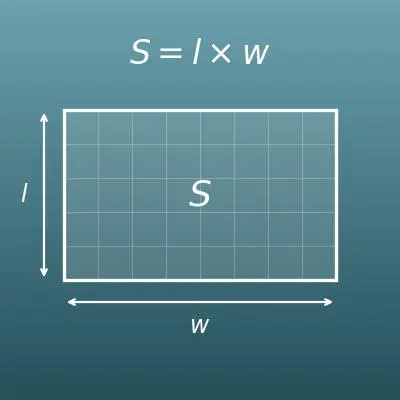
| \(S\) | ess | A symbol often used for area. On this page it is the surface area of the cube. Many US textbooks write it as \(SA\). |
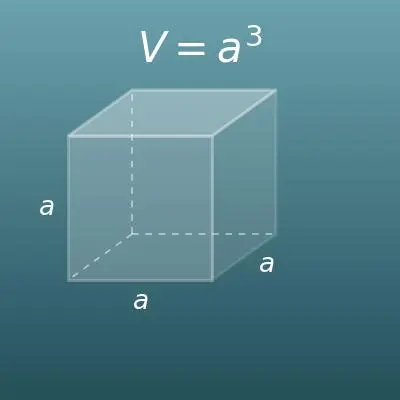
| \(a\) | a | The side length of the cube. All 12 edges of a cube are the same length, so one letter is enough. |
| \(a^2\) | a squared | The number \(a\) multiplied by itself (\(a \times a\)). The small 2 at the upper right is an exponent that tells you to multiply the number by itself. A square with side \(a\) has an area of exactly \(a^2\). |
| \(\mathrm{in^2}\) | square inches | A unit of area. A square with 1-inch sides has an area of 1 in². It is also written "sq in". |
| \(\mathrm{ft^2}\) | square feet | A unit of area. A square with 1-foot sides has an area of 1 ft². \(1\,\mathrm{ft^2} = 144\,\mathrm{in^2}\). It is also written "sq ft". |
Terms
| cube | A solid whose faces are all squares of the same size. It has 6 faces, 12 edges and 8 vertices, and every edge is the same length. Dice and a Rubik's Cube are everyday examples. |
| surface area | The total area of the whole outside of a solid. For a cube, it is the sum of the areas of its 6 square faces. It is what you need for wrapping, painting or covering the outside. |
| net | The flat shape you get by cutting a solid along its edges and unfolding it. A net of a cube is 6 identical squares joined together (there are 11 different ones, such as the cross shape). The surface area equals the area of the whole net. |
| squared | Multiplying a number by itself, also called "to the second power". The name comes from the formula for the area of a square. |
| unit conversion | Writing the same amount in a different unit. For area, the key point is that the length factor squared is the area factor (1 ft = 12 in, so 1 ft² = 144 in²). |
Good to know before you start
Here is what helps you use the calculation on this page with real understanding, not just by pressing the button.
| Multiplication (Grades 3–4) |
|
| Area of squares and rectangles (Grade 3) |
|
| Cubes, rectangular prisms and nets (Grade 6) |
|
| Multiplying decimals (Grades 5–6) |
|
How to calculate it in Excel
| Side length | 10 |
| Surface area of the cube | =6*B1^2 |
| Surface area in in² | 864 |
| Surface area in ft² | =B1/144 |
"B1" in a formula stands for "the number in that cell". "^" is a power (how many times to multiply), "*" is multiplication and "/" is division. "=6*B1^2" is 6 times the side squared, that is, 6 × side × side (Excel does powers before multiplication, so the squaring comes first as it should).
In the first table, for example, B2 shows 6 × 10 × 10 = 600 (in² if you entered inches). The second table shows 6 (ft²) in B2. Just replace the input with your own length.
How to calculate it in Google Sheets
| Side length | 10 |
| Surface area of the cube | =6*B1^2 |
| Surface area in in² | 864 |
| Surface area in ft² | =B1/144 |
How to calculate it in Python
a = 10   # side length (inches in this example)

face_area = a ** 2                        # area of one face (a square; in2 in this example)
surface_area = 6 * face_area              # surface area of the cube (area of one face x 6 faces)
surface_area_ft2 = surface_area / 144     # for input in inches, the surface area in ft2

print(f"Area of one face: {face_area} in2")
print(f"Surface area of the cube: {surface_area} in2")
print(f"In ft2: {surface_area_ft2} ft2")
How to write it in LaTeX and other math languages (copy and paste)
S = 6a²
S = 6a^{2}
<math xmlns="http://www.w3.org/1998/Math/MathML" display="block">
  <mrow>
    <mi>S</mi>
    <mo>=</mo>
    <mn>6</mn>
    <msup><mi>a</mi><mn>2</mn></msup>
  </mrow>
</math>
S = 6a^2
6 a^2
S := 6*a^2;
S = 6*a^2;
S = 6a^2
S[ft²] = S[in²] ÷ 144
S_{\mathrm{ft^2}} = S_{\mathrm{in^2}} \div 144
<math xmlns="http://www.w3.org/1998/Math/MathML" display="block">
<mrow>
<msub><mi>S</mi><mrow><msup><mi>ft</mi><mn>2</mn></msup></mrow></msub>
<mo>=</mo>
<msub><mi>S</mi><mrow><msup><mi>in</mi><mn>2</mn></msup></mrow></msub>
<mo>÷</mo>
<mn>144</mn>
</mrow>
</math>
S_(ft^2) = S_(in^2) -: 144
sIn2/144
sFt2 := sIn2/144;
s_ft2 = s_in2/144;
S(ft²) = S(in²)/144
How to have ChatGPT do the calculation
You are a math calculation assistant. Do the following calculation by actually running Python code, and base your answer only on the numbers from the execution result (do not answer by mental math or guessing).

A cube-shaped box is 10 in on each side.
Find each of the following:
1. The area of one face (a square) of this cube in in²
2. The surface area of this cube in in²
3. That surface area in ft²

Show the formulas you used and the numbers from the execution result.
How to Use
-
1Enter your numbersType the numbers you want to calculate with into the input fields
-
2CalculatePress the "Calculate" button
-
3Check the resultThe result appears on the spot. The same page also explains the idea behind the calculation and the formula
DataChef Features

No technical knowledge required.
Intuitive and user-friendly operation.

Can be used without registering personal information.

Automatic file deletion by clicking "download".

and rapid file conversion.
No attribution required.

No need to contact us for commercial use permission.
Related Features
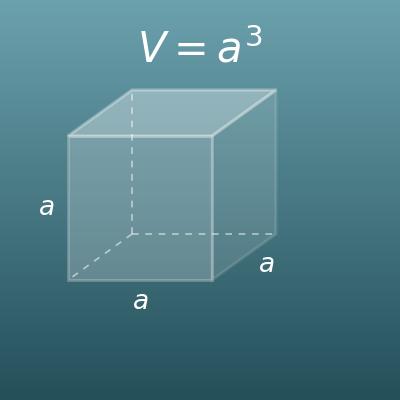
Volume of a Cube Calculator (Side × Side × Side)
Calculates the volume of the same cube, the space inside. Surface area goes with squaring, volume with cubing
Area of a Rectangle Calculator (Length × Width)
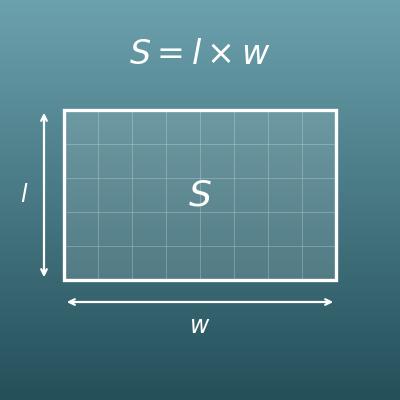
Calculates the area of a square or rectangle (side × side), the same as one face of a cube
Nth Root Calculator (Square Root, Cube Root, nth Root)
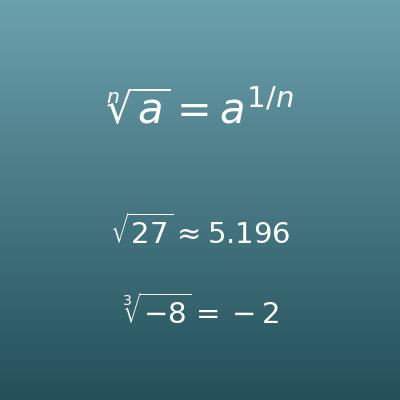
Calculates the square root (√) you use to work back from the surface area to the side length of a cube