
















Enter the two numbers X and Y, each split into a coefficient (the digits) and an exponent (the power of 10), and choose the operation. The equation below is linked to the fields, so you can also type the coefficients or exponents right into it. The result is shown in scientific, E and decimal notation, with steps such as "match the exponents" and "add the exponents".
Table of Contents
-
What you can do on this page
-
What is this calculation used for?
-
How to Use
-
Formula
-
Symbols and terms
-
Good to know before you start
-
How to calculate it in Excel
-
How to calculate it in Google Sheets
-
How to calculate it in Python
-
How to write it in LaTeX and other math languages (copy and paste)
-
How to have ChatGPT do the calculation
-
DataChef Features
-
Related Features
-
NumberChef Calculators List
What you can do on this page
- Add, subtract, multiply, divide, raise to a power, take the square root of, or square numbers in scientific notation (the form \(a \times 10^{n}\)), such as \((1.23 \times 10^{7}) + (3.45 \times 10^{2})\)
- The steps show rules such as "match the exponents, then add the coefficients" and "multiply the coefficients, add the exponents", so you learn the method, not just the answer
- The result is shown in scientific, E and decimal notation. You can also set the significant digits (how many digits to round the coefficient to) from 1 to 30 (10 if left blank)
- Check calculations with very large or very small numbers without mistakes, such as "speed of light × time" in physics or mole calculations in chemistry
- A plain-language explanation of the formulas and copy-and-paste formulas for Excel, Google Sheets and Python are all on this page
What is this calculation used for?
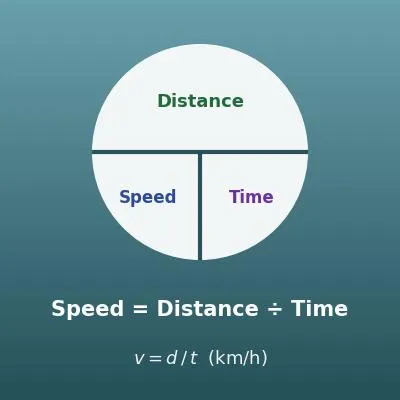
The speed of light is about \(3.0 \times 10^{8}\) m/s, and a year is about \(3.15 \times 10^{7}\) seconds. The distance light travels in a year is a multiplication: the coefficients give \(3.0 \times 3.15 = 9.45\) and the exponents give \(8 + 7 = 15\), so it is about \(9.5 \times 10^{15}\) m (one light-year is about \(9.46 \times 10^{15}\) m).
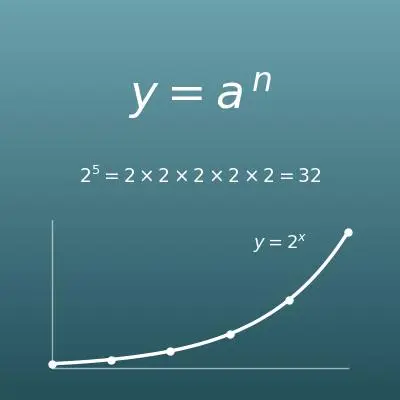
The law of exponents shrinks a multiplication with 15 zeros into a two-digit calculation. That is its power.
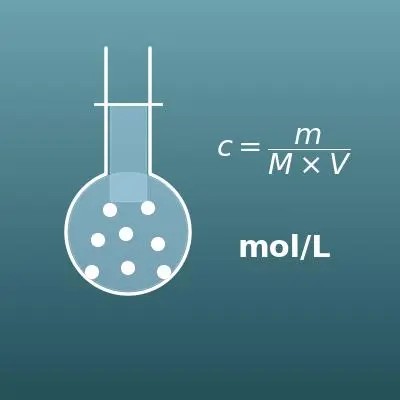
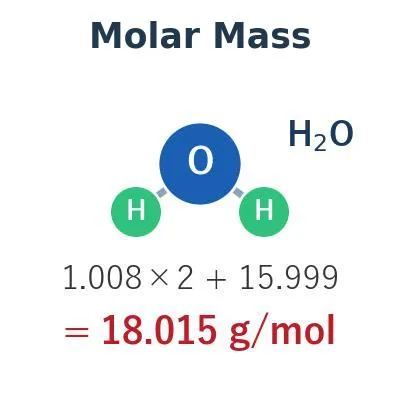
1 mole of a substance contains about \(6.02 \times 10^{23}\) particles (Avogadro's number). For example, 0.5 mole of water contains \(0.5 \times 6.02 \times 10^{23} = 3.01 \times 10^{23}\) water molecules.
Mole calculations in high school chemistry are a chain of multiplying and dividing by Avogadro's number, so the rule on this page, handling coefficients and exponents separately, leads directly to better grades.
The distance from the Sun to Earth is about \(1.5 \times 10^{11}\) m. Dividing by the speed of light, \(3 \times 10^{8}\) m/s, the coefficients give \(1.5 \div 3 = 0.5\) and the exponents give \(11 - 8 = 3\), so it is \(0.5 \times 10^{3} = 5 \times 10^{2}\) seconds, about 8 minutes 20 seconds.
In astronomy, both distances and speeds are huge, so subtracting exponents comes up in every division.
A virus is about \(1 \times 10^{-7}\) m across, and a person is about \(1.7 \times 10^{0}\) m tall. Dividing gives \(1.7 \div 1 = 1.7\) and the exponent \(0 - (-7) = 7\), so a person is about \(1.7 \times 10^{7}\) times (17 million times) the size of a virus.
Even division with negative exponents works mechanically with the one rule "subtract the exponents".
In science labs and reports, you often multiply measurements with significant figures. For example, a lot \(2.5 \times 10^{2}\) ft long and \(4.0 \times 10^{1}\) ft wide has an area of \(2.5 \times 4.0 = 10\) with exponent \(2 + 1 = 3\), which is \(10 \times 10^{3} = 1.0 \times 10^{4}\) ft².
Scientific notation keeps track of how many digits of the answer can be trusted (significant figures) as you calculate, so it is the standard for calculations based on measurements.
Formula
Symbols and terms
Symbols
| \(X\), \(Y\) | X Y | The two numbers in the calculation. On this page, each is entered as "coefficient × 10 to the power of the exponent" (for example, \(X = 1.23 \times 10^{7}\)). |
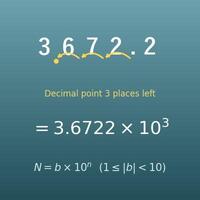
| \(a\), \(b\) | a b | The coefficients (the digits) of \(X\) and \(Y\). In normalized form, the absolute value is at least 1 and less than 10. |
| \(m\), \(n\) | m n | The exponents of \(X\) and \(Y\). The number of times 10 is multiplied, which carries the size of the number. A negative exponent stands for a small number less than 1. |
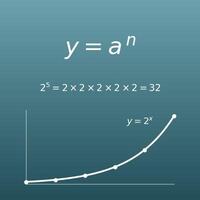
| \(k\) | k | The power, which tells what power to raise \(X\) to. On this page, it is the value of \(Y\) when you choose "Power X^Y". |
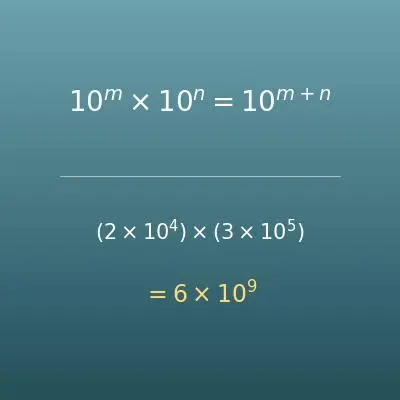
| \(10^{m+n}\) | 10 to the power m plus n | The power of 10 that appears in the law of exponents, the result of \(10^{m} \times 10^{n}\) (for example, \(10^{4} \times 10^{5} = 10^{9}\)). |
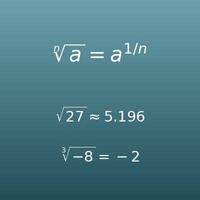
| \(\sqrt{X}\) | square root of X | The square root of \(X\): the number, 0 or greater, that gives back \(X\) when squared (for example, \(\sqrt{4 \times 10^{6}} = 2 \times 10^{3}\)). |
Terms
| law of exponents (laws of exponents) | Rules that turn calculations with powers into adding, subtracting or multiplying exponents. They are the heart of this page. The main ones are \(10^{a} \times 10^{b} = 10^{a+b}\) (multiplying adds the exponents, for example \(10^{4} \times 10^{5} = 10^{9}\)), \(10^{a} \div 10^{b} = 10^{a-b}\) (dividing subtracts them) and \((10^{a})^{b} = 10^{ab}\) (a power multiplies them). "10 multiplied 4 times" times "10 multiplied 5 times" is 10 multiplied 9 times in total. Counting like this, you can work out the rules without memorizing them. |
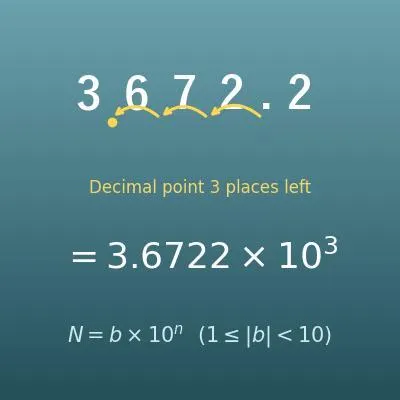
| coefficient (significand) | The \(a\) in \(a \times 10^{n}\) (the digits). The companion Scientific Notation Converter page explains it in detail. |
| exponent | The small number at the upper right of a number. On this page, it tells how many times to multiply by 10 (or, if negative, how many times to divide by 10), which carries the size of the number. |
| normalize | To adjust a number so the coefficient's absolute value is at least 1 and less than 10. If a calculation gives something like \(17.5 \times 10^{3}\), rewrite it as \(1.75 \times 10^{4}\). |
| significant digits (significant figures) | How many digits of a number, counted from the first nonzero digit, can be trusted and used. On this page, the coefficient of the result is rounded to this many digits. |
| E notation | A way of writing the \(\times 10^{n}\) part with the letter e (or E), for example 6e9 for \(6 \times 10^{9}\). The result on this page also has an E notation row. The companion Scientific Notation Converter page explains it in detail. |
Good to know before you start
Here is what helps you use the calculation on this page with real understanding, not just by pressing the button.
| Powers and exponents (Grade 6) |
|
| Scientific notation basics (Grade 8) |
|
| Laws of exponents (Grade 8) |
|
| Negative exponents (Grade 8) |
|
| Square roots (Grade 8) |
|
How to calculate it in Excel
| Coefficient of X | 1.23 |
| Exponent of X | 7 |
| Coefficient of Y | 3.45 |
| Exponent of Y | 2 |
| X + Y | =B1*10^B2+B3*10^B4 |
| X − Y | =B1*10^B2-B3*10^B4 |
| Coefficient of X | 8 |
| Exponent of X | 6 |
| Coefficient of Y | 2 |
| Exponent of Y | 2 |
| X × Y | =(B1*10^B2)*(B3*10^B4) |
| X ÷ Y | =(B1*10^B2)/(B3*10^B4) |
| Coefficient of X | 4 |
| Exponent of X | 6 |
| Power k | 2 |
| X to the power k | =(B1*10^B2)^B3 |
| √X (square root) | =SQRT(B1*10^B2) |
In the second table, B5 is the product (1600000000 = 1.6×10⁹ with the example values) and B6 is the quotient (40000 = 4×10⁴).
In the third table, B4 is the power (1.6×10¹³ with the example values) and B5 is the square root (2000 = 2×10³).
To see a result in scientific notation (E notation) such as 1.23E+07, change the result cell's format to Scientific (Home → Number Format → Scientific).
How to calculate it in Google Sheets
| Coefficient of X | 1.23 |
| Exponent of X | 7 |
| Coefficient of Y | 3.45 |
| Exponent of Y | 2 |
| X + Y | =B1*10^B2+B3*10^B4 |
| X − Y | =B1*10^B2-B3*10^B4 |
| Coefficient of X | 8 |
| Exponent of X | 6 |
| Coefficient of Y | 2 |
| Exponent of Y | 2 |
| X × Y | =(B1*10^B2)*(B3*10^B4) |
| X ÷ Y | =(B1*10^B2)/(B3*10^B4) |
| Coefficient of X | 4 |
| Exponent of X | 6 |
| Power k | 2 |
| X to the power k | =(B1*10^B2)^B3 |
| √X (square root) | =SQRT(B1*10^B2) |
You can switch a result to scientific notation (E notation) with Format → Number → Scientific.
How to calculate it in Python
import math

x = 1.23e7             # X = 1.23×10^7 (can be written as an E notation literal)
y = 3.45e2             # Y = 3.45×10^2
print(x + y)           # addition → 12300345.0
print(f"{x * y:.4e}")  # multiplication in E notation → 4.2435e+09
print(f"{x ** 2:.4e}")         # square → 1.5129e+14
print(f"{math.sqrt(x):.4e}")   # square root → 3.5071e+03
How to write it in LaTeX and other math languages (copy and paste)
a × 10ⁿ + b × 10ⁿ = (a + b) × 10ⁿ
a \times 10^{n} + b \times 10^{n} = (a + b) \times 10^{n}
<math xmlns="http://www.w3.org/1998/Math/MathML" display="block">
<mrow>
<mi>a</mi><mo>×</mo><msup><mn>10</mn><mi>n</mi></msup>
<mo>+</mo>
<mi>b</mi><mo>×</mo><msup><mn>10</mn><mi>n</mi></msup>
<mo>=</mo>
<mo>(</mo><mi>a</mi><mo>+</mo><mi>b</mi><mo>)</mo>
<mo>×</mo><msup><mn>10</mn><mi>n</mi></msup>
</mrow>
</math>
a * 10^n + b * 10^n = (a + b) * 10^n
1.23*10^7 + 3.45*10^2
evalf(1.23*10^7 + 3.45*10^2);
R = 1.23e7 + 3.45e2;
a × 10^n + b × 10^n = (a + b) × 10^n
(a × 10ᵐ) × (b × 10ⁿ) = ab × 10ᵐ⁺ⁿ, (a × 10ᵐ) ÷ (b × 10ⁿ) = (a ÷ b) × 10ᵐ⁻ⁿ
(a \times 10^{m}) \times (b \times 10^{n}) = ab \times 10^{m+n}, \quad (a \times 10^{m}) \div (b \times 10^{n}) = \dfrac{a}{b} \times 10^{m-n}
<math xmlns="http://www.w3.org/1998/Math/MathML" display="block">
<mrow>
<mo>(</mo><mi>a</mi><mo>×</mo><msup><mn>10</mn><mi>m</mi></msup><mo>)</mo>
<mo>×</mo>
<mo>(</mo><mi>b</mi><mo>×</mo><msup><mn>10</mn><mi>n</mi></msup><mo>)</mo>
<mo>=</mo>
<mi>a</mi><mi>b</mi><mo>×</mo>
<msup><mn>10</mn><mrow><mi>m</mi><mo>+</mo><mi>n</mi></mrow></msup>
</mrow>
</math>
(a * 10^m) * (b * 10^n) = a b * 10^(m+n), (a * 10^m) -: (b * 10^n) = (a -: b) * 10^(m-n)
(2*10^4) * (3*10^5)
evalf((2*10^4) * (3*10^5));
R1 = (2e4) * (3e5); R2 = (8e6) / (2e2);
(a × 10^m) × (b × 10^n) = ab × 10^(m+n), (a × 10^m) ÷ (b × 10^n) = (a ÷ b) × 10^(m−n)
(a × 10ᵐ)ᵏ = aᵏ × 10ᵐᵏ
(a \times 10^{m})^{k} = a^{k} \times 10^{mk}, \quad \sqrt{a \times 10^{m}} = \sqrt{a} \times 10^{m/2}
<math xmlns="http://www.w3.org/1998/Math/MathML" display="block">
<mrow>
<msup>
<mrow><mo>(</mo><mi>a</mi><mo>×</mo><msup><mn>10</mn><mi>m</mi></msup><mo>)</mo></mrow>
<mi>k</mi>
</msup>
<mo>=</mo>
<msup><mi>a</mi><mi>k</mi></msup>
<mo>×</mo>
<msup><mn>10</mn><mrow><mi>m</mi><mi>k</mi></mrow></msup>
</mrow>
</math>
(a * 10^m)^k = a^k * 10^(m k), sqrt(a * 10^m) = sqrt(a) * 10^(m/2)
{(2*10^3)^2, Sqrt[4*10^6]}
evalf((2*10^3)^2); evalf(sqrt(4*10^6));
R1 = (2e3)^2; R2 = sqrt(4e6);
(a × 10^m)^k = a^k × 10^(mk), √(a × 10^m) = √a × 10^(m/2)
How to have ChatGPT do the calculation
You are a calculation assistant for scientific notation. Do the following calculations by actually running Python code, and base your answer only on the numbers from the execution result (do not answer by mental math or guessing).

Calculate the following four, and show each answer both (a) in scientific notation (a coefficient with absolute value at least 1 and less than 10 × a power of 10) and (b) as an ordinary number (decimal notation).
1. (1.23 × 10^7) + (3.45 × 10^2)
2. (2 × 10^4) × (3 × 10^5)
3. (2 × 10^3) squared
4. √(4 × 10^6)

Also explain how the steps "multiply the coefficients, add the exponents" were used in the multiplication.
Show the code you used and the numbers from the execution result.
How to Use
-
1Enter your numbersType the numbers you want to calculate with into the input fields
-
2CalculatePress the "Calculate" button
-
3Check the resultThe result appears on the spot. The same page also explains the idea behind the calculation and the formula
DataChef Features

No technical knowledge required.
Intuitive and user-friendly operation.

Can be used without registering personal information.

Automatic file deletion by clicking "download".

and rapid file conversion.

No attribution required.

No need to contact us for commercial use permission.
Related Features
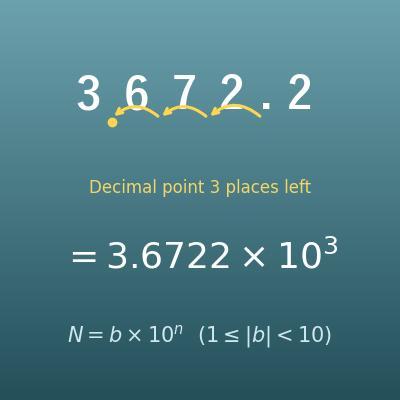
Scientific Notation Converter (b×10ⁿ, E Notation, Engineering Notation)
The companion page. Converts between ordinary numbers and scientific, E and engineering notation
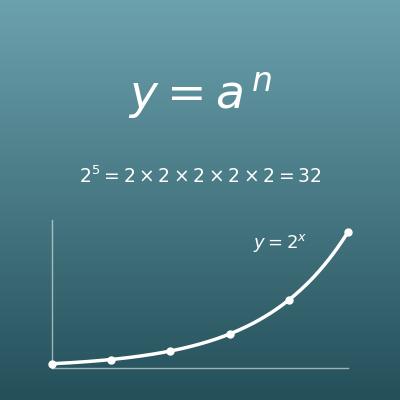
Exponent Calculator (Powers, a to the nth Power)
Calculates a power from the base and the exponent. Handy for checking how big 10 to the nth power is
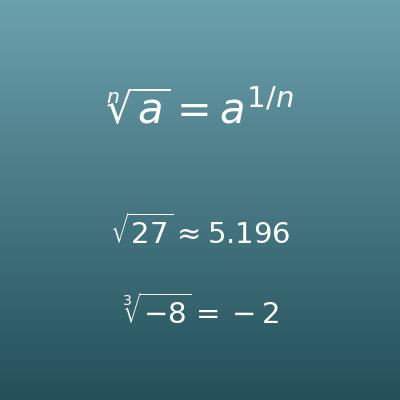
Nth Root Calculator (Square Root, Cube Root, nth Root)
For a closer look at square roots (√) themselves. Cube roots and nth roots are covered too