
























Enter the base side length and the height of a square pyramid (a pyramid with a square base). You get the surface area (base area + lateral area), plus the slant height, base area and lateral area used along the way.
Table of Contents
-
What you can do on this page
-
What is this calculation used for?
-
How to Use
-
Formulas and figures
-
Symbols and terms
-
Good to know before you start
-
How to calculate it in Excel
-
How to calculate it in Google Sheets
-
How to calculate it in Python
-
How to write it in LaTeX and other math languages (copy and paste)
-
How to have ChatGPT do the calculation
-
DataChef Features
-
Related Features
-
NumberChef Calculators List
What you can do on this page
- Just enter the side length of the base and the height, and you get the surface area of a square pyramid (base area + lateral area) on the spot
- The pyramid you entered is drawn in 3D (drag to spin it around)
- The slant height (the height of each triangular side), the base area, the lateral area and the steps are shown too, so you can check how the answer was reached, not just the answer
- A plain-language explanation of why the Pythagorean theorem comes in and how the height differs from the slant height, plus copy-and-paste formulas for Excel, Google Sheets and Python, are all on this page
What is this calculation used for?
The Great Pyramid of Giza (the Pyramid of Khufu) is almost a right square pyramid, with a base side of about 756 ft and an original height of about 481 ft. Its outside was once covered with white limestone "casing stones". Their area (the lateral area) is about \(2 \times 756 \times 612 \approx 925{,}000\,\mathrm{ft^2}\), since the slant height is \(\sqrt{378^2 + 481^2} \approx 612\,\mathrm{ft}\). That is about 21 acres, or about 16 American football fields including the end zones.
The real surface is stepped stonework, and almost all the casing stones are gone today, so this is an estimate. Still, one lateral area formula lets you put the scale of an ancient mega-project into numbers (the base sits on the ground, so for buildings you normally look at the lateral area only).
A tent held up by a single center pole (a pyramid tent) is almost a square pyramid if its floor is square. For a 12 ft × 12 ft floor and an 8 ft pole, the slant height is \(\sqrt{6^2 + 8^2} = 10\,\mathrm{ft}\), and the fabric for the sides is \(2 \times 12 \times 10 = 240\,\mathrm{ft^2}\). Including the floor, it is \(240 + 144 = 384\,\mathrm{ft^2}\).
Knowing the fabric area helps you estimate how many cans of waterproofing spray you need, how much seam tape to prepare, and about how much the fabric weighs (many real tents have short vertical walls at the bottom, so this is an estimate).
A pyramid hip roof on a square building is exactly the 4 sides of a square pyramid. For a 24 ft × 24 ft roof that rises 5 ft, the slant height is \(\sqrt{12^2 + 5^2} = 13\,\mathrm{ft}\), and the roof area is \(2 \times 24 \times 13 = 624\,\mathrm{ft^2}\), or about 6.2 "squares" (roofers measure in squares of 100 ft²).
The roof area is the basis for how many shingles, how much metal roofing or underlayment you need, and for repainting estimates (a real roof is larger by the overhang of the eaves, so this is only a guide). A roof always has more area than its footprint measured flat, and this formula counts that extra area correctly.
The surface area of a right square pyramid is a staple of middle school math, where it is found from a net, and problems with the slant height go together with the Pythagorean theorem (Grade 8) in geometry class and on tests. For example, "What is the surface area of a right square pyramid with a base side of 6 in and a height of 4 in?" The slant height is \(\sqrt{3^2 + 4^2} = 5\,\mathrm{in}\), so the answer is \(36 + 6 \times 5 \div 2 \times 4 = 96\,\mathrm{in^2}\).
The most common mistake is to use the height of the pyramid instead of the slant height for the triangle area. Remember "the height of a triangular side = the slant height", and you will get these points on the test.
Formulas and figures
Symbols and terms
Symbols
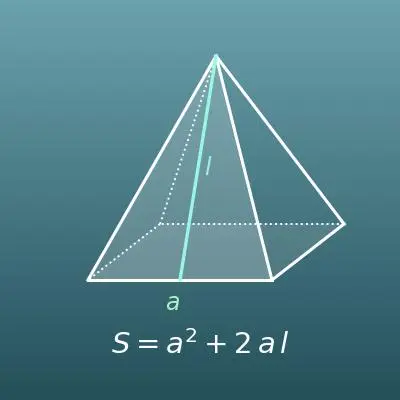
| \(S\) | ess | A common symbol for area, from the first letter of "surface". On this page it stands for the surface area of the square pyramid. |
| \(S_1\) | S sub 1 | The symbol for the base area (the area of the square base) on this page. The small 1 at the lower right is a subscript for "the first \(S\)". \(S_1 = a^2\). |
| \(S_2\) | S sub 2 | The symbol for the lateral area (the area of the 4 triangular sides) on this page. \(S_2 = 2al\) (side × slant height ÷ 2 × 4 triangles). |
| \(a\) | a | The side length of the square base. The length and width of the base are the same, so one symbol is enough. |
| \(a^2\) | a squared | The number \(a\) multiplied by itself (\(a \times a\)). The small 2 at the upper right is an exponent. On this page it is the base area (the area of the square). |
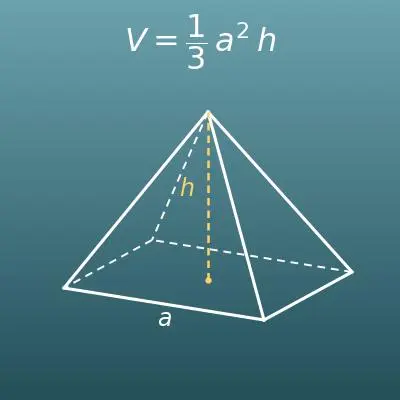
| \(h\) | aitch | The height of the pyramid, from the first letter of "height". It is measured straight up (at a right angle) from the base to the apex, and is different from a slanted edge or the slant height. |
| \(l\) | el | The symbol for the slant height (the height of a triangular side) on this page, as in US textbooks. It is found with \(l = \sqrt{\left(\dfrac{a}{2}\right)^2 + h^2}\). |
| \(\sqrt{\ }\) | square root (radical sign) | The symbol for a square root (a number that gives the number under the root when squared). For example, \(\sqrt{25} = 5\), because 5 squared is 25. It is used in the last step of finding the slant height. |
| \(\mathrm{in^2}\) | square inches | A unit of area. A square with 1-inch sides has an area of 1 in². Do not mix it up with in³ (cubic inches), the unit of volume. |
| \(\mathrm{ft^2}\) | square feet | A unit of area. A square with 1-foot sides has an area of 1 ft², and \(1\,\mathrm{ft^2} = 144\,\mathrm{in^2}\) (the length factor 12, squared). |
Terms
| square pyramid | A solid with a four-sided base that narrows to a single point (the apex). This page covers the ones with a square base (the classic pyramid shape). |
| right square pyramid | A square pyramid whose apex is directly above the center of the square base. The pyramids of Egypt have this shape. The surface area formulas on this page assume a right square pyramid (if the apex is off center, the 4 triangles are no longer congruent, and the surface area changes). |
| surface area | The area of the whole outside of a solid. It equals the total area of the net, and for a square pyramid it is "base area + lateral area". It is a different quantity from volume, which measures the space inside. |
| base area | The area of the bottom face (the base) of a solid. For a square pyramid, it is the area of the square base (side × side). |
| lateral area | The total area of the side faces of a solid (all faces except the base). For a square pyramid it is 4 congruent isosceles triangles, found with "side × slant height ÷ 2 × 4". |
| slant height | The length of the line from the top of a triangular side straight down to its base edge, at a right angle (the height of a triangular side). It is different from the height of the pyramid, and it is found with the Pythagorean theorem \(\left(\dfrac{a}{2}\right)^2 + h^2 = l^2\). |
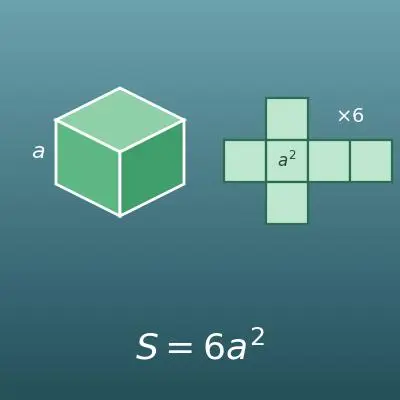
| net | The flat shape you get by cutting a solid along its edges and laying it out flat. The net of a square pyramid is "1 square and 4 isosceles triangles", and their total area is the surface area. |
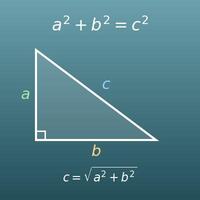
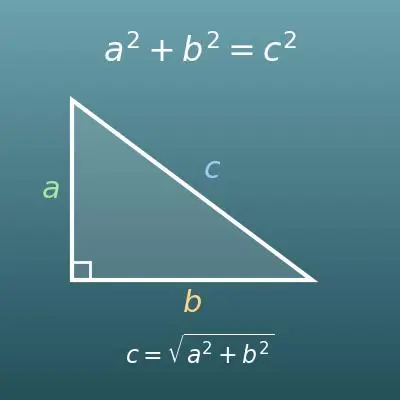
| Pythagorean theorem | The theorem that in a right triangle, "the sum of the squares of the two legs = the square of the hypotenuse". On this page it is applied to the right triangle formed by the height, half the side and the slant height, to find the slant height. |
| congruent | Exactly the same shape and size. The 4 side faces of a right square pyramid are congruent isosceles triangles, so the area of one times 4 gives the lateral area. |
Good to know before you start
Here is what helps you use the calculation on this page with real understanding, not just by pressing the button.
| Multiplication and division (Grades 3–4) |
|
| Area of a square (Grade 3) |
|
| Area of a triangle (Grade 6) |
|
| Pyramids and nets (Grade 6) |
|
| The Pythagorean theorem (Grade 8) |
|
How to calculate it in Excel
| Base area | 36 |
| Lateral area | 60 |
| Surface area | =B1+B2 |
| Base side length | 6 |
| Base area | =B1^2 |
| Base side length | 6 |
| Height | 4 |
| Slant height | =SQRT((B1/2)^2+B2^2) |
| Base side length | 6 |
| Slant height | 5 |
| Lateral area | =B1*B2/2*4 |
| Base side length | 6 |
| Height | 4 |
| Surface area | =B1^2+2*B1*SQRT((B1/2)^2+B2^2) |
In a formula, "B1" and "B2" tell Excel to use the number in that cell. "*" is multiplication, "/" is division, "^" is a power (how many times to multiply) and "SQRT" is the function for a square root.
In the first table, for example, B3 shows 36 + 60 = 96 (in² if you entered inches). The third table shows 5 in B3, the fourth shows 60 in B3, and the fifth shows 96 in B3. Just replace the input numbers with your own lengths.
How to calculate it in Google Sheets
| Base area | 36 |
| Lateral area | 60 |
| Surface area | =B1+B2 |
| Base side length | 6 |
| Base area | =B1^2 |
| Base side length | 6 |
| Height | 4 |
| Slant height | =SQRT((B1/2)^2+B2^2) |
| Base side length | 6 |
| Slant height | 5 |
| Lateral area | =B1*B2/2*4 |
| Base side length | 6 |
| Height | 4 |
| Surface area | =B1^2+2*B1*SQRT((B1/2)^2+B2^2) |
How to calculate it in Python
import math

a = 6   # base side length (in inches in this example)
h = 4   # height (straight up from the base to the apex; same unit as a)

base_area = a ** 2                            # base area (area of the square)
slant_height = math.sqrt((a / 2) ** 2 + h ** 2)  # slant height (Pythagorean theorem)
lateral_area = a * slant_height / 2 * 4       # lateral area (1 triangle x 4)
total_area = base_area + lateral_area         # surface area of the pyramid

print(f"Base area: {base_area} in2")
print(f"Slant height: {slant_height} in")
print(f"Lateral area: {lateral_area} in2")
print(f"Surface area: {total_area} in2")
How to write it in LaTeX and other math languages (copy and paste)
S = S₁ + S₂
S = S_{1} + S_{2}
<math xmlns="http://www.w3.org/1998/Math/MathML" display="block">
  <mrow>
    <mi>S</mi>
    <mo>=</mo>
    <msub><mi>S</mi><mn>1</mn></msub>
    <mo>+</mo>
    <msub><mi>S</mi><mn>2</mn></msub>
  </mrow>
</math>
S = S_1 + S_2
s1 + s2
S := S1 + S2;
S = S1 + S2;
S = S_1 + S_2
S₁ = a²
S_{1} = a^{2}
<math xmlns="http://www.w3.org/1998/Math/MathML" display="block">
  <mrow>
    <msub><mi>S</mi><mn>1</mn></msub>
    <mo>=</mo>
    <msup><mi>a</mi><mn>2</mn></msup>
  </mrow>
</math>
S_1 = a^2
a^2
S1 := a^2;
S1 = a^2;
S_1 = a^2
l = √((a/2)² + h²)
l = \sqrt{\left(\frac{a}{2}\right)^{2} + h^{2}}
<math xmlns="http://www.w3.org/1998/Math/MathML" display="block">
  <mrow>
    <mi>l</mi>
    <mo>=</mo>
    <msqrt>
      <mrow>
        <msup>
          <mrow><mo>(</mo><mfrac><mi>a</mi><mn>2</mn></mfrac><mo>)</mo></mrow>
          <mn>2</mn>
        </msup>
        <mo>+</mo>
        <msup><mi>h</mi><mn>2</mn></msup>
      </mrow>
    </msqrt>
  </mrow>
</math>
l = sqrt((a/2)^2 + h^2)
Sqrt[(a/2)^2 + h^2]
l := sqrt((a/2)^2 + h^2);
l = sqrt((a/2)^2 + h^2);
l = √((a/2)^2 + h^2)
S₂ = 2al
S_{2} = 2al
<math xmlns="http://www.w3.org/1998/Math/MathML" display="block">
  <mrow>
    <msub><mi>S</mi><mn>2</mn></msub>
    <mo>=</mo>
    <mn>2</mn>
    <mi>a</mi>
    <mi>l</mi>
  </mrow>
</math>
S_2 = 2 a l
2*a*l
S2 := 2*a*l;
S2 = 2*a*l;
S_2 = 2al
S = a² + 2a√((a/2)² + h²)
S = a^{2} + 2a\sqrt{\left(\frac{a}{2}\right)^{2} + h^{2}}
<math xmlns="http://www.w3.org/1998/Math/MathML" display="block">
  <mrow>
    <mi>S</mi>
    <mo>=</mo>
    <msup><mi>a</mi><mn>2</mn></msup>
    <mo>+</mo>
    <mn>2</mn>
    <mi>a</mi>
    <msqrt>
      <mrow>
        <msup>
          <mrow><mo>(</mo><mfrac><mi>a</mi><mn>2</mn></mfrac><mo>)</mo></mrow>
          <mn>2</mn>
        </msup>
        <mo>+</mo>
        <msup><mi>h</mi><mn>2</mn></msup>
      </mrow>
    </msqrt>
  </mrow>
</math>
S = a^2 + 2 a sqrt((a/2)^2 + h^2)
a^2 + 2*a*Sqrt[(a/2)^2 + h^2]
S := a^2 + 2*a*sqrt((a/2)^2 + h^2);
S = a^2 + 2*a*sqrt((a/2)^2 + h^2);
S = a^2 + 2a√((a/2)^2 + h^2)
How to have ChatGPT do the calculation
You are a math calculation assistant. Do the following calculation by actually running Python code, and base your answer only on the numbers from the execution result (do not answer by mental math or guessing).

A right square pyramid has a square base with 6 in sides and a height of 4 in.
Find each of the following:
1. The base area of this pyramid in in²
2. The slant height of this pyramid (the height of a triangular side) in inches (slant height = √((half the side)² + height²))
3. The lateral area of this pyramid in in² (lateral area = side × slant height ÷ 2 × 4)
4. The surface area of this pyramid in in² (surface area = base area + lateral area)

Show the formulas you used and the numbers from the execution result.
How to Use
-
1Enter your numbersType the numbers you want to calculate with into the input fields
-
2CalculatePress the "Calculate" button
-
3Check the resultThe result appears on the spot. The same page also explains the idea behind the calculation and the formula
DataChef Features

No technical knowledge required.
Intuitive and user-friendly operation.

Can be used without registering personal information.

Automatic file deletion by clicking "download".

and rapid file conversion.
No attribution required.

No need to contact us for commercial use permission.
Related Features
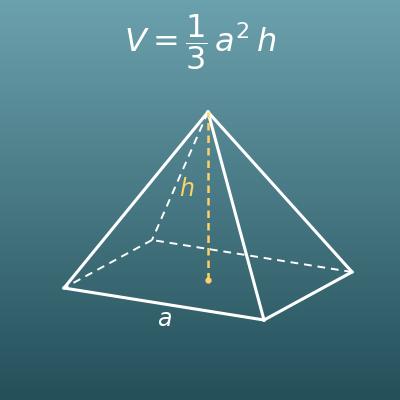
Square Pyramid Volume Calculator (Base Area × Height ÷ 3)
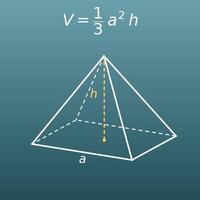
Finds the volume (how much space is inside) of the same pyramid. A good match for the surface area
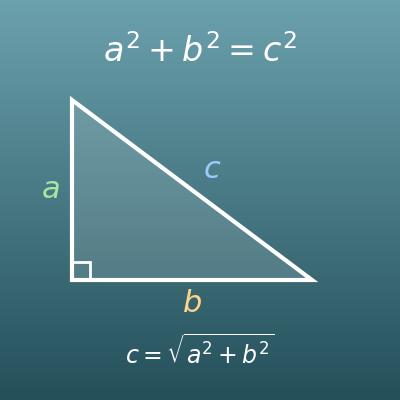
Pythagorean Theorem Calculator (Hypotenuse and Legs of a Right Triangle)
Works with the relation between the three sides of a right triangle, the idea used to find the slant height
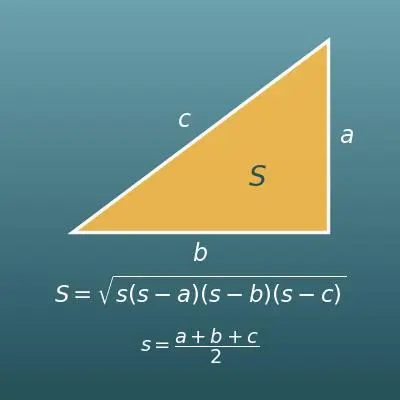
Triangle Area Calculator (from Three Sides with Heron's Formula)
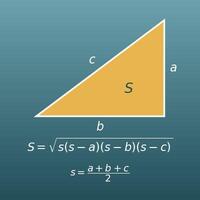
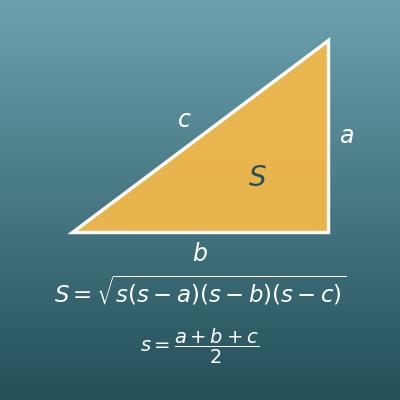
Finds the area of a triangle, the shape of each side face of the pyramid