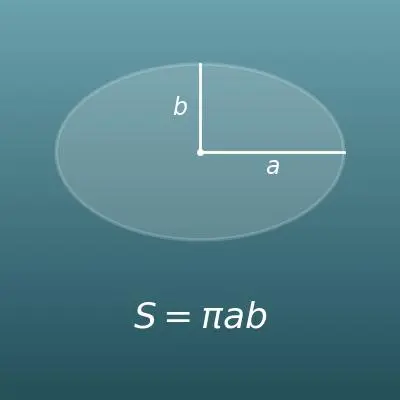
Enter the semi-major axis (the longest distance from the center to the edge) and the semi-minor axis (the shortest). You get the area (π × semi-major axis × semi-minor axis) and the exact form in terms of π.
Table of Contents
-
What you can do on this page
-
What is this calculation used for?
-
How to Use
-
Formulas and figures
-
Symbols and terms
-
Good to know before you start
-
How to calculate it in Excel
-
How to calculate it in Google Sheets
-
How to calculate it in Python
-
How to write it in LaTeX and other math languages (copy and paste)
-
How to have ChatGPT do the calculation
-
DataChef Features
-
Related Features
-
NumberChef Calculators List
What you can do on this page
- Enter the semi-major axis (the longer "radius") and the semi-minor axis (the shorter "radius"), and you get the area of the ellipse (area = pi \(\pi\) × semi-major axis × semi-minor axis) right away
- Besides the decimal answer, it shows the exact answer in terms of \(\pi\) (for a semi-major axis of 30 and a semi-minor axis of 20, area \(= 600\pi\))
- Enter the same value for both, and it works as a circle area calculator too
- A plain-language explanation of the formulas and copy-and-paste formulas for Excel, Google Sheets and Python are all on this page
What is this calculation used for?
Oval dining tables are sold by their end-to-end size, such as "72 in × 42 in". That makes the semi-major axis 36 in and the semi-minor axis 21 in, so the tabletop area is \(\pi \times 36 \times 21 = 756\pi \approx 2375\,\mathrm{in^2}\) (about 16.5 ft²).
Glass tops and table pads are often priced by area, so finding the area before you order helps you check the quote.
An oval flower bed 10 ft long and 6 ft wide has a semi-major axis of 5 ft and a semi-minor axis of 3 ft, so its area is \(\pi \times 5 \times 3 = 15\pi \approx 47.12\,\mathrm{ft^2}\).
Bags of mulch, soil, fertilizer and rolls of sod or landscape fabric list how much area they cover, so once you know the area, you can work out how much to buy before you go to the store.
Some fields, such as the infield inside a running track or some ballparks, are close to an ellipse. Treating one as an ellipse with a semi-major axis of 300 ft and a semi-minor axis of 200 ft gives a rough area of \(\pi \times 300 \times 200 = 60{,}000\pi \approx 188{,}496\,\mathrm{ft^2}\) (about 4.3 acres).
Re-sodding costs, fertilizer and watering are all planned by area, so the ellipse area formula is the starting point for facility estimates (real fields are not always exact ellipses, so this is only a rough figure).
The orbits of planets and comets are ellipses with the sun at one focus (Kepler's first law). The area an orbit encloses in one lap is exactly \(\pi a b\). Combined with Kepler's second law, "the line from the sun to a planet sweeps out equal areas in equal times", it leads to the time for one full orbit (the orbital period).
This formula is still in active use in astronomy textbooks and in designing satellite orbits.
Ultrasound machines have a tool that measures the area of an organ or lesion on the screen by drawing an ellipse around its cross section, and inside it calculates with this formula (\(\pi a b\)). Cross sections are not always perfect ellipses, so it is an approximation, but doctors and sonographers use it every day to compare size over time in numbers.
Formulas and figures
Symbols and terms
Symbols
| \(S\) | ess | A symbol often used for area. On this page it is the area of the ellipse. (Many US textbooks write area as \(A\).) |
| \(\pi\) | pi | Pi - the number of times the circumference of a circle is longer than its diameter, about 3.14159. The "3.14" used in school is a rounded value of it. |
| \(a\) | a | The semi-major axis - the longest distance from the center of the ellipse to its edge (half the major axis). |
| \(b\) | bee | The semi-minor axis - the shortest distance from the center of the ellipse to its edge (half the minor axis). |
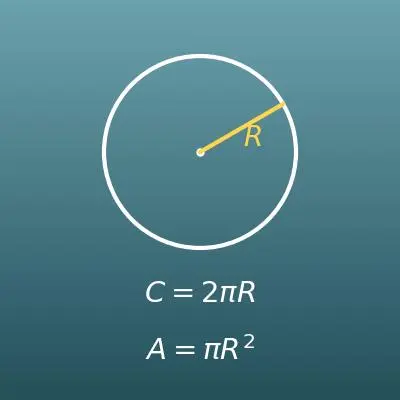
| \(r\) | ar | The radius of a circle, from the first letter of "radius". For an ellipse whose two semi-axes are equal (a circle), \(a = b = r\). |
| \(r^2\) | r squared | The number \(r\) multiplied by itself (\(r \times r\)). The small 2 at the upper right is an exponent that tells you to multiply the number by itself. |
| \(\mathrm{in^2}\) | square inches | A unit of area. A square with 1-inch sides has an area of 1 in². Enter the semi-axes in inches and the area is in in² (in feet, ft²). |
Terms
| ellipse | A curve shaped like a circle stretched (or squashed) in one direction, often called an oval in everyday English. Precisely, it is the set of points whose distances to two foci add up to the same total. Many things around us are close to an ellipse, such as the cross section of an egg or a sports field (some shapes look like ellipses but are not exact ones, such as the curves of a running track). |
| major axis | The longest end-to-end length measured through the center of an ellipse. It is the "width" of the ellipse (the longer way across) and twice the semi-major axis. |
| minor axis | The shortest end-to-end length measured through the center of an ellipse. It crosses the major axis at a right angle and is twice the semi-minor axis. |
| semi-major axis | Half the major axis - the longest distance from the center of the ellipse to its edge. It plays the role of a circle's radius, and the area formula writes it as \(a\). |
| semi-minor axis | Half the minor axis - the shortest distance from the center of the ellipse to its edge. The area formula writes it as \(b\). |
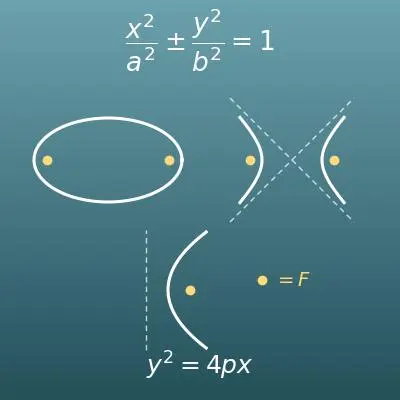
| focus (foci) | One of two special points inside an ellipse (plural foci). From any point on the edge of the ellipse, the distances to the two foci add up to the same total. When the two foci come together at one point, the ellipse becomes a circle. |
| area | The size of a shape's surface as a number. It is measured by how many unit squares (such as 1 in²) fit inside. |
| pi | The number of times the circumference (the distance around a circle) is longer than the diameter. It is about 3.14159, written with the symbol \(\pi\) (pi). It appears in the ellipse area formula just as it does in the circle area formula. |
Good to know before you start
Here is what helps you use the calculation on this page with real understanding, not just by pressing the button.
| Multiplication and decimals (Grades 3–5) |
|
| Pi and the area of a circle (Grade 7) |
|
| Expressions with variables and the symbol π (Grade 7) |
|
| The ellipse as a shape (conic sections in Algebra 2 and precalculus) |
|
How to calculate it in Excel
| Semi-major axis | 30 |
| Semi-minor axis | 20 |
| Area of the ellipse | =PI()*B1*B2 |
| Radius | 4 |
| Area of the circle | =PI()*B1^2 |
"B1" and "B2" in a formula stand for "the number in that cell". "*" is multiplication and "^" is a power (how many times to multiply). "PI()" is an Excel function that returns pi (3.14159…).
In the first table, for example, B3 shows π × 30 × 20 ≈ 1884.96 (in² if you entered inches). The second table shows about 50.27 in B2. Just replace the inputs with your own lengths.
How to calculate it in Google Sheets
| Semi-major axis | 30 |
| Semi-minor axis | 20 |
| Area of the ellipse | =PI()*B1*B2 |
| Radius | 4 |
| Area of the circle | =PI()*B1^2 |
How to calculate it in Python
import math

semi_major = 30   # semi-major axis (the longer "radius"; inches in this example)
semi_minor = 20   # semi-minor axis (the shorter "radius"; same unit as semi_major)

area = math.pi * semi_major * semi_minor   # area of the ellipse (input unit squared; in2 in this example)

print(f"Area of the ellipse: {area} in2")
How to write it in LaTeX and other math languages (copy and paste)
S = π × a × b
S = \pi a b
<math xmlns="http://www.w3.org/1998/Math/MathML" display="block">
<mrow>
<mi>S</mi>
<mo>=</mo>
<mi>π</mi>
<mo>⁢</mo>
<mi>a</mi>
<mo>⁢</mo>
<mi>b</mi>
</mrow>
</math>
S = pi a b
Pi*a*b
S := Pi*a*b;
S = pi*a*b;
S = πab
S = πr²
S = \pi r^{2}
<math xmlns="http://www.w3.org/1998/Math/MathML" display="block">
<mrow>
<mi>S</mi>
<mo>=</mo>
<mi>π</mi>
<mo>⁢</mo>
<msup><mi>r</mi><mn>2</mn></msup>
</mrow>
</math>
S = pi r^2
Pi*r^2
S := Pi*r^2;
S = pi*r^2;
S = πr^2
How to have ChatGPT do the calculation
You are a math calculation assistant. Do the following calculation by actually running Python code, and base your answer only on the numbers from the execution result (do not answer by mental math or guessing).

An ellipse has a semi-major axis of 30 in and a semi-minor axis of 20 in.
Find the area of this ellipse in in² (use math.pi for pi).

Show the formulas you used and the numbers from the execution result.
How to Use
-
1Enter your numbersType the numbers you want to calculate with into the input fields
-
2CalculatePress the "Calculate" button
-
3Check the resultThe result appears on the spot. The same page also explains the idea behind the calculation and the formula
DataChef Features

No technical knowledge required.
Intuitive and user-friendly operation.

Can be used without registering personal information.

Automatic file deletion by clicking "download".

and rapid file conversion.
No attribution required.

No need to contact us for commercial use permission.
Related Features
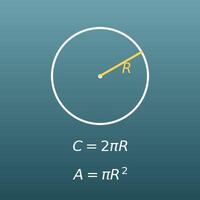
Circle Calculator (Radius, Diameter, Circumference and Area)
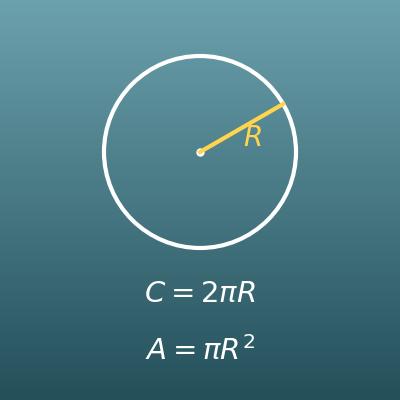
Enter any one of radius, diameter, circumference or area to get the rest. A circle is a special ellipse whose two semi-axes are equal
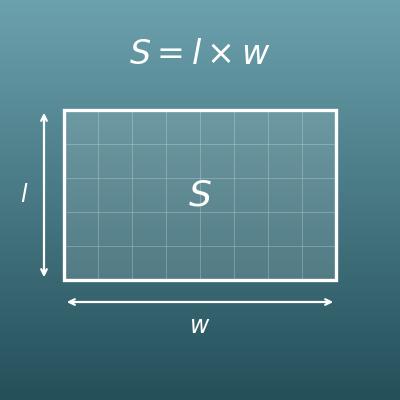
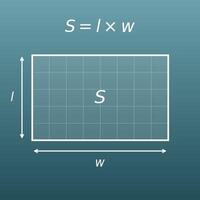
Area of a Rectangle Calculator (Length × Width)
Calculates the area of a rectangle from its length and width, with unit conversion
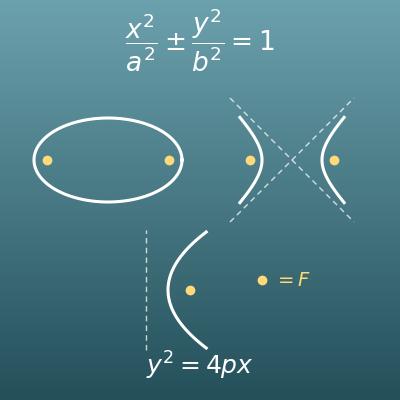
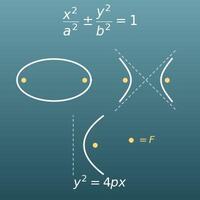
Conic Sections Calculator (Foci, Directrix and Eccentricity of Ellipses, Hyperbolas and Parabolas)
Finds the foci, vertices and eccentricity of ellipses, hyperbolas and parabolas, with steps such as c² = a² − b², exact values and a graph