
Choose how to estimate (add up from what you have, or a rough range from people or rooms) and enter the quantities. The boxes per unit, extra allowance, box sizes and tape can stay at their defaults, and the price and truck cargo volume can be left blank.
| Item (what to count) | Qty | Boxes per unit |
|---|---|---|
| Small box Books (bookshelf shelves) | ||
| Small box Dishes (cabinet shelves) | ||
| Medium box Folded clothes (dresser drawers or bins) | ||
| Medium box Hanging clothes (hangers) | ||
| Medium box Kitchenware (cabinet shelves or drawers) | ||
| Medium box Household items (storage shelves) | ||
| Small box Papers and files (file boxes) | ||
| Medium box Shoes (pairs) |
Table of Contents
-
What you can do on this page
-
What is this calculation used for?
-
How to Use
-
Formulas and figures
-
Symbols and terms
-
Good to know before you start
-
How to calculate it in Excel
-
How to calculate it in Google Sheets
-
How to calculate it in Python
-
How to write it in LaTeX and other math languages (copy and paste)
-
How to have ChatGPT do the calculation
-
DataChef Features
-
Related Features
-
NumberChef Calculators List
What you can do on this page
- Enter what you have, such as the number of bookshelf shelves, cabinet shelves, dresser drawers and hangers, and the calculator adds up the small boxes (for heavy items such as books and dishes) and medium boxes (for lighter items such as clothes)
- Every "boxes per unit" value, such as "1 bookshelf shelf = 1 small box", is an input field, so you can match it to the way you pack
- Before you count your things, you can get a rough range (minimum to maximum) from the number of people or rooms × boxes per person (or per room)
- It also works out the boxes with an extra allowance (10 to 20% is typical), the total volume in cubic feet and its share of a truck's cargo space, and the length and rolls of packing tape
- Enter the price per box (0 if you get boxes for free) to see the estimated cost. A plain-language explanation of the formulas and copy-and-paste formulas for Excel, Google Sheets and Python are all on this page
What is this calculation used for?
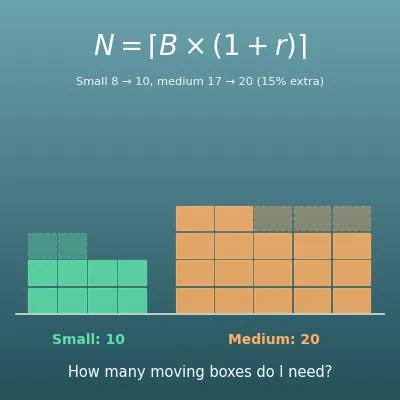
Say you are moving on your own and count 3 bookshelf shelves, 2 cabinet shelves of dishes, 4 dresser drawers, 10 hangers, 2 kitchen cabinet shelves and 3 storage shelves. The net count is \(3 + 2 = 5\) small boxes and \(4 + 1 + 2 + 3 = 10\) medium boxes. With a 15% extra allowance and rounding up, that is \(\lceil 5.75 \rceil = 6\) small boxes and \(\lceil 11.5 \rceil = 12\) medium boxes, 18 boxes in total.
With "how many more boxes do I need" as a number, it is quick to decide whether to buy only what the moving company does not provide or to buy a moving kit at a home center. Packing usually takes more than planned, so it is safer to allow plenty of extra.
In-home and online moving quotes often ask "about how many boxes will you have?" If you can give a count built up from what you own, the moving company can more easily plan the truck size and crew.
Divide the total volume by the truck's cargo volume from the company to see what share of the truck the boxes alone take up, as a guide to whether your furniture and appliances will fit in the rest (it is only a guide, because of gaps and how things are loaded).
With a portable moving container, where you move only what fits in one container, or when you ship boxes one by one, the total volume matters as well as the number of boxes. For the single-person example above (6 small and 12 medium boxes), the total volume is \(6 \times 1.333 + 12 \times 3 \approx 44\) ft³.
Compare it with the container size or the carrier's size limits to choose how to move (sizes and limits differ by company, so always check the service you use).
When clearing out a parent's home, sorting an estate or putting things in storage, count them the same way ("8 bookshelf shelves, 4 cabinet shelves, 10 dresser drawers") and the same formulas give the boxes and total volume you need.
Self-storage units are rented by floor size, such as 5 × 10 ft, so knowing the total volume helps you choose the size: a 5 × 10 ft unit with an 8 ft ceiling holds \(5 \times 10 \times 8 = 400\) ft³ at most. Things cannot be stacked with no gaps, so allow more than the total volume.
Once the number of boxes is set, the rolls of tape follow right away. Taping 30 boxes with 8 ft each takes \(30 \times 8 = 240\) ft, so with 165 ft rolls you need \(\lceil 240 \div 165 \rceil = 2\) rolls.
The number of small boxes for dishes is also a guide to how much packing paper or bubble wrap to get (the amount of packing material depends a lot on the size of the dishes and how you wrap them, so it is not calculated here; get plenty, using the number of boxes as a guide).
Formulas and figures
Symbols and terms
Symbols
| \(q\) | q | The quantity of an item, counted in an easy unit for that item: bookshelf shelves, cabinet shelves, dresser drawers, hangers, pairs of shoes and so on. It is the first letter of "quantity". |
| \(c\) | c | The boxes per unit (a coefficient). It is 1 for "1 bookshelf shelf = 1 small box" and 0.1 for "1 hanger = 0.1 medium box". It is the first letter of "coefficient". |
| \(x\) | x | The boxes for each item, found with \(x = q \times c\). |
| \(\sum x\) | sigma x | The sum of the boxes \(x\) for all items. \(\sum\) (sigma) is the sign for "add them all up"; it is the Greek letter for S, as in "sum". |
| \(B\) | B | The net count of boxes (the total before the extra allowance), found separately for small and medium boxes. |
| \(r\) | r | The extra allowance as a rate. For 15%, \(r = 0.15\), and you multiply by \(1 + r = 1.15\). It is the first letter of "rate". |
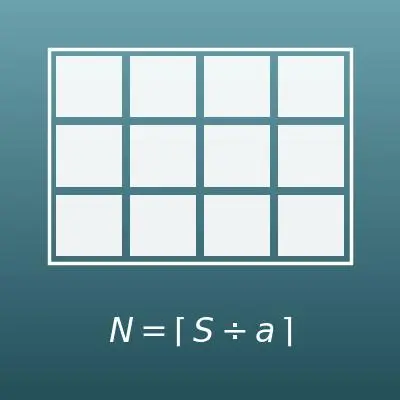
| \(N\) | N | The number of boxes with the extra allowance, found with \(N = \lceil B(1 + r) \rceil\). It is the first letter of "number". In the tape formula, it is the total of small and medium boxes with the extra allowance. |
| \(N_{S},\ N_{M}\) | N sub S, N sub M | The numbers of small (S) and medium (M) boxes with the extra allowance. The small letters S and M stand for "small" and "medium". |
| \(n\) | lowercase n | The number of people, used in the people mode for "people × boxes per person". |
| \(a,\ b\) | a, b | The minimum (\(a\)) and maximum (\(b\)) boxes per person. The defaults are 10 and 25, and you can change them to match how much you own. |
| \(N_{\min},\ N_{\max}\) | N min, N max | The low and high ends of the rough range of boxes from the number of people (or rooms): \(N_{\min} = n \times a\) and \(N_{\max} = n \times b\). |
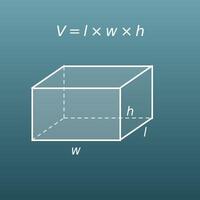
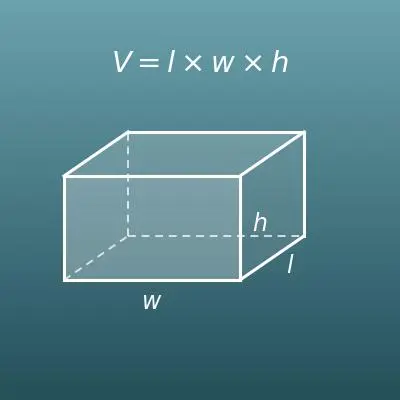
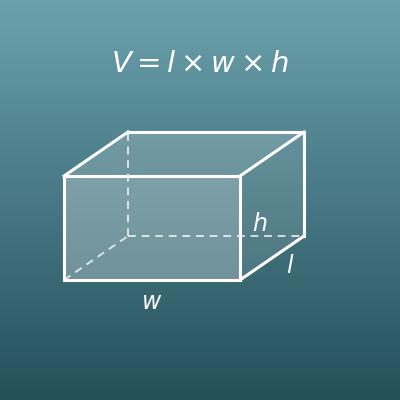
| \(w,\ d,\ h\) | w, d, h | The width, depth and height of one box, from the first letters of those words. On this page they are entered in inches. |
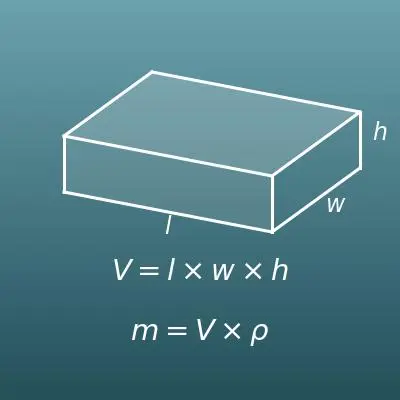
| \(v\) | lowercase v | The volume of one box: \(v = w \times d \times h\), converted to cubic feet. It is the first letter of "volume". |
| \(v_{S},\ v_{M}\) | v sub S, v sub M | The volume of one small box and one medium box. With the default sizes they are about 1.333 ft³ and 3 ft³. |
| \(V\) | capital V | The total volume of all the boxes, found with \(V = N_{S} v_{S} + N_{M} v_{M}\). |
| \(t\) | t | The length of tape used per box (ft), from the first letter of "tape". The default is 8 ft. |
| \(L\) | L | The length of one roll of tape (ft), from the first letter of "length". The default is 165 ft (55 yd). |
| \(R\) | capital R | The number of rolls of tape, from the first letter of "roll". It is found with \(R = \lceil N t \div L \rceil\). |
| \(u_{S},\ u_{M}\) | u sub S, u sub M | The price of one small box and one medium box ($ per box), from "unit price". |
| \(T\) | capital T | The estimated cost of the boxes ($), from the first letter of "total". |
| \(\lceil x \rceil\) | ceiling of x | The sign for rounding up to a whole number, called the ceiling function. (Example - \(\lceil 19.55 \rceil = 20\), \(\lceil 23 \rceil = 23\)) |
Terms
| small box | On this page, the box for heavy things such as books, dishes and papers. A US small moving box is about 1.3 to 1.5 ft³ (for example 16 × 12 × 12 in). If you put heavy things in a big box, it gets too heavy to lift or the bottom gives out, so the heavier the things, the smaller the box. |
| medium box | On this page, the box for light, bulky things such as clothes, kitchenware and household items. A US medium moving box is about 3 ft³ (for example 18 × 18 × 16 in). For very light things such as bedding, large boxes (about 4.5 ft³) are also used. |
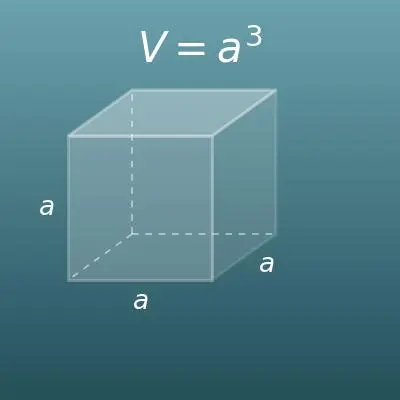
| cubic foot | A unit of volume: a cube 12 in on each side, which is 1,728 in³. Moving boxes, truck cargo space and storage units are often described in cubic feet (ft³). Boxes with the same total of width, depth and height can have different volumes, so the volume is calculated as width × depth × height. |
| extra allowance | The percentage added on top of the net count of boxes. Once packing starts, boxes tend to run short ("more books than I thought", "the packing material takes up room"), so 10 to 20% is often allowed. In the formula it is used as \(1 + r\) times. |
| net count | The amount itself, with nothing extra. On this page, it is the number of boxes before the extra allowance, just the quantities times the boxes per unit, added up. |
| rounding up | Going up to the next whole number whenever there is a decimal part. Boxes and tape come only in whole units, so box and roll counts are always rounded up. |
| cargo volume | The volume a truck or moving container can hold (ft³). All your belongings, including furniture and appliances, must fit in it. The size depends on the company and the vehicle, so this page takes it as an input. |
| dresser drawer | A drawer of a dresser, or a plastic storage bin for clothes. On this page, "the clothes in one drawer or bin = 1 medium box" is used as a unit of the rule of thumb. Some movers move light dressers with the clothes still inside, so ask first. |
| wardrobe box | A tall moving box with a hanging bar, so clothes can travel on their hangers. If you use them, you do not need to fold hanging clothes into boxes, so set the quantity of that item to 0. |
| packing material | Packing paper, bubble wrap, air pillows and the like used to wrap breakables such as dishes. Wrapping makes each item bigger, so dishes go in small boxes with room to spare, as in "1 cabinet shelf = 1 small box". |
| number of rooms | For the room-based estimate, count the bedrooms plus the living room, kitchen, dining room, home office and other main rooms. Bathrooms and hallways with little in them can be left out. For example, a 2-bedroom apartment with a living room and kitchen is 4 rooms. |
Good to know before you start
Here is what helps you use the calculation on this page with real understanding, not just by pressing the button.
| Unit rates (Grade 6) |
|
| Percents (Grade 6) |
|
| Rounding (Grades 3–4) |
|
| Volume of a rectangular prism and its units (Grade 5) |
|
How to calculate it in Excel
| Quantity (hangers) | 20 |
| Boxes per unit | 0.1 |
| Boxes for the item | =B1*B2 |
| Net count (total of medium boxes) | 17 |
| Extra allowance (%) | 15 |
| Boxes with the extra allowance | =ROUNDUP(B1*(1+B2/100),0) |
| Number of people | 2 |
| Minimum boxes per person | 10 |
| Maximum boxes per person | 25 |
| Low estimate of boxes | =B1*B2 |
| High estimate of boxes | =B1*B3 |
| Width (in) | 16 |
| Depth (in) | 12 |
| Height (in) | 12 |
| Volume of one box (ft³) | =B1*B2*B3/1728 |
| Number of small boxes | 10 |
| Volume of one small box (ft³) | 1.333 |
| Number of medium boxes | 20 |
| Volume of one medium box (ft³) | 3 |
| Total volume (ft³) | =B1*B2+B3*B4 |
| Total boxes | 30 |
| Tape per box (ft) | 8 |
| Length of one roll (ft) | 165 |
| Rolls of tape | =ROUNDUP(B1*B2/B3,0) |
| Number of small boxes | 10 |
| Price of a small box ($) | 1.50 |
| Number of medium boxes | 20 |
| Price of a medium box ($) | 2.50 |
| Estimated cost ($) | =B1*B2+B3*B4 |
"ROUNDUP(value, 0)" rounds up to a whole number (it matches ⌈ ⌉ in the formulas).
The first table gives 2 boxes, the second rounds "17 × 1.15 = 19.55" up to 20 boxes, and the third gives 20 and 50 boxes.
The fourth table divides "16 × 12 × 12 = 2304 in³" by 1,728 to get about 1.333 ft³, the fifth gives 73.33 ft³, the sixth rounds "240 ÷ 165 ≈ 1.45" up to 2 rolls, and the seventh gives $65.00. Just replace the numbers in column B with your own.
How to calculate it in Google Sheets
| Quantity (hangers) | 20 |
| Boxes per unit | 0.1 |
| Boxes for the item | =B1*B2 |
| Net count (total of medium boxes) | 17 |
| Extra allowance (%) | 15 |
| Boxes with the extra allowance | =ROUNDUP(B1*(1+B2/100),0) |
| Number of people | 2 |
| Minimum boxes per person | 10 |
| Maximum boxes per person | 25 |
| Low estimate of boxes | =B1*B2 |
| High estimate of boxes | =B1*B3 |
| Width (in) | 16 |
| Depth (in) | 12 |
| Height (in) | 12 |
| Volume of one box (ft³) | =B1*B2*B3/1728 |
| Number of small boxes | 10 |
| Volume of one small box (ft³) | 1.333 |
| Number of medium boxes | 20 |
| Volume of one medium box (ft³) | 3 |
| Total volume (ft³) | =B1*B2+B3*B4 |
| Total boxes | 30 |
| Tape per box (ft) | 8 |
| Length of one roll (ft) | 165 |
| Rolls of tape | =ROUNDUP(B1*B2/B3,0) |
| Number of small boxes | 10 |
| Price of a small box ($) | 1.50 |
| Number of medium boxes | 20 |
| Price of a medium box ($) | 2.50 |
| Estimated cost ($) | =B1*B2+B3*B4 |
How to calculate it in Python
import math

# For each item: (label, quantity, boxes per unit, size). Size "S" = small box, "M" = medium box
items = [
    ("Books (bookshelf shelves)", 4, 1.0, "S"),
    ("Dishes (cabinet shelves)", 3, 1.0, "S"),
    ("Folded clothes (dresser drawers or bins)", 6, 1.0, "M"),
    ("Hanging clothes (hangers)", 20, 0.1, "M"),
    ("Kitchenware (cabinet shelves or drawers)", 3, 1.0, "M"),
    ("Household items (storage shelves)", 4, 1.0, "M"),
    ("Papers and files (file boxes)", 2, 0.5, "S"),
    ("Shoes (pairs)", 10, 0.2, "M"),
]
extra_rate = 0.15             # extra allowance (15%)
small_box_in = (16, 12, 12)   # small box width, depth, height (in)
medium_box_in = (18, 18, 16)  # medium box width, depth, height (in)
tape_per_box_ft = 8           # packing tape per box (ft)
tape_roll_ft = 165            # length of one roll of tape (ft) = 55 yd
price_small = 1.50            # price of a small box ($), example only
price_medium = 2.50           # price of a medium box ($), example only

# Boxes for each item = quantity x boxes per unit, added up separately for small and medium boxes
net_small = sum(qty * coef for _, qty, coef, size in items if size == "S")
net_medium = sum(qty * coef for _, qty, coef, size in items if size == "M")

# Boxes with the extra allowance = net x (1 + extra rate), rounded up (small and medium separately)
boxes_small = math.ceil(net_small * (1 + extra_rate))
boxes_medium = math.ceil(net_medium * (1 + extra_rate))
boxes_total = boxes_small + boxes_medium

# Volume of one box (in^3 -> ft^3) and the total volume
vol_small = small_box_in[0] * small_box_in[1] * small_box_in[2] / 1728
vol_medium = medium_box_in[0] * medium_box_in[1] * medium_box_in[2] / 1728
total_volume = boxes_small * vol_small + boxes_medium * vol_medium

# Length of tape and rolls needed (rounded up), estimated cost
tape_length = boxes_total * tape_per_box_ft
tape_rolls = math.ceil(tape_length / tape_roll_ft)
cost = boxes_small * price_small + boxes_medium * price_medium

print(f"Small boxes: net {net_small:g} -> with extra {boxes_small}")
print(f"Medium boxes: net {net_medium:g} -> with extra {boxes_medium}")
print(f"Total: {boxes_total} boxes")
print(f"Total volume: {total_volume:.2f} ft³")
print(f"Packing tape: {tape_length:g} ft -> {tape_rolls} rolls")
print(f"Estimated cost: ${cost:.2f}")
How to write it in LaTeX and other math languages (copy and paste)
x = q × c
x = q \times c
<math xmlns="http://www.w3.org/1998/Math/MathML" display="block">
<mrow>
<mi>x</mi>
<mo>=</mo>
<mi>q</mi>
<mo>×</mo>
<mi>c</mi>
</mrow>
</math>
x = q * c
q*c
x := q*c;
x = q*c;
x = q × c
N = ⌈B × (1 + r)⌉
N = \lceil B(1 + r) \rceil
<math xmlns="http://www.w3.org/1998/Math/MathML" display="block">
<mrow>
<mi>N</mi>
<mo>=</mo>
<mo>⌈</mo>
<mi>B</mi>
<mo>⁢</mo>
<mrow><mo>(</mo><mn>1</mn><mo>+</mo><mi>r</mi><mo>)</mo></mrow>
<mo>⌉</mo>
</mrow>
</math>
N = |~ B(1 + r) ~|
Ceiling[b*(1 + r)]
N := ceil(B*(1 + r));
N = ceil(B*(1 + r));
N = ⌈B(1 + r)⌉
Nmin = n × a, Nmax = n × b
N_{\min} = n \times a,\quad N_{\max} = n \times b
<math xmlns="http://www.w3.org/1998/Math/MathML" display="block">
<mrow>
<msub><mi>N</mi><mi>min</mi></msub>
<mo>=</mo>
<mi>n</mi><mo>×</mo><mi>a</mi>
<mo>,</mo>
<msub><mi>N</mi><mi>max</mi></msub>
<mo>=</mo>
<mi>n</mi><mo>×</mo><mi>b</mi>
</mrow>
</math>
N_min = n * a, N_max = n * b
{n*a, n*b}
Nmin := n*a; Nmax := n*b;
Nmin = n*a; Nmax = n*b;
N_min = n × a, N_max = n × b
v = w × d × h
v = w \times d \times h
<math xmlns="http://www.w3.org/1998/Math/MathML" display="block">
<mrow>
<mi>v</mi>
<mo>=</mo>
<mi>w</mi>
<mo>×</mo>
<mi>d</mi>
<mo>×</mo>
<mi>h</mi>
</mrow>
</math>
v = w * d * h
w*d*h
v := w*d*h;
v = w*d*h;
v = w × d × h
V = Nₛ × vₛ + Nₘ × vₘ
V = N_{S} v_{S} + N_{M} v_{M}
<math xmlns="http://www.w3.org/1998/Math/MathML" display="block">
<mrow>
<mi>V</mi>
<mo>=</mo>
<msub><mi>N</mi><mi>S</mi></msub>
<mo>⁢</mo>
<msub><mi>v</mi><mi>S</mi></msub>
<mo>+</mo>
<msub><mi>N</mi><mi>M</mi></msub>
<mo>⁢</mo>
<msub><mi>v</mi><mi>M</mi></msub>
</mrow>
</math>
V = N_S * v_S + N_M * v_M
nS*vS + nM*vM
V := NS*vS + NM*vM;
V = NS*vS + NM*vM;
V = N_S v_S + N_M v_M
R = ⌈N × t ÷ L⌉
R = \left\lceil \frac{N t}{L} \right\rceil
<math xmlns="http://www.w3.org/1998/Math/MathML" display="block">
<mrow>
<mi>R</mi>
<mo>=</mo>
<mo>⌈</mo>
<mfrac><mrow><mi>N</mi><mo>⁢</mo><mi>t</mi></mrow><mi>L</mi></mfrac>
<mo>⌉</mo>
</mrow>
</math>
R = |~ (N t) / L ~|
Ceiling[n*t/l]
R := ceil(N*t/L);
R = ceil(N*t/L);
R = ⌈(N t)/L⌉
T = Nₛ × uₛ + Nₘ × uₘ
T = N_{S} u_{S} + N_{M} u_{M}
<math xmlns="http://www.w3.org/1998/Math/MathML" display="block">
<mrow>
<mi>T</mi>
<mo>=</mo>
<msub><mi>N</mi><mi>S</mi></msub>
<mo>⁢</mo>
<msub><mi>u</mi><mi>S</mi></msub>
<mo>+</mo>
<msub><mi>N</mi><mi>M</mi></msub>
<mo>⁢</mo>
<msub><mi>u</mi><mi>M</mi></msub>
</mrow>
</math>
T = N_S * u_S + N_M * u_M
nS*uS + nM*uM
T := NS*uS + NM*uM;
T = NS*uS + NM*uM;
T = N_S u_S + N_M u_M
How to have ChatGPT do the calculation
You are a calculation assistant for counting packing supplies for a move. Do the following calculation by actually running Python code, and base your answer only on the numbers from the execution result (do not answer by mental math or guessing).

Here is what there is to pack (quantity × boxes per unit):
For small boxes: 4 bookshelf shelves (1 box per shelf), 3 cabinet shelves of dishes (1 box per shelf), 2 file boxes (0.5 box each)
For medium boxes: 6 dresser drawers (1 box each), 20 hangers (0.1 box each), 3 kitchen cabinet shelves (1 box per shelf), 4 storage shelves (1 box per shelf), 10 pairs of shoes (0.2 box per pair)
The extra allowance is 15%. A small box is 16 × 12 × 12 in and a medium box is 18 × 18 × 16 in. Use 8 ft of tape per box and 165 ft per roll.

Find each of the following:
1. The net count of small boxes and of medium boxes (the sum of the boxes for each item)
2. The boxes with the extra allowance (net × 1.15, rounded up separately for small and medium boxes) and the total
3. The total volume of the boxes (ft³, with 1 ft³ = 1,728 in³)
4. The length of tape needed (ft) and the number of rolls (rounded up)

Show the formulas you used and the numbers from the execution result.
How to Use
-
1Enter your numbersType the numbers you want to calculate with into the input fields
-
2CalculatePress the "Calculate" button
-
3Check the resultThe result appears on the spot. The same page also explains the idea behind the calculation and the formula
DataChef Features

No technical knowledge required.
Intuitive and user-friendly operation.

Can be used without registering personal information.

Automatic file deletion by clicking "download".

and rapid file conversion.

No attribution required.

No need to contact us for commercial use permission.
Related Features
Rectangular Prism Volume Calculator (Length × Width × Height)
Find the volume of one box (width × depth × height) with unit conversions
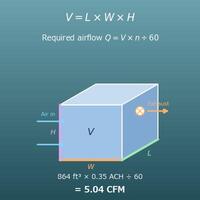
Room Volume and Ventilation Calculator (Air Changes per Hour, CFM)
Find the volume of a room and compare it with the total volume of your belongings
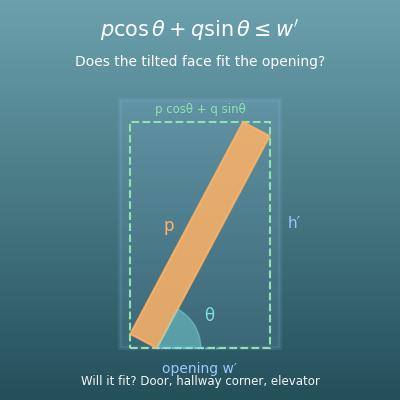
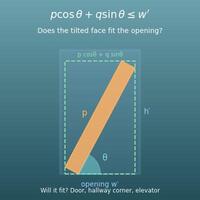
Furniture Fit Calculator (Through a Door, Around a Hallway Corner, Into an Elevator)
Check from the sizes whether furniture fits through the doors, hallway corners and elevator of your new home
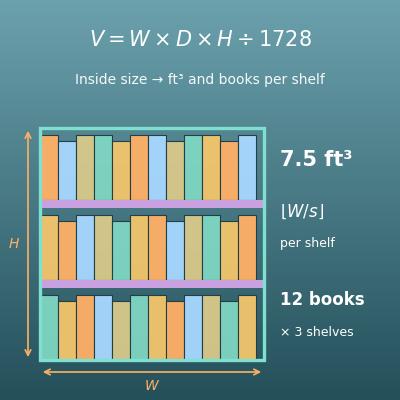
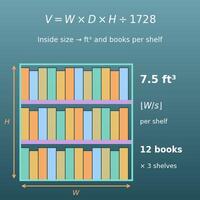
Storage Capacity Calculator (Cubic Feet, How Many Books and Bins Fit)
Find how many bins or books fit in the storage of your new home from its inside dimensions