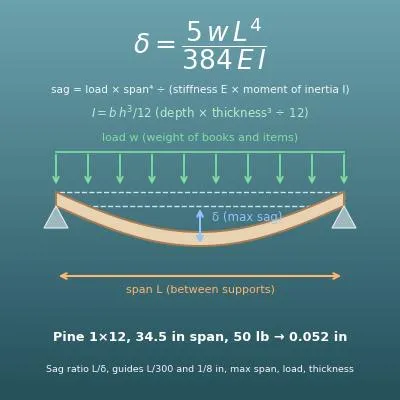
Choose what to find, then enter the amount of paint (or base) and the thinning rate. Use the thinning rate from your paint can or the maker's data sheet.
Table of Contents
-
What you can do on this page
-
What is this calculation used for?
-
How to Use
-
Formulas and figures
-
Water or thinner to add and the thinned paint (from the paint amount)
-
Share of water or thinner in the whole mix
-
Paint needed (from the batch you want to make)
-
Hardener for a 2-part paint (from the mix ratio)
-
Thinning a 2-part paint (based on base + hardener combined)
-
Converting a thinning rate by weight to volume (with weight per gallon)
-
-
Symbols and terms
-
Good to know before you start
-
How to calculate it in Excel
-
How to calculate it in Google Sheets
-
How to calculate it in Python
-
How to write it in LaTeX and other math languages (copy and paste)
-
How to have ChatGPT do the calculation
-
DataChef Features
-
Related Features
-
NumberChef Calculators List
What you can do on this page
- Enter the amount of unthinned paint (what is in the can) and the thinning rate (%), and see right away how much water or thinner to add and how much thinned paint you get
- Work backward from the batch you want, such as "I want exactly 1 gallon of thinned paint", to the paint and the water or thinner you need. Handy when you do not want leftover mix, since thinned paint cannot go back into the can
- For 2-part (2K) paints (base + hardener), find the hardener from the mix ratio (such as 4:1), then thin the mix. The thinning rate can be based on "base + hardener combined" or on "base only", whichever your product uses
- If the maker gives the thinning rate by weight but you measure with a measuring cup (by volume), enter the weight per gallon of the paint and the thinner to get the amount by volume
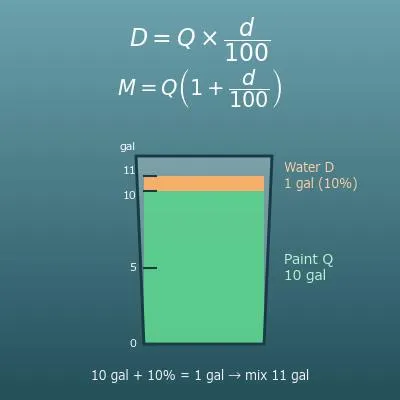
- A figure of a measuring cup filled with paint, hardener and water or thinner shows the proportions at a glance. A plain explanation of the formulas and copy-and-paste formulas for Excel, Google Sheets and Python are on this page too
What is this calculation used for?
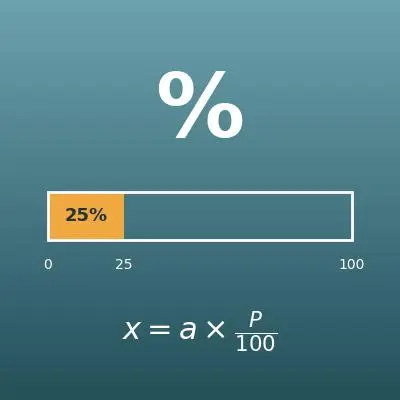
Some latex paint labels say something like "thin up to 10% with water", often for spraying. For a whole 1 gal can at 5%, add \(1 \times 5 \div 100 = 0.05\) gal (6.4 fl oz) of water, for 1.05 gal of thinned paint.
Too much water makes the film too thin and lowers hiding power (the ability to cover what is underneath), so you need more coats. Measure with a cup and start at the low end of the range. Check how many cans you need for the area first on the paint calculator page. Many modern latex paints are made to be used without thinning for brush and roller work, so follow your label.
Thinned paint cannot go back into the can, so any leftover mix is wasted. One shelf often needs only about 1 pint (0.125 gal) of mix. At 10%, mixing \(0.125 \div 1.1 \approx 0.114\) gal (about 14.5 fl oz) of paint with about 1.5 fl oz (about 3 tablespoons) of water is enough.
Working backward from the batch you need and thinning only that much saves both paint and money.
2-part urethane and epoxy coatings for garage floors, decks and boats come with data sheets like "mix 4:1 with activator, reduce 5–10%". For 1 gal of base, the activator is 0.25 gal (1 qt). At 5% of the 1.25 gal total, the reducer is 0.0625 gal (8 fl oz).
A 2-part coating must be applied within its pot life after mixing (often a few hours) or it sets, so mix only what you can apply in time. The "from the batch to make (2-part)" mode gives the base, hardener and thinner at once (always use the mix ratio and thinning rate from the data sheet).
2-part automotive clear coats use a large share of hardener, such as "2:1" or "4:1", and are then thinned with reducer for spraying. Mixing 16 fl oz (0.125 gal) of clear at 2:1 takes 8 fl oz (0.0625 gal) of hardener. At 20% of the 24 fl oz total, the reducer is 4.8 fl oz.
Small amounts must be measured exactly. Mixing cups with printed ratio scales are common, and if the data sheet gives the ratio by weight, a scale with the amounts in lb (or oz ÷ 16) is the surest way.
Some data sheets give the thinning rate by weight, while on the job people usually measure with a cup. For 1 gal of paint at 10.8 lb/gal with 10% by weight of lacquer thinner (7.1 lb/gal), the thinner by volume is about 0.152 gal (about 19.5 fl oz, about 15.2% by volume). That is over 50% more than the 12.8 fl oz you would get by treating the weight % as a volume %.
The weight per gallon is on the product data sheet (or specific gravity × 8.34), so enter it when the rate is by weight.
Formulas and figures
Symbols and terms
Symbols
| \(Q\) | cue | The amount of unthinned paint (gal or lb) - the paint taken from the can before thinning. It comes from "quantity". It is the same symbol as the "paint needed, with waste" \(Q\) on the paint calculator page, so you can enter that value as is. |
| \(d\) | dee | The thinning rate (%) - the water or thinner added as a percent of the paint. It comes from "dilution". |
| \(D\) | capital dee | The water or thinner to add. It is found with \(D = Q \times d \div 100\). It comes from "diluent" (a liquid used for thinning). |
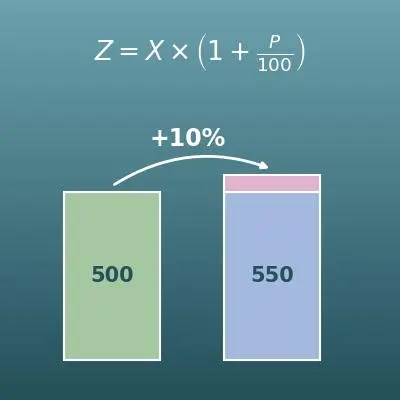
| \(M\) | em | The thinned paint. It is found with \(M = Q + D = Q \times (1 + d \div 100)\). When you work backward, you set this value first as the batch you want and then find the paint \(Q\). It comes from "mixture". |
| \(s\) | ess | The share of water or thinner in the whole mix (%). It is found with \(s = d \div (100 + d) \times 100\). It comes from "share". |
| \(A\) | ay | The amount of base in a 2-part paint. The base is often called part A, and that is the A here. |
| \(H\) | aitch | The amount of hardener in a 2-part paint. It is found with \(H = A \times b \div a\). It comes from "hardener". |
| \(a,\ b\) | ay, bee | The two numbers of the mix ratio "base \(a\) : hardener \(b\)". For "4:1", \(a = 4\) and \(b = 1\). |
| \(\rho_p\) | rho sub pee | The paint weight per gallon (lb/gal), or its specific gravity (kg/L). \(\rho\) (rho) is the usual physics symbol for density, and the subscript p stands for "paint". |
| \(\rho_s\) | rho sub ess | The weight per gallon (lb/gal) of the water or thinner, or its specific gravity. Water is 8.34 lb/gal and mineral spirits about 6.5 lb/gal. The subscript s stands for "solvent". |
Terms
| Thinning | Adding water or thinner to paint. It makes the paint flow easily and helps avoid brush and roller marks. Too much makes the film too thin and lowers performance, so stay within the range the maker gives. |
| Thinning rate | The water or thinner added as a percent of the unthinned paint. This page uses the definition "10% of 1 gal of paint is 0.1 gal of water". It is not the same as "what percent of the whole mix is water". |
| Unthinned paint | The paint as it is in the can, before thinning. For a 2-part paint, the base and hardener mixed together count as the unthinned paint. |
| Thinner (solvent) | A liquid for thinning paint. Latex (water-based) paint uses water, and oil-based (solvent-based) paint uses a thinner such as mineral spirits or lacquer thinner. The wrong one can make the paint separate or fail to cure. |
| Thinned paint | Paint with water or thinner added, ready to apply with a brush, roller or sprayer. It cannot go back into the can, so make only as much as you can use. |
| Latex paint (water-based) | Paint thinned with water. It has little odor and tools clean up with water, so it is the main choice for indoor DIY. Labels often say something like "thin up to 10% with water", and some brands say not to thin for brush and roller use. |
| Oil-based paint (alkyd) | Paint thinned with a solvent thinner, also called solvent-based paint. It sticks well and lasts, and is used for trim, doors and metal. Always thin it with the thinner the label names. |
| Mineral spirits (paint thinner) | The usual thinner for oil-based (alkyd) paint, sold as "paint thinner". Do not use it with lacquer. |
| Lacquer thinner | A thinner made for lacquer (fast-drying finishes for furniture and spraying). It is a strong solvent and can damage oil-based paint films, so check what it is meant for. |
| 2-part paint (2K) | Paint that cures by a chemical reaction when you mix two parts, the base and the hardener. Common in urethane and epoxy coatings for floors, boats and car refinishing, it usually gives a tougher film than 1-part paint. Use it up within its pot life. |
| Base (part A) | The main liquid of a 2-part paint, with the color and resin. It only cures after it is mixed with the hardener. |
| Hardener (activator, part B) | The liquid that reacts with the base of a 2-part paint to cure it. Measure it exactly to the mix ratio; too much or too little causes curing problems. |
| Mix ratio | The ratio of base to hardener, set by the maker, such as "base : hardener = 4 : 1". Whether it is by weight or by volume differs by product, so check the data sheet. |
| By weight | A ratio or percent measured by weight (lb, oz) with a scale. Industrial and automotive data sheets often give thinning rates and mix ratios by weight. |
| By volume | A ratio or percent measured by volume (gal, qt, fl oz) with a measuring cup. Paint and thinner weigh different amounts per gallon, so the value differs from the ratio by weight. |
| Specific gravity and weight per gallon | Specific gravity is how heavy a liquid is compared with water (kg per liter). US data sheets usually give the weight per gallon instead. Water is 1 (8.34 lb/gal), many paints are 1.2 to 1.4 (10 to 12 lb/gal), and solvent thinners about 0.8 (about 6.5 to 7 lb/gal). Use either to convert between weight and volume. |
| Pot life | The time after mixing a 2-part paint until it starts to set and can no longer be applied. It gets shorter when it is hot, so mix only what you can apply within the pot life. |
| Clean water | The water used to thin latex paint. Clean tap water is fine. "Thin up to 10% with water" is the same as "add up to 10% water, as a percent of the paint". |
| SDS (safety data sheet) | A document from the maker listing a product's ingredients, specific gravity and safe handling. It is on the maker's website. You can check the specific gravity there, and the product data sheet (TDS) often lists the weight per gallon. |
| Paint film | The thin layer of dried paint on the surface. Durability, water resistance and sheen depend on its thickness, so too much thinning makes a weaker film. |
| Thinning multiplier | The number you multiply by to add a percent to an amount, such as "1 + thinning rate ÷ 100". At 10% it is 1.1. Paint × 1.1 gives the thinned paint, and thinned paint ÷ 1.1 gives the paint. |
Good to know before you start
Here is what helps you use the calculation on this page with real understanding, not just by pressing the button.
| Percents (Grade 6) |
|
| Ratios (Grade 6) |
|
| Multiplying and dividing decimals (Grades 5–6) |
|
| Unit rates and converting units (Grades 5–6) |
|
| Working backward with equations (Grades 6–7) |
|
How to calculate it in Excel
| Unthinned paint (gal) | 10 |
| Thinning rate (%) | 10 |
| Water or thinner to add (gal) | =B1*B2/100 |
| Thinned paint (gal) | =B1*(1+B2/100) |
| Thinning rate (%) | 10 |
| Share of the mix (%) | =B1/(100+B1)*100 |
| Thinned paint to make (gal) | 1 |
| Thinning rate (%) | 15 |
| Paint needed (gal) | =B1/(1+B2/100) |
| Water or thinner to add (gal) | =B1-B3 |
| Base (gal) | 1 |
| Mix ratio, base part | 10 |
| Mix ratio, hardener part | 1 |
| Hardener (gal) | =B1*B3/B2 |
| Base (gal) | 1 |
| Hardener (gal) | 0.1 |
| Thinning rate (%) | 10 |
| Thinner to add (gal) | =(B1+B2)*B3/100 |
| Thinned paint (gal) | =B1+B2+B4 |
| Paint by volume (gal) | 1 |
| Paint weight (lb/gal) | 10.8 |
| Thinner weight (lb/gal) | 7.1 |
| Thinning rate (weight %) | 10 |
| Thinner to add by volume (gal) | =B1*B2/B3*B4/100 |
In the first table B3 is 1 and B4 is 11. In the second table B2 is about 9.09. In the third table B3 is about 0.870 and B4 about 0.130. In the fourth table B4 is 0.1, in the fifth B4 is 0.11 and B5 is 1.21, and in the sixth B5 is about 0.152.
The same formulas work with L, kg or lb as well (just change column B to your own numbers). To get fl oz, multiply gallons by 128.
How to calculate it in Google Sheets
| Unthinned paint (gal) | 10 |
| Thinning rate (%) | 10 |
| Water or thinner to add (gal) | =B1*B2/100 |
| Thinned paint (gal) | =B1*(1+B2/100) |
| Thinning rate (%) | 10 |
| Share of the mix (%) | =B1/(100+B1)*100 |
| Thinned paint to make (gal) | 1 |
| Thinning rate (%) | 15 |
| Paint needed (gal) | =B1/(1+B2/100) |
| Water or thinner to add (gal) | =B1-B3 |
| Base (gal) | 1 |
| Mix ratio, base part | 10 |
| Mix ratio, hardener part | 1 |
| Hardener (gal) | =B1*B3/B2 |
| Base (gal) | 1 |
| Hardener (gal) | 0.1 |
| Thinning rate (%) | 10 |
| Thinner to add (gal) | =(B1+B2)*B3/100 |
| Thinned paint (gal) | =B1+B2+B4 |
| Paint by volume (gal) | 1 |
| Paint weight (lb/gal) | 10.8 |
| Thinner weight (lb/gal) | 7.1 |
| Thinning rate (weight %) | 10 |
| Thinner to add by volume (gal) | =B1*B2/B3*B4/100 |
How to calculate it in Python
neat = 10                 # unthinned paint (gal, lb, L or kg)
dilution_rate = 10        # thinning rate (%, added as a percent of the paint)

diluent = neat * dilution_rate / 100             # water or thinner to add
mixed = neat + diluent                           # thinned paint
diluent_share = diluent / mixed * 100            # share of water or thinner in the mix (%)

# Working backward from the batch you want
target = 1                                       # thinned paint to make
neat_needed = target / (1 + dilution_rate / 100) # paint needed
diluent_needed = target - neat_needed            # water or thinner to add

# 2-part: hardener from the mix ratio (base a : hardener b), thinned on the combined amount
main = 1                                         # base (gal)
ratio_main, ratio_hardener = 10, 1               # mix ratio 10:1
hardener = main * ratio_hardener / ratio_main    # hardener
diluent_two_part = (main + hardener) * dilution_rate / 100   # thinning on base + hardener
mixed_two_part = main + hardener + diluent_two_part

# Converting a thinning rate by weight to volume (multiply by paint weight ÷ thinner weight)
paint_lb_per_gal, solvent_lb_per_gal = 10.8, 7.1
paint_gal = 1
diluent_volume = paint_gal * paint_lb_per_gal / solvent_lb_per_gal * dilution_rate / 100

print(f"Water or thinner to add: {diluent:.3f}, thinned paint: {mixed:.3f}")
print(f"Share of the mix: {diluent_share:.2f} %")
print(f"Paint needed for {target}: {neat_needed:.3f}, water or thinner: {diluent_needed:.3f}")
print(f"Hardener: {hardener:.3f} gal, thinner: {diluent_two_part:.3f} gal, thinned paint: {mixed_two_part:.3f} gal")
print(f"Thinner for {dilution_rate}% by weight, as volume: {diluent_volume:.3f} gal ({diluent_volume * 128:.1f} fl oz)")
How to write it in LaTeX and other math languages (copy and paste)
D = Q × d ÷ 100, M = Q × (1 + d ÷ 100)
D = Q \times \frac{d}{100},\quad M = Q \left(1 + \frac{d}{100}\right)
<math xmlns="http://www.w3.org/1998/Math/MathML" display="block">
<mrow>
<mi>D</mi>
<mo>=</mo>
<mi>Q</mi><mo>×</mo><mfrac><mi>d</mi><mn>100</mn></mfrac>
<mo>,</mo>
<mi>M</mi>
<mo>=</mo>
<mi>Q</mi>
<mo>⁢</mo>
<mrow><mo>(</mo><mn>1</mn><mo>+</mo><mfrac><mi>d</mi><mn>100</mn></mfrac><mo>)</mo></mrow>
</mrow>
</math>
D = Q xx d / 100, M = Q (1 + d / 100)
{q*d/100, q*(1 + d/100)}
Dw := Q*d/100; M := Q*(1 + d/100);
D = Q*d/100; M = Q*(1 + d/100);
D = Q × d/100, M = Q (1 + d/100)
s = d ÷ (100 + d) × 100
s = \frac{d}{100 + d} \times 100
<math xmlns="http://www.w3.org/1998/Math/MathML" display="block">
<mrow>
<mi>s</mi>
<mo>=</mo>
<mfrac><mi>d</mi><mrow><mn>100</mn><mo>+</mo><mi>d</mi></mrow></mfrac>
<mo>×</mo>
<mn>100</mn>
</mrow>
</math>
s = d / (100 + d) xx 100
d/(100 + d)*100
s := d/(100 + d)*100;
s = d/(100 + d)*100;
s = d/(100 + d) × 100
Q = M ÷ (1 + d ÷ 100), D = M − Q
Q = \frac{M}{1 + \dfrac{d}{100}},\quad D = M - Q
<math xmlns="http://www.w3.org/1998/Math/MathML" display="block">
<mrow>
<mi>Q</mi>
<mo>=</mo>
<mfrac><mi>M</mi><mrow><mn>1</mn><mo>+</mo><mfrac><mi>d</mi><mn>100</mn></mfrac></mrow></mfrac>
<mo>,</mo>
<mi>D</mi>
<mo>=</mo>
<mi>M</mi><mo>−</mo><mi>Q</mi>
</mrow>
</math>
Q = M / (1 + d / 100), D = M - Q
{m/(1 + d/100), m - m/(1 + d/100)}
Q := M/(1 + d/100); Dw := M - Q;
Q = M/(1 + d/100); D = M - Q;
Q = M/(1 + d/100), D = M − Q
H = A × b ÷ a
H = A \times \frac{b}{a}
<math xmlns="http://www.w3.org/1998/Math/MathML" display="block">
<mrow>
<mi>H</mi>
<mo>=</mo>
<mi>A</mi><mo>×</mo><mfrac><mi>b</mi><mi>a</mi></mfrac>
</mrow>
</math>
H = A xx b / a
a1*b/a
H := A*b/a;
H = A*b/a;
H = A × b/a
D = (A + H) × d ÷ 100, M = A + H + D
D = (A + H) \times \frac{d}{100},\quad M = A + H + D
<math xmlns="http://www.w3.org/1998/Math/MathML" display="block">
<mrow>
<mi>D</mi>
<mo>=</mo>
<mrow><mo>(</mo><mi>A</mi><mo>+</mo><mi>H</mi><mo>)</mo></mrow>
<mo>×</mo>
<mfrac><mi>d</mi><mn>100</mn></mfrac>
<mo>,</mo>
<mi>M</mi>
<mo>=</mo>
<mi>A</mi><mo>+</mo><mi>H</mi><mo>+</mo><mi>D</mi>
</mrow>
</math>
D = (A + H) xx d / 100, M = A + H + D
{(a1 + h)*d/100, a1 + h + (a1 + h)*d/100}
Dw := (A + H)*d/100; M := A + H + Dw;
D = (A + H)*d/100; M = A + H + D;
D = (A + H) × d/100, M = A + H + D
D = Q × (ρₚ ÷ ρₛ) × d ÷ 100
D = Q \times \frac{\rho_p}{\rho_s} \times \frac{d}{100}
<math xmlns="http://www.w3.org/1998/Math/MathML" display="block">
<mrow>
<mi>D</mi>
<mo>=</mo>
<mi>Q</mi>
<mo>×</mo>
<mfrac><msub><mi>ρ</mi><mi>p</mi></msub><msub><mi>ρ</mi><mi>s</mi></msub></mfrac>
<mo>×</mo>
<mfrac><mi>d</mi><mn>100</mn></mfrac>
</mrow>
</math>
D = Q xx rho_p / rho_s xx d / 100
q*(rhop/rhos)*d/100
Dw := Q*(rho_p/rho_s)*d/100;
D = Q*(rho_p/rho_s)*d/100;
D = Q × (ρ_p/ρ_s) × d/100
How to have ChatGPT do the calculation
You are an assistant for paint mixing calculations. Do the calculations below by actually running Python code, and base your answer only on the numbers from the output (do not calculate in your head or guess).
Use this definition of the thinning rate: the water or thinner added, as a percent of the unthinned paint.

1. Thin 10 gallons of latex paint at a 10% thinning rate. Find the water to add (paint × rate / 100) and the thinned paint. Also find the share of water in the whole mix (%).
2. Make exactly 1 gallon of oil-based paint thinned 15%. Find the paint needed (1 ÷ (1 + 15/100)) and the thinner to add, in gallons and fl oz.
3. A 2-part paint has a mix ratio of base : hardener = 10 : 1, and you use 1 gallon of base. Find the hardener, the thinner to add at 10% of the base + hardener total, and the thinned paint.
4. Thin 1 gallon of paint that weighs 10.8 lb/gal by 10% by weight with lacquer thinner that weighs 7.1 lb/gal. Find the thinner volume to measure with a cup (gal and fl oz).

Show the formulas you used and the numbers from the output.
How to Use
-
1Enter your numbersType the numbers you want to calculate with into the input fields
-
2CalculatePress the "Calculate" button
-
3Check the resultThe result appears on the spot. The same page also explains the idea behind the calculation and the formula
DataChef Features

No technical knowledge required.
Intuitive and user-friendly operation.

Can be used without registering personal information.

Automatic file deletion by clicking "download".

and rapid file conversion.
No attribution required.

No need to contact us for commercial use permission.
Related Features
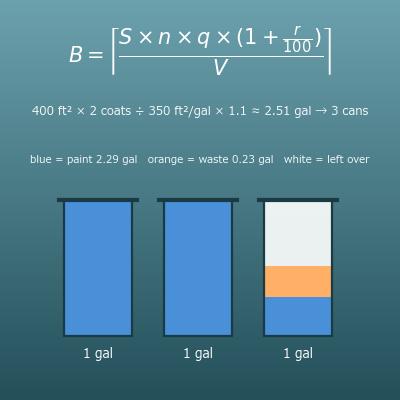
Paint Calculator (How Many Gallons and Cans, from Area, Coverage and Coats)
Find how much paint (unthinned) and how many cans you need from the area and coverage. Get the amount before thinning here
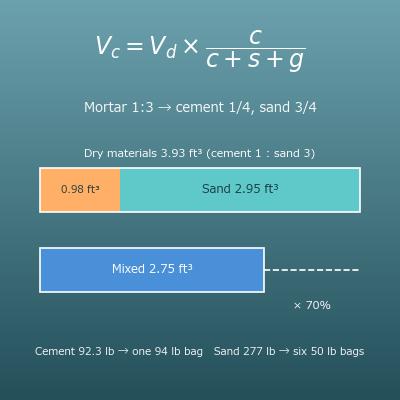
Mortar and Concrete Mix Calculator (Cement, Sand, Gravel, Water and Bags)
Find the amount of each material from a mix ratio such as 1:3. Mix ratios work the same way as on this page
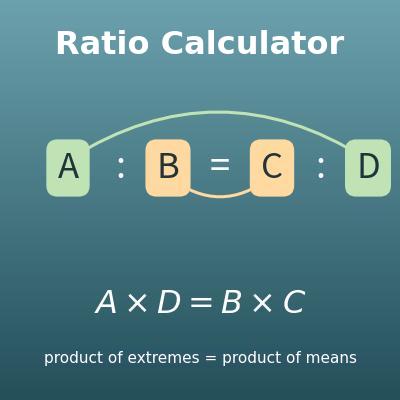
Ratio and Proportion Calculator (Solve A:B = C:D, Scale a Ratio)
From a ratio such as 10:1, find one amount that matches the other
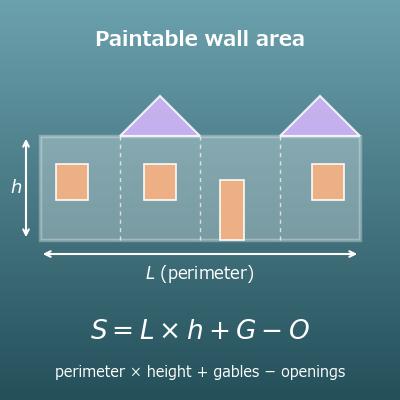
Exterior Wall Area Calculator (Square Footage for Painting and Siding)
Find the area to paint on exterior walls. Work out the paint first, then thin it on this page
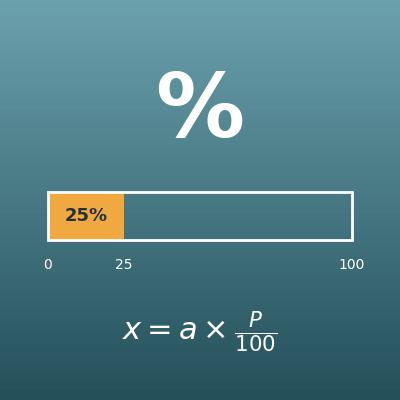
Percentage Calculator (Percent, Part and Whole)
Basic percent calculations such as "what is 10% of 1 gallon?"