

































































Choose the mount type (inside or outside) and the product, then enter the window width and height in cm. The deductions and overlaps are already filled in for the product, so you can calculate as is. The price can be left blank (then no cost is calculated).
Table of Contents
-
What you can do on this page
-
What is this calculation used for?
-
How to Use
-
Formulas and figures
-
Symbols and terms
-
Good to know before you start
-
How to calculate it in Excel
-
How to calculate it in Google Sheets
-
How to calculate it in Python
-
How to write it in LaTeX and other math languages (copy and paste)
-
How to have ChatGPT do the calculation
-
DataChef Features
-
Related Features
-
NumberChef Calculators List
What you can do on this page
- For an inside mount (inside the window frame), subtract the deduction (1/4 in by default, which you can change) from the inside width and height of the frame and see the order size right away
- For an outside mount (on the wall around the window), add an overlap on each side (about 1.5 in) and room at the top and bottom (about 1.5 in each) to the outside size of the frame
- Choose the product (horizontal blinds, roller shades, pleated or cellular shades, vertical blinds) and the default deductions and overlaps switch to common values for that product
- The order size is rounded to 1/8 in (or 1/4 in): down for an inside mount and up for an outside mount. Enter up to 3 windows to get the total area and a cost estimate from a price per ft² or a price per window
- A front view of the window and the product shows where to measure and how much to subtract or add. A plain explanation of the formulas and copy-and-paste formulas for Excel, Google Sheets and Python are on this page too
What is this calculation used for?
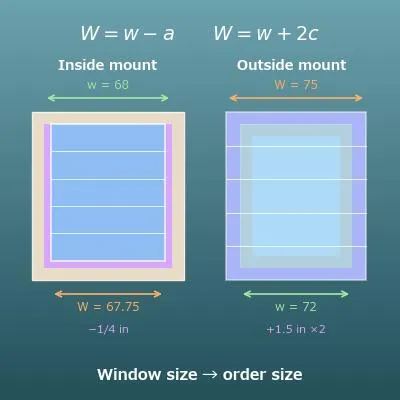
In a rental it is hard to drill into the walls, so an inside mount is a common choice (the screw holes go into the window frame instead, so check that with your landlord too). For a window with an inside size of 68 in × 48 in, with 1/4 in deductions for the width and height, the order size is \(67\tfrac{3}{4} \times 47\tfrac{3}{4}\) in.
An order at the exact inside size may not fit the frame, so the basic rule is to order the size minus the deduction (or give the exact size to a store that deducts for you). Frames are often out of square, so measure the width and height three times each and use the smallest value.
In a bedroom where the morning sun wakes you up, or a room with strong afternoon sun, an outside mount that covers the whole frame reduces light leaking around the edges. For a window with an outside size of 72 in × 52 in, with overlaps of 1.5 in on each side, at the top and at the bottom, the order size is \(75 \times 55\) in.
Roller shade fabric is a little narrower than the headrail (often about 1 to 1.5 in in total, depending on the product). If blocking light matters most, you can try wider side overlaps, such as 3 in per side for \(78 \times 55\) in, right on the spot with this formula.
For small bathroom and kitchen windows, which get splashed with water and grease, wipeable roller shades or blinds work better than curtains. For a small window with an inside size of 24 in × 20 in and an inside mount, the order size is \(23\tfrac{3}{4} \times 19\tfrac{3}{4}\) in.
The smaller the window, the more likely it is to fall below a product's minimum size (often around 1 to 2 ft for width and height), so check in the maker's specs that the order size is at least the minimum.
When you remodel an office or store, you often order the same blinds for many windows at once. For two windows with an inside size of 68 in × 48 in and one of 36 in × 44 in, the inside-mount area (1/4 in deductions) is \(22.4657 + 22.4657 + 10.8615 \approx 55.79\) ft².
At $6.50 per ft², that is about $362.65, which you can compare with the total of the window prices on a quote. Installation and shipping are separate, so also check the breakdown on the quote.
Vertical blinds that open to the side are a common choice for a sliding patio door in the living room. For an outside mount with an outside size of 76 in wide and 82 in high, and 84 in from the top of the frame to the floor, use a 4 in overlap per side, 1.5 in of room at the top and a 1.5 in overlap at the bottom so the vanes clear the floor (84 + 1.5 − 0.5 − 82 − 1.5). The order size is \(84 \times 85\) in.
A very wide opening can exceed one product's maximum size, and then you order two. Either way, check that the bottom of the vanes will not touch the floor.
Formulas and figures
Symbols and terms
Symbols
| \(w\) | lowercase double-u | The window width. Measure the inside width for an inside mount and the outside width for an outside mount. It comes from "width", and it is lowercase to tell it apart from the order width \(W\). |
| \(h\) | lowercase aitch | The window height - the inside height for an inside mount and the outside height for an outside mount. It comes from "height". |
| \(a\) | ay | The width deduction for an inside mount (both sides together). About 1/4 in is common. Think of it as "allowance". |
| \(b\) | bee | The height deduction for an inside mount (at the bottom). About 1/4 in is common, and about 1/2 in for vertical blinds. Think of it as "bottom". |
| \(W\) | capital double-u | The order width (the product width). It is \(W = w - a\) for an inside mount and \(W = w + 2c\) for an outside mount. |
| \(H\) | capital aitch | The order height (the product height). It is \(H = h - b\) for an inside mount and \(H = h + t + d\) for an outside mount. |
| \(c\) | cee | The side overlap for an outside mount (each side). There are two sides, so add it twice. About 1.5 in per side is common. Think of it as "cover". |
| \(t\) | tee | The room at the top for an outside mount, for the brackets and headrail above the frame. About 1.5 in is common. It comes from "top". |
| \(d\) | dee | The overlap at the bottom for an outside mount, how far it hangs below the frame. About 1.5 in is common. Think of it as "down". |
| \(A\) | capital ay | The product area (ft²). It is found with \(A = W \times H \div 144\). It comes from "area". |
| \(u\) | you | The price per ft² ($ per square foot of product). It comes from "unit price". |
| \(p\) | pee | The price per window (for that window's product). With three windows, they are numbered \(p_1, p_2, p_3\). It comes from "price". |
| \(T\) | capital tee | The total estimated cost. It is \(T = u \times A\) with a price per ft², or \(T = p_1 + p_2 + p_3\) with prices per window. It comes from "total". |
| \(\mathrm{ft^2}\) | square feet | A unit of area: a square 1 ft on each side, also written sq ft. \(1\,\mathrm{ft^2} = 144\,\mathrm{in^2}\) (and \(1\,\mathrm{m^2} \approx 10.76\,\mathrm{ft^2}\)). |
Terms
| Inside mount | Mounting the product with brackets on the top of the opening inside the window frame. It sits inside the frame and looks neat, and needs no holes in the wall (the screws go into the frame). Light can leak through the gaps, and the order size is smaller than the inside size by the deduction. |
| Outside mount | Mounting the product with brackets on the wall around the window or on the face of the trim. It covers the whole window, so less light leaks, which suits rooms you want dark. The order size is larger than the outside size by the overlaps. |
| Inside width and height | The size measured inside the window frame, from the inner face on the left to the right and from the top to the bottom. For an inside mount, subtract the deduction from it. |
| Outside width and height | The size measured outside the window trim, from the outer edge on the left to the right and from the top to the bottom. For an outside mount, add the overlaps to it. |
| Deduction | For an inside mount, the amount the product is made smaller than the inside size so it fits without rubbing. About 1/4 in for the width and 1/4 in for the height are common, but it differs by maker and product. Many US stores make this deduction at the factory. |
| Overlap | For an outside mount, how far the product extends past the frame to stop light leaking. About 1.5 in per side, 1.5 in at the top for mounting and 1.5 in at the bottom are common. |
| Horizontal blinds | A product with many horizontal slats that tilt to control the light. Aluminum mini blinds are common, and wood and faux wood blinds too. For an inside mount, the height deduction keeps the bottom rail from hitting the sill. |
| Roller shade | A single piece of fabric that rolls up onto a tube at the top. The fabric is a little narrower than the headrail (often about 1 to 1.5 in in total, depending on the product), so for fewer light leaks, use an outside mount with extra side overlap. |
| Pleated shade | A shade of fabric folded like an accordion that stacks up when raised. Some combine two fabrics (top-down/bottom-up). Measure it the same way as horizontal blinds. |
| Cellular shade (honeycomb) | A kind of pleated shade whose fabric forms honeycomb-shaped cells. The air in the cells insulates, reducing heat loss and gain through the window. Measure it the same way as a pleated shade. |
| Vertical blinds | A product with long vertical vanes side by side that open to the left or right. They swing in a breeze and can hit the floor or sill, so for an inside mount, use a larger height deduction, about 1/2 in. |
| Headrail | The top part of a blind or shade that holds the lift and tilt mechanism; the brackets hold it. For an outside mount, add room at the top for it above the frame. |
| Bottom rail | The bar at the very bottom of a horizontal blind. It also weighs the slats down so they hang straight. For an inside mount, the height deduction keeps it from hitting the sill. |
| Vanes (louvers) | The long vertical slats of vertical blinds. They turn to control the light and stack to one side to open. |
| Slats | The individual horizontal pieces of a blind. Common widths include 1 in (mini blinds) and 2 in (wood and faux wood). They tilt to control the light. |
| Window trim (casing) | The wood or vinyl trim around a window. An inside mount goes on the top of the opening inside it; an outside mount goes on the wall outside it or on its face. |
| Patio door | A large glass door that reaches the floor, often a sliding glass door to a deck or yard. For an outside mount, set the bottom overlap so the product is about 1/2 in shorter than the distance from its top to the floor. |
| Stud (solid backing) | The wood framing behind the wall (studs and headers) that holds screws firmly. Screws do not hold in drywall alone, so put outside-mount brackets where there is framing, or use suitable anchors. |
| Size limits | The smallest and largest width and height a product can be made in. They differ by maker, product and lift type, and sizes outside the range cannot be ordered. Always check the maker's specs before ordering. |
| Price per square foot | The price per ft² of product. Blinds and shades are usually priced from a "width × height" price grid, so a cost from a price per square foot is an estimate. |
| Rounding down | Dropping the part below the chosen step to get the smaller value. Inside-mount order sizes are rounded down so they fit the frame (for example 67.80 in → 67 3/4 in). |
| Rounding up | Moving to the larger value if there is any part below the chosen step. Outside-mount order sizes are rounded up so they cover the window (for example 75.05 in → 75 1/8 in). |
Good to know before you start
Here is what helps you use the calculation on this page with real understanding, not just by pressing the button.
| Decimals and the order of operations (Grades 5–6) |
|
| Fractions of an inch and units of length (Grades 4–5) |
|
| Area units (Grades 3–5) |
|
| Rounding (Grade 4) |
|
| Unit price and quantity (Grade 6) |
|
How to calculate it in Excel
| Inside width (in) | 68 |
| Inside height (in) | 48 |
| Width deduction (total, in) | 0.25 |
| Height deduction (in) | 0.25 |
| Order width (in) | =B1-B3 |
| Order height (in) | =B2-B4 |
| Outside width (in) | 72 |
| Outside height (in) | 52 |
| Side overlap (each side, in) | 1.5 |
| Room at the top (in) | 1.5 |
| Overlap at the bottom (in) | 1.5 |
| Order width (in) | =B1+2*B3 |
| Order height (in) | =B2+B4+B5 |
| Order width (in) | 67.75 |
| Order height (in) | 47.75 |
| Price per ft² ($) | 6.50 |
| Area (ft²) | =B1*B2/144 |
| Estimated cost ($) | =ROUND(B3*B4,2) |
The first table is the inside mount (inside size minus the deduction) and the second is the outside mount (outside size plus the overlaps). To round the order size to 1/8 in, use "=FLOOR(B1-B3,0.125)" (round down) for an inside mount and "=CEILING(B1+2*B3,0.125)" (round up) for an outside mount.
ROUND(value, 2) in the third table rounds to the cent. For several windows, place a copy of the third table for each window side by side and add up the areas and costs.
With the example numbers, B5 is 67.75 and B6 is 47.75 in the first table, B6 is 75 and B7 is 55 in the second, and B4 is about 22.4657 and B5 is 146.03 in the third. Just change column B to your own numbers.
How to calculate it in Google Sheets
| Inside width (in) | 68 |
| Inside height (in) | 48 |
| Width deduction (total, in) | 0.25 |
| Height deduction (in) | 0.25 |
| Order width (in) | =B1-B3 |
| Order height (in) | =B2-B4 |
| Outside width (in) | 72 |
| Outside height (in) | 52 |
| Side overlap (each side, in) | 1.5 |
| Room at the top (in) | 1.5 |
| Overlap at the bottom (in) | 1.5 |
| Order width (in) | =B1+2*B3 |
| Order height (in) | =B2+B4+B5 |
| Order width (in) | 67.75 |
| Order height (in) | 47.75 |
| Price per ft² ($) | 6.50 |
| Area (ft²) | =B1*B2/144 |
| Estimated cost ($) | =ROUND(B3*B4,2) |
How to calculate it in Python
import math

mount = "inside"         # mount type (inside or outside)
width_in = 68            # window width (inside size for inside mount, outside size for outside mount, in)
height_in = 48           # window height (same, in)
deduct_width_in = 0.25   # inside mount: width deduction (total, in)
deduct_height_in = 0.25  # inside mount: height deduction (in)
overlap_side_in = 1.5    # outside mount: side overlap (each side, in)
overlap_top_in = 1.5     # outside mount: room at the top (in)
overlap_bottom_in = 1.5  # outside mount: overlap at the bottom (in)
round_unit_in = 0.125    # rounding step for the order size (0.125 = 1/8 in; 0 for no rounding)
price_per_ft2 = 6.50     # price per ft² ($; 0 if not needed)

if mount == "inside":
    order_width = width_in - deduct_width_in          # order width = inside size − deduction
    order_height = height_in - deduct_height_in       # order height = inside size − deduction
    if round_unit_in > 0:                             # inside mount rounds down to fit the frame
        order_width = math.floor(order_width / round_unit_in) * round_unit_in
        order_height = math.floor(order_height / round_unit_in) * round_unit_in
else:
    order_width = width_in + 2 * overlap_side_in      # order width = outside size + side overlap × 2
    order_height = height_in + overlap_top_in + overlap_bottom_in   # order height = outside size + top room + bottom overlap
    if round_unit_in > 0:                             # outside mount rounds up to cover the window
        order_width = math.ceil(order_width / round_unit_in) * round_unit_in
        order_height = math.ceil(order_height / round_unit_in) * round_unit_in

area_ft2 = order_width * order_height / 144           # area (ft²)
cost = price_per_ft2 * area_ft2                       # estimated cost ($)

print(f"Order width: {order_width} in, order height: {order_height} in")
print(f"Area: {area_ft2:.4f} ft²")
print(f"Estimated cost: ${cost:,.2f}")
How to write it in LaTeX and other math languages (copy and paste)
W = w − a, H = h − b
W = w - a,\quad H = h - b
<math xmlns="http://www.w3.org/1998/Math/MathML" display="block">
  <mrow>
    <mi>W</mi><mo>=</mo><mi>w</mi><mo>-</mo><mi>a</mi>
    <mo>,</mo>
    <mi>H</mi><mo>=</mo><mi>h</mi><mo>-</mo><mi>b</mi>
  </mrow>
</math>
W = w - a, H = h - b
W = w - a; H = h - b
W := w - a; H := h - b;
W = w - a; H = h - b;
W = w − a, H = h − b
W = w + 2c, H = h + t + d
W = w + 2c,\quad H = h + t + d
<math xmlns="http://www.w3.org/1998/Math/MathML" display="block">
<mrow>
<mi>W</mi><mo>=</mo><mi>w</mi><mo>+</mo><mn>2</mn><mo>⁢</mo><mi>c</mi>
<mo>,</mo>
<mi>H</mi><mo>=</mo><mi>h</mi><mo>+</mo><mi>t</mi><mo>+</mo><mi>d</mi>
</mrow>
</math>
W = w + 2 c, H = h + t + d
W = w + 2*c; H = h + t + d
W := w + 2*c; H := h + t + d;
W = w + 2*c; H = h + t + d;
W = w + 2c, H = h + t + d
A = W × H ÷ 144, T = u × A
A = \frac{W H}{144},\quad T = u A
<math xmlns="http://www.w3.org/1998/Math/MathML" display="block">
<mrow>
<mi>A</mi><mo>=</mo>
<mfrac><mrow><mi>W</mi><mo>⁢</mo><mi>H</mi></mrow><mn>144</mn></mfrac>
<mo>,</mo>
<mi>T</mi><mo>=</mo><mi>u</mi><mo>⁢</mo><mi>A</mi>
</mrow>
</math>
A = (W H) / 144, T = u A
A = W*H/144; T = u*A
A := W*H/144; T := u*A;
A = W*H/144; T = u*A;
A = W H/144, T = u A
How to have ChatGPT do the calculation
You are an assistant for measuring blinds and shades. Do the calculations below by actually running Python code, and base your answer only on the numbers from the output (do not calculate in your head or guess).

There are two windows. Window 1 has an inside size of 68 in wide and 48 in high, and window 2 has an inside size of 36 in wide and 44 in high. I am ordering inside-mount horizontal blinds for both.
Use a width deduction of 1/4 in (total) and a height deduction of 1/4 in, and round the order size down to the nearest 1/8 in. The price is $6.50 per square foot.
Find each of the following.
1. The order width and order height of windows 1 and 2 (inside size − deduction)
2. The area of windows 1 and 2 (order width × order height ÷ 144, in ft²) and the total area
3. The total estimated cost (price per ft² × total area, rounded to the cent)

Show the formulas you used and the numbers from the output.
How to Use
-
1Enter your numbersType the numbers you want to calculate with into the input fields
-
2CalculatePress the "Calculate" button
-
3Check the resultThe result appears on the spot. The same page also explains the idea behind the calculation and the formula
DataChef Features

No technical knowledge required.
Intuitive and user-friendly operation.

Can be used without registering personal information.

Automatic file deletion by clicking "download".

and rapid file conversion.

No attribution required.

No need to contact us for commercial use permission.
Related Features
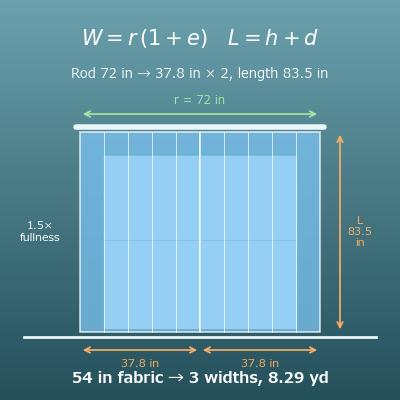
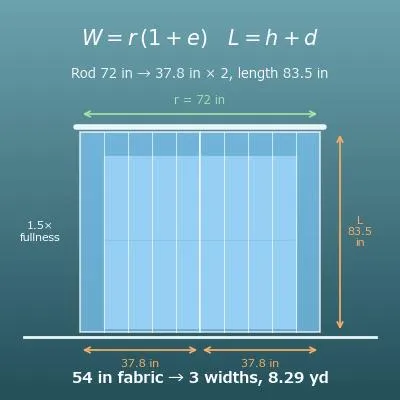
Curtain Size Calculator (Finished Width, Length and Fabric Yardage from Fullness)
For fabric curtains. Find the finished width and length from the rod width and fullness, and the fabric you need
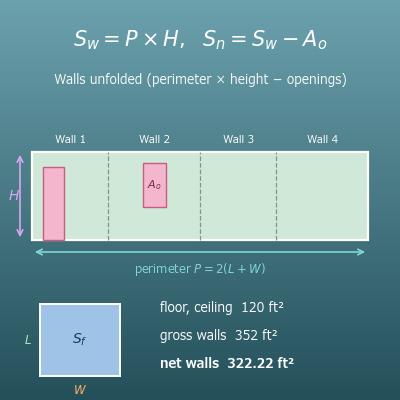
Wall Area Calculator (Wall, Ceiling and Floor Square Footage, with Doors, Windows, Perimeter and Volume)
Find the wall, ceiling and floor area of the same room at once, minus doors and windows
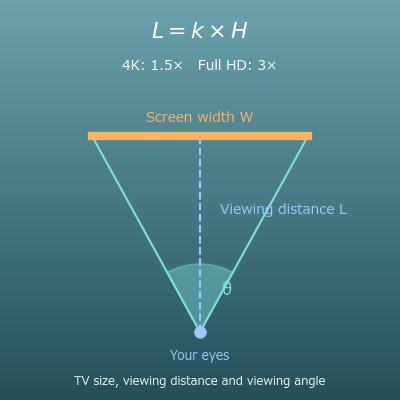
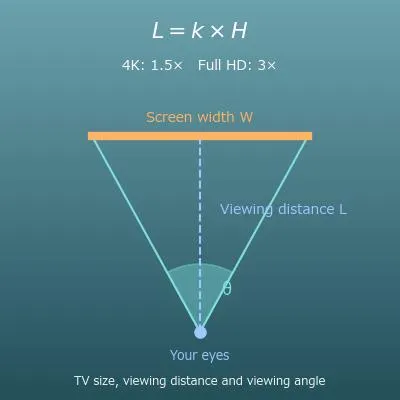
TV Size and Viewing Distance Calculator (4K, Full HD and 8K)
For the same room. Find a good TV size from the viewing distance, and the screen width and height from the size
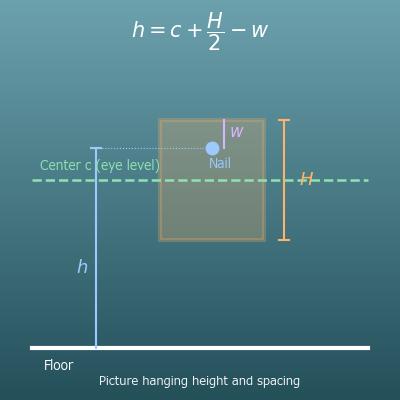
Picture Hanging Height and Spacing Calculator (Nail Height, Gallery Wall)
Find the hook height and spacing for frames on the wall around the window