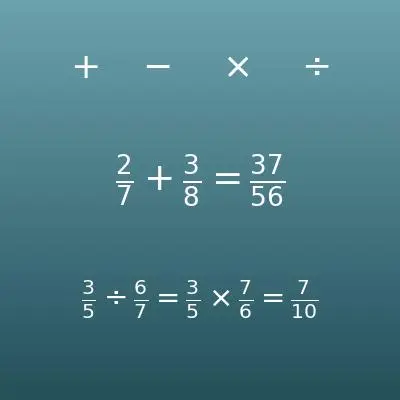
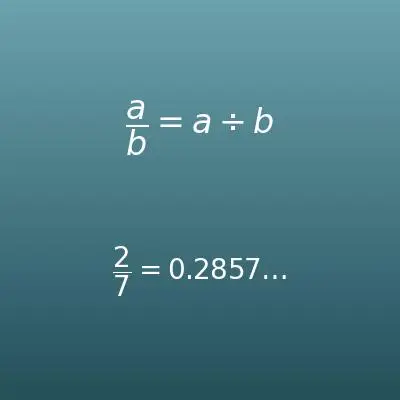
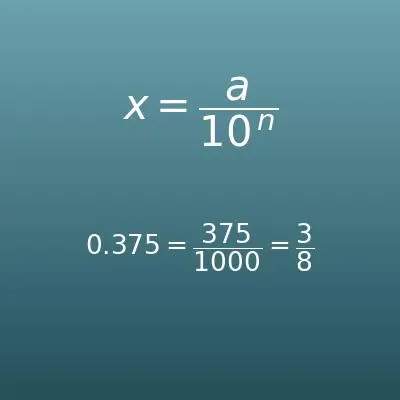
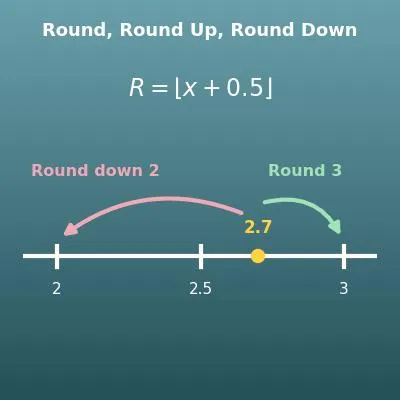
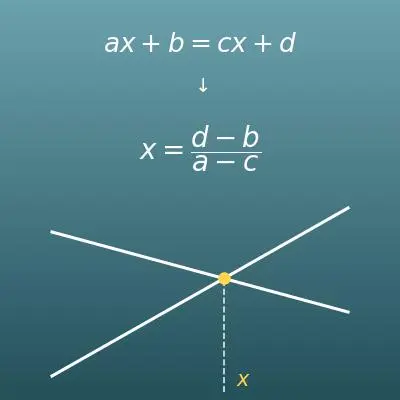

Enter the two fractions just as they look (top box = numerator, bottom box = denominator) and choose the operation (+ − × ÷) from the menu in the middle. The answer is shown in lowest terms and as a decimal, with the steps.
Table of Contents
-
What you can do on this page
-
What is this calculation used for?
-
How to Use
-
Formula
-
Adding fractions (find a common denominator, then add the numerators)
-
Subtracting fractions (find a common denominator, then subtract the numerators)
-
Multiplying fractions (multiply the numerators and the denominators)
-
Dividing fractions (multiply by the reciprocal of the divisor)
-
Simplifying (writing a fraction in lowest terms)
-
-
Symbols and terms
-
Good to know before you start
-
How to calculate it in Excel
-
How to calculate it in Google Sheets
-
How to calculate it in Python
-
How to write it in LaTeX and other math languages (copy and paste)
-
How to have ChatGPT do the calculation
-
DataChef Features
-
Related Features
-
NumberChef Calculators List
What you can do on this page
- Add, subtract, multiply and divide two fractions (for example, \(\dfrac{2}{7} + \dfrac{3}{8}\)) on the spot, just by entering the numerators and denominators
- The answer is shown in lowest terms. If it is an improper fraction greater than 1, it is also shown as a mixed number, and always as a decimal too
- The steps to the answer are shown too: finding a common denominator, multiplying by the reciprocal and simplifying
- A plain-language explanation of the formulas and copy-and-paste formulas for Excel, Google Sheets and Python are all on this page
What is this calculation used for?
Recipes often use fractions such as "\(\dfrac{1}{3}\) cup" or "\(\dfrac{3}{4}\) cup", and adjusting the amounts is fraction multiplication. For example, "\(\dfrac{2}{3}\) of \(\dfrac{3}{4}\) cup" is \(\dfrac{3}{4} \times \dfrac{2}{3} = \dfrac{1}{2}\) (half a cup).
To double a recipe or cut it in half, just multiply each fraction in the recipe, and you get exact amounts.
Suppose one partner owns \(\dfrac{1}{2}\) of a small business and two other partners split the rest equally. Each of the two owns \(\dfrac{1}{2} \times \dfrac{1}{2} = \dfrac{1}{4}\).
Check that all the shares add up to \(\dfrac{1}{2} + \dfrac{1}{4} + \dfrac{1}{4} = 1\), and you know nothing was left out. Shares in jointly owned property are worked out with the same fraction addition and multiplication.
In the US, sizes of screws, wrenches, lumber and pipes are given in fractions such as "\(\dfrac{3}{8}\) inch" or "\(\dfrac{1}{2}\) inch".
Stack two \(\dfrac{3}{8}\)-inch boards, and the total is \(\dfrac{3}{8} + \dfrac{3}{8} = \dfrac{3}{4}\) inch. The step between a \(\dfrac{1}{2}\)-inch part and a \(\dfrac{3}{8}\)-inch part is \(\dfrac{1}{2} - \dfrac{3}{8} = \dfrac{1}{8}\) inch. Choosing tools and matching sizes is fraction addition and subtraction.
A quarter note is \(\dfrac{1}{4}\) of a whole note and an eighth note is \(\dfrac{1}{8}\): note lengths are fractions to begin with. A dotted quarter note lasts \(\dfrac{1}{4} + \dfrac{1}{8} = \dfrac{3}{8}\).
In 4/4 time, the notes in each measure are arranged so that their lengths add up to \(\dfrac{4}{4} = 1\). Reading or writing rhythms in sheet music is a series of fraction additions.
"A 45-minute meeting" is \(\dfrac{3}{4}\) hour, and "a 30-minute trip" is \(\dfrac{1}{2}\) hour. An hour has 60 minutes, so time has always worked well with fractions.
Two 45-minute meetings plus a 30-minute trip add up to \(\dfrac{3}{4} + \dfrac{3}{4} + \dfrac{1}{2} = 2\) hours. You can estimate schedule totals and time left with fraction addition and subtraction.
Formula
Symbols and terms
Symbols
| \(\dfrac{a}{b}\) | a over b | The first fraction. The top number \(a\) is the numerator, and the bottom number \(b\) is the denominator. (Example - \(\dfrac{2}{7}\) has numerator 2 and denominator 7) |
| \(\dfrac{c}{d}\) | c over d | The second fraction. In division it is the divisor (the number you divide by). |
| \(\dfrac{d}{c}\) | d over c | The fraction you get by flipping the numerator and denominator of \(\dfrac{c}{d}\) (its reciprocal). It is used to change a division into a multiplication. |
| \(g\) | g | The greatest common factor of the numerator and denominator. To simplify, divide both the numerator and the denominator by it. |
Terms
| numerator | The top number of a fraction. It tells how many pieces there are. |
| denominator | The bottom number of a fraction. It tells how many equal parts 1 is split into (the size of each piece). It cannot be 0. |
| common denominator | A denominator shared by two or more fractions. Rewriting fractions with different denominators to have the same one, without changing their values, is needed before adding or subtracting. |
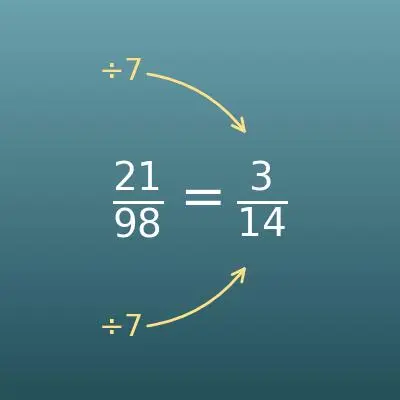
| simplifying | Dividing the numerator and denominator by a common number (their greatest common factor) to write a fraction in its simplest form. Also called reducing a fraction. |
| lowest terms | A fraction is in lowest terms (or simplest form) when it cannot be simplified any further. Every answer from this calculator is shown in lowest terms. |
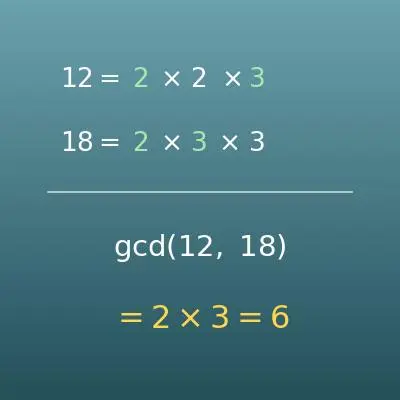
| greatest common factor (GCF) | The largest of the numbers that divide both of two numbers evenly (their common factors). It is used to simplify. (Example - for 18 and 12, it is 6) |
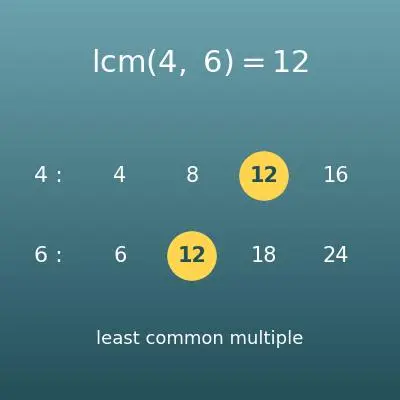
| least common multiple (LCM) | The smallest of the multiples that two numbers share. Using it as the common denominator (the least common denominator) keeps the numbers small. (Example - for 4 and 6, it is 12) |
| reciprocal | The fraction you get by flipping the numerator and denominator. Multiplied by the original number, it gives 1 (\(\dfrac{6}{7} \times \dfrac{7}{6} = 1\)). It is used to divide fractions. |
| proper fraction | A fraction whose numerator is smaller than its denominator, so it is less than 1. (Example - \(\dfrac{1}{2}\)) |
| improper fraction | A fraction whose numerator is equal to or larger than its denominator, so it is 1 or more. (Example - \(\dfrac{3}{2}\)) |
| mixed number | An improper fraction written as a whole number plus a proper fraction. (Example - \(\dfrac{3}{2} = 1\dfrac{1}{2}\), read "one and one half") It makes the size easy to picture. |
Good to know before you start
Here is what helps you use the calculation on this page with real understanding, not just by pressing the button.
| What a fraction is (Grades 3–4) |
|
| Multiplication facts and division (Grades 3–4) |
|
| Common factors and common multiples (Grades 4–6) |
|
| Equivalent fractions and adding and subtracting fractions (Grades 4–5) |
|
| Multiplying and dividing fractions (Grades 5–6) |
|
How to calculate it in Excel
| Numerator a of fraction 1 | 2 |
| Denominator b of fraction 1 | 7 |
| Numerator c of fraction 2 | 3 |
| Denominator d of fraction 2 | 8 |
| Numerator before simplifying (a×d + c×b) | =B1*B4+B3*B2 |
| Denominator before simplifying (b×d) | =B2*B4 |
| Greatest common factor | =GCD(ABS(B5),ABS(B6)) |
| Answer numerator (simplified) | =B5/B7 |
| Answer denominator (simplified) | =B6/B7 |
| As a decimal | =B5/B6 |
| Numerator a of fraction 1 | 1 |
| Denominator b of fraction 1 | 2 |
| Numerator c of fraction 2 | 1 |
| Denominator d of fraction 2 | 3 |
| Numerator before simplifying (a×d − c×b) | =B1*B4-B3*B2 |
| Denominator before simplifying (b×d) | =B2*B4 |
| Greatest common factor | =GCD(ABS(B5),ABS(B6)) |
| Answer numerator (simplified) | =B5/B7 |
| Answer denominator (simplified) | =B6/B7 |
| As a decimal | =B5/B6 |
| Numerator a of fraction 1 | 2 |
| Denominator b of fraction 1 | 3 |
| Numerator c of fraction 2 | 9 |
| Denominator d of fraction 2 | 4 |
| Numerator before simplifying (a×c) | =B1*B3 |
| Denominator before simplifying (b×d) | =B2*B4 |
| Greatest common factor | =GCD(ABS(B5),ABS(B6)) |
| Answer numerator (simplified) | =B5/B7 |
| Answer denominator (simplified) | =B6/B7 |
| As a decimal | =B5/B6 |
| Numerator a of fraction 1 | 3 |
| Denominator b of fraction 1 | 5 |
| Numerator c of fraction 2 | 6 |
| Denominator d of fraction 2 | 7 |
| Numerator before simplifying (a×d) | =B1*B4 |
| Denominator before simplifying (b×c) | =B2*B3 |
| Greatest common factor | =GCD(ABS(B5),ABS(B6)) |
| Answer numerator (simplified) | =B5/B7 |
| Answer denominator (simplified) | =B6/B7 |
| As a decimal | =B5/B6 |
| Numerator before simplifying | 18 |
| Denominator before simplifying | 12 |
| Greatest common factor | =GCD(ABS(B1),ABS(B2)) |
| Simplified numerator | =B1/B3 |
| Simplified denominator | =B2/B3 |
"*" is multiplication, "/" is division, and GCD is the Excel function for the greatest common factor (ABS is there just to remove any minus sign).
In the first table (addition), for example, B8 and B9 are the numerator and denominator of the simplified answer: for \(\dfrac{2}{7} + \dfrac{3}{8}\), you get \(\dfrac{37}{56}\) (about 0.6607 as a decimal).
To work with a negative fraction, put the minus sign on the numerator.
How to calculate it in Google Sheets
| Numerator a of fraction 1 | 2 |
| Denominator b of fraction 1 | 7 |
| Numerator c of fraction 2 | 3 |
| Denominator d of fraction 2 | 8 |
| Numerator before simplifying (a×d + c×b) | =B1*B4+B3*B2 |
| Denominator before simplifying (b×d) | =B2*B4 |
| Greatest common factor | =GCD(ABS(B5),ABS(B6)) |
| Answer numerator (simplified) | =B5/B7 |
| Answer denominator (simplified) | =B6/B7 |
| As a decimal | =B5/B6 |
| Numerator a of fraction 1 | 1 |
| Denominator b of fraction 1 | 2 |
| Numerator c of fraction 2 | 1 |
| Denominator d of fraction 2 | 3 |
| Numerator before simplifying (a×d − c×b) | =B1*B4-B3*B2 |
| Denominator before simplifying (b×d) | =B2*B4 |
| Greatest common factor | =GCD(ABS(B5),ABS(B6)) |
| Answer numerator (simplified) | =B5/B7 |
| Answer denominator (simplified) | =B6/B7 |
| As a decimal | =B5/B6 |
| Numerator a of fraction 1 | 2 |
| Denominator b of fraction 1 | 3 |
| Numerator c of fraction 2 | 9 |
| Denominator d of fraction 2 | 4 |
| Numerator before simplifying (a×c) | =B1*B3 |
| Denominator before simplifying (b×d) | =B2*B4 |
| Greatest common factor | =GCD(ABS(B5),ABS(B6)) |
| Answer numerator (simplified) | =B5/B7 |
| Answer denominator (simplified) | =B6/B7 |
| As a decimal | =B5/B6 |
| Numerator a of fraction 1 | 3 |
| Denominator b of fraction 1 | 5 |
| Numerator c of fraction 2 | 6 |
| Denominator d of fraction 2 | 7 |
| Numerator before simplifying (a×d) | =B1*B4 |
| Denominator before simplifying (b×c) | =B2*B3 |
| Greatest common factor | =GCD(ABS(B5),ABS(B6)) |
| Answer numerator (simplified) | =B5/B7 |
| Answer denominator (simplified) | =B6/B7 |
| As a decimal | =B5/B6 |
| Numerator before simplifying | 18 |
| Denominator before simplifying | 12 |
| Greatest common factor | =GCD(ABS(B1),ABS(B2)) |
| Simplified numerator | =B1/B3 |
| Simplified denominator | =B2/B3 |
Copy the whole table, paste it into cell A1, and replace the numbers in the input cells at the top (numerators and denominators) with your own.
How to calculate it in Python
from fractions import Fraction

fraction_1 = Fraction(2, 7)   # first fraction (numerator, denominator)
fraction_2 = Fraction(3, 8)   # second fraction (numerator, denominator)

print(fraction_1 + fraction_2)         # addition -> 37/56
print(fraction_1 - fraction_2)         # subtraction -> -5/56
print(fraction_1 * fraction_2)         # multiplication -> 3/28
print(fraction_1 / fraction_2)         # division -> 16/21
print(float(fraction_1 + fraction_2))  # the sum as a decimal -> 0.6607142857142857
How to write it in LaTeX and other math languages (copy and paste)
a/b + c/d = (a×d + c×b)/(b×d)
\dfrac{a}{b} + \dfrac{c}{d} = \dfrac{ad + cb}{bd}
<math xmlns="http://www.w3.org/1998/Math/MathML" display="block">
<mrow>
<mfrac><mi>a</mi><mi>b</mi></mfrac>
<mo>+</mo>
<mfrac><mi>c</mi><mi>d</mi></mfrac>
<mo>=</mo>
<mfrac>
<mrow><mi>a</mi><mo>×</mo><mi>d</mi><mo>+</mo><mi>c</mi><mo>×</mo><mi>b</mi></mrow>
<mrow><mi>b</mi><mo>×</mo><mi>d</mi></mrow>
</mfrac>
</mrow>
</math>
a/b + c/d = (a*d + c*b)/(b*d)
Together[a/b + c/d]
r := normal(a/b + c/d);
r = simplifyFraction(a/b + c/d);
a/b + c/d = (a×d + c×b)/(b×d)
a/b − c/d = (a×d − c×b)/(b×d)
\dfrac{a}{b} - \dfrac{c}{d} = \dfrac{ad - cb}{bd}
<math xmlns="http://www.w3.org/1998/Math/MathML" display="block">
<mrow>
<mfrac><mi>a</mi><mi>b</mi></mfrac>
<mo>−</mo>
<mfrac><mi>c</mi><mi>d</mi></mfrac>
<mo>=</mo>
<mfrac>
<mrow><mi>a</mi><mo>×</mo><mi>d</mi><mo>−</mo><mi>c</mi><mo>×</mo><mi>b</mi></mrow>
<mrow><mi>b</mi><mo>×</mo><mi>d</mi></mrow>
</mfrac>
</mrow>
</math>
a/b - c/d = (a*d - c*b)/(b*d)
Together[a/b - c/d]
r := normal(a/b - c/d);
r = simplifyFraction(a/b - c/d);
a/b - c/d = (a×d - c×b)/(b×d)
a/b × c/d = (a×c)/(b×d)
\dfrac{a}{b} \times \dfrac{c}{d} = \dfrac{ac}{bd}
<math xmlns="http://www.w3.org/1998/Math/MathML" display="block">
<mrow>
<mfrac><mi>a</mi><mi>b</mi></mfrac>
<mo>×</mo>
<mfrac><mi>c</mi><mi>d</mi></mfrac>
<mo>=</mo>
<mfrac>
<mrow><mi>a</mi><mo>×</mo><mi>c</mi></mrow>
<mrow><mi>b</mi><mo>×</mo><mi>d</mi></mrow>
</mfrac>
</mrow>
</math>
a/b xx c/d = (a*c)/(b*d)
Together[(a/b)*(c/d)]
r := normal((a/b)*(c/d));
r = simplifyFraction((a/b)*(c/d));
a/b × c/d = (a×c)/(b×d)
a/b ÷ c/d = a/b × d/c = (a×d)/(b×c)
\dfrac{a}{b} \div \dfrac{c}{d} = \dfrac{a}{b} \times \dfrac{d}{c} = \dfrac{ad}{bc}
<math xmlns="http://www.w3.org/1998/Math/MathML" display="block">
<mrow>
<mfrac><mi>a</mi><mi>b</mi></mfrac>
<mo>÷</mo>
<mfrac><mi>c</mi><mi>d</mi></mfrac>
<mo>=</mo>
<mfrac><mi>a</mi><mi>b</mi></mfrac>
<mo>×</mo>
<mfrac><mi>d</mi><mi>c</mi></mfrac>
<mo>=</mo>
<mfrac>
<mrow><mi>a</mi><mo>×</mo><mi>d</mi></mrow>
<mrow><mi>b</mi><mo>×</mo><mi>c</mi></mrow>
</mfrac>
</mrow>
</math>
a/b -: c/d = a/b xx d/c = (a*d)/(b*c)
Together[(a/b)/(c/d)]
r := normal((a/b)/(c/d));
r = simplifyFraction((a/b)/(c/d));
a/b ÷ c/d = (a×d)/(b×c)
a/b = (a÷g)/(b÷g) (g = GCD(a, b))
\dfrac{a}{b} = \dfrac{a \div g}{b \div g} \quad (g = \gcd(a, b))
<math xmlns="http://www.w3.org/1998/Math/MathML" display="block">
<mrow>
<mfrac><mi>a</mi><mi>b</mi></mfrac>
<mo>=</mo>
<mfrac>
<mrow><mi>a</mi><mo>÷</mo><mi>g</mi></mrow>
<mrow><mi>b</mi><mo>÷</mo><mi>g</mi></mrow>
</mfrac>
</mrow>
</math>
a/b = (a-:g)/(b-:g)
Simplify[a/b]
r := normal(a/b);
r = simplifyFraction(a/b);
a/b = (a÷g)/(b÷g)
How to have ChatGPT do the calculation
You are a fraction calculation assistant. Do the following calculations by actually running Python code, and base your answer only on the numbers from the execution result (do not answer by mental math or guessing). In Python, use the fractions module (Fraction) from the standard library.

Calculate each of the following, and give each answer both as a fraction in lowest terms and as a decimal.
1. 2/7 + 3/8
2. 1/2 - 3/4
3. 2/3 × 9/4
4. 3/5 ÷ 6/7

Show the formulas you used and the numbers from the execution result.
How to Use
-
1Enter your numbersType the numbers you want to calculate with into the input fields
-
2CalculatePress the "Calculate" button
-
3Check the resultThe result appears on the spot. The same page also explains the idea behind the calculation and the formula
DataChef Features

No technical knowledge required.
Intuitive and user-friendly operation.

Can be used without registering personal information.

Automatic file deletion by clicking "download".

and rapid file conversion.

No attribution required.

No need to contact us for commercial use permission.
Related Features
Percentage Calculator (Percent, Part and Whole)
Enter any two of the base amount, the part and the percentage, and get the third
Percentage Change Calculator (Increase and Decrease)
Enter any two of the original value, the percent change and the new value, and get the third
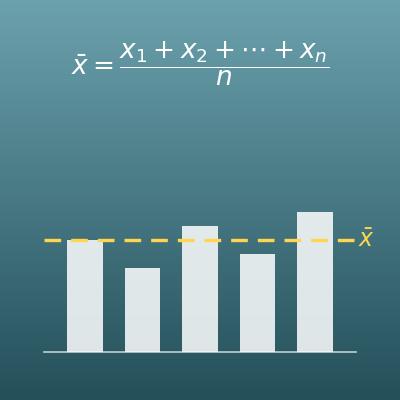
Average Calculator (Mean)
Enter a list of numbers and get the average, the sum, the median and more at once
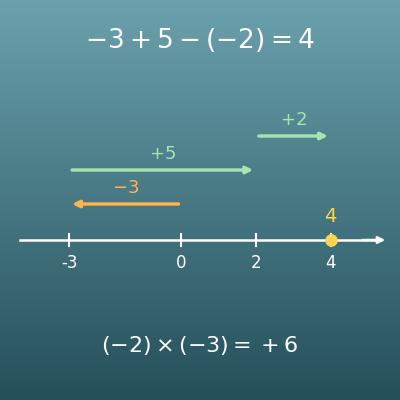
Positive and Negative Numbers Calculator (Integer Rules, Steps and Number Line)
Adds, subtracts, multiplies and divides numbers with negatives, with sign-rule steps and a number line