
Enter the volume you need (after mixing) and the mix. Typical values are already filled in for the yield, water-cement ratio, bulk density and bag weight. Change them if the product specifies other values.
Table of Contents
-
What you can do on this page
-
What is this calculation used for?
-
How to Use
-
Formulas and figures
-
Symbols and terms
-
Good to know before you start
-
How to calculate it in Excel
-
How to calculate it in Google Sheets
-
How to calculate it in Python
-
How to write it in LaTeX and other math languages (copy and paste)
-
How to have ChatGPT do the calculation
-
DataChef Features
-
Related Features
-
NumberChef Calculators List
What you can do on this page
- From the volume you need (ft³ or yd³, or area × thickness) and a mix ratio (presets such as 1:3 mortar and 1:2:4 concrete, or your own), you get the volume and weight of cement, sand and gravel on the spot
- The number of bags is rounded up for the bag size you choose (94 lb cement, 50 lb sand and so on, all changeable) and shown next to the value before rounding, so you can see where the count comes from
- The water is found from the water-cement ratio (w/c). The formulas also show the yield (the mixed volume is smaller than the dry materials) and the waste factor for spills and material left on tools
- You can also work backward to find how much you can make with the cement bags you have. It is handy for checking how much mortar one bag of cement makes and how many bags of sand go with it
- Enter bag prices to get the estimated cost. A plain-language explanation of the formulas and copy-and-paste formulas for Excel, Google Sheets and Python are all on this page
What is this calculation used for?
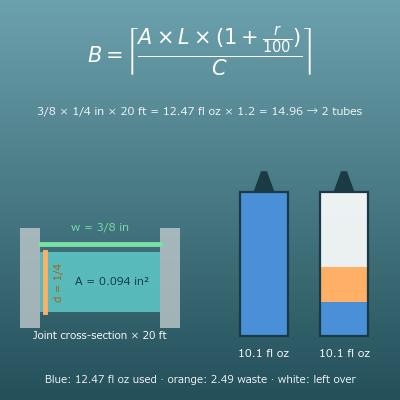
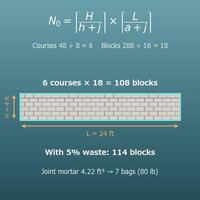
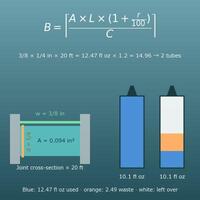
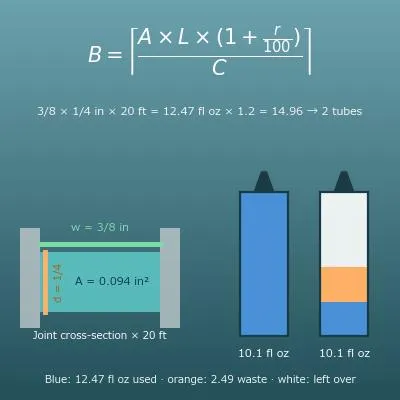
For a short garden wall of concrete blocks, the mortar for the 3/8 in joints is often well under 1 ft³, which you can find from the joint area × thickness. Enter that volume with a 1:3 mix, and you find that one bag of cement is plenty, and how many 50 lb bags of sand to buy.
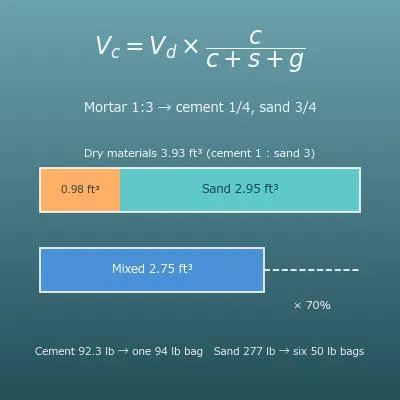
The smaller the job, the more useful the backward calculation "how much does one bag of cement make?" becomes. One 94 lb bag in 1:3 mortar makes about 2.8 ft³ (at a 70% yield).
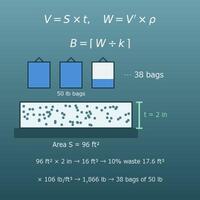
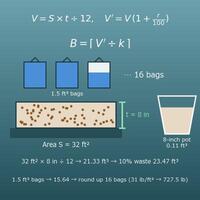
A 5 ft × 4 ft slab 4 in thick needs \(20 \times 4 \div 12 \approx 6.67\) ft³ (about 0.25 yd³). With a 1:2:4 mix, a 67% yield and 5% waste, the dry materials come to about 10.4 ft³: cement about 1.49 ft³ (about 140 lb, two 94 lb bags), sand about 2.99 ft³ (about 281 lb, six 50 lb bags) and gravel about 5.97 ft³ (about 597 lb, twelve 50 lb bags), with about 77 lb (about 9.3 gal) of water.
Materials and water together weigh more than 1,000 lb, so at this size you should decide whether to mix it yourself, rent a mixer, or use premixed concrete bags. An 80 lb bag of premixed concrete makes about 0.6 ft³, so this slab would take \(\lceil 6.67 \div 0.6 \rceil = 12\) bags. Find the volume from the shape with the "Concrete Calculator" and enter it here to get the breakdown.
To redo the tile at an entry, spreading a ¾ in mortar bed over 30 ft² takes \(30 \times 0.75 \div 12 = 1.875\) ft³. With a 1:3 mix, a 70% yield and 10% waste, the dry materials come to about 2.95 ft³: cement about 0.74 ft³ (about 69 lb, one bag) and sand about 2.21 ft³ (about 208 lb, five 50 lb bags).
Counting the tiles themselves with the "Tile Calculator" and the mortar bed on this page keeps items from being missed in your estimate.
Premixed mortar in bags (sand already included, such as Type N or Type S masonry mortar) only needs water and is convenient, but for larger amounts buying cement and sand separately and mixing them yourself often costs less. Find the bags of cement and sand and the estimated cost on this page, and compare them with the number of premixed bags (the amount one bag makes is printed on the bag) to decide which suits your job.
Prices vary by store and region, so enter the prices at the store where you will buy.
Masonry and landscaping estimates list mixes and quantities such as "1:3 mortar, ... ft²" or "1:2:4 concrete, ... yd³". Enter the same mix and quantity on this page to see the breakdown into cement, sand and gravel (weight and bags), so you can follow where the estimate's materials come from.
In real jobs the yield, waste and water change with site conditions, and labor, delivery and tools cost extra, so the material quantities alone cannot tell you whether the price is fair. Use this as a guide.
Formulas and figures
Symbols and terms
Symbols
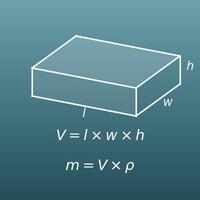
| \(V\) | vee | The volume needed (the amount of mortar or concrete after mixing, in ft³ or yd³). From the first letter of "volume". 1 yd³ = 27 ft³. |
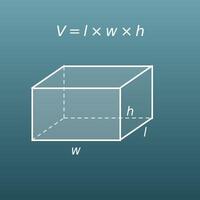
| \(A\) | ay | The area of the surface to cover or pour (ft²). From the first letter of "area". |
| \(t\) | tee | The thickness (ft). From the first letter of "thickness". A thickness measured in inches is divided by 12 to turn it into feet before multiplying. |
| \(r\) | ar | The waste factor (%), the extra for material left in the mortar box and on tools and for spills. From the first letter of "rate". |
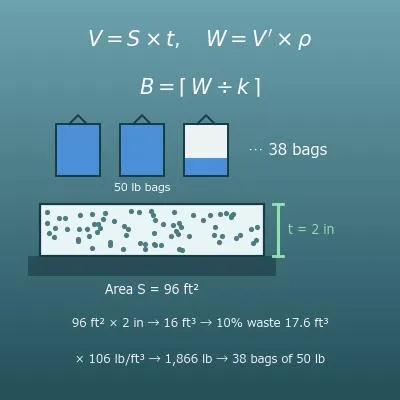
| \(V'\) | vee prime | The volume needed with waste. Found with \(V' = V \times (1 + r \div 100)\). The prime mark (′) shows "a slightly changed version of \(V\)". |
| \(y\) | why | The yield (%), the mixed volume as a share of the total dry materials. From the first letter of "yield". |
| \(V_d\) | vee sub dee | The total dry volume of the materials before mixing (ft³). Found with \(V_d = V' \div (y \div 100)\). The subscript d comes from "dry". |
| \(c,\ s,\ g\) | see, ess, gee | The cement, sand and gravel parts of the mix ratio by volume. From the first letters of "cement", "sand" and "gravel". For "1:3", \(c = 1,\ s = 3,\ g = 0\). |
| \(V_c,\ V_s,\ V_g\) | vee sub see, vee sub ess, vee sub gee | The volumes of cement, sand and gravel (ft³). Each is the total dry volume times "that material's part ÷ the sum of the ratio". |
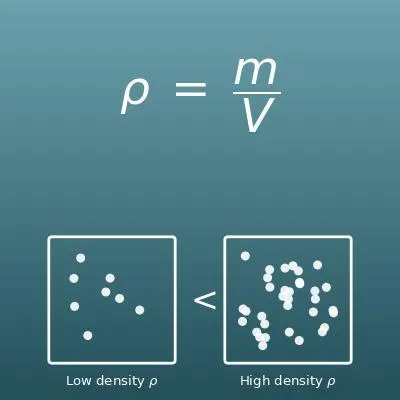
| \(\rho\) | rho | The bulk density (lb/ft³). The Greek letter rho, the usual symbol for density in physics. Cement, sand and gravel each have their own, \(\rho_c,\ \rho_s,\ \rho_g\). |
| \(W\) | double-u | The weight of a material (lb). Found with \(W = V \times \rho\). From the first letter of "weight". The cement weight is written \(W_c\) and the water \(W_w\). |
| \(b\) | bee | The weight of one bag (lb). From the first letter of "bag". In the US, cement is commonly 94 lb and sand and gravel 50 lb. |
| \(N\) | en | The number of bags. Found with \(N = \lceil W \div b \rceil\). From the first letter of "number". |
| \(W/C\) | water-cement ratio | The water-cement ratio (%), the weight of water ÷ the weight of cement. It sets the amount of water. |
| \(h\) | aitch | The number of cement bags on hand (the input for working backward). From the first letter of "have". |
| \(V_{mix}\) | vee sub mix | The mixed volume you can make with the cement on hand (ft³). From "mix". |
| \(u\) | you | The price of one bag ($). From the first letter of "unit price". |
| \(T\) | tee | The estimated cost (materials only). From the first letter of "total". |
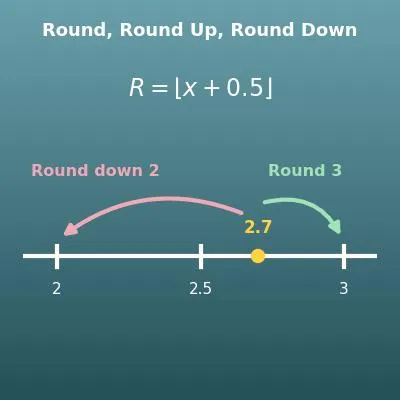
| \(\lceil x \rceil\) | ceiling of x | The symbol for rounding up to a whole number. (Example - \(\lceil 5.54 \rceil = 6\), \(\lceil 2 \rceil = 2\)) |
Terms
| mortar | Cement and sand mixed with water. It is used for block and brick joints, as a base coat or finish on walls and floors, and as a bed under tile. It has no gravel, so it can be worked into small spaces. Bagged masonry mortar in the US (such as Type N and Type S) also contains lime. |
| concrete | Cement, sand and gravel mixed with water. The gravel makes it hard and strong, so it is used for slabs, footings, posts and other parts that carry loads. Thinking of it as mortar with gravel added shows why the same formulas work on this page. |
| cement | A gray powder made by heating limestone and other materials. It reacts with water and hardens (hydration), acting as the "glue" that binds sand and gravel. In the US, portland cement is sold in 94 lb bags (one "sack", taken as 1 ft³) and 47 lb bags. |
| mix ratio | The proportions in which cement, sand and gravel are mixed. On this page it is by volume. "1:3" is 1 part cement to 3 parts sand, and "1:2:4" is 1 part cement, 2 parts sand and 4 parts gravel. |
| by volume | A mix measured by volume. You can measure "1 bucket of cement to 3 buckets of sand" with the same bucket, so on job sites and for DIY a mix by volume is more common than a mix by weight. |
| yield | The mixed volume of mortar or concrete as a percentage of the total dry materials. It is below 100% because the cement paste fills the gaps between the grains of sand and gravel (often about 65–75% for mortar and 60–70% for concrete). Estimators often use its reciprocal, a dry volume factor of about 1.4–1.5. |
| water-cement ratio | The weight of water as a percentage of the weight of cement, written w/c. The lower it is, the stronger the result; the higher, the softer and easier to work. About 55–65% for mortar and 50–60% for concrete is typical, but follow the product instructions if there are any. |
| bulk density | The weight of loose material poured out of the bag, per unit volume (lb/ft³). It includes the gaps between the grains, so it is lower than the density of the grains themselves (about 165 lb/ft³ for sand and gravel). Typical values are about 94 lb/ft³ for cement, 94–100 for sand and 100 for gravel. |
| waste factor | The percentage added to the net amount for material left in the mortar box and on the trowel and shovel, spills, and extra used on uneven surfaces. 5–10% is common. |
| rounding up | If there is any decimal part, the number goes up to the next whole number. Materials can only be bought in whole bags, so the number of bags is always rounded up. |
| mortar box | A shallow, wide tub for mixing mortar or concrete (also called a mixing tub). You put the materials in it and mix them with a hoe or shovel. |
| joint | The gap between blocks, bricks or tiles. It is filled with mortar to bond them and seal the gap. For concrete block walls in the US, a 3/8 in joint is standard. |
| mud slab | A thin layer of concrete poured on the ground before building a foundation. It gives a clean, level surface for layout lines and forms and needs little strength, so it is made with a lean mix (little cement), such as 1:3:6. |
| hydration | The chemical reaction in which cement hardens with water. It hardens by reacting with water, not by drying out, so keeping it moist for a while after placing (curing) makes it stronger. |
| curing | Protecting freshly placed concrete or mortar from drying out, freezing and rain while it hardens, for example by covering it with plastic or keeping it wet. |
| plastering | Applying mortar, plaster or stucco to walls and floors with a trowel. A 1:3 mortar is a common mix for base coats and finishes in this kind of work. |
| quantity takeoff | Working out the amounts and costs of materials a job needs from the drawings and specifications. The quantities on an estimate come from it. The formulas on this page turn the idea of mixing by volume used in estimating directly into formulas. |
| ready-mix concrete | Concrete mixed at a plant and delivered by truck. For larger amounts it is faster and more reliable than mixing your own. You can find the amount needed with the "Concrete Calculator". |
Good to know before you start
Here is what helps you use the calculation on this page with real understanding, not just by pressing the button.
| Volume and units (Grades 5–6) |
|
| Ratios (Grade 6) |
|
| Percentages (Grade 6) |
|
| Unit rates (Grade 6) |
|
| Rounding (Grades 3–4) |
|
How to calculate it in Excel
| Area (ft²) | 40 |
| Thickness (in) | 0.75 |
| Volume needed (ft³) | =B1*B2/12 |
| Volume needed (ft³) | 2.5 |
| Waste factor (%) | 10 |
| Volume with waste (ft³) | =B1*(1+B2/100) |
| Volume with waste (ft³) | 2.75 |
| Yield (%) | 70 |
| Total dry volume (ft³) | =B1/(B2/100) |
| Total dry volume (ft³) | 3.929 |
| Cement part | 1 |
| Sand part | 3 |
| Gravel part | 0 |
| Cement volume (ft³) | =B1*B2/(B2+B3+B4) |
| Sand volume (ft³) | =B1*B3/(B2+B3+B4) |
| Gravel volume (ft³) | =B1*B4/(B2+B3+B4) |
| Volume of the material (ft³) | 0.982 |
| Bulk density (lb/ft³) | 94 |
| Bag weight (lb) | 94 |
| Weight (lb) | =B1*B2 |
| Bags | =ROUNDUP(B4/B3,0) |
| Cement weight (lb) | 92.3 |
| Water-cement ratio (%) | 60 |
| Water (lb) | =B1*B2/100 |
| Water (gal) | =B3/8.34 |
| Cement bags on hand | 1 |
| Bag weight (lb) | 94 |
| Cement bulk density (lb/ft³) | 94 |
| Sum of the ratio | 4 |
| Cement part | 1 |
| Yield (%) | 70 |
| Mixed volume you can make (ft³) | =B1*B2/B3*B4/B5*B6/100 |
| Cement bags | 1 |
| Price per bag of cement ($) | 15 |
| Sand bags | 6 |
| Price per bag of sand ($) | 6 |
| Gravel bags | 0 |
| Price per bag of gravel ($) | 0 |
| Estimated cost ($) | =B1*B2+B3*B4+B5*B6 |
"ROUNDUP(value, 0)" is the function that rounds up to a whole number (it matches ⌈ ⌉ in the formulas).
B3 of the first table is 2.5 (the thickness in inches is divided by 12 to get feet), B3 of the second is 2.75, B3 of the third is about 3.929, B5 to B7 of the fourth are about 0.982, 2.947 and 0, B4 of the fifth is about 92.3 and B5 is 1, B3 of the sixth is about 55.4 lb (B4 about 6.64 gal), B7 of the seventh is 2.8, and B7 of the eighth is 51.
Use the fifth table once for each material by changing B1 to B3 (for sand, 2.946, 94 and 50). Just replace the numbers in column B with your own.
How to calculate it in Google Sheets
| Area (ft²) | 40 |
| Thickness (in) | 0.75 |
| Volume needed (ft³) | =B1*B2/12 |
| Volume needed (ft³) | 2.5 |
| Waste factor (%) | 10 |
| Volume with waste (ft³) | =B1*(1+B2/100) |
| Volume with waste (ft³) | 2.75 |
| Yield (%) | 70 |
| Total dry volume (ft³) | =B1/(B2/100) |
| Total dry volume (ft³) | 3.929 |
| Cement part | 1 |
| Sand part | 3 |
| Gravel part | 0 |
| Cement volume (ft³) | =B1*B2/(B2+B3+B4) |
| Sand volume (ft³) | =B1*B3/(B2+B3+B4) |
| Gravel volume (ft³) | =B1*B4/(B2+B3+B4) |
| Volume of the material (ft³) | 0.982 |
| Bulk density (lb/ft³) | 94 |
| Bag weight (lb) | 94 |
| Weight (lb) | =B1*B2 |
| Bags | =ROUNDUP(B4/B3,0) |
| Cement weight (lb) | 92.3 |
| Water-cement ratio (%) | 60 |
| Water (lb) | =B1*B2/100 |
| Water (gal) | =B3/8.34 |
| Cement bags on hand | 1 |
| Bag weight (lb) | 94 |
| Cement bulk density (lb/ft³) | 94 |
| Sum of the ratio | 4 |
| Cement part | 1 |
| Yield (%) | 70 |
| Mixed volume you can make (ft³) | =B1*B2/B3*B4/B5*B6/100 |
| Cement bags | 1 |
| Price per bag of cement ($) | 15 |
| Sand bags | 6 |
| Price per bag of sand ($) | 6 |
| Gravel bags | 0 |
| Price per bag of gravel ($) | 0 |
| Estimated cost ($) | =B1*B2+B3*B4+B5*B6 |
How to calculate it in Python
import math

area_ft2 = 40               # area (ft²)
thickness_in = 0.75         # thickness (in)
ratio = (1, 3, 0)           # mix ratio by volume, cement : sand : gravel. For 1:2:4 concrete use (1, 2, 4)
waste_percent = 10          # waste factor (%)
yield_percent = 70          # yield (%)
wc_percent = 60             # water-cement ratio w/c (%)
density = (94, 94, 100)     # bulk density (lb/ft³) of cement, sand, gravel
bag_lb = (94, 50, 50)       # bag weight (lb) of cement, sand, gravel
price = (15, 6, 0)          # price per bag ($) of cement, sand, gravel (examples; 0 is left out of the cost)

volume_ft3 = area_ft2 * thickness_in / 12                        # volume needed (ft³). Thickness changed to feet
volume_with_waste = volume_ft3 * (1 + waste_percent / 100)        # volume with waste (ft³)
dry_volume = volume_with_waste / (yield_percent / 100)            # total dry volume before mixing (ft³)
ratio_sum = sum(ratio)

names = ("Cement", "Sand", "Gravel")
total_weight = 0
cost = 0
for i in range(3):
    volume_i = dry_volume * ratio[i] / ratio_sum                  # volume of each material (ft³)
    weight_i = volume_i * density[i]                              # weight (lb)
    bags_i = math.ceil(weight_i / bag_lb[i]) if weight_i > 0 else 0   # bags (rounded up)
    total_weight += weight_i
    cost += bags_i * price[i]
    if i == 0:
        cement_weight = weight_i
    print(f"{names[i]}: {volume_i:.3f} ft³, {weight_i:.3f} lb, bags: {bags_i} (before rounding up {weight_i / bag_lb[i]:.3f})")

water_lb = cement_weight * wc_percent / 100                       # water (lb)
water_gal = water_lb / 8.34                                       # water (gal). 1 gal of water is about 8.34 lb
print(f"Volume needed: {volume_ft3} ft³ -> with waste {volume_with_waste:.3f} ft³ -> total dry volume {dry_volume:.3f} ft³")
print(f"Water: {water_lb:.3f} lb ({water_gal:.2f} gal), total weight with water: {total_weight + water_lb:.1f} lb, estimated cost: ${cost:,.2f}")

# Working backward: mixed volume you can make with one bag of cement (ft³)
have_bags = 1
cement_volume = have_bags * bag_lb[0] / density[0]
mix_volume = cement_volume * ratio_sum / ratio[0] * yield_percent / 100
print(f"Mixed volume from {have_bags} bag(s) of cement: {mix_volume:.3f} ft³")
How to write it in LaTeX and other math languages (copy and paste)
V = A × t
V = A \times t
<math xmlns="http://www.w3.org/1998/Math/MathML" display="block">
<mrow>
<mi>V</mi>
<mo>=</mo>
<mi>A</mi><mo>×</mo><mi>t</mi>
</mrow>
</math>
V = A xx t
a*t
V := A*t;
V = A*t;
V = A × t
V' = V × (1 + r ÷ 100)
V' = V \left(1 + \frac{r}{100}\right)
<math xmlns="http://www.w3.org/1998/Math/MathML" display="block">
<mrow>
<msup><mi>V</mi><mo>′</mo></msup>
<mo>=</mo>
<mi>V</mi>
<mo>⁢</mo>
<mrow><mo>(</mo><mn>1</mn><mo>+</mo><mfrac><mi>r</mi><mn>100</mn></mfrac><mo>)</mo></mrow>
</mrow>
</math>
V' = V (1 + r / 100)
v*(1 + r/100)
V2 := V*(1 + r/100);
V2 = V*(1 + r/100);
V' = V (1 + r/100)
V_d = V' ÷ (y ÷ 100)
V_d = \frac{V'}{y / 100}
<math xmlns="http://www.w3.org/1998/Math/MathML" display="block">
<mrow>
<msub><mi>V</mi><mi>d</mi></msub>
<mo>=</mo>
<mfrac>
<msup><mi>V</mi><mo>′</mo></msup>
<mrow><mi>y</mi><mo>/</mo><mn>100</mn></mrow>
</mfrac>
</mrow>
</math>
V_d = V' / (y / 100)
v2/(y/100)
Vd := V2/(y/100);
Vd = V2/(y/100);
V_d = V'/(y/100)
V_c = V_d × c ÷ (c + s + g)
V_c = V_d \times \frac{c}{c + s + g}
<math xmlns="http://www.w3.org/1998/Math/MathML" display="block">
<mrow>
<msub><mi>V</mi><mi>c</mi></msub>
<mo>=</mo>
<msub><mi>V</mi><mi>d</mi></msub>
<mo>×</mo>
<mfrac><mi>c</mi><mrow><mi>c</mi><mo>+</mo><mi>s</mi><mo>+</mo><mi>g</mi></mrow></mfrac>
</mrow>
</math>
V_c = V_d xx c / (c + s + g)
vd*c/(c + s + g)
Vc := Vd*c/(c + s + g);
Vc = Vd*c/(c + s + g);
V_c = V_d × c/(c + s + g)
W = V × ρ, N = ⌈W ÷ b⌉
W = V \times \rho,\quad N = \left\lceil \frac{W}{b} \right\rceil
<math xmlns="http://www.w3.org/1998/Math/MathML" display="block">
<mrow>
<mi>W</mi><mo>=</mo><mi>V</mi><mo>×</mo><mi>ρ</mi>
<mo>,</mo>
<mi>N</mi><mo>=</mo>
<mo>⌈</mo><mfrac><mi>W</mi><mi>b</mi></mfrac><mo>⌉</mo>
</mrow>
</math>
W = V xx rho, N = |~ W / b ~|
{v*rho, Ceiling[v*rho/b]}
W := V*rho; N := ceil(W/b);
W = V*rho; N = ceil(W/b);
W = V × ρ, N = ⌈W/b⌉
W_w = W_c × (W/C) ÷ 100
W_w = W_c \times \frac{W/C}{100}
<math xmlns="http://www.w3.org/1998/Math/MathML" display="block">
<mrow>
<msub><mi>W</mi><mi>w</mi></msub>
<mo>=</mo>
<msub><mi>W</mi><mi>c</mi></msub>
<mo>×</mo>
<mfrac><mrow><mi>W</mi><mo>/</mo><mi>C</mi></mrow><mn>100</mn></mfrac>
</mrow>
</math>
W_w = W_c xx (W/C) / 100
wc*ratio/100
Ww := Wc*ratio/100;
Ww = Wc*ratio/100;
W_w = W_c × (W/C)/100
V_mix = (h × b_c ÷ ρ_c) × (c + s + g) ÷ c × y ÷ 100
V_{mix} = \frac{h \times b_c}{\rho_c} \times \frac{c + s + g}{c} \times \frac{y}{100}
<math xmlns="http://www.w3.org/1998/Math/MathML" display="block">
<mrow>
<msub><mi>V</mi><mi>mix</mi></msub>
<mo>=</mo>
<mfrac><mrow><mi>h</mi><mo>×</mo><msub><mi>b</mi><mi>c</mi></msub></mrow><msub><mi>ρ</mi><mi>c</mi></msub></mfrac>
<mo>×</mo>
<mfrac><mrow><mi>c</mi><mo>+</mo><mi>s</mi><mo>+</mo><mi>g</mi></mrow><mi>c</mi></mfrac>
<mo>×</mo>
<mfrac><mi>y</mi><mn>100</mn></mfrac>
</mrow>
</math>
V_(mix) = (h xx b_c) / rho_c xx (c + s + g) / c xx y / 100
h*bc/rhoc*(c + s + g)/c*y/100
Vmix := h*bc/rhoc*(c + s + g)/c*y/100;
Vmix = h*bc/rhoc*(c + s + g)/c*y/100;
V_mix = (h × b_c)/ρ_c × (c + s + g)/c × y/100
T = N_c × u_c + N_s × u_s + N_g × u_g
T = N_c u_c + N_s u_s + N_g u_g
<math xmlns="http://www.w3.org/1998/Math/MathML" display="block">
<mrow>
<mi>T</mi>
<mo>=</mo>
<msub><mi>N</mi><mi>c</mi></msub><mo>⁢</mo><msub><mi>u</mi><mi>c</mi></msub>
<mo>+</mo>
<msub><mi>N</mi><mi>s</mi></msub><mo>⁢</mo><msub><mi>u</mi><mi>s</mi></msub>
<mo>+</mo>
<msub><mi>N</mi><mi>g</mi></msub><mo>⁢</mo><msub><mi>u</mi><mi>g</mi></msub>
</mrow>
</math>
T = N_c u_c + N_s u_s + N_g u_g
nc*uc + ns*us + ng*ug
T := Nc*uc + Ns*us + Ng*ug;
T = Nc*uc + Ns*us + Ng*ug;
T = N_c u_c + N_s u_s + N_g u_g
How to have ChatGPT do the calculation
You are a quantity calculation assistant for masonry and concrete work. Do the following calculation by actually running Python code, and base your answer only on the numbers from the execution result (do not answer by mental math or guessing).

I am spreading mortar ¾ in thick over 40 ft² along a flower bed. The mix is 1 part cement to 3 parts sand by volume, the waste factor is 10%, the yield is 70% (the mixed volume as a share of the total dry materials), and the water-cement ratio is 60%. The bulk densities are 94 lb/ft³ for cement and 94 lb/ft³ for sand, and the bags are 94 lb for cement and 50 lb for sand.
Find each of the following:
1. The volume needed (area × thickness, in ft³)
2. The volume needed with waste (× (1 + waste factor / 100))
3. The total dry volume before mixing (÷ (yield / 100))
4. The volume of cement and of sand (total dry volume × part ÷ sum of the ratio) and their weights (× bulk density)
5. The number of bags of cement and of sand (weight ÷ bag weight, rounded up), and the values before rounding up
6. The water (cement weight × water-cement ratio / 100), in lb and in gallons (1 gal ≈ 8.34 lb)
7. The mixed volume one 94 lb bag of cement makes (94 ÷ 94 × (1 + 3) ÷ 1 × 70 / 100)

Show the formulas you used and the numbers from the execution result.
How to Use
-
1Enter your numbersType the numbers you want to calculate with into the input fields
-
2CalculatePress the "Calculate" button
-
3Check the resultThe result appears on the spot. The same page also explains the idea behind the calculation and the formula
DataChef Features

No technical knowledge required.
Intuitive and user-friendly operation.

Can be used without registering personal information.

Automatic file deletion by clicking "download".

and rapid file conversion.

No attribution required.

No need to contact us for commercial use permission.
Related Features
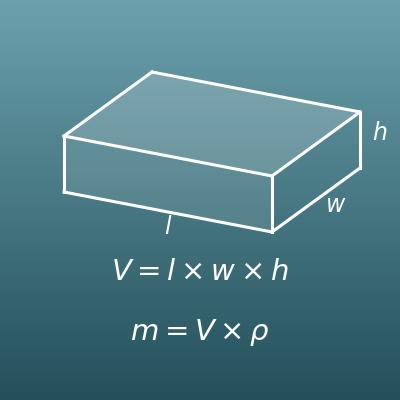
Concrete Calculator (Cubic Yards, Weight and Bags)
Find the volume, weight and number of bags of concrete from the shape, such as a slab, column or steps
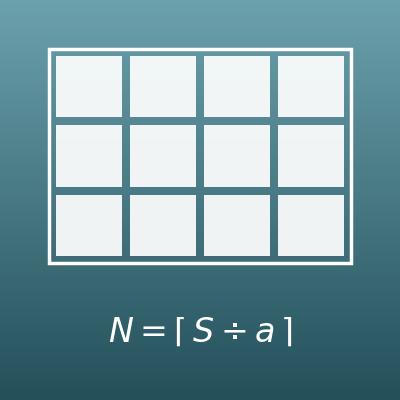
Tile Calculator (How Many Tiles, Boxes and Cost)
Find the number of tiles and boxes to lay over a mortar bed
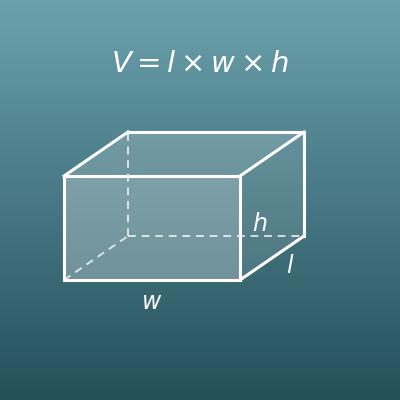
Rectangular Prism Volume Calculator (Length × Width × Height)
A simple length × width × height volume calculation
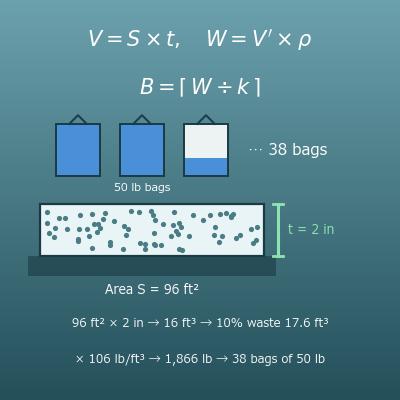
Gravel Calculator (Cubic Yards, Tons and Bags)
Find the volume, weight and bags when you only buy gravel or crushed stone for a base or to spread
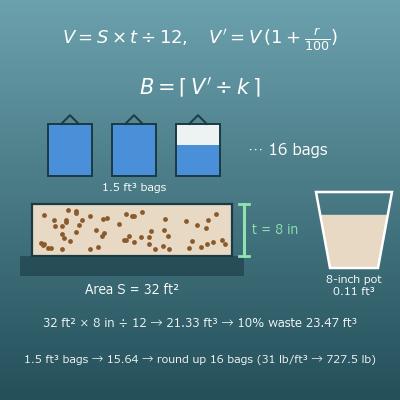
Soil Calculator for Beds, Planters and Pots (Cubic Feet, Cubic Yards, Pounds and Bags)
Find how much soil or sand you need for beds, planters and pots, in volume, weight and bags
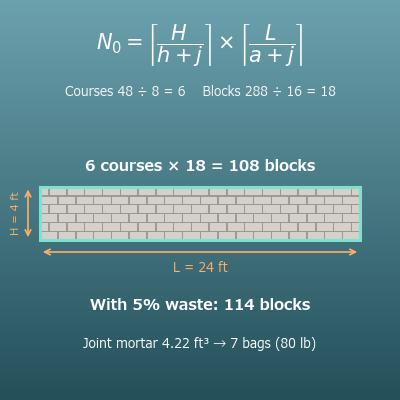
Concrete Block Calculator (Blocks, Mortar Bags and Rebar for a Block Wall)
Find the number of blocks and the joint mortar from the wall length and height, then use that amount on this page
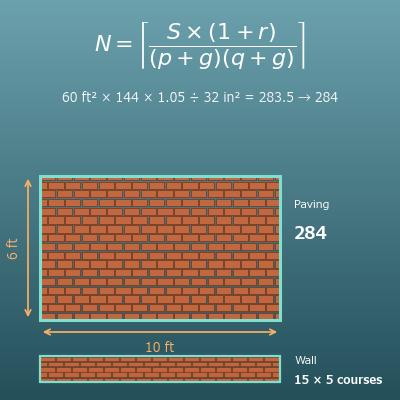
Brick Calculator (Patios, Paths, Garden Edges and Low Walls)
Find the number of bricks to lay or stack, and the joint mortar in volume, weight and bags