










































Choose what to check, then enter the size of the item and of the door, hallway or elevator (cm). The clearance is subtracted from the opening or hallway for packing, handles and padding (default 3 cm; leave it blank for 3 cm, or enter 0 for none).
Table of Contents
-
What you can do on this page
-
What is this calculation used for?
-
How to Use
-
Formulas and figures
-
Symbols and terms
-
Good to know before you start
-
How to calculate it in Excel
-
How to calculate it in Google Sheets
-
How to calculate it in Python
-
How to write it in LaTeX and other math languages (copy and paste)
-
How to have ChatGPT do the calculation
-
DataChef Features
-
Related Features
-
NumberChef Calculators List
What you can do on this page
- Enter the width, depth and height of a piece of furniture or an appliance and the width and height of a door, window or other opening. You get one of three verdicts: "likely to fit", "likely to fit if tilted" or "unlikely to fit"
- See which of the three faces of the item (front, side or top) to turn toward the opening (upright, on its side or lying down), and how many inches to spare
- For a tall, thin item, see how many degrees from vertical to tilt it. If it does not fit, see how many inches it is short
- For an L-shaped hallway corner, find the longest item that can turn it, taking the item width into account, and the tightest angle
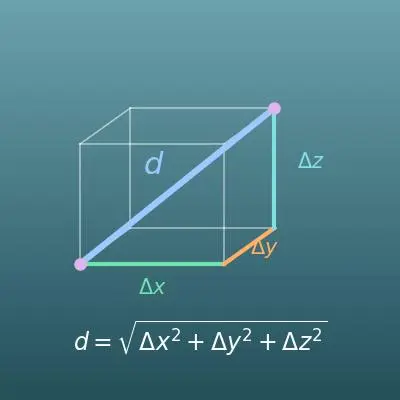
- From the inside size of an elevator car, see if the item fits as is or when tilted, and find the floor diagonal and the space diagonal (the limit for a long, thin item)
What is this calculation used for?
A sofa 84 in wide, 38 in deep and 34 in high is likely to fit through a door 36 in wide and 80 in high (clearance 1 in) if you turn the side face (depth 38 × height 34) toward the opening: stand the sofa on its back and carry it in end first, with the 34 in height across and the 38 in depth up. It fits with 1 in to spare in width. Before you give the sofa away because "84 in will never fit through a 36 in door", you can check with numbers whether choosing the right face makes it fit.
With only 1 in to spare, it will be very tight in real life once doorknobs, hinges and protective padding are counted. For a tight fit like this, give the sizes to the moving company when they come to look, and talk about options such as taking the door off its hinges or removing the legs.
A front-load washer 27 in wide, 30 in deep and 38 in high is unlikely to fit through a laundry room door with a 24 in opening (clearance 1 in, so an effective width of 23 in). Every face has a short side of at least 27 in, so it is 4 in short in width. For appliances such as refrigerators and washers, where every face is wide, turning the face or tilting cannot fix a shortage in width. You need to take the door off, use another route, or choose a slightly smaller model.
Delivery guides from stores and makers often give the path width needed as "the unit width plus so many inches". Enter that extra amount in the "Clearance" field, and you can check it the same way the guide does. Whether the unit fits the space where it goes (the drain pan or the height of the faucets) is a separate question, so check the installation manual for that.
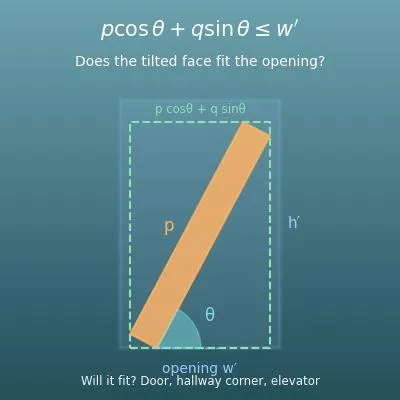
A thin panel 81 in tall and 4 in thick (a floor mirror or the back panel of a wardrobe before assembly) is 1 in too tall to go upright through an 80 in high door. Tilt it about 20° from vertical, and the height needed drops to about 77.5 in and the width needed is about 31.5 in, so it is likely to go through a 36 in wide door. "Just tilt it a little" only works like this for thin items that are only a little too tall.
A thick bookcase or wardrobe needs much more width as soon as you tilt it, so it is usually carried lying down (with the top or side face toward the opening). Flat-pack furniture that you assemble in the room only needs its parts to fit, so you do not have to worry about the size of the finished piece.
At a right-angle corner between hallways 36 in and 48 in wide (clearance 1 in), a rod with no width could turn up to about 115.5 in. But for a sofa 34 in deep, the longest length that can turn is only about 45.7 in, so an 84 in sofa carried flat is unlikely to make the turn. For an item with a width, the rod formula gives a badly wrong answer; you need the formula that corrects for the width.
In a case like this, carrying the sofa on end (enter its height as the length and its depth as the width) often works. For U-shaped stairs, treat the stair width and the landing depth as the hallway widths \(a\) and \(b\), and the stairs as two right-angle corners in a row; the same formula gives an estimate (take off handrails and light fixtures with the clearance).
In a car 68 in wide, 51 in deep and 96 in high (clearance 1 in), a rolled rug 100 in long and 8 in thick is longer than the 95 in effective ceiling height, but it is likely to fit if you raise its long side about 57° from the floor within the width × height face of the car. On the other hand, a boxed item of the same length with a 20 × 20 in cross section is unlikely to fit even when tilted. Even with room to spare on the space diagonal (about 126.5 in), the thickness gets in the way.
Once you know an item will not fit in the elevator, you can weigh carrying it up the stairs (check the corners with the corner formula) against hoisting it in from outside (often at extra cost) before you get a quote. The building manager or the elevator maker's spec sheet has the car's inside dimensions and the door size. The door is often narrower, so enter the door size too.
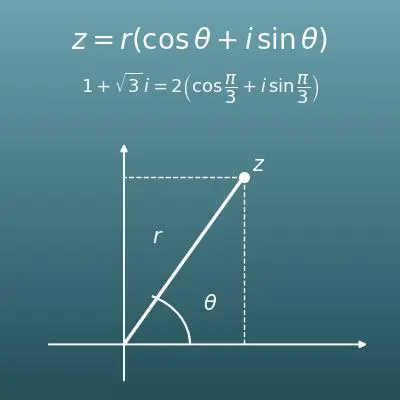
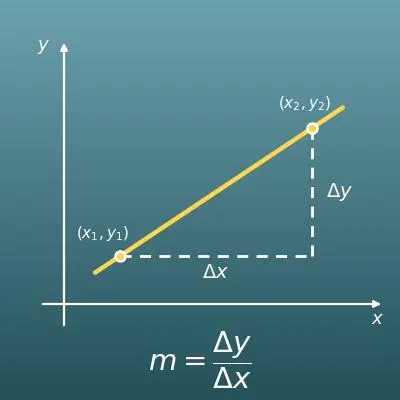
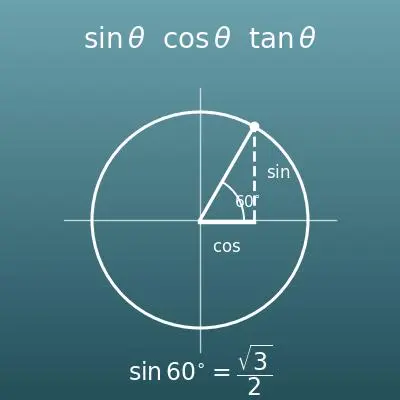
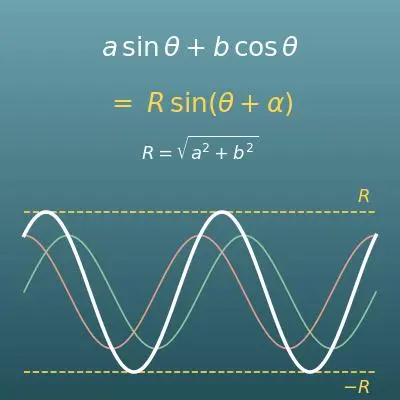
The width needed for a tilted face, \(p\cos\theta + q\sin\theta\), and the height needed, \(p\sin\theta + q\cos\theta\), just add up the horizontal and vertical parts (\(p\cos\theta\) and \(p\sin\theta\)) of a side of length \(p\) tilted to the angle \(\theta\). This is the most basic use of the trigonometric ratios. The longest length that can turn a hallway corner is the smallest value of \(L(\theta) = \dfrac{a}{\sin\theta} + \dfrac{b}{\cos\theta}\), a classic calculus optimization problem (the "ladder around a corner" problem).
Thinking about a real piece of furniture going around a corner makes it easier to see why the smallest value gives the longest length: the item passes through every angle while it turns.
Formulas and figures
Symbols and terms
Symbols
| \(W,\ D,\ H\) | W, D, H | The first letters of the width, depth and height of the item, in the order of a catalog's "width × depth × height". The unit is inches. |
| \(w,\ h\) | lowercase w, h | The width and height of the opening (door or window), measured on the inside. They are lowercase to tell them apart from the item's \(W\) and \(H\). In the elevator formula, \(h\) is the height of the car (effective inside size). |
| \(c\) | c | The first letter of "clearance": the length taken off the opening, hallway or car size for packing, handles, protective padding and so on (in inches). |
| \(w',\ h'\) | w prime, h prime | The width and height of the effective opening: \(w' = w - c\) and \(h' = h - c\). The prime mark at the top right shows "the value after the clearance is taken off". |
| \(p,\ q\) | p, q | The two sides of the face turned toward the opening. In the condition for fitting, they are the side across the width and the side along the height. In the condition for tilting, \(p\) is the long side and \(q\) the short side. They are two of the item's \(W\), \(D\) and \(H\). |
| \(\theta\) | theta | An angle. The Greek letter theta is often used for angles. In the condition for tilting, it is the angle between the long side of the face and the floor. At the hallway corner, it is the angle between the item and the first hallway. |
| \(W_{\theta},\ H_{\theta}\) | W sub theta, H sub theta | The width and height needed when the face is tilted by the angle \(\theta\) (the width and height of the bounding rectangle of the tilted face). The small \(\theta\) at the bottom right shows "a value that changes with the angle". |
| \(a,\ b\) | a, b | At the hallway corner, \(a\) is the hallway width before the corner and \(b\) the width after it. For the elevator, \(a\) is the car width and \(b\) its depth (both are effective sizes, after the clearance). |
| \(L,\ d\) | L, d | The length \(L\) and width \(d\) of the item turned at the corner: its long side and short side seen from above. With \(d = 0\), the item is treated as a rod with no thickness. |
| \(L_{\max}\) | L max | The longest length that can turn the corner. "max" is short for maximum. For a rod it is \(\bigl(a^{2/3}+b^{2/3}\bigr)^{3/2}\); for an item of width \(d\) it is the smallest value of \(L(\theta)\). |
| \(\min_{\theta}\) | minimum over theta | The smallest value as the angle \(\theta\) changes. "min" is short for minimum. While turning the corner the item passes through every angle, so the length at the tightest angle is the limit. |
| \(\sin\theta,\ \cos\theta\) | sine theta, cosine theta | Trigonometric ratios. In a right triangle, \(\sin\theta\) is the opposite side divided by the hypotenuse, and \(\cos\theta\) is the adjacent side divided by the hypotenuse. When a side of length \(p\) is tilted to the angle \(\theta\), its vertical part is \(p\sin\theta\) and its horizontal part is \(p\cos\theta\). |
| \(D_{\text{floor}},\ D_{\text{side}},\ D_{\text{space}}\) | D floor, D side, D space | The floor diagonal of the car, the diagonal of a face when the item is stood up at an angle, and the space diagonal. \(D\) is the first letter of "diagonal". |
| \(\sqrt{\ }\) | square root | The square root: the positive number that gives the number inside when squared. It is used to find diagonals with the Pythagorean theorem (example - \(\sqrt{36^{2}+48^{2}} = \sqrt{3600} = 60\)). |
| \(\le\) | less than or equal to | The inequality sign for "the left value is at most the right value". \(p \le w'\) says the side \(p\) of the item is at most the effective opening width \(w'\); in other words, it still fits when they are exactly equal. |
| \(a^{2/3}\) | a to the two-thirds power | \(a\) raised to the power \(\dfrac{2}{3}\): square \(a\), then take the cube root. It is the same as \(\sqrt[3]{a^{2}}\). For example, \(8^{2/3} = \sqrt[3]{64} = 4\). It appears in the formula for the longest rod that can turn a corner. |
| \(\approx\) | approximately equal to | The sign for "approximately equal". It is used when a value that does not come out evenly, such as a trigonometric ratio or a square root, is rounded to a decimal. |
Terms
| inside measurement | The size of a door or window frame measured from the inside to the inside. It is smaller than the size over the outside of the frame, and it is the size furniture can actually pass through. If the door cannot be taken off, the opening is narrower by the thickness of the door opened to 90°, so measure it in that state. |
| effective opening | The inside measurement of the opening minus the clearance for packing, handles, doorknobs, protective padding and so on. It is the size the furniture can really use. Every check on this page uses this size, and it is also shown in the result. |
| clearance | The gap needed between the item and the opening, for the thickness of packing, handles and hinges that stick out, protective boards and the movers' hands. People usually allow 1 to 2 in. The right value depends on the item and how it is moved, so you can change it in the input field. |
| protective padding | Boards, sheets, blankets or cardboard put on the floor, walls and door frame during a move to protect them from damage. Movers usually put it on, and it makes the opening narrower by its thickness, so include it in the clearance. |
| front face | The width × height face of the item. With this face toward the opening, the item moves in the direction of its depth. For a sofa, it is the face you see from the seat side. |
| side face | The depth × height face of the item. With this face toward the opening, the item moves in the direction of its width. A wide sofa or bed is usually carried this way. |
| top face | The width × depth face of the item. With this face toward the opening, the item moves in the direction of its height, top first. For a tall bookcase or refrigerator, this is carrying it lying down. |
| bounding rectangle | The smallest rectangle with horizontal and vertical sides that fully encloses a tilted shape. A tilted face of the item fits through the opening when the width and height of this rectangle fit the effective opening. |
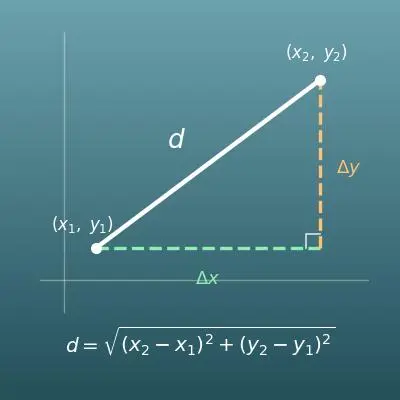
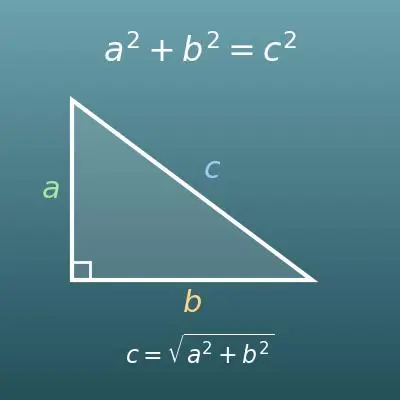
| diagonal | The line joining opposite corners of a rectangle (and its length). For a rectangle with sides \(x\) and \(y\), it is \(\sqrt{x^{2}+y^{2}}\). If the diagonal of a face of the item is longer than the diagonal of the opening, the item cannot go through however you tilt it. |
| space diagonal | The line joining opposite corners of a box through its inside. For sides \(a\), \(b\) and \(h\), it is \(\sqrt{a^{2}+b^{2}+h^{2}}\), the longest straight line inside the car. A thin rod up to this length fits. |
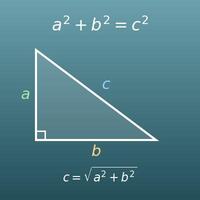
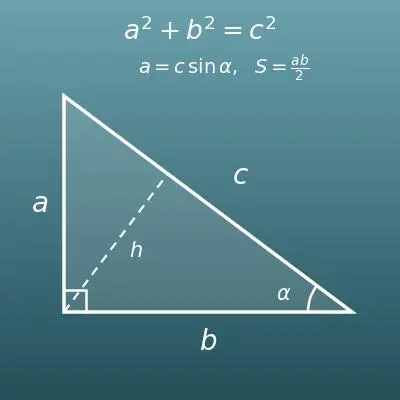
| Pythagorean theorem | The theorem that in a right triangle, (one leg)² + (other leg)² = (hypotenuse)². All the diagonals on this page are found with this theorem. |
| trigonometric ratio | The ratios \(\sin\), \(\cos\) and \(\tan\) of the sides of a right triangle. They give side lengths from a known angle, and are used for the width and height of a tilted face and for the corner formula. |
| minimum value | The smallest value a function takes as the angle changes. At a corner, the item passes through every angle while turning, so the length that fits at the tightest angle (the minimum value) is the longest length that can turn. |
| inside dimension | A size measured on the inside of a box or elevator car. It is smaller than the outside size by the thickness of the walls. Elevator spec sheets list it as the car's inside dimensions. |
| landing | The flat area partway up a staircase. On U-shaped stairs, the item is turned 180° here. Treat the stair width and the landing depth as the hallway widths \(a\) and \(b\), and the corner formula gives an estimate. |
Good to know before you start
Here is what helps you use the calculation on this page with real understanding, not just by pressing the button.
If you get stuck, going back over these topics is the quickest way forward.
| Units of length and how to measure (Grades 2–4) |
|
| Comparing sizes and inequality signs (Grades 3–6) |
|
| Rectangular prisms and their faces (Grade 5) |
|
| The Pythagorean theorem (Grade 8) |
|
| Trigonometric ratios sin and cos (Geometry) |
|
| Rational exponents and the minimum of a function (Algebra 2 and Calculus) |
|
How to calculate it in Excel
| Item width W (in) | 84 |
| Item depth D (in) | 38 |
| Item height H (in) | 34 |
| Opening width w (in) | 36 |
| Opening height h (in) | 80 |
| Clearance c (in) | 1 |
| Effective opening width w' (in) | =B4-B6 |
| Effective opening height h' (in) | =B5-B6 |
| Front face (W×H) toward the opening | =IF(OR(AND(B1<=B7,B3<=B8),AND(B3<=B7,B1<=B8)),"Fits","Does not fit") |
| Side face (D×H) toward the opening | =IF(OR(AND(B2<=B7,B3<=B8),AND(B3<=B7,B2<=B8)),"Fits","Does not fit") |
| Top face (W×D) toward the opening | =IF(OR(AND(B1<=B7,B2<=B8),AND(B2<=B7,B1<=B8)),"Fits","Does not fit") |
| Long side of the face p (in) | 81 |
| Short side of the face q (in) | 4 |
| Angle of the long side to the floor θ (degrees) | 70 |
| Width needed Wθ (in) | =B1*COS(RADIANS(B3))+B2*SIN(RADIANS(B3)) |
| Height needed Hθ (in) | =B1*SIN(RADIANS(B3))+B2*COS(RADIANS(B3)) |
| Hallway width before the corner a (in) | 36 |
| Hallway width after the corner b (in) | 36 |
| Item width d (in) | 20 |
| Angle θ (degrees) | 45 |
| Longest rod that can turn (in) | =(B1^(2/3)+B2^(2/3))^(3/2) |
| Length that fits at the angle θ, L(θ) (in) | =B1/SIN(RADIANS(B4))+B2/COS(RADIANS(B4))-B3/(SIN(RADIANS(B4))*COS(RADIANS(B4))) |
| Car width a (in) | 36 |
| Car depth b (in) | 48 |
| Car height h (in) | 80 |
| Floor diagonal (in) | =SQRT(B1^2+B2^2) |
| Diagonal when stood up at an angle (in) | =SQRT(B2^2+B3^2) |
| Space diagonal (in) | =SQRT(B1^2+B2^2+B3^2) |
The first table uses the sofa 84 in wide, 38 in deep and 34 in high and the 36 × 80 in door (clearance 1 in). B7 becomes 35 and B8 becomes 79. B10 (side face) shows "Fits", while B9 (front face) and B11 (top face) show "Does not fit". "IF" switches what is shown based on a condition, "AND" stands for "both are true" and "OR" for "at least one is true". OR combines the two cases: the face as it is, and the face turned 90°.
The second table tilts the 81 × 4 face to 70°. B4 is about 31.5 and B5 about 77.5. "RADIANS" turns degrees into radians, the angle unit that COS and SIN use. The third table is the corner of two 36 in hallways: B5 (rod) is about 101.8 and B6 (width 20 at 45°) about 61.8. To find the longest item with a width, change the angle in B4 one degree at a time and look for the smallest B6 (with equal hallway widths, the smallest is at 45°). The fourth table is a 36 × 48 × 80 in car: B4 is 60, B5 about 93.3 and B6 is 100.
How to calculate it in Google Sheets
| Item width W (in) | 84 |
| Item depth D (in) | 38 |
| Item height H (in) | 34 |
| Opening width w (in) | 36 |
| Opening height h (in) | 80 |
| Clearance c (in) | 1 |
| Effective opening width w' (in) | =B4-B6 |
| Effective opening height h' (in) | =B5-B6 |
| Front face (W×H) toward the opening | =IF(OR(AND(B1<=B7,B3<=B8),AND(B3<=B7,B1<=B8)),"Fits","Does not fit") |
| Side face (D×H) toward the opening | =IF(OR(AND(B2<=B7,B3<=B8),AND(B3<=B7,B2<=B8)),"Fits","Does not fit") |
| Top face (W×D) toward the opening | =IF(OR(AND(B1<=B7,B2<=B8),AND(B2<=B7,B1<=B8)),"Fits","Does not fit") |
| Long side of the face p (in) | 81 |
| Short side of the face q (in) | 4 |
| Angle of the long side to the floor θ (degrees) | 70 |
| Width needed Wθ (in) | =B1*COS(RADIANS(B3))+B2*SIN(RADIANS(B3)) |
| Height needed Hθ (in) | =B1*SIN(RADIANS(B3))+B2*COS(RADIANS(B3)) |
| Hallway width before the corner a (in) | 36 |
| Hallway width after the corner b (in) | 36 |
| Item width d (in) | 20 |
| Angle θ (degrees) | 45 |
| Longest rod that can turn (in) | =(B1^(2/3)+B2^(2/3))^(3/2) |
| Length that fits at the angle θ, L(θ) (in) | =B1/SIN(RADIANS(B4))+B2/COS(RADIANS(B4))-B3/(SIN(RADIANS(B4))*COS(RADIANS(B4))) |
| Car width a (in) | 36 |
| Car depth b (in) | 48 |
| Car height h (in) | 80 |
| Floor diagonal (in) | =SQRT(B1^2+B2^2) |
| Diagonal when stood up at an angle (in) | =SQRT(B2^2+B3^2) |
| Space diagonal (in) | =SQRT(B1^2+B2^2+B3^2) |
How to calculate it in Python
import math

# ---- Door or opening: does an item W x D x H fit through an opening w x h (clearance c)? ----
W, D, H = 84, 38, 34       # item width, depth, height (in)
w, h, c = 36, 80, 1        # opening width and height (inside measurement) and clearance (in)
w_eff, h_eff = w - c, h - c
faces = {"front (W x H)": (W, H), "side (D x H)": (D, H), "top (W x D)": (W, D)}

def fits_upright(p, q, width, height):
    """Does face p x q fit as is (turning it 90 degrees is allowed)?"""
    return (p <= width and q <= height) or (q <= width and p <= height)

def fits_tilted(p, q, width, height):
    """Is there an angle from 0 to 90 degrees where the rectangle around the tilted face p x q fits? (0.01-degree steps)"""
    p, q = max(p, q), min(p, q)
    for i in range(9001):
        t = math.radians(i / 100)
        need_w = p * math.cos(t) + q * math.sin(t)
        need_h = p * math.sin(t) + q * math.cos(t)
        if need_w <= width and need_h <= height:
            return i / 100
    return None

print(f"Effective opening: {w_eff} x {h_eff} in")
for name, (p, q) in faces.items():
    if fits_upright(p, q, w_eff, h_eff):
        print(f"{name}: likely to fit with this face toward the opening")
    else:
        angle = fits_tilted(p, q, w_eff, h_eff)
        print(f"{name}: " + (f"likely to fit if the long side is tilted to {angle} degrees from the floor" if angle is not None else "unlikely to fit"))

# ---- Hallway corner: can an item of length L and width d turn a right-angle corner between hallways a and b wide? ----
a, b, L, d = 36, 36, 60, 20
rod_max = (a ** (2 / 3) + b ** (2 / 3)) ** 1.5
lengths = []
for i in range(1, 9000):
    t = math.radians(i / 100)
    lengths.append((a * math.cos(t) + b * math.sin(t) - d) / (math.sin(t) * math.cos(t)))
L_max = min(lengths)
print(f"Longest rod that can turn: {rod_max:.1f} in, item {d} in wide: {L_max:.1f} in -> "
      + ("likely to turn" if L <= L_max else "unlikely to turn"))

# ---- Elevator: diagonals of a car a x b x h ----
ea, eb, eh = 36, 48, 80
print(f"Floor diagonal {math.hypot(ea, eb):.1f} in, stood up at an angle {math.hypot(eb, eh):.1f} in, "
      f"space diagonal {math.sqrt(ea**2 + eb**2 + eh**2):.1f} in")
How to write it in LaTeX and other math languages (copy and paste)
w' = w − c, h' = h − c, p ≤ w' and q ≤ h'
w' = w - c,\quad h' = h - c,\quad p \le w' \ \text{and}\ q \le h'
<math xmlns="http://www.w3.org/1998/Math/MathML" display="block">
  <mrow>
    <msup><mi>w</mi><mo>′</mo></msup><mo>=</mo><mi>w</mi><mo>−</mo><mi>c</mi>
    <mo>,</mo>
    <msup><mi>h</mi><mo>′</mo></msup><mo>=</mo><mi>h</mi><mo>−</mo><mi>c</mi>
    <mo>,</mo>
    <mi>p</mi><mo>≤</mo><msup><mi>w</mi><mo>′</mo></msup>
    <mo>∧</mo>
    <mi>q</mi><mo>≤</mo><msup><mi>h</mi><mo>′</mo></msup>
  </mrow>
</math>
w' = w - c, h' = h - c, p <= w' and q <= h'
weff = w - c; heff = h - c; fits = (p <= weff && q <= heff) || (q <= weff && p <= heff)
weff := w - c; heff := h - c; fits := (p <= weff and q <= heff) or (q <= weff and p <= heff);
weff = w - c; heff = h - c; fits = (p <= weff && q <= heff) || (q <= weff && p <= heff); % p, q: the two sides of the face toward the opening
w' = w − c, h' = h − c, p ≤ w' ∧ q ≤ h'
W_θ = p cos θ + q sin θ, H_θ = p sin θ + q cos θ, W_θ ≤ w' and H_θ ≤ h'
W_{\theta} = p\cos\theta + q\sin\theta,\quad H_{\theta} = p\sin\theta + q\cos\theta,\quad W_{\theta} \le w' \ \text{and}\ H_{\theta} \le h'
<math xmlns="http://www.w3.org/1998/Math/MathML" display="block">
<mrow>
<msub><mi>W</mi><mi>θ</mi></msub><mo>=</mo>
<mi>p</mi><mo>⁢</mo><mi>cos</mi><mo>⁡</mo><mi>θ</mi>
<mo>+</mo>
<mi>q</mi><mo>⁢</mo><mi>sin</mi><mo>⁡</mo><mi>θ</mi>
<mo>,</mo>
<msub><mi>H</mi><mi>θ</mi></msub><mo>=</mo>
<mi>p</mi><mo>⁢</mo><mi>sin</mi><mo>⁡</mo><mi>θ</mi>
<mo>+</mo>
<mi>q</mi><mo>⁢</mo><mi>cos</mi><mo>⁡</mo><mi>θ</mi>
</mrow>
</math>
W_theta = p cos theta + q sin theta, H_theta = p sin theta + q cos theta
{p*Cos[theta] + q*Sin[theta], p*Sin[theta] + q*Cos[theta]} (* theta in radians; for degrees use theta Degree *)
Wt := p*cos(theta) + q*sin(theta); Ht := p*sin(theta) + q*cos(theta);
Wt = p*cosd(theta) + q*sind(theta); Ht = p*sind(theta) + q*cosd(theta); % theta in degrees
W_θ = p cos θ + q sin θ, H_θ = p sin θ + q cos θ
L_max = (a^(2/3) + b^(2/3))^(3/2) (rod), L(θ) = a/sin θ + b/cos θ − d/(sin θ cos θ), L_max = min L(θ)
L_{\max} = \left(a^{2/3} + b^{2/3}\right)^{3/2},\quad L(\theta) = \frac{a}{\sin\theta} + \frac{b}{\cos\theta} - \frac{d}{\sin\theta\cos\theta},\quad L_{\max} = \min_{0 < \theta < 90^\circ} L(\theta)
<math xmlns="http://www.w3.org/1998/Math/MathML" display="block">
<mrow>
<msub><mi>L</mi><mi>max</mi></msub><mo>=</mo>
<msup>
<mrow><mo>(</mo><msup><mi>a</mi><mrow><mn>2</mn><mo>/</mo><mn>3</mn></mrow></msup><mo>+</mo><msup><mi>b</mi><mrow><mn>2</mn><mo>/</mo><mn>3</mn></mrow></msup><mo>)</mo></mrow>
<mrow><mn>3</mn><mo>/</mo><mn>2</mn></mrow>
</msup>
<mo>,</mo>
<mi>L</mi><mo>(</mo><mi>θ</mi><mo>)</mo><mo>=</mo>
<mfrac><mi>a</mi><mrow><mi>sin</mi><mo>⁡</mo><mi>θ</mi></mrow></mfrac>
<mo>+</mo>
<mfrac><mi>b</mi><mrow><mi>cos</mi><mo>⁡</mo><mi>θ</mi></mrow></mfrac>
<mo>−</mo>
<mfrac><mi>d</mi><mrow><mi>sin</mi><mo>⁡</mo><mi>θ</mi><mo>⁢</mo><mi>cos</mi><mo>⁡</mo><mi>θ</mi></mrow></mfrac>
</mrow>
</math>
L_max = (a^(2/3) + b^(2/3))^(3/2), L(theta) = a/sin theta + b/cos theta - d/(sin theta cos theta)
lrod = (a^(2/3) + b^(2/3))^(3/2); NMinimize[{a/Sin[t] + b/Cos[t] - d/(Sin[t]*Cos[t]), 0.01 < t < Pi/2 - 0.01}, t]
lrod := (a^(2/3) + b^(2/3))^(3/2); L := theta -> a/sin(theta) + b/cos(theta) - d/(sin(theta)*cos(theta)); Lmax := minimize(L(theta), theta = 0.01 .. Pi/2 - 0.01);
lrod = (a^(2/3) + b^(2/3))^(3/2); L = @(t) a./sin(t) + b./cos(t) - d./(sin(t).*cos(t)); [t0, Lmax] = fminbnd(L, 0.01, pi/2 - 0.01); % t in radians
L_max = (a^(2/3) + b^(2/3))^(3/2), L(θ) = a/sin θ + b/cos θ − d/(sin θ cos θ)
D_floor = √(a² + b²), D_side = √(b² + h²), D_space = √(a² + b² + h²)
D_{\text{floor}} = \sqrt{a^{2}+b^{2}},\quad D_{\text{side}} = \sqrt{b^{2}+h^{2}},\quad D_{\text{space}} = \sqrt{a^{2}+b^{2}+h^{2}}
<math xmlns="http://www.w3.org/1998/Math/MathML" display="block">
  <mrow>
    <msub><mi>D</mi><mtext>floor</mtext></msub><mo>=</mo>
    <msqrt><msup><mi>a</mi><mn>2</mn></msup><mo>+</mo><msup><mi>b</mi><mn>2</mn></msup></msqrt>
    <mo>,</mo>
    <msub><mi>D</mi><mtext>side</mtext></msub><mo>=</mo>
    <msqrt><msup><mi>b</mi><mn>2</mn></msup><mo>+</mo><msup><mi>h</mi><mn>2</mn></msup></msqrt>
    <mo>,</mo>
    <msub><mi>D</mi><mtext>space</mtext></msub><mo>=</mo>
    <msqrt><msup><mi>a</mi><mn>2</mn></msup><mo>+</mo><msup><mi>b</mi><mn>2</mn></msup><mo>+</mo><msup><mi>h</mi><mn>2</mn></msup></msqrt>
  </mrow>
</math>
D_floor = sqrt(a^2 + b^2), D_side = sqrt(b^2 + h^2), D_space = sqrt(a^2 + b^2 + h^2)
{Sqrt[a^2 + b^2], Sqrt[b^2 + h^2], Sqrt[a^2 + b^2 + h^2]}
Dfloor := sqrt(a^2 + b^2); Dside := sqrt(b^2 + h^2); Dspace := sqrt(a^2 + b^2 + h^2);
Dfloor = sqrt(a^2 + b^2); Dside = sqrt(b^2 + h^2); Dspace = sqrt(a^2 + b^2 + h^2); % a, b, h: effective inside size of the car
D_floor = √(a^2 + b^2), D_side = √(b^2 + h^2), D_space = √(a^2 + b^2 + h^2)
How to have ChatGPT do the calculation
You are a calculation assistant for checking whether furniture fits through a door. Do the following calculation by actually running Python code, and base your answer only on the numbers from the execution result (do not answer by mental math or guessing).

A sofa 84 in wide, 38 in deep and 34 in high must go through a door 36 in wide and 80 in high (inside measurement). Allow a clearance of 1 in for packing and protective padding.
Find each of the following:
1. The effective opening width and height (subtract the 1 in clearance from the opening width and from the height)
2. For each of the three faces of the sofa (width × height, depth × height, width × depth), whether it fits the effective opening as is (the two sides p, q of the face satisfy p ≤ effective width and q ≤ effective height; p and q may be swapped)
3. If no face fits, whether there is an angle from 0° to 90° where, with the long side of the face tilted θ degrees from the floor, both the width needed p cosθ + q sinθ and the height needed p sinθ + q cosθ fit
4. The longest box 20 in wide that can turn a right-angle corner between two hallways 36 in wide (the smallest value of L(θ) = a/sinθ + b/cosθ − d/(sinθ cosθ) for θ from 0° to 90°)

Show the formulas you used and the numbers from the execution result.
How to Use
-
1Enter your numbersType the numbers you want to calculate with into the input fields
-
2CalculatePress the "Calculate" button
-
3Check the resultThe result appears on the spot. The same page also explains the idea behind the calculation and the formula
DataChef Features

No technical knowledge required.
Intuitive and user-friendly operation.

Can be used without registering personal information.

Automatic file deletion by clicking "download".

and rapid file conversion.

No attribution required.

No need to contact us for commercial use permission.
Related Features
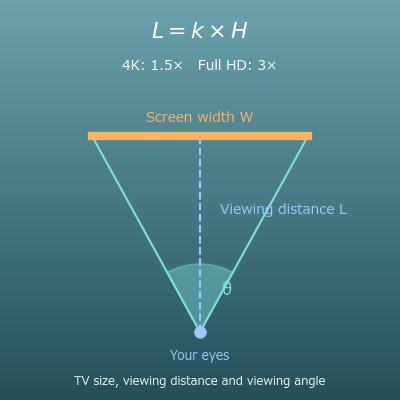
TV Size and Viewing Distance Calculator (4K, Full HD and 8K)
Find the width and height of a new TV screen from its size in inches. Useful with a size check before delivery
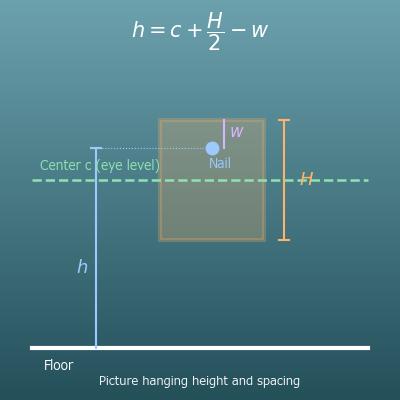
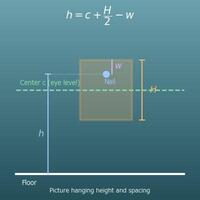
Picture Hanging Height and Spacing Calculator (Nail Height, Gallery Wall)
Decorate the wall once the furniture is in. Find the hook height for a frame and the spacing for a row of frames
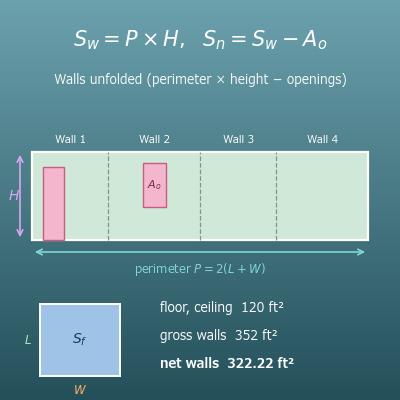
Wall Area Calculator (Wall, Ceiling and Floor Square Footage, with Doors, Windows, Perimeter and Volume)
Organize the room size and openings, then find the wall and floor areas and the perimeter
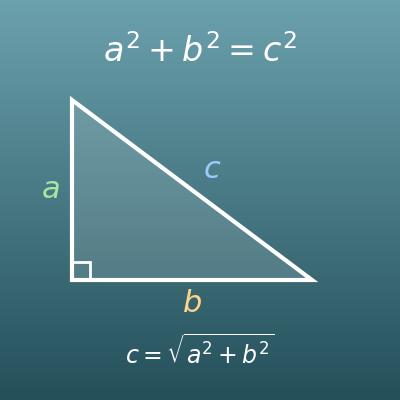
Pythagorean Theorem Calculator (Hypotenuse and Legs of a Right Triangle)
Find the diagonal of an opening or a furniture face from its two sides, step by step. The diagonals on this page come from this theorem
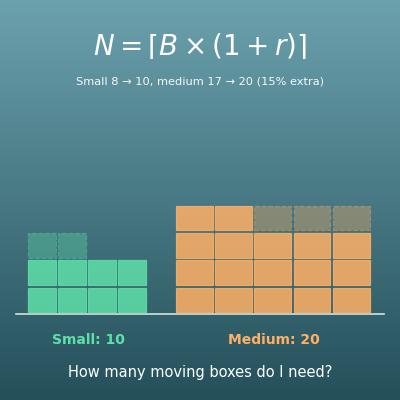
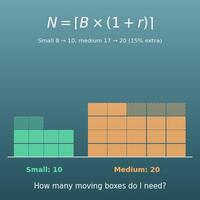
Moving Box Calculator (How Many Boxes Do I Need?)
Also for your move. Estimate how many moving boxes you need from your belongings or household size