
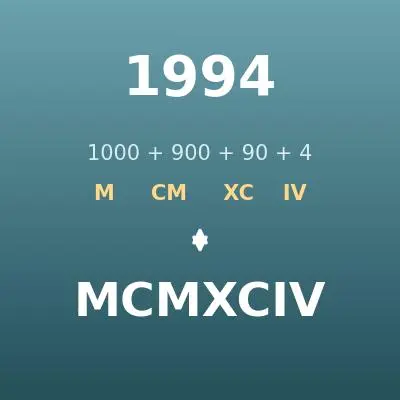

Enter either a number (in Arabic numerals) or a Roman numeral. The page tells which one it is and converts it the other way, with a breakdown such as 1000 + 900 + 90 + 4.
Table of Contents
-
What you can do on this page
-
What is this calculation used for?
-
How to Use
-
Formula
-
Symbols and terms
-
Good to know before you start
-
How to calculate it in Excel
-
How to calculate it in Google Sheets
-
How to calculate it in Python
-
How to write it in LaTeX and other math languages (copy and paste)
-
How to have ChatGPT do the calculation
-
DataChef Features
-
Related Features
-
NumberChef Calculators List
What you can do on this page
- Convert either way with a single input field: "What is 1994 in Roman numerals?" or "What number is MCMXCIV?" (the page tells automatically whether you entered a number or a Roman numeral)
- A step-by-step breakdown such as 1000 + 900 + 90 + 4 → M + CM + XC + IV shows you how the conversion works, so you learn to do it yourself
- Read the Roman numerals you see on clock faces, in movie and game sequel numbers, in Olympic and Super Bowl numbers and more, right away
- Numbers of 4,000 or more are converted to Roman numerals with a bar on top (a vinculum). You can type a barred symbol with an underscore, up to 3,999,999
- Nonstandard forms such as IIII, common on clock faces, are read too, and the standard form (IV) is shown alongside
What is this calculation used for?
The most common place to see Roman numerals is the face of a watch or a wall clock. XII is 12 o'clock, III is 3 o'clock and IX is 9 o'clock: once you know the subtractive rule, you can read them all.
Look closely, and many clocks show 4 o'clock as IIII instead of the standard IV. This is a traditional nonstandard form with several proposed explanations, such as "it balances the left and right sides of the dial" or "it avoids IV, the start of the god Jupiter's name in Latin (IVPPITER)". It lives on today as an exception to the rules.
"Rocky IV" is the 4th movie, "Final Fantasy VII" is the 7th game and "Star Wars: Episode IV" is the 4th episode: Roman numerals are widely used to number sequels.
Beyond X they get harder to read, as in "XIII" (the 13th), but if you know the subtractive rule, you will not get lost. Reading the numbers in titles at a glance is a nice bit of general knowledge.
Big international competitions use Roman numerals for their numbers. The 2024 Paris Olympics were officially the "Games of the XXXIII Olympiad" (the 33rd), and the Super Bowl, the biggest yearly game in American sports, is written like "Super Bowl LVIII" (the 58th, in 2024).
When you see this on the news or on a poster, you can work it out: XXXIII = 10 + 10 + 10 + 1 + 1 + 1 = 33.
The numbers of European monarchs and popes are written in Roman numerals: Queen Elizabeth II, Louis XIV of France (the "Sun King") and Pope John Paul II.
When you meet a name like "Henry VIII" in a history book, in the news or on a commemorative coin, you can read it correctly: VIII = 5 + 1 + 1 + 1 = 8.
At the very end of a movie's credits, the year it was made is sometimes given in Roman numerals, such as "MMXXVI" (2026). Cornerstones and monuments on buildings in the US and Europe also traditionally carry the year of completion in Roman numerals.
For example, MCMLXIV is 1000 + 900 + 60 + 4 = 1964, the year the Civil Rights Act was signed in the United States. Even a long year can be read correctly if you split it into chunks, M, CM, LX, IV, and add them up.
Formula
Symbols and terms
Symbols
| I | one | The symbol for 1. It is thought to come from the shape of one finger. I = 1, II = 2, III = 3. |
| V | five | The symbol for 5. One theory says it comes from the shape of an open hand (five fingers). |
| X | ten | The symbol for 10. One theory says it is two V's (5) joined together. |
| L | fifty | The symbol for 50. |
| C | one hundred | The symbol for 100. It is thought to be the first letter of the Latin centum (100), the same root as "cent" (1/100 of a dollar) and "century" (100 years). |
| D | five hundred | The symbol for 500. One theory says it comes from the right half of an old symbol for 1000. |
| M | one thousand | The symbol for 1000. It is thought to be the first letter of the Latin mille (1000), the same root as "millimeter" (1/1000 of a meter) and "mile" (originally 1,000 Roman paces). |
| X̅ | ten thousand (X with a bar) | A bar over a symbol (a vinculum) multiplies its value by 1,000. X̅ is 10 × 1000 = 10,000. On this page you type it with an underscore, as in "_X". |
Terms
| Roman numerals | A way of writing numbers born in ancient Rome, using combinations of seven symbols, I, V, X, L, C, D and M. There is no place value; a number is written by adding and subtracting the values of the symbols. There is no symbol for 0. |
| Arabic numerals | The everyday way of writing numbers with the ten digits 0 to 9. They were born in India and reached Europe through the Arab world, which is why they are also called Hindu-Arabic numerals. They use place value, so the same "9" is worth 9, 90 or 900 depending on where it is written. |
| subtractive notation | Writing a smaller symbol before a larger one to show subtraction. Only six pairs are standard, IV (4), IX (9), XL (40), XC (90), CD (400) and CM (900). It avoids writing the same symbol four times in a row. |
| greedy algorithm | A method that always picks the largest option available at that moment. It is one of the basic ideas in programming. Converting a number to Roman numerals this way always gives the standard form. |
| vinculum | A bar drawn over symbols (Latin for "bond" or "tie"). A barred symbol is worth 1,000 times its usual value, so numbers of 4,000 or more, which the seven basic symbols cannot write, can be written. This page supports numbers up to 3,999,999. |
| nonstandard form | A way of writing that does not follow the standard rules but has long been in wide use. The best-known example is IIII on clock faces (standard form IV), sometimes called the "watchmaker's four". The calculator on this page reads nonstandard forms too and shows the standard form alongside. |
Good to know before you start
Here is what helps you use the calculation on this page with real understanding, not just by pressing the button.
| Addition and subtraction (Grades 1–3) |
|
| Place value in base ten (elementary school) |
|
| Breaking an amount into the largest pieces first (elementary school, money) |
|
How to calculate it in Excel
| Arabic numerals | 1994 |
| Roman numerals | =ROMAN(B1) |
| Roman numerals | MCMXCIV |
| Arabic numerals | =ARABIC(B1) |
In the second table, enter a Roman numeral in B1 and B2 shows the number (1994 for MCMXCIV). The ARABIC function also accepts lower case (mcmxciv).
How to calculate it in Google Sheets
| Arabic numerals | 1994 |
| Roman numerals | =ROMAN(B1) |
| Roman numerals | MCMXCIV |
| Arabic numerals | =ARABIC(B1) |
The upper limit of ROMAN is 3,999, the same as in Excel, but Google Sheets converts only 1 to 3,999: 0 gives an error.
How to calculate it in Python
value = "1994"   # the value to convert (a number or a Roman numeral)

# table for the greedy algorithm (largest first; subtractive pairs such as 900=CM are included)
VALUES = [(1000, "M"), (900, "CM"), (500, "D"), (400, "CD"), (100, "C"),
          (90, "XC"), (50, "L"), (40, "XL"), (10, "X"), (9, "IX"),
          (5, "V"), (4, "IV"), (1, "I")]

def to_roman(n):
    # number -> Roman numeral (replace with symbols, taking the largest value that fits each time)
    result = ""
    for v, symbol in VALUES:
        while n >= v:
            result += symbol
            n -= v
    return result

SYMBOL_VALUES = {"I": 1, "V": 5, "X": 10, "L": 50, "C": 100, "D": 500, "M": 1000}

def to_arabic(roman):
    # Roman numeral -> number (subtract when the next symbol is larger)
    total = 0
    for i, ch in enumerate(roman):
        v = SYMBOL_VALUES[ch]
        if i + 1 < len(roman) and SYMBOL_VALUES[roman[i + 1]] > v:
            total -= v
        else:
            total += v
    return total

s = value.strip().upper()
if s.isdigit():
    print(f"{s} = {to_roman(int(s))}")
else:
    print(f"{s} = {to_arabic(s)}")
How to write it in LaTeX and other math languages (copy and paste)
N = v₁ + v₂ + ⋯ + vₖ
N = v_1 + v_2 + \cdots + v_k
<math xmlns="http://www.w3.org/1998/Math/MathML" display="block">
<mrow>
<mi>N</mi>
<mo>=</mo>
<msub><mi>v</mi><mn>1</mn></msub>
<mo>+</mo>
<msub><mi>v</mi><mn>2</mn></msub>
<mo>+</mo>
<mo>⋯</mo>
<mo>+</mo>
<msub><mi>v</mi><mi>k</mi></msub>
</mrow>
</math>
N = v_1 + v_2 + cdots + v_k
RomanNumeral[1994]
convert(1994, roman);
N = sum([1000 900 90 4]);
N = v_1 + v_2 + ⋯ + v_k
N = Σ ±vᵢ
N = \sum_{i=1}^{k} \pm v_i
<math xmlns="http://www.w3.org/1998/Math/MathML" display="block">
<mrow>
<mi>N</mi>
<mo>=</mo>
<munderover>
<mo>∑</mo>
<mrow><mi>i</mi><mo>=</mo><mn>1</mn></mrow>
<mi>k</mi>
</munderover>
<mo>±</mo>
<msub><mi>v</mi><mi>i</mi></msub>
</mrow>
</math>
N = sum_(i=1)^k +-v_i
FromRomanNumeral["MCMXCIV"]
convert("MCMXCIV", arabic);
N = 1000 - 100 + 1000 - 10 + 100 - 1 + 5;
N = ∑_(i=1)^k ±v_i
How to have ChatGPT do the calculation
You are a calculation assistant for Roman numeral conversion. Do the following conversions by actually running Python code, and base your answer only on the execution result (do not answer by mental math or guessing).

1. Convert 1994 to Roman numerals.
2. Convert the Roman numeral MCMXCIV to a number.
3. Convert 2026 to Roman numerals.

For the conversions from numbers, also show how the value breaks down, as in 1994 = 1000 + 900 + 90 + 4.
Show the code you used and the execution result.
How to Use
-
1Enter your numbersType the numbers you want to calculate with into the input fields
-
2CalculatePress the "Calculate" button
-
3Check the resultThe result appears on the spot. The same page also explains the idea behind the calculation and the formula
DataChef Features

No technical knowledge required.
Intuitive and user-friendly operation.

Can be used without registering personal information.

Automatic file deletion by clicking "download".

and rapid file conversion.

No attribution required.

No need to contact us for commercial use permission.
Related Features
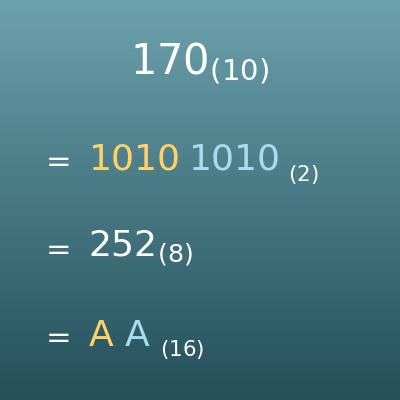
Number Base Converter (Binary, Octal, Decimal and Hexadecimal)
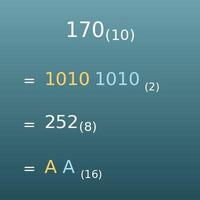
Another way to write numbers. Converts to binary, hexadecimal and more, with step-by-step work
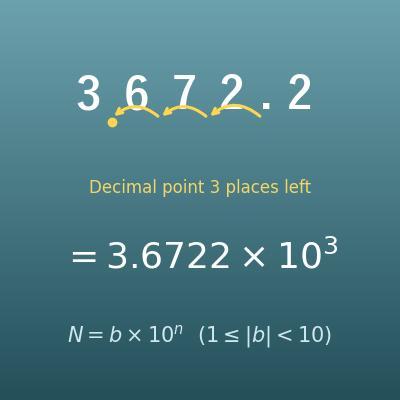
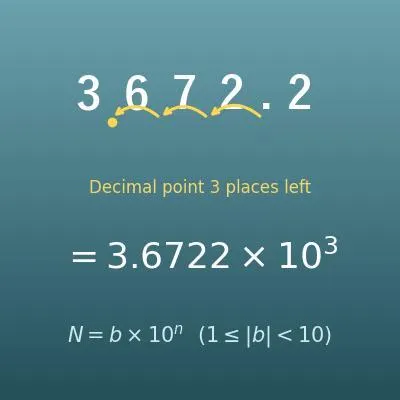
Scientific Notation Converter (b×10ⁿ, E Notation, Engineering Notation)
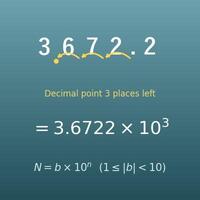
Another way to write numbers. Rewrites 3672.2 as 3.6722 × 10³ and similar