
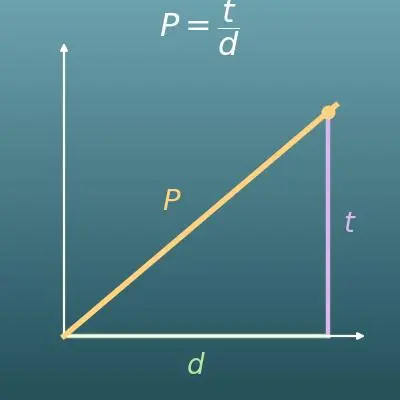
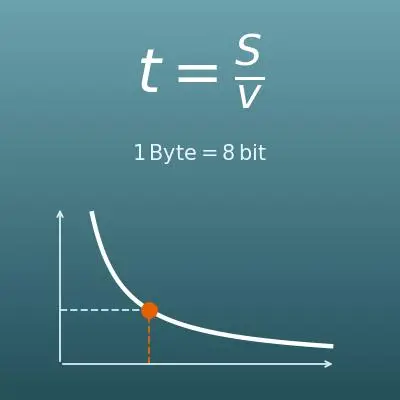
Enter the two values you know out of speed, distance and time. The third is calculated, along with the speed converted to m/min and m/s.
Table of Contents
-
What you can do on this page
-
What is this calculation used for?
-
How to Use
-
Formula
-
Symbols and terms
-
Good to know before you start
-
How to calculate it in Excel
-
How to calculate it in Google Sheets
-
How to calculate it in Python
-
How to write it in LaTeX and other math languages (copy and paste)
-
How to have ChatGPT do the calculation
-
DataChef Features
-
Related Features
-
NumberChef Calculators List
What you can do on this page
- Enter any two of speed, distance and time, and the third is calculated on the spot
- Time can be entered as hours, minutes and seconds (entering just "90 minutes" or just "20 seconds" is fine too)
- Along with the speed in mph, the result also shows it converted to feet per minute (ft/min) and feet per second (ft/s). Switch "Units" to Metric to work in km/h, m/min and m/s instead
- A plain-language explanation of the formulas and copy-and-paste formulas for Excel, Google Sheets and Python are all on this page
What is this calculation used for?
If your destination is 195 miles away and you average 65 mph on the interstate, the trip takes \(195 \div 65 = 3\) hours.
Add time for breaks and traffic, and you can decide when to leave. The estimated time of arrival on your GPS or map app is built the same way, adding up the time for each stretch of road from its expected speed.
To finish a marathon (26.2 miles) in 3 hours 30 minutes, you need an average speed of \(26.2 \div 3.5 \approx 7.49\) mph (about 7.5 mph).
Runners turn this into a pace, "minutes per mile" (about 8:01 per mile here, or about 4:59 per km), and manage their effort by checking the watch. The speed formula is the foundation of every training plan.
Suppose a high-speed train covers 300 miles in 2 hours 30 minutes. Its average speed is \(300 \div 2.5 = 120\) mph.
That is well below its top speed of, say, 180 mph, because the time includes accelerating, slowing down and stopping at stations. Railway planners work with this stop-inclusive average speed when they build timetables.
When the forecast says "the hurricane is moving north at 12 mph" and it is 180 miles away, you can estimate that it will take \(180 \div 12 = 15\) hours to reach you (real storms change speed and direction, so this is only a rough guide).
"Should I prepare tonight, or is tomorrow morning soon enough?" The speed formula gives you a way to think about the timing of your own safety decisions.
Listings often say "a 10-minute walk to the station". A typical walking speed is about 3 mph, which is 264 feet per minute, so 10 minutes is \(264 \times 10 = 2{,}640\) feet, exactly half a mile.
Waiting at crossings and walking uphill are not included, so it may take a bit longer in real life. Knowing the speed formula, you can take the distance on a map and re-estimate the walking time for yourself.
Formula
Symbols and terms
Symbols
| \(v\) | vee | The symbol for speed, from the first letter of "velocity". (Example - at 50 mph, \(v = 50\)) |
| \(d\) | dee | The symbol for distance, from the first letter of "distance". (Example - for 150 miles, \(d = 150\)) |
| \(t\) | tee | The symbol for time, from the first letter of "time". (Example - for 3 hours, \(t = 3\)) |
| \(\mathrm{mph}\) | miles per hour | A unit of speed - how many miles are covered in 1 hour. "40 miles per hour" and "40 mph" are the same thing. It is the unit on US speed limit signs and car speedometers. (1 mph is about 1.61 km/h.) |
| \(\mathrm{ft/s}\) | feet per second | A unit of speed - how many feet are covered in 1 second. The slash (/) stands for "per". In science and physics, meters per second (m/s) is the standard unit instead. |
Terms
| speed | The distance covered per unit of time (per hour, per minute, per second, and so on). It is the classic example of a unit rate in elementary and middle school math. |
| distance | How far you actually travel. Strictly speaking, the straight-line distance between two points and the distance along the road can differ; the speed formula uses the distance actually traveled. |
| mph (miles per hour) | Speed written as the distance covered per 1 hour. The same speed gives different numbers in different units (30 mph = 2,640 ft/min = 44 ft/s). |
| ft/min (feet per minute) | Speed written as the distance covered per 1 minute. The same speed gives different numbers in different units (30 mph = 2,640 ft/min = 44 ft/s). |
| ft/s (feet per second) | Speed written as the distance covered per 1 second. The same speed gives different numbers in different units (30 mph = 2,640 ft/min = 44 ft/s). |
| unit rate | A way of comparing amounts by "how much per 1". Besides speed, population density (people per square mile) and fuel economy (miles per gallon) are unit rates too. |
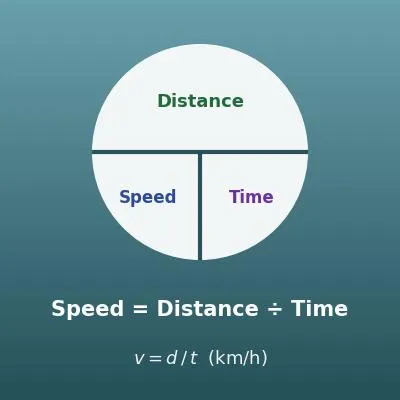
| speed-distance-time triangle | A memory aid for the speed, distance and time formulas. Write distance at the top of a triangle and speed and time side by side at the bottom; cover the one you want and the remaining two show you the formula. Handy, but it is better to understand "speed = distance per 1 unit of time" than to rely on the picture alone. |
| average speed | The speed found from "total distance ÷ total time", which evens out the changes in speed along the way. Real vehicles keep accelerating, slowing down and stopping, so the speed you calculate is normally an average speed. |
| pace | Time per unit of distance, such as minutes per mile or minutes per km, used by runners and walkers. It is the flip side of speed - 6 mph is a pace of 10 minutes per mile (60 ÷ 6 = 10). |
Good to know before you start
Here is what helps you use the calculation on this page with real understanding, not just by pressing the button.
| Speed and unit rates (Grades 5–6) |
|
| How division and multiplication are related (Grades 3–4) |
|
| Converting units of length and time (Grades 4–5) |
|
| Working with decimals (Grades 5–6) |
|
How to calculate it in Excel
| Distance d (mi) | 130 |
| Time t (hours) | 2 |
| Speed v (mph) | =B1/B2 |
| Speed v (mph) | 50 |
| Time t (hours) | 3 |
| Distance d (mi) | =B1*B2 |
| Distance d (mi) | 150 |
| Speed v (mph) | 60 |
| Time t (hours) | =B1/B2 |
| Speed (mph) | 30 |
| Converted to ft/min | =B1*5280/60 |
| Converted to ft/s | =B1*5280/3600 |
In the first table, for example, enter the distance 130 in B1 and the time 2 in B2, and B3 shows the speed 65 (mph). "/" is division and "*" is multiplication.
The fourth table is the unit conversion. Enter 30 mph in B1 and you get 2,640 ft/min and 44 ft/s at the same time.
How to calculate it in Google Sheets
| Distance d (mi) | 130 |
| Time t (hours) | 2 |
| Speed v (mph) | =B1/B2 |
| Speed v (mph) | 50 |
| Time t (hours) | 3 |
| Distance d (mi) | =B1*B2 |
| Distance d (mi) | 150 |
| Speed v (mph) | 60 |
| Time t (hours) | =B1/B2 |
| Speed (mph) | 30 |
| Converted to ft/min | =B1*5280/60 |
| Converted to ft/s | =B1*5280/3600 |
How to calculate it in Python
distance_mi = 150   # distance (miles)
speed_mph = 60      # speed (mph)

time_hours = distance_mi / speed_mph          # time taken (hours)
speed_ft_per_min = speed_mph * 5280 / 60      # converted to ft/min
speed_ft_per_sec = speed_mph * 5280 / 3600    # converted to ft/s

hours = int(time_hours)                        # whole-number part = hours
minutes = round((time_hours - hours) * 60)     # decimal part x 60 = minutes
print(f"Time taken: {time_hours} hours ({hours} h {minutes} min)")
print(f"Speed converted: {speed_ft_per_min} ft/min / {speed_ft_per_sec} ft/s")
How to write it in LaTeX and other math languages (copy and paste)
v = d ÷ t
v = \dfrac{d}{t}
<math xmlns="http://www.w3.org/1998/Math/MathML" display="block">
  <mrow>
    <mi>v</mi>
    <mo>=</mo>
    <mfrac><mi>d</mi><mi>t</mi></mfrac>
  </mrow>
</math>
v = d / t
d / t
v := d / t;
v = d / t;
v = d / t
d = v × t
d = v t
<math xmlns="http://www.w3.org/1998/Math/MathML" display="block">
<mrow>
<mi>d</mi>
<mo>=</mo>
<mi>v</mi>
<mo>⁢</mo>
<mi>t</mi>
</mrow>
</math>
d = v * t
v * t
d := v * t;
d = v * t;
d = v t
t = d ÷ v
t = \dfrac{d}{v}
<math xmlns="http://www.w3.org/1998/Math/MathML" display="block">
  <mrow>
    <mi>t</mi>
    <mo>=</mo>
    <mfrac><mi>d</mi><mi>v</mi></mfrac>
  </mrow>
</math>
t = d / v
d / v
t := d / v;
t = d / v;
t = d / v
v[ft/s] = v[mph] × 5280 ÷ 3600
v_{\mathrm{ft/s}} = v_{\mathrm{mph}} \times \dfrac{5280}{3600}
<math xmlns="http://www.w3.org/1998/Math/MathML" display="block">
<mrow>
<msub><mi>v</mi><mtext>ft/s</mtext></msub>
<mo>=</mo>
<msub><mi>v</mi><mtext>mph</mtext></msub>
<mo>×</mo>
<mfrac><mn>5280</mn><mn>3600</mn></mfrac>
</mrow>
</math>
v_(ft/s) = v_(mph) * 5280 / 3600
v * 5280 / 3600
v_fts := v_mph * 5280 / 3600;
v_fts = v_mph * 5280 / 3600;
v_(ft/s) = v_(mph) × 5280 / 3600
How to have ChatGPT do the calculation
You are a calculation assistant for speed, distance and time. Do the following calculation by actually running Python code, and base your answer only on the numbers from the execution result (do not answer by mental math or guessing).

A car travels 150 miles at 60 mph.
Find each of the following:
1. The time taken (also show it in the form "X hours Y minutes")
2. This speed converted to feet per minute (ft/min)
3. This speed converted to feet per second (ft/s)

Show the formulas you used and the numbers from the execution result.
How to Use
-
1Enter your numbersType the numbers you want to calculate with into the input fields
-
2CalculatePress the "Calculate" button
-
3Check the resultThe result appears on the spot. The same page also explains the idea behind the calculation and the formula
DataChef Features

No technical knowledge required.
Intuitive and user-friendly operation.

Can be used without registering personal information.

Automatic file deletion by clicking "download".

and rapid file conversion.

No attribution required.

No need to contact us for commercial use permission.
Related Features
Average Calculator (Mean)
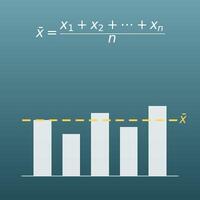
Enter your numbers to get the average, the sum and more at once. The same idea is behind "average speed"
Percentage Calculator (Percent, Part and Whole)
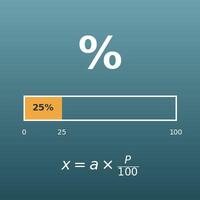
Enter any two of the base amount, the part and the percentage, and get the third. Like speed, it finds one value from the other two