












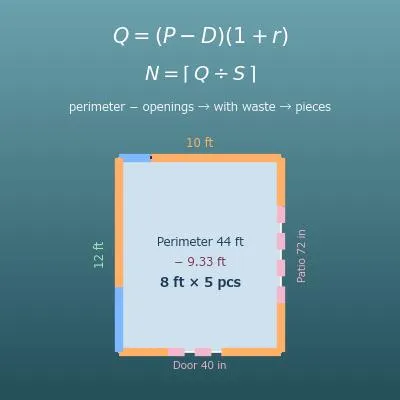
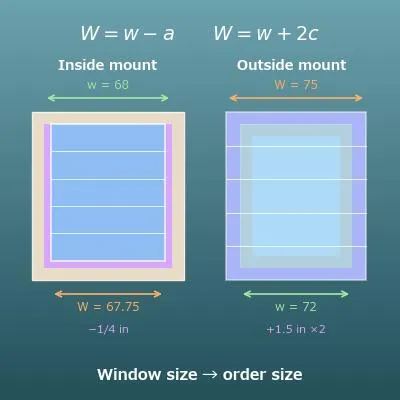
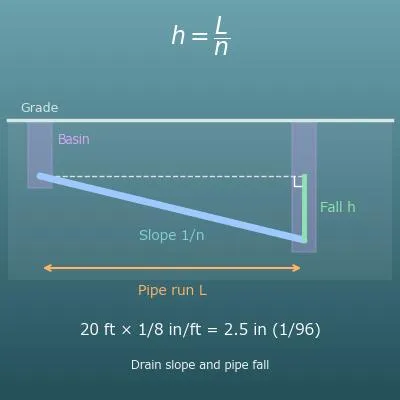
Enter the area to insulate, the insulation thickness, the package size and the waste factor. The thermal conductivity and the price can be left blank (then those items are not calculated).
Table of Contents
-
What you can do on this page
-
What is this calculation used for?
-
How to Use
-
Formulas and figures
-
Symbols and terms
-
Good to know before you start
-
How to calculate it in Excel
-
How to calculate it in Google Sheets
-
How to calculate it in Python
-
How to write it in LaTeX and other math languages (copy and paste)
-
How to have ChatGPT do the calculation
-
DataChef Features
-
Related Features
-
NumberChef Calculators List
What you can do on this page
- Enter the area to insulate (as length × width or as a total area), the insulation thickness and the package size, and you get the number of batts and bags you need on the spot
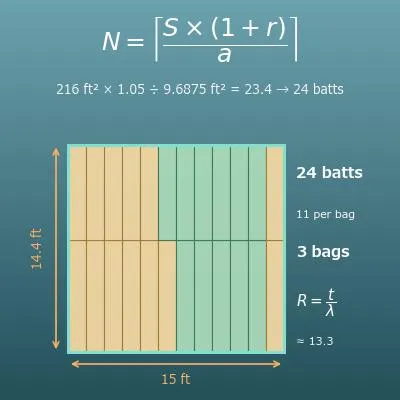
- Enter the package as "batt width × length × batts per bag" or as "coverage per bag" (ft²). The area needed with a waste factor for cutouts and scraps, and the bags before rounding up, are shown too
- You also see the area the bags will actually cover and how much is left over, so it works backward too: "how many square feet will these bags cover?"
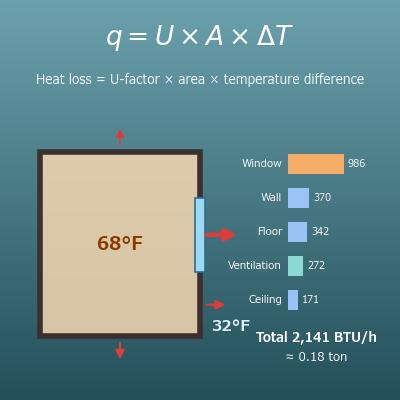
- Enter the thermal conductivity \(k\) (or pick a typical value for the material from the list), and the R-value for that thickness, \(R = t \div k\), is calculated too
- Enter a price (per bag or per ft²) to get the material cost. A plain-language explanation of the formulas and copy-and-paste formulas for Excel, Google Sheets and Python are all on this page
What is this calculation used for?
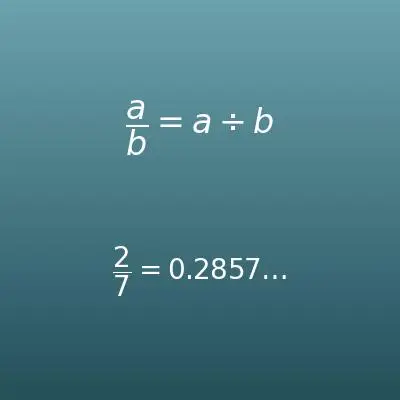
Adding insulation on the attic floor is one of the most popular DIY energy upgrades, and the U.S. Department of Energy recommends about R-30 to R-60 for attics, depending on the climate zone. For the attic over an 18 ft × 12 ft room (216 ft²) with a 5% waste factor, the area needed is \(216 \times 1.05 = 226.8\) ft². If, for example, each bag covers 60 ft² at the depth you want, you need \(\lceil 226.8 \div 60 \rceil = \lceil 3.78 \rceil = 4\) bags.
Knowing the number of bags helps you plan the trip to the home center. Attics are dark with poor footing, so step only on the joists (never between them, or you can break through the ceiling), and wear a dust mask, gloves and long sleeves.
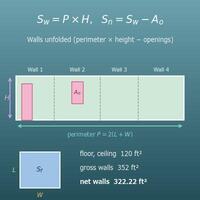
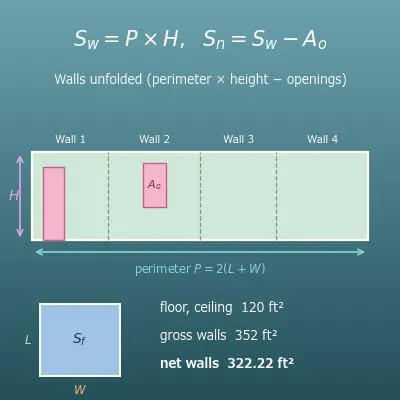
When you open up walls and insulate them, the area to insulate is the net wall area after subtracting windows and doors. For the two exterior walls of a corner bedroom, 12 ft and 14 ft long and 8 ft high, the wall area is \((12 + 14) \times 8 = 208\) ft². Subtract two 3 ft × 5 ft windows (30 ft²) to get 178 ft². With a 10% waste factor and R-13 bags that cover 106.56 ft², you need \(178 \times 1.1 = 195.8\) ft², and \(195.8 \div 106.56 \approx 1.84\), rounded up to 2 bags.
Walls have many cutouts around wiring, pipes, electrical boxes and blocking, so allowing more waste than for an attic keeps you from running short halfway. You can find the net wall area with the "Wall, Ceiling and Floor Area Calculator".
The same formula works for rigid foam boards on basement walls. For 36 ft of wall 7 ft high (252 ft²) with 4 ft × 8 ft boards (32 ft² each) and no waste factor, you need \(\lceil 252 \div 32 \rceil = \lceil 7.875 \rceil = 8\) boards.
Foam boards are usually sold one at a time, so set "batts per bag" to 1, and the number of bags equals the number of boards. Boards are cut around windows, pipes and outlets, so in practice allow a waste factor for the cutouts too.
Which insulates better, 3.5 in of high-performance fiberglass (typical k = 0.263) or 2 in of XPS foam board (typical k = 0.194)? Compare the R-values: \(3.5 \div 0.263 \approx 13.3\) for the first and \(2 \div 0.194 \approx 10.3\) for the second, so in this example the 3.5 in fiberglass insulates better.
The same formula also tells you that where there is no room for thickness, a material with a lower conductivity gets you the same R-value in less space. Conductivity differs by product, so use the product data sheet values when you compare.
An insulation quote often lists the area, the R-value and the number of bags, such as "attic, R-38, 1,200 sq ft, 25 bags". If you know the area and the coverage per bag, these formulas let you follow where the number of bags comes from, and ask how much waste the contractor has allowed for.
A real quote also covers air sealing, baffles, vapor retarder and labor, so the number of bags alone does not tell you whether the price is fair.
Formulas and figures
Symbols and terms
Symbols
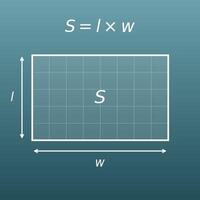
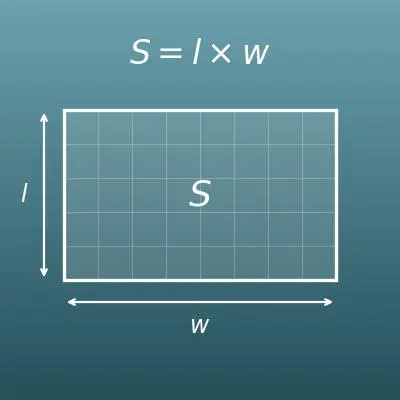
| \(S\) | S | The area to insulate (the net size of the space). Said to come from "square" or "surface". Enter it as length × width or as a total area. |
| \(L\), \(W\) | L, W | The length and width of the space (ft), from "length" and "width". Measure wall to wall. |
| \(P\) | P | The total length of the walls to insulate (ft). The letter comes from "perimeter". |
| \(H\) | H | The wall height (ft), from "height". 8 ft is common for rooms in US houses. |
| \(r\) | r (lowercase) | The waste factor, from "rate". The value entered in % is divided by 100 before use (5% → 0.05). |
| \(S_r\) | S sub r | The area needed with waste: the area \(S\) plus the waste factor \(r\). Found with \(S_r = S \times (1 + r)\). |
| \(w\), \(l\) | w, l (lowercase) | The width and length of one batt. Lowercase, to tell them apart from the room \(L\) and \(W\). Batt sizes are in inches (for example, 15 in × 93 in). |
| \(a\) | a | The area of one batt, from "area". Found with \(a = w \times l\). |
| \(k\) | k | The number of batts in one bag (package). (On this page, the thermal conductivity k is written \(\lambda\) in the formulas to keep the two apart.) |
| \(A\) | A (capital) | The coverage per bag. Found with \(A = a \times k\), or enter the coverage printed on the package directly. |
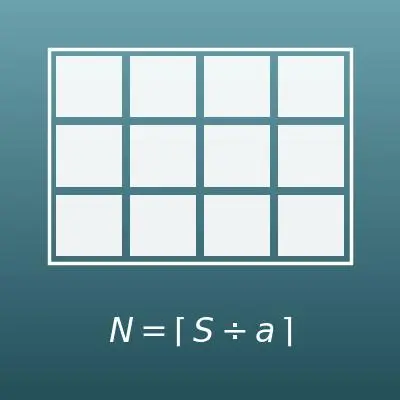
| \(N\) | N (capital) | The number of batts needed, from "number". Found with \(N = \lceil S_r \div a \rceil\). |
| \(B\) | B | The number of bags needed, from "bag". Found with \(B = \lceil N \div k \rceil\) (or \(\lceil S_r \div A \rceil\)). |
| \(S_c\) | S sub c | The area the bags cover. Found with \(S_c = B \times A\). The c stands for "cover". |
| \(D\) | D | What is left over beyond the area to insulate. \(D = S_c - S\), from "difference". |
| \(t\) | t | The insulation thickness, from "thickness". Entered in inches (for example, 3.5 in for a 2×4 wall). |
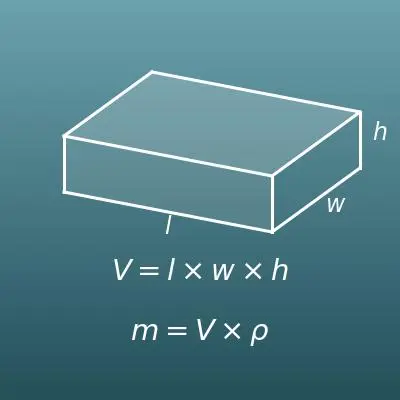
| \(V\) | V | The volume of insulation (ft³), from "volume". Found with \(V = S \times t\). |
| \(\lambda\) | lambda | The thermal conductivity. In the US it is usually written k, in BTU·in/(h·ft²·°F); metric countries use the Greek letter lambda, in W/(m·K). The smaller it is, the better the material insulates. |
| \(R\) | R (capital) | The R-value (thermal resistance), from "resistance". Found with \(R = t \div \lambda\). In the US it is in h·ft²·°F/BTU and printed as "R-13" and so on. The larger it is, the better the layer insulates. |
| \(u\) | u | The unit price of the insulation (per bag or per ft²), from "unit price". |
| \(Q\) | Q | The quantity that matches the price unit (bags or area), from "quantity". |
| \(T\) | T (capital) | The estimated cost (the insulation only, without vapor retarder or labor), from "total". |
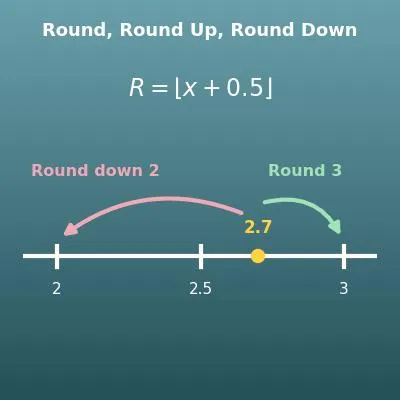
| \(\lceil x \rceil\) | ceiling of x | The ceiling function: rounds up to the next whole number. (Examples: \(\lceil 23.41 \rceil = 24\), \(\lceil 2 \rceil = 2\)) |
Terms
| insulation | Material placed in walls, ceilings and floors to slow the flow of heat between inside and outside. The main types are fibers (fiberglass, mineral wool, cellulose) and foam plastics (polystyrene, polyurethane and polyiso, phenolic foam). |
| fiberglass | Insulation made of glass spun into fine fibers, like cotton. It is inexpensive and the most widely used. Batts come in widths that fit the stud spacing (15 in and 23 in) and are sold by R-value, such as R-13, R-15 and R-19 for walls and R-30 and up for attics. |
| mineral wool | Insulation made by melting rock such as basalt and spinning it into fibers (also called rock wool). It is a fiber type like fiberglass, and it resists fire well. |
| extruded polystyrene | Rigid foam board made by pushing foamed polystyrene out into sheets (XPS), often pink or blue. It resists water and is stiff, so it is often used on basement walls, under slabs and around foundations. About R-5 per inch. |
| expanded polystyrene | Rigid foam made by expanding polystyrene beads and molding them together (EPS), the white foam also used for packaging. It is lighter and cheaper than XPS, and its conductivity depends on its density. |
| polyurethane foam | Foam insulation made from polyurethane. Boards (and polyiso boards) have low conductivity and work where there is little room for thickness. It is also sprayed on site as spray foam, which often has a higher conductivity than boards, so enter the value from the product data sheet rather than the board value in the list. |
| phenolic foam | Rigid foam board made from phenolic resin. It has one of the lowest conductivities among common insulation, and is chosen for a high R-value in a thin layer. |
| cellulose | Insulation made from recycled paper such as newspaper, turned into fibers. It is mostly blown into attics and walls with a machine, and the amount comes from the volume (area × depth) and the installed density (pounds per cubic foot). |
| thermal conductivity | How easily heat passes through a material, called the k-value in the US (BTU·in/(h·ft²·°F)) and lambda in metric (W/(m·K)). The smaller it is, the better the material insulates. It differs by density and product, so use the product data sheet value. |
| R-value | How well a layer of a given thickness resists heat, found by dividing the thickness by the conductivity. In the US it is in h·ft²·°F/BTU (R-13, R-30 and so on); the metric R-value in m²·K/W is about 5.68 times smaller. The larger it is, the better the layer insulates, and it lets you compare different materials on the same scale. |
| waste factor | The extra share of material added to the area for cutouts, scraps and a spare. 5–10% is common, more for walls with a lot of wiring, pipes and blocking. |
| scrap | The pieces left over when batts are cut to fit between studs or at the ends. Not all of them can be used elsewhere, so the waste factor allows for them. |
| net area | The area without any extra or spare. On this page, "Area to insulate (net)" is the area before the waste factor. |
| inside dimensions | Measurements from the inside face of one wall to the inside face of the opposite wall. The area of an attic floor or a floor is measured this way. |
| stud | One of the vertical framing members in a wall, usually 2×4 or 2×6 lumber set 16 in or 24 in on center. Wall insulation fits between the studs, so batts are made in widths that match the spacing. |
| joist | One of the horizontal framing members that hold up a floor or a ceiling, set at regular spacing. Insulation under a floor or on an attic floor fits between the joists. |
| blocking | Short pieces of lumber fixed between studs or joists for support, fire blocking or mounting. Insulation has to be cut around them, which is one reason scraps are produced. |
| openings | Windows, doors and other holes in a wall. The wall area to insulate is the whole wall area minus the openings. |
| flange | The paper edges on both sides of a kraft-faced batt. They are stapled to the sides or faces of the studs, and the listed batt width usually matches the stud spacing. |
| cavity insulation | Insulation fitted into the spaces between studs, joists or rafters. It is the most common method in wood-frame houses, and the batt count on this page assumes it. Foam boards fastened over the outside of the framing are called continuous insulation. |
| area to insulate | The size of the space to fill with insulation. For an attic or a floor, the floor area of the room; for walls, the net wall area after subtracting windows, doors and other openings. |
| rounding up | Changing a value with a decimal part to the next whole number. Insulation comes only in whole batts and bags, so always round up the number of batts and bags. |
| density | The weight per unit of volume (pounds per cubic foot, or kg/m³). For fiberglass, a higher density means the fibers are packed more tightly and the material insulates somewhat better per inch. |
Good to know before you start
Here is what helps you use the calculation on this page with real understanding, not just by pressing the button.
| Area of a rectangle (Grades 3–4) |
|
| Volume of a rectangular prism (Grade 5) |
|
| Converting units of length, area and volume (Grades 4–6) |
|
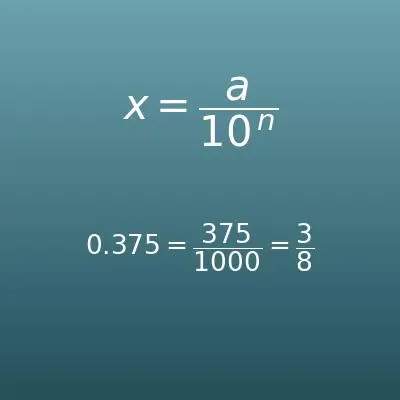
| Multiplying and dividing decimals (Grades 5–6) |
|
| Percentages (Grades 6–7) |
|
| Rounding (Grades 3–4) |
|
| How heat moves (elementary and middle school science) |
|
How to calculate it in Excel
| Length (ft) | 18 |
| Width (ft) | 12 |
| Area to insulate (ft²) | =B1*B2 |
| Area to insulate (ft²) | 216 |
| Waste factor (%) | 5 |
| Area needed with waste (ft²) | =B1*(1+B2/100) |
| Batt width (in) | 15 |
| Batt length (in) | 93 |
| Batts per bag | 11 |
| Area of one batt (ft²) | =B1*B2/144 |
| Coverage per bag (ft²) | =B4*B3 |
| Area needed with waste (ft²) | 226.8 |
| Area of one batt (ft²) | 9.6875 |
| Batts needed | =ROUNDUP(B1/B2,0) |
| Batts needed | 24 |
| Batts per bag | 11 |
| Bags needed | =ROUNDUP(B1/B2,0) |
| Bags | 3 |
| Coverage per bag (ft²) | 106.5625 |
| Area to insulate (ft²) | 216 |
| Area covered (ft²) | =B1*B2 |
| Left over (ft²) | =B4-B3 |
| Area to insulate (ft²) | 216 |
| Thickness (in) | 3.5 |
| Volume (ft³) | =B1*B2/12 |
| Thickness (in) | 3.5 |
| Thermal conductivity k (BTU·in/(h·ft²·°F)) | 0.263 |
| R-value (h·ft²·°F/BTU) | =B1/B2 |
| Unit price ($) | 50 |
| Quantity (bags or ft²) | 3 |
| Estimated cost ($) | =B1*B2 |
"ROUNDUP(value, 0)" rounds up to a whole number (the ⌈ ⌉ in the formulas).
The third table divides the batt size in square inches by "/144" to get square feet (B4 shows 9.6875 and B5 shows 106.5625).
B3 in the first table shows 216, B3 in the second 226.8, B3 in the fourth 24 batts, B3 in the fifth 3 bags, the sixth table 319.6875 and 103.6875, B3 in the seventh 63, B3 in the eighth about 13.31 (R-13), and B3 in the ninth 150. Just replace the numbers in column B with your own.
How to calculate it in Google Sheets
| Length (ft) | 18 |
| Width (ft) | 12 |
| Area to insulate (ft²) | =B1*B2 |
| Area to insulate (ft²) | 216 |
| Waste factor (%) | 5 |
| Area needed with waste (ft²) | =B1*(1+B2/100) |
| Batt width (in) | 15 |
| Batt length (in) | 93 |
| Batts per bag | 11 |
| Area of one batt (ft²) | =B1*B2/144 |
| Coverage per bag (ft²) | =B4*B3 |
| Area needed with waste (ft²) | 226.8 |
| Area of one batt (ft²) | 9.6875 |
| Batts needed | =ROUNDUP(B1/B2,0) |
| Batts needed | 24 |
| Batts per bag | 11 |
| Bags needed | =ROUNDUP(B1/B2,0) |
| Bags | 3 |
| Coverage per bag (ft²) | 106.5625 |
| Area to insulate (ft²) | 216 |
| Area covered (ft²) | =B1*B2 |
| Left over (ft²) | =B4-B3 |
| Area to insulate (ft²) | 216 |
| Thickness (in) | 3.5 |
| Volume (ft³) | =B1*B2/12 |
| Thickness (in) | 3.5 |
| Thermal conductivity k (BTU·in/(h·ft²·°F)) | 0.263 |
| R-value (h·ft²·°F/BTU) | =B1/B2 |
| Unit price ($) | 50 |
| Quantity (bags or ft²) | 3 |
| Estimated cost ($) | =B1*B2 |
How to calculate it in Python
import math

room_length_ft = 18        # length of the space (ft)
room_width_ft = 12         # width of the space (ft)
thickness_in = 3.5         # insulation thickness (in)
batt_width_in = 15         # batt width (in)
batt_length_in = 93        # batt length (in)
batts_per_bag = 11         # batts per bag
waste_percent = 5          # waste factor (%)
k_value = 0.263            # thermal conductivity k (BTU·in/(h·ft²·°F)). Use the product data sheet value
price_per_bag = 50         # price per bag ($)

area_ft2 = room_length_ft * room_width_ft                              # area to insulate (net)
required_area_ft2 = area_ft2 * (1 + waste_percent / 100)              # area needed with waste
batt_area_ft2 = batt_width_in * batt_length_in / 144                  # area of one batt (in² to ft²)
bag_area_ft2 = batt_area_ft2 * batts_per_bag                          # coverage per bag

batts_needed = math.ceil(required_area_ft2 / batt_area_ft2)           # batts needed (rounded up)
bags_needed = math.ceil(batts_needed / batts_per_bag)                 # bags needed (rounded up)
coverable_area_ft2 = bags_needed * bag_area_ft2                       # area these bags cover
surplus_area_ft2 = coverable_area_ft2 - area_ft2                      # left over beyond the area
volume_ft3 = area_ft2 * thickness_in / 12                             # volume (ft³)
r_value = thickness_in / k_value                                      # R-value (h·ft²·°F/BTU)
cost = bags_needed * price_per_bag                                    # estimated cost ($)

print(f"Area to insulate: {area_ft2:.4f} ft², with waste: {required_area_ft2:.4f} ft²")
print(f"Area of one batt: {batt_area_ft2:.4f} ft², coverage per bag: {bag_area_ft2:.4f} ft²")
print(f"Batts needed: {batts_needed}, bags needed: {bags_needed}")
print(f"Area covered: {coverable_area_ft2:.4f} ft², left over: {surplus_area_ft2:.4f} ft²")
print(f"Volume: {volume_ft3:.4f} ft³, R-value: R-{r_value:.2f}")
print(f"Estimated cost: ${cost:,.2f}")
How to write it in LaTeX and other math languages (copy and paste)
S = L × W, S = P × H
S = L \times W,\quad S = P \times H
<math xmlns="http://www.w3.org/1998/Math/MathML" display="block">
<mrow>
<mi>S</mi><mo>=</mo><mi>L</mi><mo>×</mo><mi>W</mi>
<mo>,</mo>
<mi>S</mi><mo>=</mo><mi>P</mi><mo>×</mo><mi>H</mi>
</mrow>
</math>
S = L xx W, S = P xx H
{L*W, P*H}
S := L*W; S := P*H;
S = L*W; S = P*H;
S = L × W, S = P × H
Sr = S × (1 + r)
S_r = S \times (1 + r)
<math xmlns="http://www.w3.org/1998/Math/MathML" display="block">
<mrow>
<msub><mi>S</mi><mi>r</mi></msub>
<mo>=</mo>
<mi>S</mi>
<mo>×</mo>
<mrow><mo>(</mo><mn>1</mn><mo>+</mo><mi>r</mi><mo>)</mo></mrow>
</mrow>
</math>
S_r = S xx (1 + r)
s*(1 + r)
S_r := S*(1 + r);
S_r = S*(1 + r);
S_r = S × (1 + r)
a = w × l, A = a × k
a = w \times l,\quad A = a \times k
<math xmlns="http://www.w3.org/1998/Math/MathML" display="block">
<mrow>
<mi>a</mi><mo>=</mo><mi>w</mi><mo>×</mo><mi>l</mi>
<mo>,</mo>
<mi>A</mi><mo>=</mo><mi>a</mi><mo>×</mo><mi>k</mi>
</mrow>
</math>
a = w xx l, A = a xx k
{w*l, w*l*k}
a := w*l; A := a*k;
a = w*l; A = a*k;
a = w × l, A = a × k
N = ⌈Sr ÷ a⌉
N = \left\lceil \frac{S_r}{a} \right\rceil
<math xmlns="http://www.w3.org/1998/Math/MathML" display="block">
<mrow>
<mi>N</mi>
<mo>=</mo>
<mo>⌈</mo>
<mfrac><msub><mi>S</mi><mi>r</mi></msub><mi>a</mi></mfrac>
<mo>⌉</mo>
</mrow>
</math>
N = |~ S_r / a ~|
Ceiling[sr/a]
N := ceil(S_r/a);
N = ceil(S_r/a);
N = ⌈S_r/a⌉
B = ⌈N ÷ k⌉, B = ⌈Sr ÷ A⌉
B = \left\lceil \frac{N}{k} \right\rceil,\quad B = \left\lceil \frac{S_r}{A} \right\rceil
<math xmlns="http://www.w3.org/1998/Math/MathML" display="block">
<mrow>
<mi>B</mi><mo>=</mo>
<mo>⌈</mo><mfrac><mi>N</mi><mi>k</mi></mfrac><mo>⌉</mo>
<mo>,</mo>
<mi>B</mi><mo>=</mo>
<mo>⌈</mo><mfrac><msub><mi>S</mi><mi>r</mi></msub><mi>A</mi></mfrac><mo>⌉</mo>
</mrow>
</math>
B = |~ N / k ~|, B = |~ S_r / A ~|
{Ceiling[n/k], Ceiling[sr/A]}
B := ceil(N/k); B := ceil(S_r/A);
B = ceil(N/k); B = ceil(S_r/A);
B = ⌈N/k⌉, B = ⌈S_r/A⌉
Sc = B × A, D = Sc − S
S_c = B \times A,\quad D = S_c - S
<math xmlns="http://www.w3.org/1998/Math/MathML" display="block">
<mrow>
<msub><mi>S</mi><mi>c</mi></msub><mo>=</mo><mi>B</mi><mo>×</mo><mi>A</mi>
<mo>,</mo>
<mi>D</mi><mo>=</mo><msub><mi>S</mi><mi>c</mi></msub><mo>−</mo><mi>S</mi>
</mrow>
</math>
S_c = B xx A, D = S_c - S
{b*A, b*A - s}
S_c := B*A; D_s := S_c - S;
S_c = B*A; D = S_c - S;
S_c = B × A, D = S_c − S
V = S × t
V = S \times t
<math xmlns="http://www.w3.org/1998/Math/MathML" display="block">
<mrow>
<mi>V</mi><mo>=</mo><mi>S</mi><mo>×</mo><mi>t</mi>
</mrow>
</math>
V = S xx t
s*t
V := S*t;
V = S*t;
V = S × t
R = t ÷ λ
R = \frac{t}{\lambda}
<math xmlns="http://www.w3.org/1998/Math/MathML" display="block">
<mrow>
<mi>R</mi><mo>=</mo>
<mfrac><mi>t</mi><mi>λ</mi></mfrac>
</mrow>
</math>
R = t / lambda
t/\[Lambda]
R := t/lambda;
R = t/lambda;
R = t/λ
T = u × Q
T = u \times Q
<math xmlns="http://www.w3.org/1998/Math/MathML" display="block">
<mrow>
<mi>T</mi><mo>=</mo><mi>u</mi><mo>×</mo><mi>Q</mi>
</mrow>
</math>
T = u * Q
u*q
T := u*Q;
T = u*Q;
T = u × Q
How to have ChatGPT do the calculation
You are a quantity calculation assistant for home insulation jobs. Do the following calculation by actually running Python code, and base your answer only on the numbers from the execution result (do not answer by mental math or guessing).

I am insulating an area of 18 ft × 12 ft with R-13 fiberglass batts, 3.5 in thick (each batt 15 in wide × 93 in long, 11 batts per bag, thermal conductivity k = 0.263 BTU·in/(h·ft²·°F)). The waste factor is 5%.
Find each of the following:
1. The area to insulate (ft²) and the area needed with the 5% waste factor (ft²)
2. The area of one batt (ft²) and the coverage per bag (ft²)
3. The number of batts needed (area needed ÷ area of one batt, rounded up) and the number of bags (batts ÷ batts per bag, rounded up)
4. The area those bags cover (ft²) and how much is left over beyond the area to insulate (ft²)
5. The R-value for 3.5 in (thickness in inches ÷ k)

Show the formulas you used and the numbers from the execution result.
How to Use
-
1Enter your numbersType the numbers you want to calculate with into the input fields
-
2CalculatePress the "Calculate" button
-
3Check the resultThe result appears on the spot. The same page also explains the idea behind the calculation and the formula
DataChef Features

No technical knowledge required.
Intuitive and user-friendly operation.

Can be used without registering personal information.

Automatic file deletion by clicking "download".

and rapid file conversion.

No attribution required.

No need to contact us for commercial use permission.
Related Features
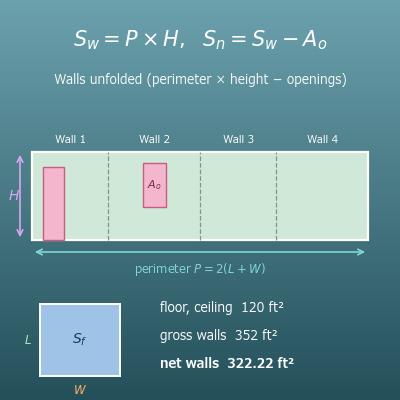
Wall Area Calculator (Wall, Ceiling and Floor Square Footage, with Doors, Windows, Perimeter and Volume)
Find the net wall area (minus windows and doors) and the ceiling area first, then work out the insulation
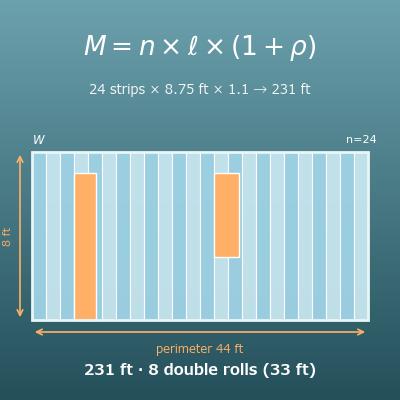
Wallpaper Calculator (How Many Rolls, with Pattern Repeat and Waste)
Work out the wallpaper for finishing the walls after insulating them
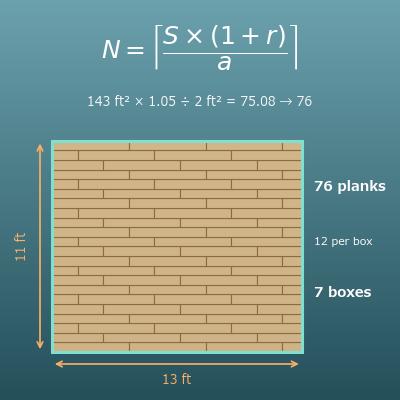
Flooring Calculator (Planks, Boxes, Waste Factor and Cost)
Find the planks and boxes when you replace the floor along with insulating under it
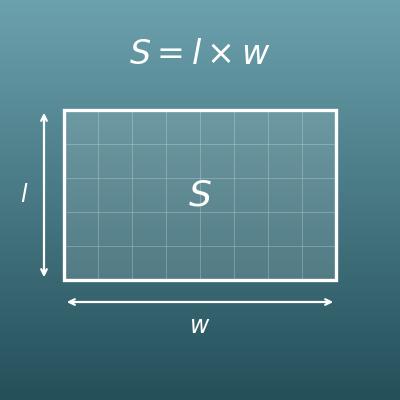
Area of a Rectangle Calculator (Length × Width)
Find the area of one ceiling or one wall from length × width
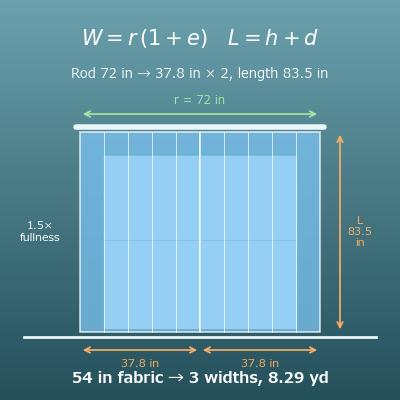
Curtain Size Calculator (Finished Width, Length and Fabric Yardage from Fullness)
Find the finished width and length of curtains, which also help insulate windows, and the fabric you need
Room Volume and Ventilation Calculator (Air Changes per Hour, CFM)
For the air in the same room, find the ventilation needed from the room volume and air changes per hour
Screw Calculator (How Many Screws for Drywall, Plywood and Decking)
Find how many screws you need for drywall and plywood from the spacing and the number of sheets