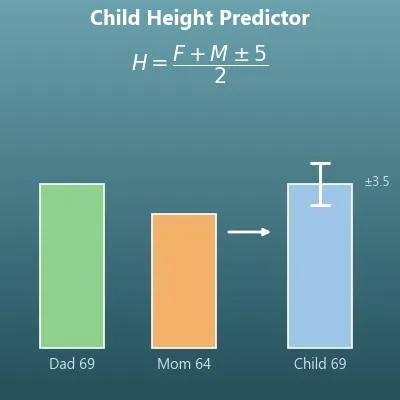
Enter the father's and mother's heights (cm) and choose your child's sex. The estimated adult height (target height) and its usual range (target range - predicted height ± 9 cm) are calculated together.
Table of Contents
-
What you can do on this page
-
What is this calculation used for?
-
How to Use
-
Formula
-
Symbols and terms
-
Good to know before you start
-
How to calculate it in Excel
-
How to calculate it in Google Sheets
-
How to calculate it in Python
-
How to write it in LaTeX and other math languages (copy and paste)
-
How to have ChatGPT do the calculation
-
DataChef Features
-
Related Features
-
NumberChef Calculators List
What you can do on this page
- Enter the father's and mother's heights (in feet and inches) and your child's sex, and get an estimate of your child's adult height (target height) on the spot
- The usual range (target range: predicted height ± 3.5 inches) is shown too, so you can think in terms of a range, not a single number
- The formula is the mid-parental height method used in pediatrics: (father's height + mother's height ± 5 inches) ÷ 2. Switch "Units" to Metric to use centimeters (± 13 cm)
- A plain-language explanation of the formulas and copy-and-paste formulas for Excel, Google Sheets and Python are all on this page
What is this calculation used for?
"How tall will I be when I grow up?" is a question almost every family hears at some point. With the target height formula, you can use just the parents' heights to give an answer with a basis: "about this many inches, give or take 3.5 inches".
If you add that it is a genetic estimate, not an exact prediction, the question also becomes a chance to talk about averages and ranges (variation).
When evaluating short stature or other growth concerns, pediatricians and growth specialists use the target height from the parents' heights as reference information on "where genetics would place this child", together with growth charts and other checks.
Real medical decisions combine many pieces of information, such as bone age X-rays and hormone tests, so nothing can be diagnosed from this formula alone. If you are worried, do not judge from this number by yourself; talk to your pediatrician.
The target height can only estimate the genetic part. Environmental factors such as nutrition, sleep and exercise also have a big effect on actual height.
Knowing that the prediction is only the middle of a range makes it easier not to worry over the number itself and to focus on what the family can do, such as a balanced diet and enough sleep.
In sports where size is often discussed, such as volleyball and basketball, coaches sometimes treat the parents' heights as one piece of information about a young athlete's future build. The target height turns that idea into a formula.
However, the range is ± 3.5 inches, and ability in a sport is not decided by height alone. Use it as a reference for the outlook, not as a tool that narrows a child's possibilities.
Formula
Symbols and terms
Symbols
| \(H\) | aitch | Predicted height (target height) - an estimate of the child's adult height based on the parents' heights (inches). |
| \(F\) | ef | The father's height (inches), from the first letter of "father". |
| \(M\) | em | The mother's height (inches), from the first letter of "mother". |
| \(L\) | el | The low end of the range (inches) - the predicted height minus 3.5 inches. It is the first letter of "lower". |
| \(U\) | you | The high end of the range (inches) - the predicted height plus 3.5 inches. It is the first letter of "upper". |
| \(\pm\) | plus or minus | A single symbol for "both the value added and the value subtracted". "Predicted height \(\pm 3.5\) in" means "from 3.5 inches below the predicted height to 3.5 inches above it". |
Terms
| target height (mid-parental height) | A child's genetic height target, estimated from the parents' heights. Pediatricians commonly use (father's height + mother's height ± 5 inches) ÷ 2, or ± 13 cm when working in centimeters. It is also called mid-parental height. |
| target range | The range around the target height where adult height usually falls. About ± 3.5 inches (± 9 cm) of the predicted height is a common guide. |
| average | The sum of some numbers divided by how many numbers there are. The part "(father's height + mother's height) ÷ 2" in this formula is the average height of the two parents. |
| genetic factors | Effects of the traits a child inherits from the parents. This formula can only estimate a target based on genetic factors. |
| environmental factors | Effects of the living environment, such as nutrition, sleep and exercise. Height depends on these as well as on genetic factors, but they are not part of this formula. |
| bone age | How mature the bones are, shown as an age, usually checked with an X-ray of the hand. Predictions that use bone age are used by pediatricians as a more precise method than the simple formula on this page. |
| Khamis-Roche method | A statistical method developed in the United States that predicts adult height from the child's age, current height and weight, and the parents' heights. It needs no X-ray and is fairly precise, but it uses detailed tables of coefficients for each age, and it was built from data on white American children, so it may fit children of other backgrounds less well. |
| growth chart | A graph of how height and weight usually increase with age. Pediatricians use growth charts (such as the CDC and WHO charts) at checkups; they are the basic tool for checking a child's growth against a range. |
Good to know before you start
Here is what helps you use the calculation on this page with real understanding, not just by pressing the button.
| Averages (Grade 6) |
|
| Working with decimals (Grades 4–5) |
|
| Converting feet and inches (Grade 4) |
|
| Spread and range in data (Grades 6–7) |
|
How to calculate it in Excel
| Father's height (in) | 69 |
| Mother's height (in) | 64 |
| Predicted height of a boy (in) | =(B1+B2+5)/2 |
| Father's height (in) | 69 |
| Mother's height (in) | 64 |
| Predicted height of a girl (in) | =(B1+B2-5)/2 |
| Predicted height (in) | 69 |
| Low end of the range (in) | =B1-3.5 |
| High end of the range (in) | =B1+3.5 |
In the first table, for example, a father of 69 in and a mother of 64 in give 69 (in) in B3. The second table (girl) gives 64, and the third table gives a low end of 65.5 and a high end of 72.5.
Heights are in inches (5 ft 9 in = 5 × 12 + 9 = 69 in). Just replace the input cells with your own numbers.
How to calculate it in Google Sheets
| Father's height (in) | 69 |
| Mother's height (in) | 64 |
| Predicted height of a boy (in) | =(B1+B2+5)/2 |
| Father's height (in) | 69 |
| Mother's height (in) | 64 |
| Predicted height of a girl (in) | =(B1+B2-5)/2 |
| Predicted height (in) | 69 |
| Low end of the range (in) | =B1-3.5 |
| High end of the range (in) | =B1+3.5 |
How to calculate it in Python
father_height_in = 69  # father's height (inches), 5 ft 9 in
mother_height_in = 64  # mother's height (inches), 5 ft 4 in

predicted_boy = (father_height_in + mother_height_in + 5) / 2   # predicted height of a boy
predicted_girl = (father_height_in + mother_height_in - 5) / 2  # predicted height of a girl

def ft_in(inches):
    feet, rest = divmod(inches, 12)                              # split into feet and inches
    return f"{int(feet)} ft {rest:g} in"

print(f"Boy: {predicted_boy} in = {ft_in(predicted_boy)} (range: {predicted_boy - 3.5}-{predicted_boy + 3.5} in)")
print(f"Girl: {predicted_girl} in = {ft_in(predicted_girl)} (range: {predicted_girl - 3.5}-{predicted_girl + 3.5} in)")
How to write it in LaTeX and other math languages (copy and paste)
H = (F + M + 5) ÷ 2
H = \dfrac{F + M + 5}{2}
<math xmlns="http://www.w3.org/1998/Math/MathML" display="block">
  <mrow>
    <mi>H</mi>
    <mo>=</mo>
    <mfrac>
      <mrow><mi>F</mi><mo>+</mo><mi>M</mi><mo>+</mo><mn>5</mn></mrow>
      <mn>2</mn>
    </mfrac>
  </mrow>
</math>
H = (F + M + 5) / 2
(F + M + 5)/2
H := (F + M + 5) / 2;
H = (F + M + 5) / 2;
H = (F + M + 5) / 2
H = (F + M − 5) ÷ 2
H = \dfrac{F + M - 5}{2}
<math xmlns="http://www.w3.org/1998/Math/MathML" display="block">
<mrow>
<mi>H</mi>
<mo>=</mo>
<mfrac>
<mrow><mi>F</mi><mo>+</mo><mi>M</mi><mo>−</mo><mn>5</mn></mrow>
<mn>2</mn>
</mfrac>
</mrow>
</math>
H = (F + M - 5) / 2
(F + M - 5)/2
H := (F + M - 5) / 2;
H = (F + M - 5) / 2;
H = (F + M - 5) / 2
L = H − 3.5, U = H + 3.5
L = H - 3.5,\quad U = H + 3.5
<math xmlns="http://www.w3.org/1998/Math/MathML" display="block">
<mrow>
<mi>L</mi><mo>=</mo><mi>H</mi><mo>−</mo><mn>3.5</mn>
<mo>,</mo>
<mi>U</mi><mo>=</mo><mi>H</mi><mo>+</mo><mn>3.5</mn>
</mrow>
</math>
L = H - 3.5, U = H + 3.5
{H - 3.5, H + 3.5}
L := H - 3.5; U := H + 3.5;
L = H - 3.5; U = H + 3.5;
L = H - 3.5, U = H + 3.5
How to have ChatGPT do the calculation
You are a calculation assistant. Do the following calculation by actually running Python code, and base your answer only on the numbers from the execution result (do not answer by mental math or guessing).

The father is 5 ft 9 in (69 in) tall and the mother is 5 ft 4 in (64 in) tall.
Using the mid-parental height formula used in pediatrics (boy = (father + mother + 5 in) ÷ 2, girl = (father + mother − 5 in) ÷ 2), find:
1. The predicted adult height if the child is a boy
2. The predicted adult height if the child is a girl
3. The usual range for each (predicted height ± 3.5 in, low end and high end)

Show each answer in inches and in feet and inches, along with the formulas you used and the numbers from the execution result. Also add a note that this is a genetic estimate based on the parents' heights, not medical advice.
How to Use
-
1Enter your numbersType the numbers you want to calculate with into the input fields
-
2CalculatePress the "Calculate" button
-
3Check the resultThe result appears on the spot. The same page also explains the idea behind the calculation and the formula
DataChef Features

No technical knowledge required.
Intuitive and user-friendly operation.

Can be used without registering personal information.

Automatic file deletion by clicking "download".

and rapid file conversion.

No attribution required.

No need to contact us for commercial use permission.
Related Features
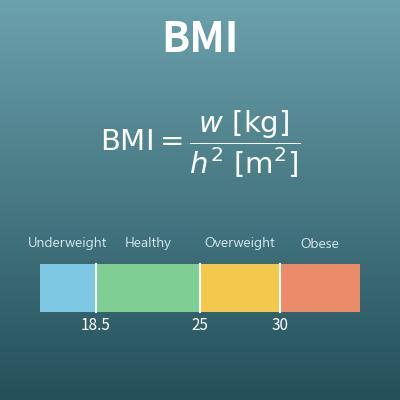
BMI Calculator (Body Mass Index and Healthy Weight Range)
Calculates your BMI and weight category from your height and weight, along with a healthy weight range
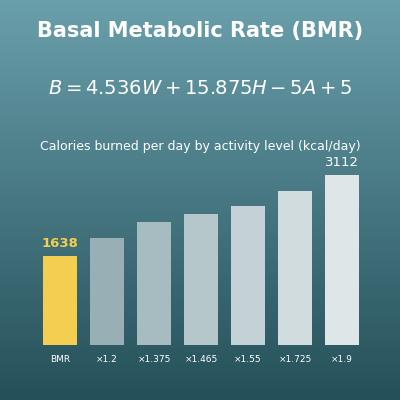
BMR Calculator (Basal Metabolic Rate and Daily Calories by Activity Level)
Estimates your basal metabolic rate and daily calorie burn from your age, sex, height and weight
Calorie Calculator (Maintenance Calories and Weight Loss or Gain Plans)
Calculates your maintenance calories and daily calorie targets for losing or gaining weight at different rates