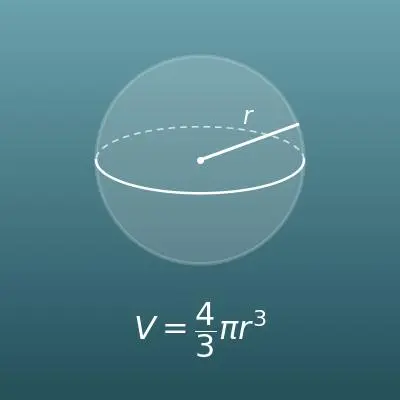
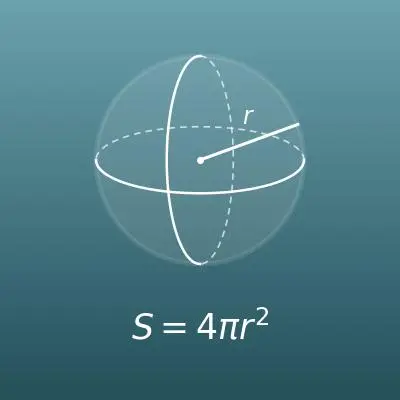
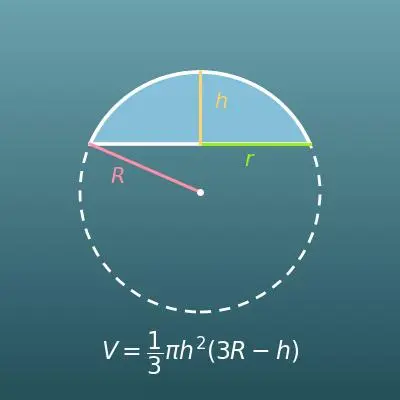
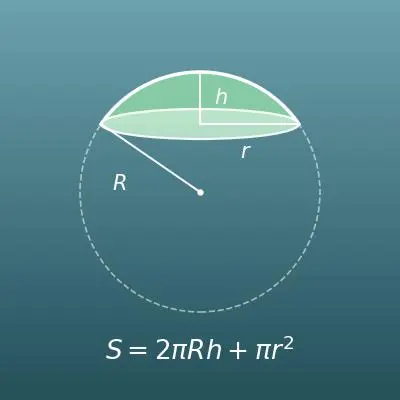

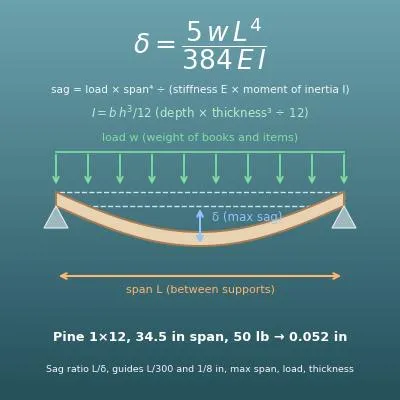
Enter the radius of the sphere. The surface area (4 × π × radius squared) is shown, along with the conversion to m².
Table of Contents
-
What you can do on this page
-
What is this calculation used for?
-
How to Use
-
Formulas and figures
-
Symbols and terms
-
Good to know before you start
-
How to calculate it in Excel
-
How to calculate it in Google Sheets
-
How to calculate it in Python
-
How to write it in LaTeX and other math languages (copy and paste)
-
How to have ChatGPT do the calculation
-
DataChef Features
-
Related Features
-
NumberChef Calculators List
What you can do on this page
- Enter the radius of a sphere, and its surface area (surface area = \(4 \times \pi \times\) radius squared) is calculated on the spot
- The sphere is also drawn as a 3D shape (drag it to turn it around)
- The result also shows the area in square feet (ft²) when you enter inches. Switch "Units" to Metric to use cm² and m² instead
- Also explains what to do when you only know the diameter (radius = diameter ÷ 2, or \(S = \pi d^2\))
- A plain-language explanation of the formulas and copy-and-paste formulas for Excel, Google Sheets and Python are all on this page
What is this calculation used for?
Spherical storage tanks have their whole surface repainted from time to time, and the paint needed is estimated from the area to paint, the surface area of the sphere. For a tank 60 ft across, \(S = \pi d^2 = \pi \times 60^2 \approx 11{,}310\,\mathrm{ft^2}\). If a gallon covers about 350 ft², one coat takes about 33 gallons, and the numbers flow on into material costs and schedules.
Real tanks also have pipes and scaffolding, so the order starts from this value plus some extra.
The Earth is nearly a sphere (strictly, it is slightly flattened), so with a radius of about 3,959 miles its surface area is \(4\pi \times 3959^2 \approx 1.97 \times 10^8\,\mathrm{mi^2}\), about 197 million square miles. The figures in science and geography books, "about 197 million square miles, about 70% of it ocean", come from estimates like this and from measurements.
For the Moon (radius about 1,080 miles), you get about 14.7 million square miles, only about \(\dfrac{1}{13}\) of the Earth's surface area.
A size 5 soccer ball is about 8.7 in across, so its cover has an area of \(\pi \times 8.7^2 \approx 238\,\mathrm{in^2}\). Ball makers divide this surface area into panels (32 for the classic pentagons and hexagons) to work out how much leather or synthetic leather to cut.
This is the theoretical amount before adding seam allowances and waste, and the surface area formula is where it starts.
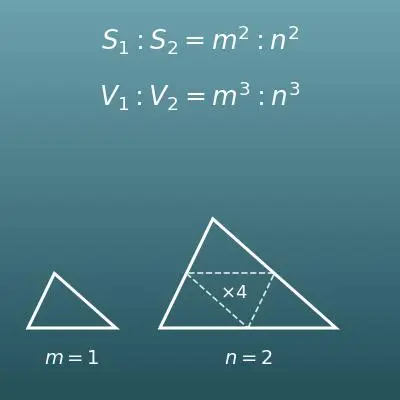
If you treat an animal's body roughly as a sphere, halving the radius cuts the volume (a stand-in for body weight) to \(\dfrac{1}{8}\), but the surface area (the skin that loses heat) only to \(\dfrac{1}{4}\). So the smaller the body, the more surface area it has for each unit of volume, and the faster it loses heat.
Ideas such as "animals in cold regions tend to be larger" (Bergmann's rule) and "babies get cold faster than adults" are explained by this ratio of surface area to volume (real bodies are not spheres, so this is only a model for thinking).
It has been proved mathematically that, of all shapes that hold the same volume, the sphere has the smallest surface area. Water drops and soap bubbles are round because surface tension pulls their surface area down as far as it can.
On the other hand, things that should dissolve fast, like powdered milk or instant coffee, and things that should react fast, like the iron powder in disposable hand warmers, are made into fine grains to increase their surface area for each unit of volume. The surface area formula lets you check everyday effects like these with numbers.
Formulas and figures
Symbols and terms
Symbols
| \(S\) | ess | A common symbol for area and surface area, from the first letter of "surface". On this page it stands for the surface area of the sphere (some books write SA). |
| \(r\) | ar | The radius of the sphere, from the first letter of "radius". It is the distance from the center of the sphere to its surface. |
| \(d\) | dee | The diameter of the sphere, from the first letter of "diameter". It is the distance straight across the widest part of the sphere, twice the radius (\(d = 2r\)). |
| \(\pi\) | pi | The ratio of a circle's circumference to its diameter. It goes on forever as about 3.14159…, and 3.14 is a common rounded value. |
| \(r^2\) | r squared | The number \(r\) multiplied by itself (\(r \times r\)). The small raised 2 is an exponent. (Example: \(3^2 = 3 \times 3 = 9\)) |
| \(\mathrm{in^2}\) | square inches | A unit of area. A square that is 1 inch on each side has an area of 1 in². Do not mix it up with in³ (cubic inches), which is a unit of volume. |
| \(\mathrm{ft^2}\) | square feet | A unit of area. A square that is 1 foot on each side has an area of 1 ft². \(1\,\mathrm{ft^2} = 144\,\mathrm{in^2}\) (the length factor 12, squared). |
Terms
| sphere | A perfectly round solid made of all the points that are the same distance from a center. Balls, marbles and soap bubbles are spheres; they look like a circle from any direction. |
| radius | The distance from the center of a sphere (or circle) to its surface. This is the value you enter in the calculator. It is half the diameter. |
| diameter | The length of a line from surface to surface through the center of a sphere (or circle). It is twice the radius. Balls are often described by their diameter. |
| surface area | The total area of the outside of a solid. For a sphere, it is how much area the "skin" would cover if you could spread it all out. It is a different amount from the volume, which is how much the solid holds. |
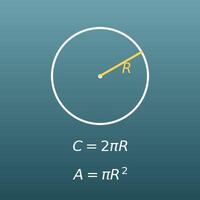
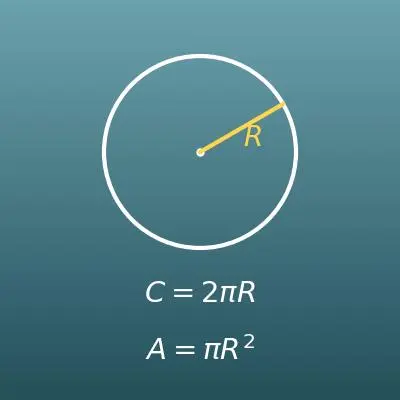
| great circle | The largest circle you get when you cut a sphere with a flat plane through its center. Its radius is the same as the sphere's, and its area is \(\pi r^2\). The surface area of a sphere is exactly 4 times the area of its great circle. |
| pi | The number of times a circle's diameter fits around its circumference (about 3.14), written \(\pi\). It appears not only in circle formulas but also in the surface area and volume of a sphere. |
| exponent | The small raised number in \(3^2\), which tells how many times the number is used as a factor. The area formula has a power of 2 because a surface spreads out in 2 directions: length and width. |
Good to know before you start
Here is what helps you use the calculation on this page with real understanding, not just by pressing the button.
| Circles and pi (Grade 7) |
|
| Area of a circle (Grade 7) |
|
| What area is and its units (Grades 3–5) |
|
| Exponents (Grades 6–8) |
|
| Spheres and the surface area formula (Grade 8 and high school geometry) |
|
How to calculate it in Excel
| Radius r (in) | 5 |
| Surface area (in²) | =4*PI()*B1^2 |
| Diameter d (in) | 10 |
| Surface area (in²) | =PI()*B1^2 |
| Surface area in in² | 314.16 |
| Surface area in ft² | =B1/144 |
"PI()" is the Excel function that returns pi (3.14159…), "*" is multiplication, "/" is division and "^" is an exponent (how many times to multiply). "=4*PI()*B1^2" means "4 × π × B1 squared".
In the first table, for example, B2 shows about 314.16 (in² for a radius of 5 in). The second table is the same sphere (diameter 10 in), so it also shows about 314.16, and the third table shows about 2.18 (ft²) in B2. Just replace the input numbers with your own.
How to calculate it in Google Sheets
| Radius r (in) | 5 |
| Surface area (in²) | =4*PI()*B1^2 |
| Diameter d (in) | 10 |
| Surface area (in²) | =PI()*B1^2 |
| Surface area in in² | 314.16 |
| Surface area in ft² | =B1/144 |
How to calculate it in Python
import math

radius = 5   # radius of the sphere (inches in this example)

surface_area = 4 * math.pi * radius ** 2   # surface area of the sphere (input unit squared, in2 in this example)
surface_area_ft2 = surface_area / 144      # in square feet (for inputs in inches)

print(f"Surface area: {surface_area} in2")
print(f"In square feet: {surface_area_ft2} ft2")
How to write it in LaTeX and other math languages (copy and paste)
S = 4πr²
S = 4\pi r^{2}
<math xmlns="http://www.w3.org/1998/Math/MathML" display="block">
<mrow>
<mi>S</mi>
<mo>=</mo>
<mn>4</mn>
<mi>π</mi>
<msup><mi>r</mi><mn>2</mn></msup>
</mrow>
</math>
S = 4 pi r^2
4*Pi*r^2
S := 4*Pi*r^2;
S = 4*pi*r^2;
S = 4πr^2
S = πd²
S = \pi d^{2}
<math xmlns="http://www.w3.org/1998/Math/MathML" display="block">
<mrow>
<mi>S</mi>
<mo>=</mo>
<mi>π</mi>
<msup><mi>d</mi><mn>2</mn></msup>
</mrow>
</math>
S = pi d^2
Pi*d^2
S := Pi*d^2;
S = pi*d^2;
S = πd^2
How to have ChatGPT do the calculation
You are a math calculation assistant. Do the following calculation by actually running Python code, and base your answer only on the numbers from the execution result (do not answer by mental math or guessing).

A sphere has a radius of 5 inches.
Find each of the following:
1. The surface area of the sphere in square inches (in²) (S = 4 × π × r²)
2. That surface area in square feet (1 ft² = 144 in²)

Show the formulas you used and the numbers from the execution result.
How to Use
-
1Enter your numbersType the numbers you want to calculate with into the input fields
-
2CalculatePress the "Calculate" button
-
3Check the resultThe result appears on the spot. The same page also explains the idea behind the calculation and the formula
DataChef Features

No technical knowledge required.
Intuitive and user-friendly operation.

Can be used without registering personal information.

Automatic file deletion by clicking "download".

and rapid file conversion.
No attribution required.

No need to contact us for commercial use permission.
Related Features
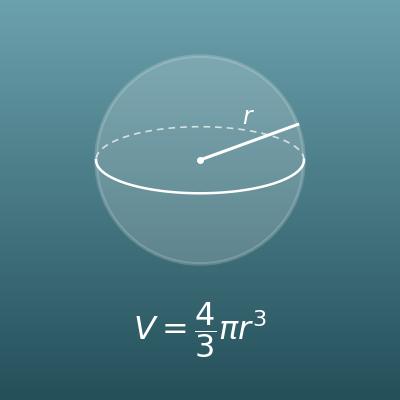
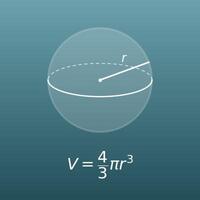
Sphere Volume Calculator (V = 4/3 × π × r³)
Find how much the same sphere holds (its volume). A good formula to learn together with surface area
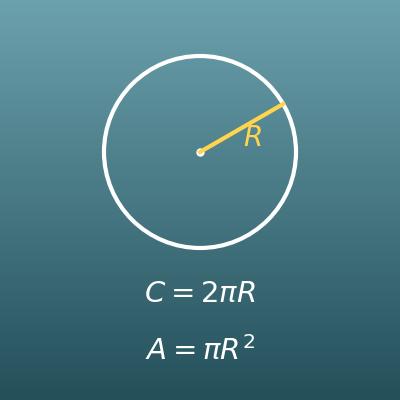
Circle Calculator (Radius, Diameter, Circumference and Area)
For the circle you get when you slice a sphere, find the radius, diameter, circumference and area all at once
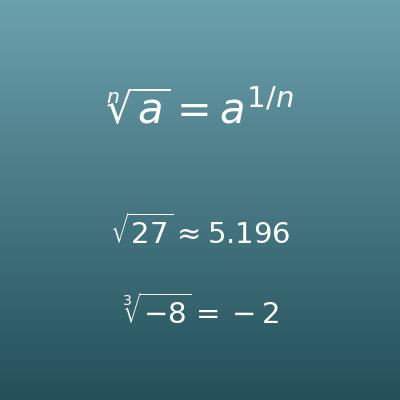
Nth Root Calculator (Square Root, Cube Root, nth Root)
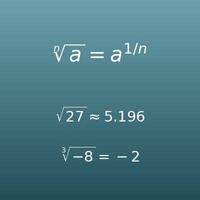
Calculate the square root, which you need to work back from a surface area to the radius