





















































































































































Choose what to find, then enter the screw size and the material (for the pilot hole), or the thickness of the board you are attaching (for the screw length). If the ratios are left blank, common rules of thumb are used (softwood 0.65, hardwood 0.75, plywood/MDF 0.7, 2.5 times the board thickness, 0.67 of the base piece).
Table of Contents
-
What you can do on this page
-
What is this calculation used for?
-
How to Use
-
Formulas and figures
-
Symbols and terms
-
Good to know before you start
-
How to calculate it in Excel
-
How to calculate it in Google Sheets
-
How to calculate it in Python
-
How to write it in LaTeX and other math languages (copy and paste)
-
How to have ChatGPT do the calculation
-
DataChef Features
-
Related Features
-
NumberChef Calculators List
What you can do on this page
- Choose the screw size (#6, #8, #10 and so on) and the material (softwood, hardwood, or plywood/MDF), and you get the pilot hole size and the nearest drill bits in your set (such as 1/64 in steps)
- Enter the thickness of the board you are attaching, and you get the right screw length from a rule of thumb (2 to 2.5 times the board thickness, or about 2/3 of the thickness of the base piece) and the nearest standard length (1, 1-1/4, 1-5/8, 2, 2-1/2 in and so on)
- Enter the thickness of the base piece, and the page checks whether the screw pokes out the back (and how much wood is left)
- For flat-head screws you also get the countersink size, and if you enter the screw length, the depth of the pilot hole
- The ratios, the drill bit steps and the list of standard lengths can all be changed, so you can match the maker's recommendations and the tools you have
What is this calculation used for?
A 1×4 is actually 3/4 in thick and a 2×4 is 1-1/2 in. To fasten a 3/4 in board to a 2×4, a screw 2 to 2.5 times the board thickness is 1-1/2 to 1-7/8 in, so 1-5/8 in or 2 in screws are the choices. The penetration is 7/8 to 1-1/4 in, which leaves at least 1/4 in of the 2×4, so the screw does not go through.
Pine is softwood, so the pilot hole for a #8 screw is about 0.164 × 0.65 ≈ 0.107 in, which is 7/64 in. In the middle of a board you can often skip the pilot hole, but within about 1 in of the end, or in end grain, a pilot hole prevents splitting.
Hardwood is dense and takes a lot of force to drive a screw into, so without a pilot hole it can split or the screw can snap. For a #10 screw (0.190 in), the pilot hole is 0.190 × 0.75 ≈ 0.143 in, which falls between 9/64 in and 5/32 in. Near the end of a board or in a thin part, the larger 5/32 in is the safer choice.
In hardwood a flat head will not sink in by itself, so countersink the hole to match the head (about 0.39 in for a #10) before driving the screw. On furniture where the screws show, this extra step keeps the heads flush and the wood around them from cracking.
Screws do not hold in drywall itself, so they must be long enough to reach the stud behind it. To go through 1/2 in drywall and at least 1 in into the stud, the screw must be \(0.5 + 1 = 1.5\) in or longer, so 1-1/2 in or 1-5/8 in screws are the choices.
A 2×4 stud is 3-1/2 in deep, so enter 3.5 as the thickness of the base piece to confirm that a long screw will not come out the other side. Find the studs with a stud finder, and for anything that carries weight, such as a grab bar, use the screws named in the product's installation instructions.
To fasten 3/4 in plywood to the joists, 2.5 times the board thickness is 1.875 in, so 2 in screws are the guide, and a penetration of 1-1/4 in leaves plenty of joist. The pilot hole in plywood is about 0.7 times the screw diameter: \(0.164 \times 0.7 \approx 0.115\) in for a #8, which is 7/64 in with a 1/64 in drill set. For 5/4 deck boards (actually 1 in thick), 2.5 times gives 2.5 in, which is why 2-1/2 in deck screws are the usual choice.
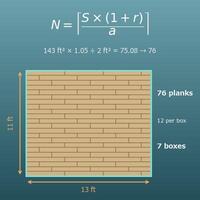
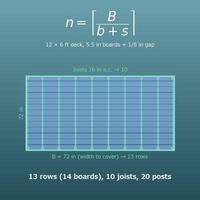
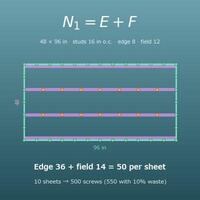
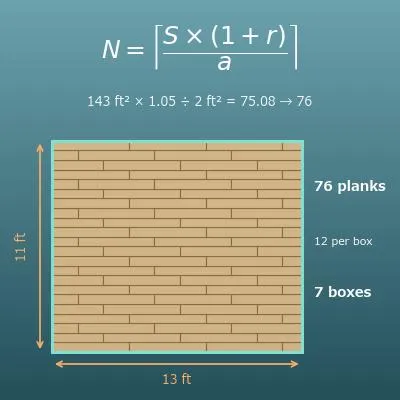
For a large floor or deck, the total number of screws is the screws per board times the number of boards. You can find the number of flooring planks with the "Flooring Calculator".
To fasten a 1/2 in board face to face onto a 3/4 in board, 2.5 times the board thickness (1-1/4 in) gives a penetration of 3/4 in, which leaves no wood at all behind the tip, so the back splits or bulges. In this case, set the penetration to 2/3 of the base piece (0.5 in): \(0.5 + 0.5 = 1\) in, so a 1 in screw (1/2 in penetration, 1/4 in left) does not go through.
Thin boards and end grain split easily, so use a thinner #6 screw with a pilot hole (0.138 × 0.65 ≈ 0.090 in, which is 3/32 in), and keep away from the edges.
For materials other than wood, screw makers publish charts of the recommended pilot hole for self-tapping screws by material and thickness. For plastic it is often about 80 to 90% of the screw diameter, and for aluminum or sheet metal it also depends on the sheet thickness. Enter "recommended pilot hole ÷ screw diameter" from the chart in "Other (enter the ratio)" on this calculator, and you can pick the nearest drill bit the same way.
In metal, a pilot hole that is too small snaps the screw, and one that is too large leaves the threads with nothing to grip, so following the chart matters even more than in wood.
"0.65 times the diameter", "2.5 times the board thickness" and "2/3 of the base piece" are all "amount × multiplier", as taught in elementary school. Rounding a pilot hole to 1/64 in steps is rounding down and up to a multiple of a fraction, and checking whether a screw goes through is comparing a difference with 0. It is a good example of arithmetic that prevents mistakes in real projects.
Formulas and figures
Symbols and terms
Symbols
| \(d\) | dee | The screw diameter across the threads (in), from the first letter of "diameter". For a US wood screw it comes from the gauge: #8 is 0.164 in. |
| \(r\) | ar | The material ratio (the pilot hole as a fraction of the screw diameter), from the first letter of "ratio". 0.65 for softwood, 0.75 for hardwood and 0.7 for plywood/MDF are common rules of thumb, and you can change it in this calculator. |
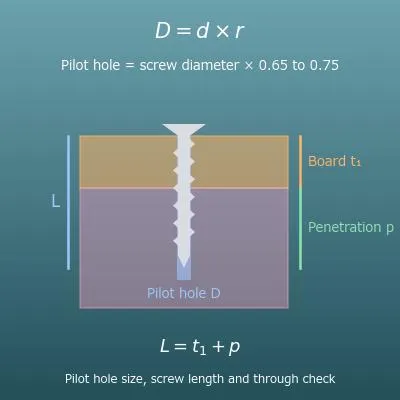
| \(D\) | capital dee | The pilot hole size (in). It is found with \(D = d \times r\), and you pick the nearest drill bit in your set (such as 1/64 in steps). |
| \(t_1\) | tee one | The thickness of the board you attach (in), from the first letter of "thickness". The subscript 1 is for the first board, on the screw head side. |
| \(t_2\) | tee two | The thickness of the base piece (in). The subscript 2 is for the second piece, where the screw tip goes. It is used to check whether the screw goes through. |
| \(k\) | kay | The multiple (the screw length as a multiple of the board thickness). 2 to 2.5 is the usual rule, and this calculator uses 2.5 by default. |
| \(q\) | cue | The fraction (the penetration as a fraction of the base piece). This calculator uses \(q\) to keep it apart from the pilot hole ratio \(r\) (the letter has no special origin). About 2/3 (0.67) is the usual rule. |
| \(L\) | el | The screw length (in), from the first letter of "length". It is measured from under the head to the tip; for flat-head screws, the length usually includes the head, from the top of the head to the tip. |
| \(p\) | pee | The penetration into the base piece (in), from the first letter of "penetration". \(p = L - t_1\), and the threads along this length grip the base piece. |
| \(m\) | em | The wood left in the base piece (in), from the first letter of "margin". \(m = t_2 - p\), and if it is more than 0, the screw does not go through. |
| \(\approx\) | approximately equal to | The sign for "approximately equal". It is used when a value that does not come out evenly is rounded to a decimal. |
Terms
| pilot hole | A small hole drilled before driving a screw. It keeps the wood from splitting, helps the screw go in straight, and makes it easier to drive. It is narrower than the threads and as deep as the screw is long or a little deeper. |
| screw gauge | The number for the thickness of a US wood screw, such as #6, #8 or #10. The diameter across the threads is 0.060 + 0.013 × N in (#8 is 0.164 in). "#8 × 1-5/8" on a package means gauge 8, 1-5/8 in long. Metric screws are sized by the diameter in mm instead ("4 × 40" is 4 mm across and 40 mm long). |
| thread diameter | The diameter measured across the tips of the threads, also called the major diameter. This is the size of a wood screw or coarse-thread screw. The pilot hole must be narrower than this, or the threads cannot grip the wood. |
| shank diameter | The diameter of the body of the screw at the bottom of the threads, also called the root diameter. A coarse-thread screw has a thin shank, about 65 to 70% of the thread diameter (about 0.11 in for a #8). In softwood, the pilot hole is the same as the shank or a little smaller; in hardwood, a little larger. |
| wood screw | The traditional screw for wood. It is sized by gauge, has threads only near the tip, and has a smooth shank under the head. Brass screws and other soft screws break easily, so a pilot hole is especially important. |
| coarse-thread screw | A wood screw with widely spaced (coarse) threads, a thin shank and a flat head, such as a deck screw or construction screw. It is the most common screw for DIY, and with a power drill it often goes into softwood without a pilot hole. It is sized by gauge and length (#8 × 1-5/8 in, #10 × 3 in and so on). |
| self-tapping screw | A screw that cuts its own threads as it goes into the pilot hole, such as a sheet metal screw. It is used in thin steel, plastic and aluminum, and makers publish charts of the recommended pilot hole for each material. For materials other than wood, use those charts instead of the ratios on this page. |
| flat head | A screw head with a cone-shaped underside that sinks into the surface, also called a countersunk head. Most coarse-thread screws have one. In hardwood or thin boards the head may not sink in, or the board may split, so countersink the hole first. |
| countersink | Widening the top of the pilot hole into a cone so that a flat-head screw sits flush with the surface. The size is about the same as the head diameter, and you cut it lightly with a countersink bit or the tip of a larger drill bit. |
| softwood | Light, soft wood, mostly from conifers, such as pine, spruce, fir and cedar. Screws hold well and it rarely splits, so a small pilot hole (60 to 70% of the screw diameter) is enough, and thin screws often go in with no pilot hole at all. |
| hardwood | Dense, hard wood, mostly from broadleaf trees, such as oak, maple, cherry, walnut and teak. It takes a lot of force to drive a screw and splits easily, so use a larger pilot hole (70 to 80% of the screw diameter) and always drill one. |
| plywood | A panel made of thin layers of wood glued together with the grain of each layer at right angles to the next. It rarely splits between layers, but screws driven into its edge can pull the layers apart. |
| MDF | Medium-density fiberboard, made of wood fibers pressed together with glue. It is even and easy to work, but screws hold less well than in solid wood, and screws in its edge split it easily, so drill a pilot hole (about 70% of the screw diameter). |
| penetration | How far the tip end of the screw goes into the base piece. It is the screw length minus the thickness of the board you attach (also called the bite), and the threads here grip the base piece and give the holding power. With a screw 2 to 2.5 times the board thickness, the penetration is 1 to 1.5 times the board thickness. |
| base piece | The piece the screw tip goes into, such as a stud, a joist or another board. It is the piece that holds the board you attach. If it is thin, the screw may go through, so enter its thickness if you know it. |
| go through | The screw tip coming out the back of the base piece. Besides looking bad and causing injuries, it splits and tears the wood on the back. If the wood left is 0 or less, the screw goes through, and even with a little wood left the back may bulge. |
| holding power | How strongly a driven screw grips the wood without pulling out. It depends on the penetration, the thread area and the hardness of the wood. A screw in end grain cannot grip the fibers well and is said to hold only about half as well as one in the side of a board. |
| end grain | The cut end of a board, across the grain. Screws driven here only slip in between the fibers, so they hold poorly and split the wood easily. When you must screw into end grain, use a long, thin screw, drill a pilot hole, and keep away from the edges. |
| standard length | The lengths screws are sold in. For wood screws and deck screws, 1, 1-1/4, 1-1/2, 1-5/8, 2, 2-1/2, 3 and 3-1/2 in are common (they vary a little by maker). Choose the one nearest the estimate. |
| splitting | Wood cracking along the grain from the force of a screw going in. It happens easily near a board end, in end grain, in hardwood, in dry wood and with thick screws. A pilot hole, moving away from the end, or a thinner screw prevents it. |
| drywall | The panels on interior walls and ceilings, made of gypsum between sheets of paper. Screws hardly hold in drywall itself, so use a screw long enough to reach the framing (studs) behind it, or a drywall anchor. |
Good to know before you start
Here is what helps you use the calculation on this page with real understanding, not just by pressing the button.
If you get stuck, going back over these topics is the fastest way forward.
| Measuring length in inches and fractions of an inch (Grades 3–4) |
|
| Multiplying decimals (Grade 5) |
|
| Multiples and fractions of an amount (Grades 5–6) |
|
| Rounding down and rounding up (Grade 4) |
|
| Subtracting and comparing (Grades 1–3) |
|
How to calculate it in Excel
| Screw diameter d (in, #8) | 0.164 |
| Material ratio r (softwood 0.65, hardwood 0.75, plywood 0.7) | 0.65 |
| Pilot hole D (in) | =B1*B2 |
| Pilot hole D (in) | 0.1066 |
| Drill bit step (in, 1/64) | 0.015625 |
| Nearest drill bit, smaller (in) | =FLOOR(B1,B2) |
| Nearest drill bit, larger (in) | =CEILING(B1,B2) |
| Thickness of the board you attach t1 (in) | 0.75 |
| Multiple k (2 to 2.5) | 2.5 |
| Screw length L (in) | =B1*B2 |
| Penetration into the base piece p (in) | =B3-B1 |
| Thickness of the board you attach t1 (in) | 0.75 |
| Thickness of the base piece t2 (in) | 1.5 |
| Fraction q (of the base piece) | 0.67 |
| Penetration p (in) | =B2*B3 |
| Screw length L (in) | =B1+B4 |
| Standard length you chose (in) | 2 |
| Wood left m (in, more than 0 = does not go through) | =B2-(B6-B1) |
The first table is a #8 screw (0.164 in) in softwood (ratio 0.65), and B3 shows 0.1066. The second table rounds that 0.1066 to 1/64 in steps: B3 shows 0.09375 (3/32 in) and B4 shows 0.109375 (7/64 in). "FLOOR" rounds down to a multiple of the step and "CEILING" rounds up. The third table is a 0.75 in board × 2.5, so B3 shows 1.875 and B4 shows 1.125. The fourth table is a 0.75 in board, a 1.5 in base piece and a fraction of 0.67: B4 shows 1.005, B5 shows 1.755, and with the 2 in standard length you chose, the wood left in B7 is 0.25 (more than 0, so it does not go through).
"*" is multiplication and "-" is subtraction. For a different material or thickness, change the ratio, multiple and thickness cells.
How to calculate it in Google Sheets
| Screw diameter d (in, #8) | 0.164 |
| Material ratio r (softwood 0.65, hardwood 0.75, plywood 0.7) | 0.65 |
| Pilot hole D (in) | =B1*B2 |
| Pilot hole D (in) | 0.1066 |
| Drill bit step (in, 1/64) | 0.015625 |
| Nearest drill bit, smaller (in) | =FLOOR(B1,B2) |
| Nearest drill bit, larger (in) | =CEILING(B1,B2) |
| Thickness of the board you attach t1 (in) | 0.75 |
| Multiple k (2 to 2.5) | 2.5 |
| Screw length L (in) | =B1*B2 |
| Penetration into the base piece p (in) | =B3-B1 |
| Thickness of the board you attach t1 (in) | 0.75 |
| Thickness of the base piece t2 (in) | 1.5 |
| Fraction q (of the base piece) | 0.67 |
| Penetration p (in) | =B2*B3 |
| Screw length L (in) | =B1+B4 |
| Standard length you chose (in) | 2 |
| Wood left m (in, more than 0 = does not go through) | =B2-(B6-B1) |
How to calculate it in Python
import math
from fractions import Fraction

# ---- Pilot hole size ----
screw_dia = 0.164        # screw diameter d (in). #8 = 0.060 + 0.013 x 8
ratio = 0.65             # material ratio r (softwood 0.65, hardwood 0.75, plywood 0.7)
drill_step = 1 / 64      # step between your drill bit sizes (in)

pilot_dia = round(screw_dia * ratio, 4)
drill_lower = math.floor(pilot_dia / drill_step) * drill_step
drill_upper = math.ceil(pilot_dia / drill_step) * drill_step
print(f"Pilot hole: {pilot_dia} in -> drill bit {Fraction(drill_lower).limit_denominator(64)} in or {Fraction(drill_upper).limit_denominator(64)} in")

# ---- Screw length ----
board_thickness = 0.75   # thickness of the board you attach t1 (in)
mate_thickness = 1.5     # thickness of the base piece t2 (in)
length_ratio = 2.5       # multiple k (of the board thickness)
std_lengths = [0.5, 0.625, 0.75, 1, 1.25, 1.5, 1.625, 2, 2.5, 3, 3.5, 4]

target_length = board_thickness * length_ratio
penetration = target_length - board_thickness
print(f"Screw length: {target_length} in (penetration {penetration} in)")

# Standard lengths that reach the base piece without going through, and the one nearest the estimate
usable = [L for L in std_lengths if 0 < L - board_thickness < mate_thickness]
best = min(usable, key=lambda L: abs(L - target_length))
margin = mate_thickness - (best - board_thickness)
print(f"Recommended standard length: {best} in (wood left {margin} in -> {'does not go through' if margin > 0 else 'goes through'})")
How to write it in LaTeX and other math languages (copy and paste)
D = d × r
D = d \, r
<math xmlns="http://www.w3.org/1998/Math/MathML" display="block">
<mrow>
<mi>D</mi><mo>=</mo><mi>d</mi><mo>⁢</mo><mi>r</mi>
</mrow>
</math>
D = d r
d*r
pilot := d*r; # In Maple, D is the differential operator (a reserved name), so the pilot hole is named pilot
D = d*r; % d is the screw diameter, r is the material ratio (softwood 0.65, hardwood 0.75, plywood 0.7)
D = dr
L = k × t₁, p = L − t₁
L = k\,t_{1},\quad p = L - t_{1}
<math xmlns="http://www.w3.org/1998/Math/MathML" display="block">
<mrow>
<mi>L</mi><mo>=</mo><mi>k</mi><mo>⁢</mo><msub><mi>t</mi><mn>1</mn></msub>
<mo>,</mo>
<mi>p</mi><mo>=</mo><mi>L</mi><mo>-</mo><msub><mi>t</mi><mn>1</mn></msub>
</mrow>
</math>
L = k t_1, p = L - t_1
{k*t1, k*t1 - t1}
L := k*t1; p := L - t1;
L = k*t1; p = L - t1; % t1 is the thickness of the board you attach, k is the multiple (2 to 2.5)
L = kt_1, p = L − t_1
p = q × t₂, L = t₁ + p
p = q\,t_{2},\quad L = t_{1} + p
<math xmlns="http://www.w3.org/1998/Math/MathML" display="block">
<mrow>
<mi>p</mi><mo>=</mo><mi>q</mi><mo>⁢</mo><msub><mi>t</mi><mn>2</mn></msub>
<mo>,</mo>
<mi>L</mi><mo>=</mo><msub><mi>t</mi><mn>1</mn></msub><mo>+</mo><mi>p</mi>
</mrow>
</math>
p = q t_2, L = t_1 + p
{q*t2, t1 + q*t2}
p := q*t2; L := t1 + p;
p = q*t2; L = t1 + p; % t2 is the thickness of the base piece, q is the fraction (about 2/3)
p = qt_2, L = t_1 + p
m = t₂ − p = t₂ − (L − t₁)
m = t_{2} - p = t_{2} - (L - t_{1})
<math xmlns="http://www.w3.org/1998/Math/MathML" display="block">
  <mrow>
    <mi>m</mi><mo>=</mo><msub><mi>t</mi><mn>2</mn></msub><mo>-</mo><mi>p</mi>
    <mo>=</mo><msub><mi>t</mi><mn>2</mn></msub><mo>-</mo>
    <mo>(</mo><mi>L</mi><mo>-</mo><msub><mi>t</mi><mn>1</mn></msub><mo>)</mo>
  </mrow>
</math>
m = t_2 - p = t_2 - (L - t_1)
t2 - (L - t1)
m := t2 - (L - t1);
m = t2 - (L - t1); % m > 0 means it does not go through
m = t_2 − p = t_2 − (L − t_1)
How to have ChatGPT do the calculation
You are a calculation assistant for choosing screws in woodworking and DIY. Do the following calculation by actually running Python code, and base your answer only on the numbers from the execution result (do not answer by mental math or guessing).

I am driving a #8 wood screw (thread diameter 0.164 in) through a 3/4 in pine board (softwood) into a 1-1/2 in pine 2×4.
Find each of the following:
1. The pilot hole size (diameter × 0.65) and the nearest drill bits in 1/64 in steps (rounded down and rounded up), shown as fractions of an inch
2. The screw length (board thickness × 2.5) and the penetration into the base piece (length − board thickness)
3. From the standard lengths 1, 1-1/4, 1-1/2, 1-5/8, 2, 2-1/2, 3 and 3-1/2 in, the length nearest the estimate that does not go through the 1-1/2 in base piece
4. The wood left in the base piece with that length (base piece thickness − penetration)

Show the formulas you used and the numbers from the execution result.
How to Use
-
1Enter your numbersType the numbers you want to calculate with into the input fields
-
2CalculatePress the "Calculate" button
-
3Check the resultThe result appears on the spot. The same page also explains the idea behind the calculation and the formula
DataChef Features

No technical knowledge required.
Intuitive and user-friendly operation.

Can be used without registering personal information.

Automatic file deletion by clicking "download".

and rapid file conversion.

No attribution required.

No need to contact us for commercial use permission.
Related Features
Lumber Cut List Calculator (Boards Needed and Cutting Layout)
Plan the cuts before you screw things together. How many pieces you get from each board and how many boards to buy
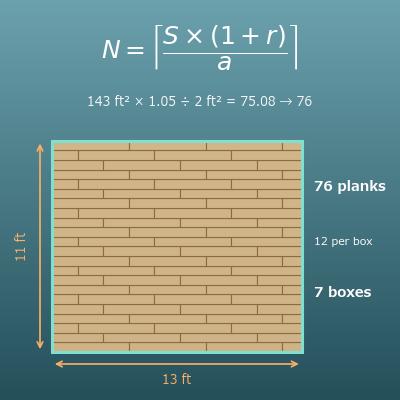
Flooring Calculator (Planks, Boxes, Waste Factor and Cost)
For the number of planks and boxes of flooring when you fasten boards to the joists

Stair Calculator (Rise, Run, Number of Steps, Stringer Length and Angle)
For planning the riser height, tread depth and number of steps when you build stairs or a step stool
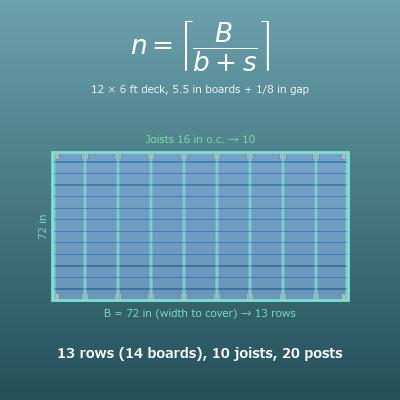
Deck Materials Calculator (Decking, Joists, Posts and Screws)
Find the number of deck boards, joists and posts, and about how many screws you need
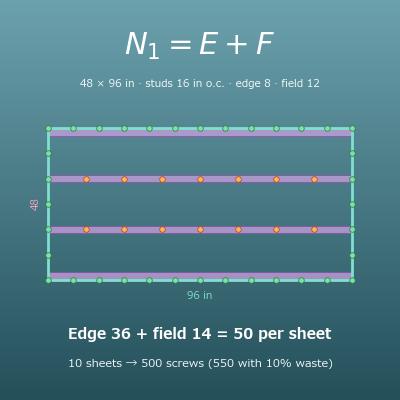
Screw Calculator (How Many Screws for Drywall, Plywood and Decking)
Once you know the size and length, find the screws per drywall or plywood sheet, the total and the number of boxes