






















































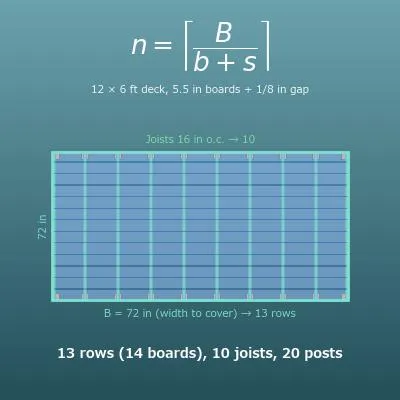

Enter the deck size, the decking (width, gap, stock length, direction), the joists (spacing, stock length) and the posts (how the joists are carried, spacing). Thickness, joist width and prices can be left blank.
Table of Contents
-
What you can do on this page
-
What is this calculation used for?
-
How to Use
-
Formulas and figures
-
Symbols and terms
-
Good to know before you start
-
How to calculate it in Excel
-
How to calculate it in Google Sheets
-
How to calculate it in Python
-
How to write it in LaTeX and other math languages (copy and paste)
-
How to have ChatGPT do the calculation
-
DataChef Features
-
Related Features
-
NumberChef Calculators List
What you can do on this page
- Enter the deck width × depth and the width, gap and stock length of the deck boards, and you get how many rows and boards you need (boards to buy with waste, and the total length) on the spot
- Choose whether the boards run along the width or along the depth. The page also shows how wide to rip the last row (or whether the leftover can be taken up in the gaps)
- From the joist spacing (such as 16 in on center) it finds the number of joists and their actual spacing, and from the post spacing (such as 6 ft) the number of posts. It covers both joists sitting directly on posts (or deck blocks) and joists on beams
- It also estimates the deck screws from where the rows cross the joists. Enter prices (optional) for decking, joists, beams and posts to get the cost of each and the total
- A plan view shows the rows of decking, joists, beams and posts, so you can see the layout as you count materials. A plain-language explanation of the formulas and copy-and-paste formulas for Excel, Google Sheets and Python are also on this page
What is this calculation used for?
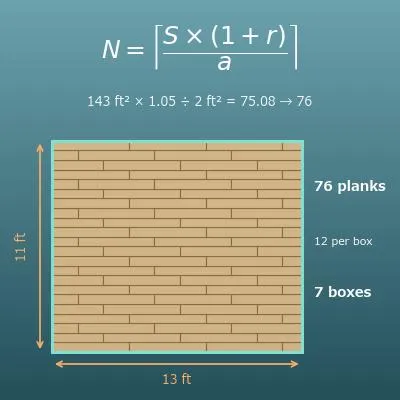
For example, a 12 × 12 ft deck of 5/4×6 deck boards (5.5 in wide) with 1/8 in gaps takes \(\lceil 144 \div 5.625 \rceil = 26\) rows, 28 boards of 12 ft with a 5% waste factor, 10 joists at 16 in on center, 30 deck blocks (or 9 posts with beams), and about 520 deck screws.
Working out the rows and boards before you go to the lumberyard cuts down on extra trips when you run short and on piles of leftovers. You can also compare stock lengths, for example when the length you can carry in your truck limits what you buy.
Composite deck boards come in set sizes, such as 5.5 in wide and 12, 16 or 20 ft long, and the maker sets the gap and joist spacing. For example, a 16 ft wide × 10 ft deep deck with 5.5 in boards and 3/16 in gaps running along the width takes \(\lceil 120 \div 5.6875 \rceil = 22\) rows; with 16 ft boards (one per row) that is 22 net, or 24 with a 5% waste factor.
Enter the maker's gap and joist spacing as they are, and you can check the "boards per 100 sq ft" guides in a catalog against your own deck size (follow the maker's installation guide for the structure and fasteners).
For a 6 × 3 ft platform with the boards running along the 6 ft side, the width to cover is 36 in, so 5.5 in boards with 1/8 in gaps take \(\lceil 36 \div 5.625 \rceil = 7\) rows (6.4 rounded up). Each board is 72 in, so a 12 ft board gives two rows, and \(\lceil 7 \div 2 \rceil = 4\) boards are enough.
The smaller the deck, the more "rows per stock board" changes the count, so choosing the stock length goes straight into the material cost.
A contractor's estimate lists material quantities such as "decking ○ pcs", "joists ○ pcs" and "footings ○". Knowing these formulas, you can follow how the rows and pieces come from the deck size, and sort out what to ask in the meeting (board direction, joist spacing, beams or not, the waste allowance).
A real estimate also includes fascia, stairs, railings, footings, hardware, finishing, permits and labor, so the material counts alone cannot tell you whether the price is fair.
Interlocking deck tiles for a balcony or patio are counted by dividing the area by the area of one tile, so the "Tile Calculator" approach fits them better than the rows-of-decking formula on this page.
Deciding whether you are building a framed deck with joists and posts or simply laying tiles, and picking the calculator that matches, is the first step in estimating materials.
Formulas and figures
Symbols and terms
Symbols
| \(W\) | double-u | The deck width, from the first letter of "width". You can enter it in ft or in, and it is turned into inches for the calculation. |
| \(D\) | dee | The deck depth (how far it sticks out from the house), from the first letter of "depth". |
| \(A\) | ay | The deck size along the boards (the board length). \(A = W\) if the boards run along the width, and \(A = D\) if they run along the depth. It is also the length along which the joists are spaced. |
| \(B\) | bee | The deck size across the boards (the width to cover with rows of decking). \(B = D\) if the boards run along the width, and \(B = W\) if they run along the depth. It is also the joist length. |
| \(b\) | small bee | The width of one deck board (in), from the first letter of "board". 5.5 in for a 2×6 or a 5/4×6 deck board. |
| \(s\) | ess | The gap between boards (in), from the first letter of "space". The default is 1/8 in. |
| \(L\) | el | The stock length of the deck boards (in), from the first letter of "length". |
| \(n\) | en | The rows of decking, found with \(n = \lceil B \div (b + s) \rceil\). From the first letter of "number". |
| \(k\) | kay | The rows you get from one stock board, found with \(k = \lfloor L \div A \rfloor\). |
| \(M_{0}\) | M sub zero | The deck boards in stock lengths (net, without waste), found with \(M_{0} = \lceil n \div k \rceil\) (or \(n \times \lceil A \div L \rceil\) when spliced). |
| \(r\) | ar | The waste factor (%), from the first letter of "rate". The default is 5%. |
| \(M\) | em | The boards to buy with waste, found with \(M = \lceil M_{0} \times (1 + r \div 100) \rceil\). From the first letter of "material". |
| \(\ell\) | script el | The total length of decking with waste (ft), found with \(\ell = n \times A \times (1 + r \div 100)\). It is written as a script l to keep it apart from the stock length \(L\). |
| \(p\) | pee | The joist spacing (on center, in), from the first letter of "pitch". The example uses 16 in, but use the decking maker's recommended value. |
| \(p'\) | p prime | The actual joist spacing (in), after rounding the count up so the spacing is no more than \(p\). It is found with \(A \div (J - 1)\). |
| \(J\) | jay | The number of joists, found with \(J = \lceil A \div p \rceil + 1\). From the first letter of "joist". |
| \(q\) | cue | The post spacing (on center, in), also used for the beam spacing when beams are used. The example uses 72 in, but use the value from the span tables and the building code for your joists and beams. |
| \(K\) | capital kay | The number of posts: \(K = J \times (\lceil B \div q \rceil + 1)\) with joists directly on posts, or \(K = G \times (\lceil A \div q \rceil + 1)\) with beams. |
| \(G\) | gee | The number of beams, found with \(G = \lceil B \div q \rceil + 1\). From the first letter of "girder" (another word for a beam). |
| \(v\) | vee | The screws at each place where a row of decking crosses a joist. The default is 2. |
| \(V\) | capital vee | The rough number of deck screws, found with \(V = n \times J \times v\). |
| \(u\) | you | The unit price of a material ($), from the first letter of "unit price". Decking per board or per foot; joists, beams and posts per piece. |
| \(Q\) | capital cue | The quantity to match the price (pieces or total length), from the first letter of "quantity". |
| \(C\) | see | The cost of each material ($), found with \(C = u \times Q\). From the first letter of "cost". |
| \(T\) | tee | The estimated total ($), from the first letter of "total". It is the materials only, for decking, joists, beams and posts. |
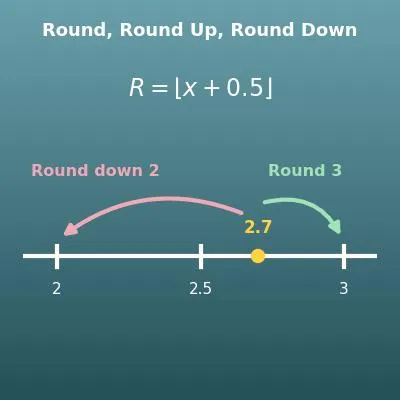
| \(\lceil x \rceil\) | ceiling of x | The symbol for rounding up to a whole number, called the ceiling function. (Example - \(\lceil 25.6 \rceil = 26\), \(\lceil 9 \rceil = 9\)) |
| \(\lfloor x \rfloor\) | floor of x | The symbol for rounding down to a whole number, called the floor function. (Example - \(\lfloor 1.01 \rfloor = 1\), \(\lfloor 2.22 \rfloor = 2\)) |
Terms
| decking | The boards laid side by side on top of the deck, also called deck boards. They come in wood (pressure-treated pine, cedar, hardwoods) and composite. 5/4×6 (1 × 5-1/2 in actual) and 2×6 (1-1/2 × 5-1/2 in actual) are the common sizes. |
| joist | A framing board set on edge just under the decking, at right angles to it and evenly spaced, that carries the deck boards. The boards are screwed to the joists. 16 in on center is standard for decks, and the decking maker sets the recommended spacing for the board thickness and material. |
| beam | A heavier member (often doubled 2×8s or 2×10s) under the joists that carries them. With beams, the posts go only under the beams, so fewer posts are needed. |
| post | A short column standing on a footing that holds up the joists or beams. Besides wood posts (often 4×4 or 6×6), adjustable steel posts are used. |
| footing | The concrete base a post stands on, such as a poured concrete footing or a precast deck block. You need one per post, set level and at the right height. Footings for attached decks usually must go below the frost line; follow the building code. |
| stock length | The standard lengths lumber and deck boards are sold in. US lumber comes in even-foot lengths such as 8, 10, 12, 14 and 16 ft, and composite deck boards often in 12, 16 and 20 ft. (Metric timber is often sold in 300 mm steps, such as 2.4, 3.6 and 4.8 m.) |
| splice | Joining two or more boards end to end to make one row when one stock length is too short (a butt joint). The joint must land on a joist (or beam), and the joints are usually staggered from row to row. |
| yield | How many pieces of the length you need can be cut from one stock board, found by dividing the stock length by the piece length and rounding down. To include saw kerf, use the "Lumber Cut List Calculator". |
| waste factor | The extra, as a share of the net amount, for ripping the last row, trimming split ends, cutting around knots or warps, and spares for mistakes. 5 to 10% is common for deck boards. |
| deck width | The length of the deck along the house (along the patio door or wall). It is often the longer side of the deck. |
| deck depth | How far the deck sticks out from the house wall into the yard (also called the projection). |
| on center (o.c.) | The distance from the center of one member to the center of the next. Joist and post spacings are given this way in building, such as "16 in o.c." (it is different from the clear space between members). |
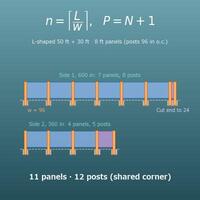
| fencepost problem | A classic math puzzle about how the number of items in a row relates to the number of spaces. With one at each end, "items = spaces + 1". The "+1" in the joist and post formulas comes from this idea. |
| rounding up | Changing a number with a decimal part to the next whole number. Rows and pieces cannot stop partway, so they are always rounded up. |
| rounding down | Dropping the decimal part to get a whole number. The pieces you get from one stock board are rounded down, since you cannot cut a piece that is too short. |
| composite decking | Deck boards made of wood fibers and plastic (PVC decking is similar). They do not rot and need little upkeep, but they expand and shrink with temperature, so the maker sets the gap and joist spacing. |
| hardwood decking | Deck boards of hard, rot-resistant tropical woods such as ipe, cumaru and garapa. They are so hard that pilot holes are needed, and their sizes often differ from softwood lumber. |
| fascia | A board fastened to the side of the deck to hide the rim joist, board ends and framing. It is not in the counts on this page, so get it separately if needed. |
| end grain | The cut end of a board, across its length. The exposed fibers split and chip easily and soak up rain. Trimming split ends is part of the waste on deck boards. |
| pressure-treated lumber | Softwood lumber (often southern yellow pine) with preservative forced in under pressure to resist rot and insects. It is the usual framing lumber for US decks and a low-cost decking choice. Use fasteners rated for treated lumber, and choose "ground contact" lumber for posts and parts near the ground. |
| adjustable post | A steel post used instead of a wood post, with a screw to fine-tune the height. It sits on a footing and carries the joists or beams. Posts are counted the same way as wood posts. |
Good to know before you start
Here is what helps you use the calculation on this page with real understanding, not just by pressing the button.
| Converting units of length (Grades 4–5) |
|
| Division with remainders (Grades 3–4) |
|
| Rounding (Grades 3–4) |
|
| The fencepost problem (Grades 3–5) |
|
| Percents (Grade 6) |
|
| Multiplying and dividing decimals (Grade 5) |
|
How to calculate it in Excel
| Width to cover B (in) | 144 |
| Board width b (in) | 5.5 |
| Gap s (in) | 0.125 |
| Rows of decking n | =ROUNDUP(B1/(B2+B3),0) |
| Rows of decking n | 26 |
| Stock length L (in) | 144 |
| Board length A (in) | 144 |
| Rows per stock board k | =ROUNDDOWN(B2/B3,0) |
| Deck boards (net) | =ROUNDUP(B1/B4,0) |
| Deck boards (net) | 26 |
| Waste factor r (%) | 5 |
| Rows of decking n | 26 |
| Board length A (in) | 144 |
| Boards to buy with waste M | =ROUNDUP(B1*(1+B2/100),0) |
| Total length with waste (ft) | =B3*B4/12*(1+B2/100) |
| Board length A (in) | 144 |
| Joist spacing p (in) | 16 |
| Joists J | =ROUNDUP(B1/B2,0)+1 |
| Actual spacing (in) | =B1/(B3-1) |
| Joists J | 10 |
| Joist length B (in) | 144 |
| Post spacing q (in) | 72 |
| Posts K | =B1*(ROUNDUP(B2/B3,0)+1) |
| Width to cover B (in) | 144 |
| Post spacing q (in) | 72 |
| Beam length A (in) | 144 |
| Beams G | =ROUNDUP(B1/B2,0)+1 |
| Posts K | =B4*(ROUNDUP(B3/B2,0)+1) |
| Rows of decking n | 26 |
| Joists J | 10 |
| Screws per crossing v | 2 |
| Deck screws V | =B1*B2*B3 |
| Deck board price ($ each) | 20 |
| Deck boards to buy | 28 |
| Joist price ($ each) | 20 |
| Joist boards | 10 |
| Post price ($ each) | 12 |
| Posts | 30 |
| Estimated total ($) | =B1*B2+B3*B4+B5*B6 |
"ROUNDUP(value, 0)" rounds up to a whole number (the ⌈ ⌉ in the formulas), and "ROUNDDOWN(value, 0)" rounds down (the ⌊ ⌋).
B4 in the first table is 26 rows. In the second, B4 is 1 row and B5 is 26 boards. In the third, B5 is 28 boards and B6 is 327.6 ft. In the fourth, B3 is 10 joists and B4 is 16 in. B4 in the fifth is 30 posts. In the sixth, B4 is 3 beams and B5 is 9 posts. B4 in the seventh is 520 screws, and B7 in the eighth is $1,120. Just change column B to your own numbers.
How to calculate it in Google Sheets
| Width to cover B (in) | 144 |
| Board width b (in) | 5.5 |
| Gap s (in) | 0.125 |
| Rows of decking n | =ROUNDUP(B1/(B2+B3),0) |
| Rows of decking n | 26 |
| Stock length L (in) | 144 |
| Board length A (in) | 144 |
| Rows per stock board k | =ROUNDDOWN(B2/B3,0) |
| Deck boards (net) | =ROUNDUP(B1/B4,0) |
| Deck boards (net) | 26 |
| Waste factor r (%) | 5 |
| Rows of decking n | 26 |
| Board length A (in) | 144 |
| Boards to buy with waste M | =ROUNDUP(B1*(1+B2/100),0) |
| Total length with waste (ft) | =B3*B4/12*(1+B2/100) |
| Board length A (in) | 144 |
| Joist spacing p (in) | 16 |
| Joists J | =ROUNDUP(B1/B2,0)+1 |
| Actual spacing (in) | =B1/(B3-1) |
| Joists J | 10 |
| Joist length B (in) | 144 |
| Post spacing q (in) | 72 |
| Posts K | =B1*(ROUNDUP(B2/B3,0)+1) |
| Width to cover B (in) | 144 |
| Post spacing q (in) | 72 |
| Beam length A (in) | 144 |
| Beams G | =ROUNDUP(B1/B2,0)+1 |
| Posts K | =B4*(ROUNDUP(B3/B2,0)+1) |
| Rows of decking n | 26 |
| Joists J | 10 |
| Screws per crossing v | 2 |
| Deck screws V | =B1*B2*B3 |
| Deck board price ($ each) | 20 |
| Deck boards to buy | 28 |
| Joist price ($ each) | 20 |
| Joist boards | 10 |
| Post price ($ each) | 12 |
| Posts | 30 |
| Estimated total ($) | =B1*B2+B3*B4+B5*B6 |
How to calculate it in Python
import math

deck_w_in = 144         # deck width (in), 12 ft
deck_d_in = 144         # deck depth (in), 12 ft
board_w_in = 5.5        # board width (in), 5/4x6 or 2x6 actual
gap_in = 0.125          # gap between boards (in), 1/8
board_len_in = 144      # stock length of the deck boards (in), 12 ft
joist_pitch_in = 16     # joist spacing (in, on center)
joist_len_in = 144      # stock length of the joists (in), 12 ft
post_pitch_in = 72      # post spacing (in), 6 ft
loss_rate = 5           # waste factor (%)
screws_per_joint = 2    # screws per crossing

# Boards run along the width: board length A = width, width to cover B = depth (swap them to run along the depth)
board_len_dir = deck_w_in
across = deck_d_in

rows = math.ceil(across / (board_w_in + gap_in))                    # rows of decking (rounded up)
if board_len_dir <= board_len_in:
    per_stock = math.floor(board_len_in / board_len_dir)             # rows per stock board (rounded down)
    boards_net = math.ceil(rows / per_stock)                         # net stock boards
else:
    boards_net = rows * math.ceil(board_len_dir / board_len_in)      # when spliced
boards_buy = math.ceil(boards_net * (1 + loss_rate / 100))           # boards to buy with waste
board_length_ft = rows * board_len_dir / 12 * (1 + loss_rate / 100)  # total length with waste (ft)

spans = math.ceil(board_len_dir / joist_pitch_in)                    # number of joist spaces
joists = spans + 1                                                   # joists (both ends included)
joist_pitch_actual = board_len_dir / spans                           # actual spacing
joist_stocks = math.ceil(joists / math.floor(joist_len_in / across)) # joist stock boards (when the stock is longer than a joist)

posts_per_joist = math.ceil(across / post_pitch_in) + 1              # posts per joist
posts = joists * posts_per_joist                                     # posts (joists directly on posts)
screws = rows * joists * screws_per_joint                            # rough deck screws

print(f"Rows of decking: {rows}")
print(f"Deck boards: {boards_net} net -> {boards_buy} with waste (total length {board_length_ft:.2f} ft)")
print(f"Joists: {joists} (actual spacing {joist_pitch_actual:.1f} in, {joist_stocks} stock boards)")
print(f"Posts: {posts}")
print(f"Deck screws: {screws}")
How to write it in LaTeX and other math languages (copy and paste)
n = ⌈B ÷ (b + s)⌉
n = \left\lceil \frac{B}{b + s} \right\rceil
<math xmlns="http://www.w3.org/1998/Math/MathML" display="block">
<mrow>
<mi>n</mi>
<mo>=</mo>
<mo>⌈</mo>
<mfrac><mi>B</mi><mrow><mi>b</mi><mo>+</mo><mi>s</mi></mrow></mfrac>
<mo>⌉</mo>
</mrow>
</math>
n = |~ B / (b + s) ~|
Ceiling[B/(b + s)]
n := ceil(B/(b + s));
n = ceil(B/(b + s));
n = ⌈B/(b + s)⌉
k = ⌊L ÷ A⌋, M₀ = ⌈n ÷ k⌉
k = \left\lfloor \frac{L}{A} \right\rfloor,\quad M_{0} = \left\lceil \frac{n}{k} \right\rceil
<math xmlns="http://www.w3.org/1998/Math/MathML" display="block">
<mrow>
<mi>k</mi>
<mo>=</mo>
<mo>⌊</mo>
<mfrac><mi>L</mi><mi>A</mi></mfrac>
<mo>⌋</mo>
<mo>,</mo>
<msub><mi>M</mi><mn>0</mn></msub>
<mo>=</mo>
<mo>⌈</mo>
<mfrac><mi>n</mi><mi>k</mi></mfrac>
<mo>⌉</mo>
</mrow>
</math>
k = |__ L / A __|, M_0 = |~ n / k ~|
k = Floor[L/A]; m0 = Ceiling[n/k]
k := floor(L/A); M0 := ceil(n/k);
k = floor(L/A); M0 = ceil(n/k);
k = ⌊L/A⌋, M_0 = ⌈n/k⌉
M = ⌈M₀ × (1 + r/100)⌉, ℓ = n × A × (1 + r/100)
M = \left\lceil M_{0} \left(1 + \frac{r}{100}\right) \right\rceil,\quad \ell = n A \left(1 + \frac{r}{100}\right)
<math xmlns="http://www.w3.org/1998/Math/MathML" display="block">
<mrow>
<mi>M</mi>
<mo>=</mo>
<mo>⌈</mo>
<msub><mi>M</mi><mn>0</mn></msub>
<mrow><mo>(</mo><mn>1</mn><mo>+</mo><mfrac><mi>r</mi><mn>100</mn></mfrac><mo>)</mo></mrow>
<mo>⌉</mo>
<mo>,</mo>
<mi>ℓ</mi>
<mo>=</mo>
<mi>n</mi><mo>⁢</mo><mi>A</mi>
<mrow><mo>(</mo><mn>1</mn><mo>+</mo><mfrac><mi>r</mi><mn>100</mn></mfrac><mo>)</mo></mrow>
</mrow>
</math>
M = |~ M_0 (1 + r/100) ~|, l = n A (1 + r/100)
m = Ceiling[m0 (1 + r/100)]; l = n a (1 + r/100)
M := ceil(M0*(1 + r/100)); l := n*A*(1 + r/100);
M = ceil(M0*(1 + r/100)); l = n*A*(1 + r/100);
M = ⌈M_0 (1 + r/100)⌉, ℓ = nA(1 + r/100)
J = ⌈A ÷ p⌉ + 1, p' = A ÷ (J − 1)
J = \left\lceil \frac{A}{p} \right\rceil + 1,\quad p' = \frac{A}{J - 1}
<math xmlns="http://www.w3.org/1998/Math/MathML" display="block">
<mrow>
<mi>J</mi>
<mo>=</mo>
<mo>⌈</mo>
<mfrac><mi>A</mi><mi>p</mi></mfrac>
<mo>⌉</mo>
<mo>+</mo>
<mn>1</mn>
<mo>,</mo>
<msup><mi>p</mi><mo>′</mo></msup>
<mo>=</mo>
<mfrac><mi>A</mi><mrow><mi>J</mi><mo>−</mo><mn>1</mn></mrow></mfrac>
</mrow>
</math>
J = |~ A / p ~| + 1, p' = A / (J - 1)
j = Ceiling[a/p] + 1; pActual = a/(j - 1)
J := ceil(A/p) + 1; pActual := A/(J - 1);
J = ceil(A/p) + 1; pActual = A/(J - 1);
J = ⌈A/p⌉ + 1, p' = A/(J − 1)
K = J × (⌈B ÷ q⌉ + 1)
K = J \left( \left\lceil \frac{B}{q} \right\rceil + 1 \right)
<math xmlns="http://www.w3.org/1998/Math/MathML" display="block">
<mrow>
<mi>K</mi>
<mo>=</mo>
<mi>J</mi>
<mo>⁢</mo>
<mrow>
<mo>(</mo>
<mo>⌈</mo>
<mfrac><mi>B</mi><mi>q</mi></mfrac>
<mo>⌉</mo>
<mo>+</mo>
<mn>1</mn>
<mo>)</mo>
</mrow>
</mrow>
</math>
K = J (|~ B / q ~| + 1)
k = j (Ceiling[b/q] + 1)
K := J*(ceil(B/q) + 1);
K = J*(ceil(B/q) + 1);
K = J(⌈B/q⌉ + 1)
G = ⌈B ÷ q⌉ + 1, K = G × (⌈A ÷ q⌉ + 1)
G = \left\lceil \frac{B}{q} \right\rceil + 1,\quad K = G \left( \left\lceil \frac{A}{q} \right\rceil + 1 \right)
<math xmlns="http://www.w3.org/1998/Math/MathML" display="block">
<mrow>
<mi>G</mi>
<mo>=</mo>
<mo>⌈</mo>
<mfrac><mi>B</mi><mi>q</mi></mfrac>
<mo>⌉</mo>
<mo>+</mo>
<mn>1</mn>
<mo>,</mo>
<mi>K</mi>
<mo>=</mo>
<mi>G</mi>
<mo>⁢</mo>
<mrow>
<mo>(</mo>
<mo>⌈</mo>
<mfrac><mi>A</mi><mi>q</mi></mfrac>
<mo>⌉</mo>
<mo>+</mo>
<mn>1</mn>
<mo>)</mo>
</mrow>
</mrow>
</math>
G = |~ B / q ~| + 1, K = G (|~ A / q ~| + 1)
g = Ceiling[b/q] + 1; k = g (Ceiling[a/q] + 1)
G := ceil(B/q) + 1; K := G*(ceil(A/q) + 1);
G = ceil(B/q) + 1; K = G*(ceil(A/q) + 1);
G = ⌈B/q⌉ + 1, K = G(⌈A/q⌉ + 1)
V = n × J × v
V = n J v
<math xmlns="http://www.w3.org/1998/Math/MathML" display="block">
<mrow>
<mi>V</mi>
<mo>=</mo>
<mi>n</mi>
<mo>×</mo>
<mi>J</mi>
<mo>×</mo>
<mi>v</mi>
</mrow>
</math>
V = n * J * v
n j v
V := n*J*v;
V = n*J*v;
V = n × J × v
C = u × Q, T = C₁ + C₂ + C₃ + C₄
C = u Q,\quad T = C_{1} + C_{2} + C_{3} + C_{4}
<math xmlns="http://www.w3.org/1998/Math/MathML" display="block">
<mrow>
<mi>C</mi>
<mo>=</mo>
<mi>u</mi>
<mo>×</mo>
<mi>Q</mi>
<mo>,</mo>
<mi>T</mi>
<mo>=</mo>
<msub><mi>C</mi><mn>1</mn></msub>
<mo>+</mo>
<msub><mi>C</mi><mn>2</mn></msub>
<mo>+</mo>
<msub><mi>C</mi><mn>3</mn></msub>
<mo>+</mo>
<msub><mi>C</mi><mn>4</mn></msub>
</mrow>
</math>
C = u * Q, T = C_1 + C_2 + C_3 + C_4
c = u q; t = c1 + c2 + c3 + c4
C := u*Q; T := C1 + C2 + C3 + C4;
C = u*Q; T = C1 + C2 + C3 + C4;
C = u × Q, T = C_1 + C_2 + C_3 + C_4
How to have ChatGPT do the calculation
You are a quantity calculation assistant for deck materials. Do the following calculation by actually running Python code, and base your answer only on the numbers from the execution result (do not answer by mental math or guessing).

I am building a 12 ft wide × 12 ft deep deck with 5/4×6 deck boards (5.5 in wide, 12 ft long) and 1/8 in gaps, running along the width (board length 144 in). Joists go no more than 16 in apart, with one at each end, and each joist (144 in long) is cut from a 12 ft board. Posts go under every joist, no more than 72 in apart, with one at each end.
Find each of the following:
1. The rows of decking (width to cover 144 in ÷ (5.5 + 0.125), rounded up) and how wide to rip the last row
2. The net number of deck boards, and the boards to buy with a 5% waste factor (rounded up)
3. The number of joists (144 ÷ 16, rounded up, + 1), the actual spacing, and the joist boards
4. The number of posts (joists × (144 ÷ 72, rounded up, + 1))
5. The rough number of deck screws (rows × joists × 2)

Show the formulas you used and the numbers from the execution result.
How to Use
-
1Enter your numbersType the numbers you want to calculate with into the input fields
-
2CalculatePress the "Calculate" button
-
3Check the resultThe result appears on the spot. The same page also explains the idea behind the calculation and the formula
DataChef Features

No technical knowledge required.
Intuitive and user-friendly operation.

Can be used without registering personal information.

Automatic file deletion by clicking "download".

and rapid file conversion.

No attribution required.

No need to contact us for commercial use permission.
Related Features
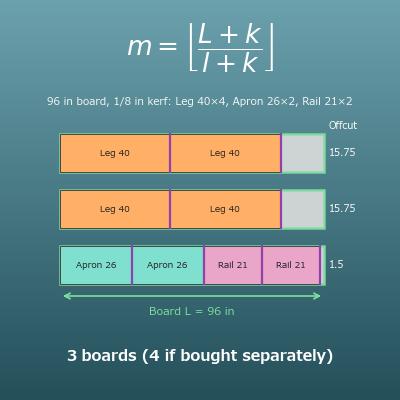
Lumber Cut List Calculator (Boards Needed and Cutting Layout)
Find how many pieces you can cut from each board, saw kerf included, and the layout that uses the fewest boards
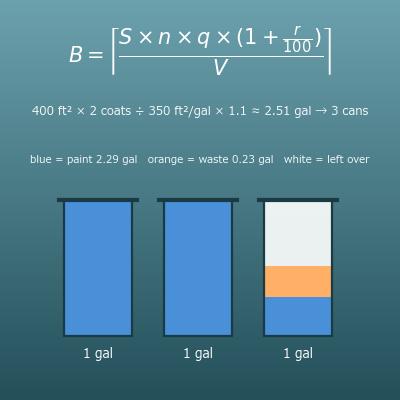
Paint Calculator (How Many Gallons and Cans, from Area, Coverage and Coats)
Find how much deck stain or sealer you need, and how many cans, from the area to cover
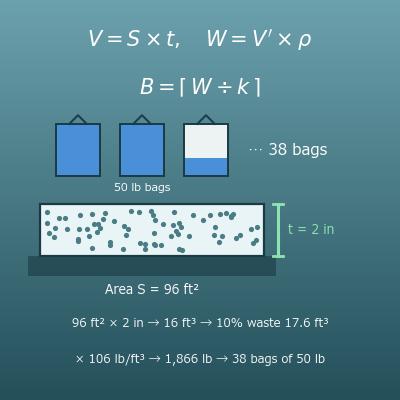
Gravel Calculator (Cubic Yards, Tons and Bags)
Find the gravel to spread under the deck to stop weeds, from the area and depth
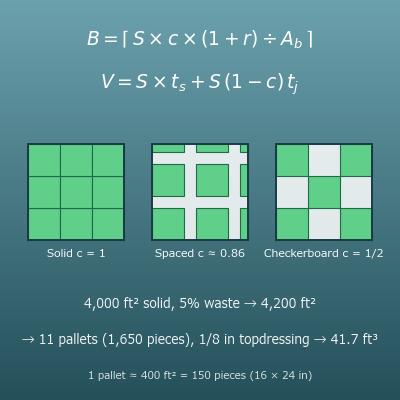
Sod Calculator (Square Feet, Pallets and Topdressing)
For the sod and topdressing when you lay a lawn around the deck
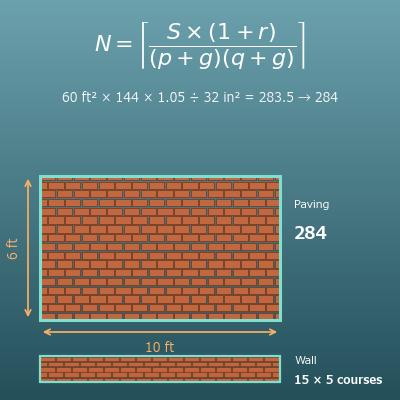
Brick Calculator (Patios, Paths, Garden Edges and Low Walls)
Find the bricks, joints included, for a path or garden bed edge around the deck
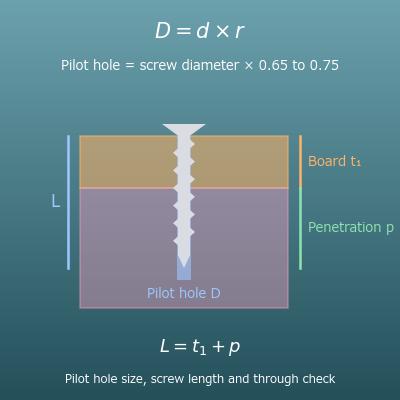
Pilot Hole and Screw Length Calculator (#6, #8, #10 Wood Screws)
Find the pilot hole and the right screw length for fastening deck boards
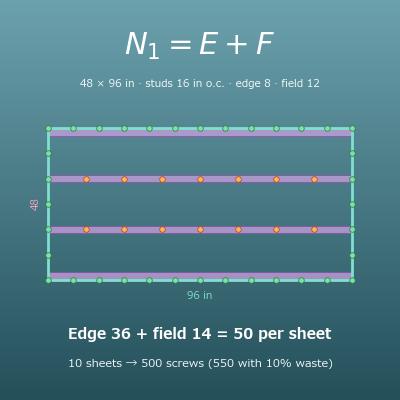
Screw Calculator (How Many Screws for Drywall, Plywood and Decking)
From the screws per board, find the total, the total with waste and the boxes to buy
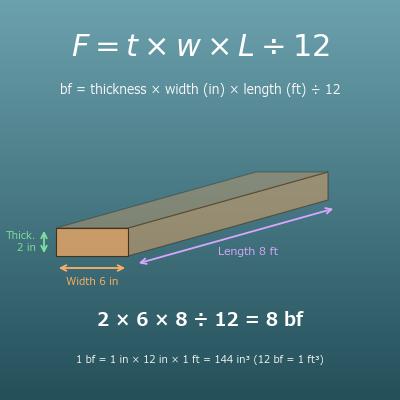
Board Foot Calculator (Board Feet, Cubic Feet and Lumber Cost)
Find the lumber volume in board feet and the cost from the size, length and number of pieces
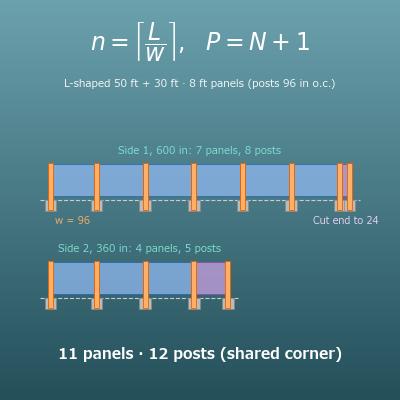
Fence Calculator (Posts, Panels, Rails and Pickets)
Find the posts, pickets and rails for a railing or fence around the deck from its length
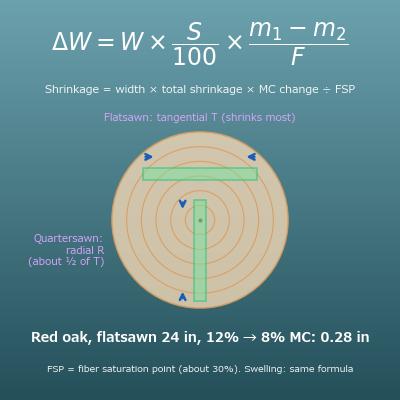
Wood Shrinkage Calculator (Wood Movement from Moisture Content Change)
Find how much a deck board changes in width as it dries or takes on water, to set the gap