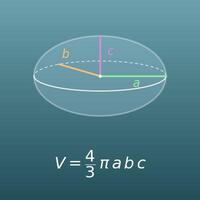
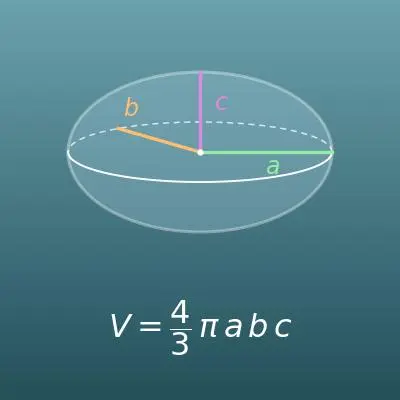
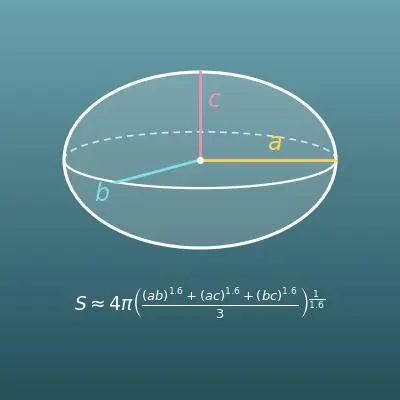
Enter the three semi-axes \(a\), \(b\) and \(c\) of the ellipsoid (the distances from the center to the surface). You get the surface area \(S\) (Thomsen's approximation), and the area in m² if you entered centimeters.
Table of Contents
-
What you can do on this page
-
What is this calculation used for?
-
How to Use
-
Formulas and figures
-
Symbols and terms
-
Good to know before you start
-
How to calculate it in Excel
-
How to calculate it in Google Sheets
-
How to calculate it in Python
-
How to write it in LaTeX and other math languages (copy and paste)
-
How to have ChatGPT do the calculation
-
DataChef Features
-
Related Features
-
NumberChef Calculators List
What you can do on this page
- Just enter the three semi-axes \(a\), \(b\) and \(c\) (the distances from the center to the surface), and you get the surface area of the ellipsoid on the spot (calculated with Thomsen's approximation, which is widely used around the world)
- The result is also shown as a 3D figure you can rotate with the mouse, so you can see at a glance which length goes in which direction
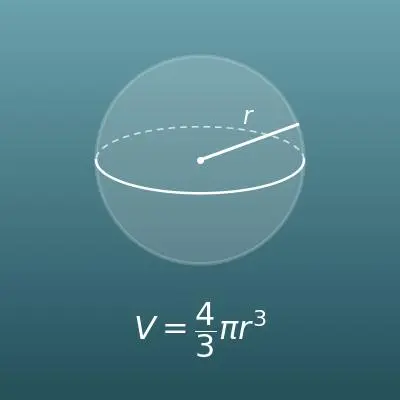
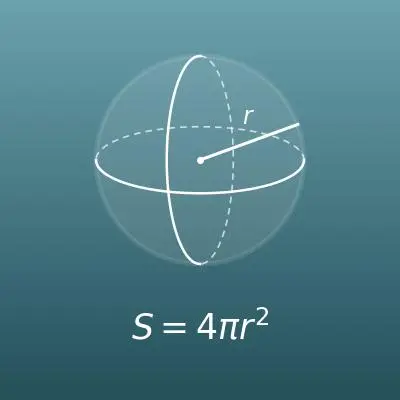
- Enter the same length in all three fields and it works for the surface area of a sphere (\(S = 4\pi r^2\)) too (in this case the result is exact, not an approximation)
- If you enter inches, the area is also converted to square feet (ft²)
- A plain-language explanation of the formulas and copy-and-paste formulas for Excel, Google Sheets and Python are all on this page
What is this calculation used for?
The Earth is a spheroid, slightly flattened by its spin. Put an equatorial radius of about 3,963 mi and a polar radius of about 3,950 mi into this formula, and the surface area comes out to about \(1.97 \times 10^8\,\mathrm{mi^2}\) (about 197 million square miles), which agrees well with the value in reference books.
Facts such as "about 70% of the Earth's surface is ocean", and estimates of the amount of air and seawater, start from this surface area. The formula is really used for bodies that are not perfect spheres.
A chicken egg is close to an ellipsoid. For an egg about 2.4 in long and about 1.8 in thick, the semi-axes are \(1.2 \times 0.9 \times 0.9\,\mathrm{in}\), and the surface area is about \(12.5\,\mathrm{in^2}\).
The amount of material that covers a surface, such as chocolate for coating egg-shaped candy, the area for dyeing or printing on eggshells, or the size of shrink-wrap film, can be estimated from the surface area (real eggs are not perfect ellipsoids, so this is only a guide).
The hull of an airship is designed close to a long spheroid. For example, treat an airship 240 ft long with a maximum diameter of 46 ft as an ellipsoid with semi-axes of \(120 \times 23 \times 23\,\mathrm{ft}\), and the surface area is about \(27{,}500\,\mathrm{ft^2}\). This is useful for a first estimate of how much envelope fabric or paint is needed.
Surface area is also directly tied to air resistance (skin friction) and to how heat flows in and out, so it is one of the first quantities to pin down when designing vehicles or dome buildings (the detailed design then switches to calculations on the real shape).
Watermelons and melons are close to ellipsoids, so this formula can estimate their surface area from their size. For a watermelon with semi-axes of \(6 \times 5 \times 5\,\mathrm{in}\), the surface area is about \(357\,\mathrm{in^2}\) (about 2.5 ft²).
It helps as a guide for jobs that cover the surface of the fruit, such as choosing the size of fruit bags, the amount of food-grade wax or coating, or how much wrapping material to order.
A football is close to a long spheroid. For a ball about 11 in long and about 7 in thick in the middle, the semi-axes are \(5.5 \times 3.5 \times 3.5\,\mathrm{in}\), and the surface area is about \(215\,\mathrm{in^2}\).
The ball is made by sewing together 4 panels, so you can estimate that each panel needs about 54 in² of material (the seam allowance and bulging are added on top). It is a first step in planning material for curved products.
Formulas and figures
Symbols and terms
Symbols
| \(S\) | ess | A common symbol for area and surface area, from the first letter of "surface". On this page it stands for the surface area of the ellipsoid. |
| \(a,\ b,\ c\) | a, b, c | The lengths of the three semi-axes of the ellipsoid. Each is a distance from the center to the surface, like the radius of a sphere. Each is half the length from end to end (the axis). |
| \(\pi\) | pi | The ratio of a circle's circumference to its diameter. It is \(3.14159265\ldots\), a decimal that never ends and never repeats (an irrational number). The "3.14" used in school is an approximation of it. |
| \(\approx\) | approximately equal to | A symbol that says the two sides are nearly equal. Thomsen's formula is an approximation, so its two sides are joined with this symbol instead of an equals sign (=). |
| \(x^{1.6}\) | x to the power 1.6 | A power whose exponent (the small number at the upper right) is a decimal. \(x^{1.6} = x^{\frac{8}{5}}\), which is the fifth root of \(x\) multiplied by itself 8 times (rational exponents, taught in Algebra 2). It is hard to do by hand, but easy with a scientific calculator, Excel or Python. |
| \(r\) | r | The radius of a sphere, from the first letter of "radius". A sphere is an ellipsoid whose three semi-axes are all \(r\). |
| \(\mathrm{in^2}\) | square inches | A unit of area. A square with 1-inch sides has an area of 1 in². Do not mix it up with in³ (cubic inches), the unit of volume. |
| \(\mathrm{ft^2}\) | square feet | A unit of area. A square with 1-foot (12-inch) sides has an area of 1 ft², so \(1\,\mathrm{ft^2} = 144\,\mathrm{in^2}\). |
Terms
| ellipsoid | A smooth, egg-like solid, the 3D version of an ellipse. Wherever you slice it with a plane, the cross section is an ellipse (or a circle). A football or a watermelon has a shape close to it. |
| semi-axis | A distance from the center of the ellipsoid to its surface, measured in one of three directions of symmetry (at right angles to each other). These three lengths fix the size and shape of the ellipsoid. Each is half the length from end to end (the axis). |
| surface area | The area of the whole outside of a solid. It is the area of the "skin" of the solid if you could cut it open and lay it flat, and it is given in units of area such as in² or ft². |
| approximation | A formula that gives a value close enough to the exact one with a simple calculation. For quantities that are hard to calculate exactly, like the surface area of an ellipsoid, approximations are widely used in practice. |
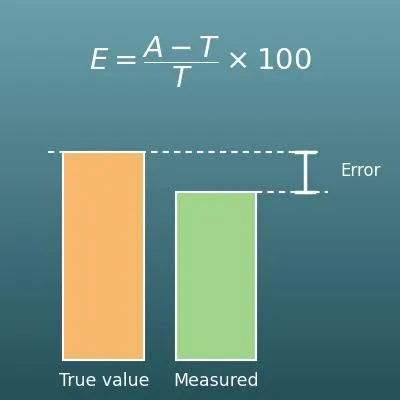
| Thomsen's approximation | An approximation for the surface area of an ellipsoid, proposed in 2004 by Knud Thomsen of Denmark. With the exponent 1.6, the error is known to stay within about ±1.06% for any shape, and it is the standard choice in calculators and in practice around the world. |
| elliptic integral | A college-level integral that appears when you find the exact surface area of an ellipsoid or the exact perimeter of an ellipse. The answer cannot be written with ordinary expressions (the four operations, powers and roots), so in practice approximations or numerical methods are used. |
| sphere | A special ellipsoid whose three semi-axes are all equal. It looks like a circle of the same size from every direction, and its surface area is \(S = 4\pi r^2\). |
| spheroid | The solid you get by spinning an ellipse around one of its axes, that is, an ellipsoid with two of its three semi-axes equal. A football (long, a prolate spheroid) and a mandarin orange (flattened, an oblate spheroid) are examples, and the Earth is a slightly flattened spheroid too. |
Good to know before you start
Here is what helps you use the calculation on this page with real understanding, not just by pressing the button.
| Multiplication and exponents (squares) (Grades 3–6) |
|
| What area is and its units (Grades 3–5) |
|
| Pi (Grade 7) |
|
| Surface area of a sphere (high school geometry) |
|
| Rational exponents (Algebra 2) |
|
How to calculate it in Excel
| Semi-axis a | 10 |
| Semi-axis b | 5 |
| Semi-axis c | 8 |
| Ellipsoid surface area | =4*PI()*(((B1*B2)^1.6+(B1*B3)^1.6+(B2*B3)^1.6)/3)^(1/1.6) |
| Radius | 3 |
| Sphere surface area | =4*PI()*B1^2 |
| Surface area in in² | 360 |
| Surface area in ft² | =B1/144 |
In a formula, "B1" and "B2" tell Excel to use the number in that cell. "*" is multiplication, "/" is division, "^" is a power (how many times to multiply; decimals such as 1.6 work too) and "PI()" is a function that returns pi (π).
In the first table, for example, B4 shows about 730.87 (in² if you entered inches). The second table shows about 113.10 in B2, and the third table shows 2.5 in B2. Just replace the input numbers with your own lengths.
How to calculate it in Google Sheets
| Semi-axis a | 10 |
| Semi-axis b | 5 |
| Semi-axis c | 8 |
| Ellipsoid surface area | =4*PI()*(((B1*B2)^1.6+(B1*B3)^1.6+(B2*B3)^1.6)/3)^(1/1.6) |
| Radius | 3 |
| Sphere surface area | =4*PI()*B1^2 |
| Surface area in in² | 360 |
| Surface area in ft² | =B1/144 |
How to calculate it in Python
import math

a = 10   # semi-axis a (in inches in this example; distance from the center to the surface)
b = 5    # semi-axis b (same unit as a)
c = 8    # semi-axis c (same unit as a and b)

# Thomsen's approximation (exponent p = 1.6). "**" is the power operator
p = 1.6
mean = ((a * b) ** p + (a * c) ** p + (b * c) ** p) / 3
surface_area = 4 * math.pi * mean ** (1 / p)   # ellipsoid surface area (input unit squared; in2 in this example)
surface_area_ft2 = surface_area / 144          # surface area in ft2, if you entered inches

print(f"Ellipsoid surface area: {surface_area} in2")
print(f"In square feet: {surface_area_ft2} ft2")
How to write it in LaTeX and other math languages (copy and paste)
S \approx 4\pi \left( \dfrac{(ab)^{1.6} + (ac)^{1.6} + (bc)^{1.6}}{3} \right)^{\frac{1}{1.6}}
<math xmlns="http://www.w3.org/1998/Math/MathML" display="block">
<mrow>
<mi>S</mi>
<mo>≈</mo>
<mn>4</mn>
<mi>π</mi>
<msup>
<mrow>
<mo>(</mo>
<mfrac>
<mrow>
<msup><mrow><mo>(</mo><mi>a</mi><mi>b</mi><mo>)</mo></mrow><mn>1.6</mn></msup>
<mo>+</mo>
<msup><mrow><mo>(</mo><mi>a</mi><mi>c</mi><mo>)</mo></mrow><mn>1.6</mn></msup>
<mo>+</mo>
<msup><mrow><mo>(</mo><mi>b</mi><mi>c</mi><mo>)</mo></mrow><mn>1.6</mn></msup>
</mrow>
<mn>3</mn>
</mfrac>
<mo>)</mo>
</mrow>
<mrow><mn>1</mn><mo>/</mo><mn>1.6</mn></mrow>
</msup>
</mrow>
</math>
S ~~ 4 pi (((a b)^1.6 + (a c)^1.6 + (b c)^1.6)/3)^(1/1.6)
4 Pi (((a b)^1.6 + (a c)^1.6 + (b c)^1.6)/3)^(1/1.6)
S := 4*Pi*(((a*b)^1.6 + (a*c)^1.6 + (b*c)^1.6)/3)^(1/1.6);
S = 4*pi*(((a*b)^1.6 + (a*c)^1.6 + (b*c)^1.6)/3)^(1/1.6);
S ≈ 4π(((ab)^1.6 + (ac)^1.6 + (bc)^1.6)/3)^(1/1.6)
S = 4πr²
S = 4\pi r^{2}
<math xmlns="http://www.w3.org/1998/Math/MathML" display="block">
<mrow>
<mi>S</mi>
<mo>=</mo>
<mn>4</mn>
<mi>π</mi>
<msup><mi>r</mi><mn>2</mn></msup>
</mrow>
</math>
S = 4 pi r^2
4 Pi r^2
S := 4*Pi*r^2;
S = 4*pi*r^2;
S = 4πr^2
S[ft²] = S[in²] ÷ 144
S_{\mathrm{ft^2}} = S_{\mathrm{in^2}} \div 144
<math xmlns="http://www.w3.org/1998/Math/MathML" display="block">
<mrow>
<msub><mi>S</mi><mrow><msup><mi mathvariant="normal">ft</mi><mn>2</mn></msup></mrow></msub>
<mo>=</mo>
<msub><mi>S</mi><mrow><msup><mi mathvariant="normal">in</mi><mn>2</mn></msup></mrow></msub>
<mo>÷</mo>
<mn>144</mn>
</mrow>
</math>
S_(ft^2) = S_(in^2) -: 144
sIn2/144
sFt2 := sIn2/144;
s_ft2 = s_in2/144;
S(ft²) = S(in²)/144
How to have ChatGPT do the calculation
You are a math calculation assistant. Do the following calculation by actually running Python code, and base your answer only on the numbers from the execution result (do not answer by mental math or guessing).

An ellipsoid has semi-axes a = 10 in, b = 5 in and c = 8 in (a semi-axis is the distance from the center to the surface).
Find each of the following:
1. The surface area of this ellipsoid in in². Use Thomsen's approximation S = 4 × π × (((a×b)^1.6 + (a×c)^1.6 + (b×c)^1.6) / 3)^(1/1.6)
2. That surface area in square feet (ft²)

Show the formulas you used and the numbers from the execution result.
How to Use
-
1Enter your numbersType the numbers you want to calculate with into the input fields
-
2CalculatePress the "Calculate" button
-
3Check the resultThe result appears on the spot. The same page also explains the idea behind the calculation and the formula
DataChef Features

No technical knowledge required.
Intuitive and user-friendly operation.

Can be used without registering personal information.

Automatic file deletion by clicking "download".

and rapid file conversion.
No attribution required.

No need to contact us for commercial use permission.
Related Features
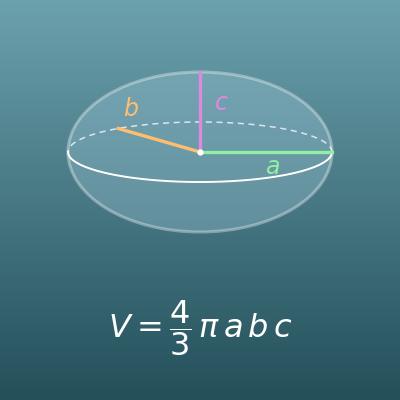
Ellipsoid Volume Calculator (V = 4/3 πabc)
Finds how much space the same ellipsoid takes up (its volume) from the three semi-axes, using an exact formula
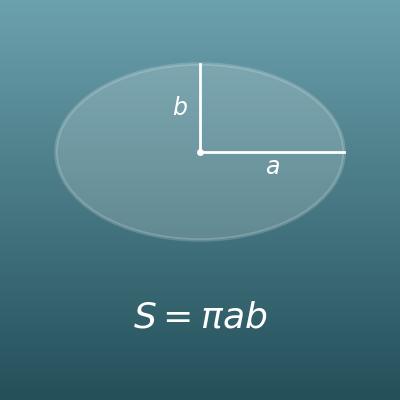
Area of an Ellipse Calculator (π × Semi-Major Axis × Semi-Minor Axis)
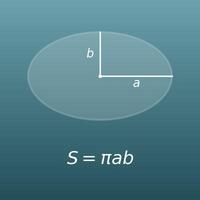
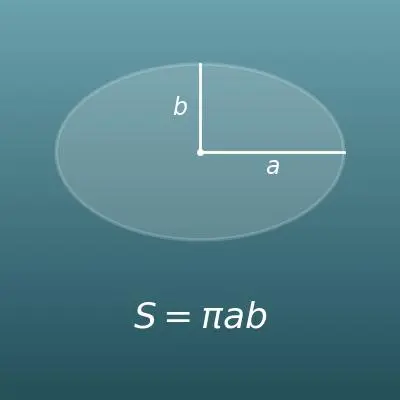
Finds the area of the ellipse you see when you cut an ellipsoid in half