

















Choose "Find the bill from kWh" or "Find kWh from a budget", then enter the kWh used (or your budget) and the rates of your plan. For a tiered plan, choose "Tiered" under "Rate type" to show the fields for each tier.
Table of Contents
-
What you can do on this page
-
What is this calculation used for?
-
How to Use
-
Formula
-
Symbols and terms
-
Good to know before you start
-
How to calculate it in Excel
-
How to calculate it in Google Sheets
-
How to calculate it in Python
-
How to write it in LaTeX and other math languages (copy and paste)
-
How to have ChatGPT do the calculation
-
DataChef Features
-
Related Features
-
NumberChef Calculators List
What you can do on this page
- Enter the kWh shown on your electric bill or your utility account and the rates of your plan, and you get the total bill for that month on the spot
- Tiered rates such as "first 500 kWh at one price, up to 1,000 kWh at another, and more above that" are supported (up to 3 tiers). You also see the kWh and cost in each tier, and the effective rate (the total divided by the kWh, or what you really pay per kWh)
- You can add a monthly customer charge and other per-kWh charges, such as a fuel adjustment charge or delivery charges (a negative value is allowed for credits)
- To keep your bill under a set amount, switch to the reverse mode to find how many kWh your budget allows (with tiered rates, the tiers are filled in order for an exact answer)
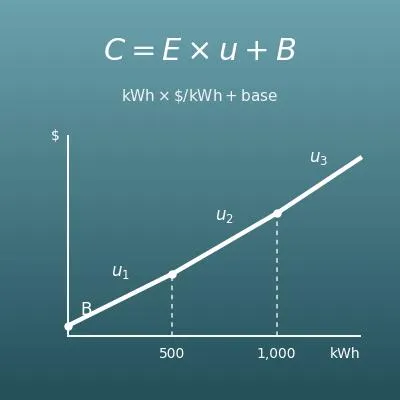
- A line graph shows how the bill grows with usage. With tiered rates, you can see the slope (the rate) change at each tier boundary
What is this calculation used for?
Your bill shows the kWh used and the amount due, but you only see why it comes to that amount when you work out the breakdown. For example, with 1,200 kWh, a $12 customer charge, tiered rates ($0.12 for the first 500 kWh, $0.14 up to 1,000 kWh, $0.16 above that) and other charges of $0.03/kWh, the bill is an energy charge of $162 + other charges of $36 + a customer charge of $12 = $210.
Once you can work out the breakdown yourself, you can tell why a bill went up, for example "the fuel adjustment charge went up" or "usage reached Tier 3", and understand the change. (The real bill may differ by a few cents because of rounding, taxes and fees.)
Once you decide "I want to keep electricity under $100 a month", work backward to find how many kWh that allows. Then you can check your usage in your utility account during the month. For example, with a $12 customer charge, a flat rate of $0.15/kWh and other charges of $0.02/kWh, the limit is \((100 - 12) \div 0.17 \approx 517.6\) kWh.
A goal in kWh instead of dollars lets you track a number you control, your usage, even if the rates change.
With tiered rates, the kWh you cut come off the top tier (the highest price) first. If a home that uses 1,200 kWh cuts 100 kWh by using the air conditioner less, the cut comes from Tier 3, so the savings are \(100 \times (0.16 + 0.03) = 19\) dollars. That is more than the $17.50 you would get with the average effective rate ($0.175/kWh).
On the other hand, if a home stays within Tier 1 (for example 400 kWh) and cuts 50 kWh, it saves only the Tier 1 price, \(50 \times (0.12 + 0.03) = 7.50\) dollars. With this formula you can see in numbers that the same cut saves more in a home that uses a lot, which helps you decide what to do first.
Replacing appliances with efficient ones, or using power from your own solar panels, cuts the kWh you buy from the utility. The money saved is "kWh cut × the price those kWh were charged at (plus other charges)". For example, if you cut 150 kWh a month and those kWh were in Tier 3 ($0.16/kWh) plus other charges of $0.03/kWh, you save \(150 \times 0.19 = 28.50\) dollars a month, or $342 a year.
This estimate is the result for the rates and usage you entered. In reality it changes with seasonal usage, rate changes and how your utility credits solar power (net metering rules differ by state). Allow a margin over several years when you decide.
If there is one meter for the home and you only know each person's kWh from submeters or smart plugs, be careful how you split the money. With tiered rates, splitting the bill "by share of kWh" can give the heavy user too much of the cheap tiers, or put too much of the customer charge on one person.
One fair way is to multiply each person's kWh by the overall effective rate (bill ÷ total kWh). With this method, everyone shares the customer charge and the tier differences on average. It gives you a common starting point when you talk about how to split the bill.
If you compare plans only by "the lowest rate", the ranking can flip because of the customer charge or the tier limits. Fix your own usage (for example 900 kWh), calculate the total bill for each plan with its customer charge, rates and tiers, and line them up by effective rate ($/kWh) for a fair comparison. In states where you can choose an electricity supplier, this is also a good way to compare offers.
Do the calculation for both a low-use month and a high-use month to see seasonal differences, such as "cheaper in summer and winter but more expensive in spring and fall". Rates change, so compare at current rates and check again from time to time.
Formula
Symbols and terms
Symbols
| \(E\) | Electricity used (energy). The total electricity used that month, in kWh (kilowatt-hours). From the word "energy". Your bill may call it "usage" or "kWh used". |
| \(u\) | Rate. The price of 1 kWh ($/kWh). From "unit price". |
| \(a\) | Other per-kWh charges ($/kWh). The total of charges added for each kWh used, such as a fuel adjustment charge, delivery charges and riders. From the word "addition". It can be negative (a credit). |
| \(B\) | Customer charge ($/month). A fixed monthly fee you pay no matter how much you use. From "basic charge". |
| \(C\) | Total bill ($). From the word "cost". |
| \(L_1,\ L_2\) | The Tier 1 and Tier 2 limits (kWh) of a tiered rate. From the word "limit". The small number at the lower right (a subscript) shows which tier. For "first 500 kWh", \(L_1 = 500\). |
| \(E_1,\ E_2,\ E_3\) | The kWh in each tier. When usage \(E\) is stacked from the cheapest tier, this is the amount that falls in each tier. \(E_1 + E_2 + E_3 = E\). |
| \(u_1,\ u_2,\ u_3\) | The rate of each tier ($/kWh). In most tiered plans, higher tiers cost more. |
| \(F\) | Energy charge ($). The part of the bill figured with the tier rates. From "fee". |
| \(\bar{u}\) | Effective rate ($/kWh). The total bill divided by the kWh used, or what you really pay per kWh. The bar over the letter marks an averaged value, just as the mean is written \(\bar{x}\) in statistics. |
| \(P\) | Budget ($). The most you want to pay for electricity. B is already used for the customer charge, so this page uses P, from "plan", for the budget. |
| \(\min(E,\ L_1)\) | The smaller of \(E\) and \(L_1\). Short for "minimum". It writes "the limit if usage is over it, otherwise the usage itself" as one expression. |
Terms
| kWh (kilowatt-hour) | The unit of energy, or the total amount of electricity used. Using 1 kW (1000 W) for 1 hour uses 1 kWh. Electric bills are based on kWh, such as "usage 900 kWh". |
| Electric bill | The monthly statement from your utility. It shows the kWh used, the amount due and the rates and charges. Many utilities also show it on their website or app. |
| Customer charge | A fixed monthly fee you pay even if you use no electricity. It is also called a basic service charge or a base charge. Some plans have none. |
| Energy charge | The charge based on how many kWh you use, figured as rate × kWh. With tiered rates, it is figured for each tier and added up. |
| Tiered rate | A rate that splits usage into tiers, such as "first 500 kWh", "up to 1,000 kWh" and "more than that", with a different price for each tier. When the price goes up with each tier, it is also called an inclining block rate. The more you use, the more kWh fall into the pricier tiers, so saving energy also lowers your cost per kWh. |
| Flat rate | A rate where every kWh costs the same no matter how much you use. The bill is simply "kWh × rate + customer charge". |
| Effective rate | The total bill divided by the kWh used, or what you really pay per kWh. It is an average that includes the customer charge, the tiers and the other charges, and it is used to compare plans and roughly estimate savings. |
| Fuel adjustment charge | A charge (or credit) per kWh that passes changes in the cost of power plant fuel, such as natural gas and coal, on to customers. It is updated from time to time and may be called a fuel cost adjustment or a power cost adjustment. Check your bill for the name and amount. |
| Delivery charge | The charge for bringing electricity to your home over the power lines, often split into transmission and distribution charges. In states where you can choose your electricity supplier, the bill shows the supply charge and the delivery charge separately. Many delivery charges are set per kWh. |
| Rider | An extra line item on a bill, approved by the state utility commission, that recovers a specific cost, such as energy efficiency programs or storm recovery. Many riders are charged per kWh. |
| Progressive pricing | A system where a higher rate applies only to the part above each threshold as the amount grows. Tiered electricity rates and federal income tax brackets both work this way. Not every unit is charged at the higher rate, which is the key point. |
Good to know before you start
Here is what helps you understand the calculations on this page, not just use them.
If you get stuck, going back over the topics in this table is the quickest way forward.
| Multiplying and dividing decimals (Grade 5) |
|
| Unit rates (Grade 6) |
|
| Expressions and solving equations (Grades 7 to 8) |
|
| Graphs of linear functions (Grade 8) |
|
| Power and energy (middle school physical science) |
|
How to calculate it in Excel
| Electricity used (kWh) | 900 |
| Rate ($/kWh) | 0.14 |
| Other per-kWh charges ($/kWh) | 0.03 |
| Customer charge ($) | 12 |
| Total bill ($) | =B1*(B2+B3)+B4 |
| Electricity used (kWh) | 1200 |
| Tier 1 limit (kWh) | 500 |
| Tier 1 rate ($/kWh) | 0.12 |
| Tier 2 limit (kWh) | 1000 |
| Tier 2 rate ($/kWh) | 0.14 |
| Tier 3 rate ($/kWh) | 0.16 |
| kWh in Tier 1 | =MIN(B1,B2) |
| kWh in Tier 2 | =MAX(MIN(B1,B4)-B2,0) |
| kWh in Tier 3 | =MAX(B1-B4,0) |
| Energy charge ($) | =B7*B3+B8*B5+B9*B6 |
| Energy charge ($) | 162 |
| Other per-kWh charges ($/kWh) | 0.03 |
| Electricity used (kWh) | 1200 |
| Customer charge ($) | 12 |
| Total bill ($) | =B1+B2*B3+B4 |
| Effective rate ($/kWh) | =B5/B3 |
| Budget ($) | 165 |
| Customer charge ($) | 12 |
| Rate ($/kWh) | 0.14 |
| Other per-kWh charges ($/kWh) | 0.03 |
| kWh you can use | =(B1-B2)/(B3+B4) |
The first table is a flat-rate example, and B5 shows 165 ($). The second table is a tiered example. It uses MIN (the smaller value) and MAX (the larger value) to find the kWh in each tier (500, 500 and 200 in B7 to B9), and B10 shows an energy charge of 162 ($).
The third table adds the other per-kWh charges and the customer charge to that energy charge. B5 shows 210 ($) and B6 shows an effective rate of 0.175 ($/kWh). The fourth table works backward, and B5 shows 900 (kWh). Just change the numbers in column B to your own plan's values.
How to calculate it in Google Sheets
| Electricity used (kWh) | 900 |
| Rate ($/kWh) | 0.14 |
| Other per-kWh charges ($/kWh) | 0.03 |
| Customer charge ($) | 12 |
| Total bill ($) | =B1*(B2+B3)+B4 |
| Electricity used (kWh) | 1200 |
| Tier 1 limit (kWh) | 500 |
| Tier 1 rate ($/kWh) | 0.12 |
| Tier 2 limit (kWh) | 1000 |
| Tier 2 rate ($/kWh) | 0.14 |
| Tier 3 rate ($/kWh) | 0.16 |
| kWh in Tier 1 | =MIN(B1,B2) |
| kWh in Tier 2 | =MAX(MIN(B1,B4)-B2,0) |
| kWh in Tier 3 | =MAX(B1-B4,0) |
| Energy charge ($) | =B7*B3+B8*B5+B9*B6 |
| Energy charge ($) | 162 |
| Other per-kWh charges ($/kWh) | 0.03 |
| Electricity used (kWh) | 1200 |
| Customer charge ($) | 12 |
| Total bill ($) | =B1+B2*B3+B4 |
| Effective rate ($/kWh) | =B5/B3 |
| Budget ($) | 165 |
| Customer charge ($) | 12 |
| Rate ($/kWh) | 0.14 |
| Other per-kWh charges ($/kWh) | 0.03 |
| kWh you can use | =(B1-B2)/(B3+B4) |
How to calculate it in Python
kwh = 1200                      # Electricity used (kWh)
base_fee = 12                   # Customer charge ($/month). 0 if none
extra_per_kwh = 0.03            # Other per-kWh charges ($/kWh). 0 if none
# Tiered rate: (limit in kWh, rate) from the cheapest tier. The last tier has limit None (no limit)
# For a flat rate, write just one tier, such as [(None, 0.14)]
tiers = [(500, 0.12), (1000, 0.14), (None, 0.16)]

# kWh and charge for each tier (stack the usage from the cheapest tier)
energy_charge = 0
previous_limit = 0
for limit, unit_price in tiers:
    if limit is None:
        part = max(kwh - previous_limit, 0)
    else:
        part = max(min(kwh, limit) - previous_limit, 0)
        previous_limit = limit
    energy_charge += part * unit_price
    print(f"{part:.2f} kWh x ${unit_price}/kWh = ${part * unit_price:.2f}")

total = energy_charge + extra_per_kwh * kwh + base_fee
print(f"Energy charge ${energy_charge:.2f} / other charges ${extra_per_kwh * kwh:.2f} / customer charge ${base_fee}")
print(f"Total bill ${total:.2f} / effective rate ${total / kwh:.4f}/kWh")

# Working backward: kWh a budget allows (fill the tiers in order)
budget = 210
remaining = budget - base_fee
available_kwh = 0
previous_limit = 0
for limit, unit_price in tiers:
    price_with_extra = unit_price + extra_per_kwh
    if limit is None:
        available_kwh += remaining / price_with_extra
        break
    cost_to_fill = (limit - previous_limit) * price_with_extra
    if remaining <= cost_to_fill:
        available_kwh += remaining / price_with_extra
        break
    available_kwh += limit - previous_limit
    remaining -= cost_to_fill
    previous_limit = limit
print(f"kWh you can use with a ${budget} budget: {available_kwh:.2f} kWh")
How to write it in LaTeX and other math languages (copy and paste)
C = E × (u + a) + B
C = E \times (u + a) + B
<math xmlns="http://www.w3.org/1998/Math/MathML" display="block">
<mrow>
<mi>C</mi>
<mo>=</mo>
<mi>E</mi>
<mo>×</mo>
<mo>(</mo>
<mi>u</mi>
<mo>+</mo>
<mi>a</mi>
<mo>)</mo>
<mo>+</mo>
<mi>B</mi>
</mrow>
</math>
C = E * (u + a) + B
cost = energy*(unitPrice + extra) + baseFee
C := E*(u + a) + B;
C = E*(u + a) + B;
C = E×(u + a) + B
F = E₁×u₁ + E₂×u₂ + E₃×u₃
F = E_1 u_1 + E_2 u_2 + E_3 u_3
<math xmlns="http://www.w3.org/1998/Math/MathML" display="block">
  <mrow>
    <mi>F</mi>
    <mo>=</mo>
    <msub><mi>E</mi><mn>1</mn></msub>
    <msub><mi>u</mi><mn>1</mn></msub>
    <mo>+</mo>
    <msub><mi>E</mi><mn>2</mn></msub>
    <msub><mi>u</mi><mn>2</mn></msub>
    <mo>+</mo>
    <msub><mi>E</mi><mn>3</mn></msub>
    <msub><mi>u</mi><mn>3</mn></msub>
  </mrow>
</math>
F = E_1 u_1 + E_2 u_2 + E_3 u_3
energyCharge = e1*u1 + e2*u2 + e3*u3
F := E1*u1 + E2*u2 + E3*u3;
F = E1*u1 + E2*u2 + E3*u3;
F = E_1 u_1 + E_2 u_2 + E_3 u_3
C = F + a × E + B, ū = C ÷ E
C = F + aE + B, \quad \bar{u} = \frac{C}{E}
<math xmlns="http://www.w3.org/1998/Math/MathML" display="block">
<mrow>
<mi>C</mi>
<mo>=</mo>
<mi>F</mi>
<mo>+</mo>
<mi>a</mi>
<mi>E</mi>
<mo>+</mo>
<mi>B</mi>
<mo>,</mo>
<mspace width="1em"/>
<mover><mi>u</mi><mo>¯</mo></mover>
<mo>=</mo>
<mfrac><mi>C</mi><mi>E</mi></mfrac>
</mrow>
</math>
C = F + a E + B, bar u = C / E
total = energyCharge + extra*energy + baseFee; effectivePrice = total/energy
C := F + a*E + B; ubar := C/E;
C = F + a*E + B; u_bar = C/E;
C = F + aE + B, u̅ = C/E
E = (P − B) ÷ (u + a)
E = \frac{P - B}{u + a}
<math xmlns="http://www.w3.org/1998/Math/MathML" display="block">
<mrow>
<mi>E</mi>
<mo>=</mo>
<mfrac>
<mrow><mi>P</mi><mo>−</mo><mi>B</mi></mrow>
<mrow><mi>u</mi><mo>+</mo><mi>a</mi></mrow>
</mfrac>
</mrow>
</math>
E = (P - B) / (u + a)
energy = (budget - baseFee)/(unitPrice + extra)
E := (P - B)/(u + a);
E = (P - B)/(u + a);
E = (P − B)/(u + a)
How to have ChatGPT do the calculation
You are an electric bill assistant. Do the calculation below by actually running Python code, and base your answer only on the numbers from the output (do not calculate in your head or guess).

The electricity used is 1,200 kWh. The plan has tiered rates: $0.12/kWh for the first 500 kWh, $0.14/kWh above 500 kWh up to 1,000 kWh, and $0.16/kWh above 1,000 kWh. The customer charge is $12 a month, and other per-kWh charges (such as a fuel adjustment charge) total $0.03/kWh.
For the tiered rate, stack the usage from the cheapest tier and add up "kWh in each tier × that tier's rate" to get the energy charge. Then add "other charges × kWh" and the customer charge to get the total.
Find each of the following.
1. The kWh and charge ($) in each tier
2. The energy charge, the total of the other charges, the customer charge and the total bill ($)
3. The effective rate (total ÷ kWh, in $/kWh, to 4 decimal places)
4. With the same plan, how many kWh you can use to keep the bill under $180 (spend the budget minus the customer charge from the cheapest tier upward)

Show the formulas you used and the numbers from the output.
How to Use
-
1Enter your numbersType the numbers you want to calculate with into the input fields
-
2CalculatePress the "Calculate" button
-
3Check the resultThe result appears on the spot. The same page also explains the idea behind the calculation and the formula
DataChef Features

No technical knowledge required.
Intuitive and user-friendly operation.

Can be used without registering personal information.

Automatic file deletion by clicking "download".

and rapid file conversion.

No attribution required.

No need to contact us for commercial use permission.
Related Features
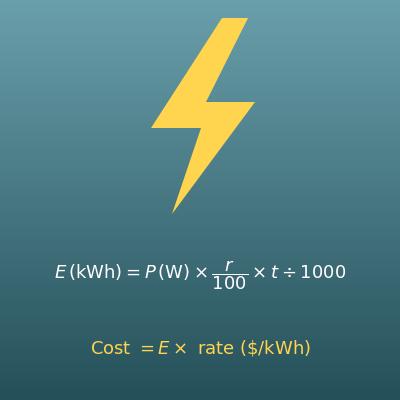
Electricity Cost Calculator (Appliance Energy Use and Cost)
Finds the energy use and cost per day, week, month and year from an appliance's wattage, duty cycle and hours of use
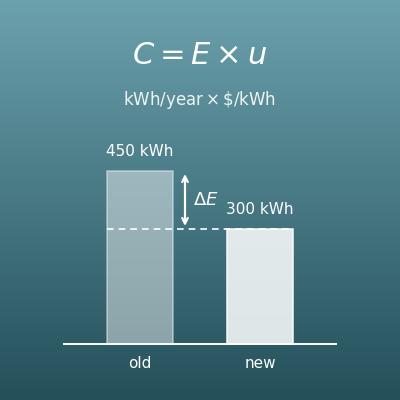
Annual kWh to Cost Calculator (EnergyGuide Label)
Turns the yearly kWh on an EnergyGuide label into the yearly, monthly and daily cost, and compares two models
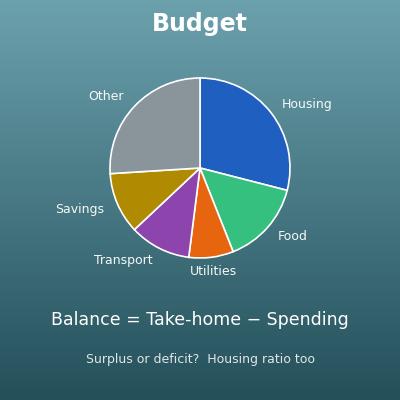
Monthly Budget Calculator (Income, Expenses and Housing Ratio)
Shows your monthly surplus or shortfall and the breakdown of spending, including utilities such as electricity