



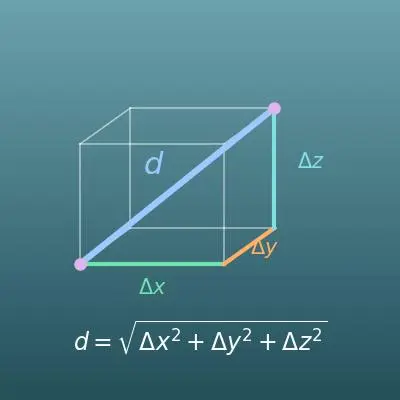


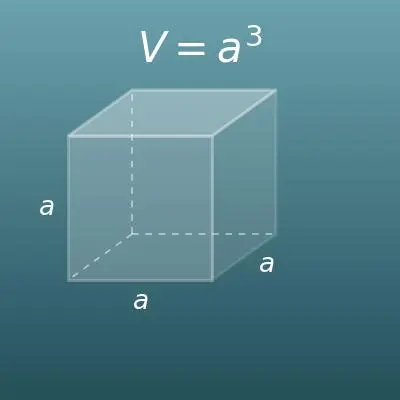
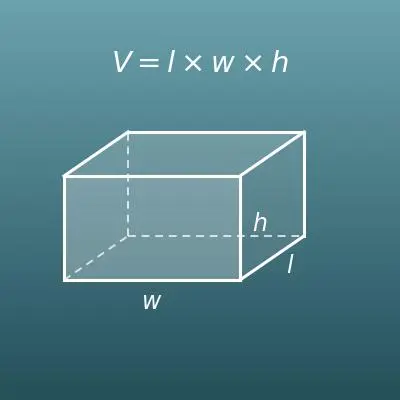







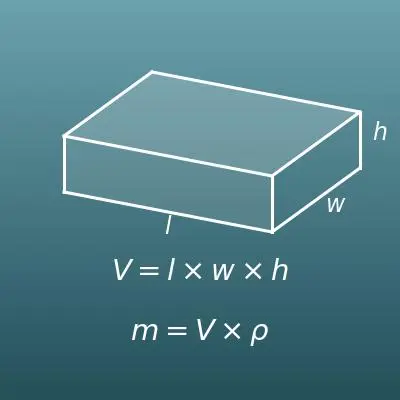
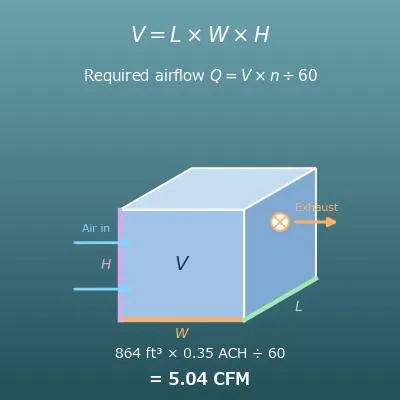
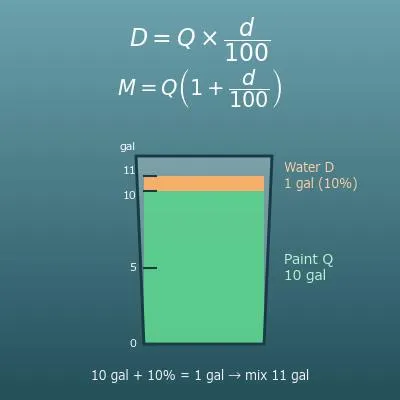
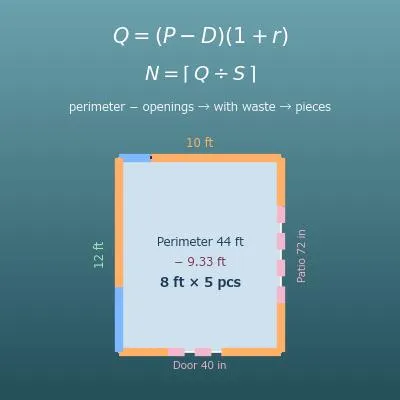
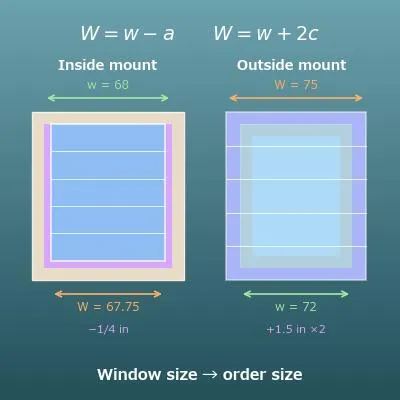
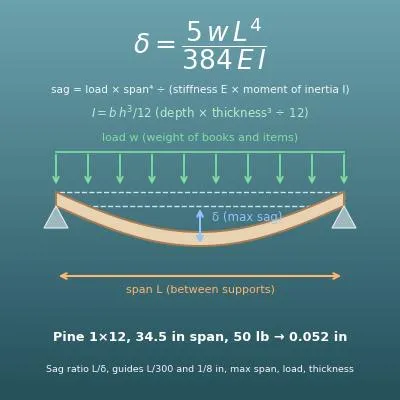
Enter the length, width and height of the box. The volume (length × width × height) is shown, along with conversions to liters (L) and cubic meters (m³).
Table of Contents
-
What you can do on this page
-
What is this calculation used for?
-
How to Use
-
Formulas and figures
-
Symbols and terms
-
Good to know before you start
-
How to calculate it in Excel
-
How to calculate it in Google Sheets
-
How to calculate it in Python
-
How to write it in LaTeX and other math languages (copy and paste)
-
How to have ChatGPT do the calculation
-
DataChef Features
-
Related Features
-
NumberChef Calculators List
What you can do on this page
- Enter the three lengths (length, width and height), and the volume of the rectangular prism (volume = length × width × height) is calculated on the spot
- The result also shows the volume in other units: US gallons and cubic feet if you enter inches, and US gallons if you enter feet. Switch "Units" to Metric to get liters and cubic meters instead
- The result is also drawn as a 3D shape. Drag it with the mouse to turn it around and check its shape and size
- A plain-language explanation of the formulas and copy-and-paste formulas for Excel, Google Sheets and Python are all on this page
What is this calculation used for?
A standard 10-gallon aquarium is 20 in long, 10 in wide and 12 in tall. Its volume is \(20 \times 10 \times 12 = 2400\,\mathrm{in^3}\), which is \(2400 \div 231 \approx 10.4\) gallons (in practice you do not fill it to the brim, so it holds a little less water).
Heater wattage, filter capacity and how many fish you can keep are all rated "per gallon", so choosing an aquarium starts with this calculation.
If the inside of a bathtub is 50 in long and 22 in wide and you fill it 12 in deep, the water is \(50 \times 22 \times 12 = 13200\,\mathrm{in^3}\), or about \(13200 \div 231 \approx 57\) gallons (real tubs have sloped sides, so it is a little less).
A US showerhead uses at most 2.5 gallons per minute, so a 10-minute shower uses about 25 gallons or less. Comparing a bath with a shower, like many ways to save water, starts with a volume calculation.
Carriers charge not only by actual weight but also by "dimensional weight". A common formula is "length × width × height (in inches) ÷ 139". A box 24 in by 16 in by 12 in has a volume of \(24 \times 16 \times 12 = 4608\,\mathrm{in^3}\), so its dimensional weight is \(4608 \div 139 \approx 33.2\) lb, which is rounded up to 34 lb.
The lighter and bulkier a package is, the more its volume matters, so this calculation is used every day in shipping.
To fill a raised bed that is 8 ft long, 4 ft wide and 1 ft deep, you need \(8 \times 4 \times 1 = 32\,\mathrm{ft^3}\) of soil.
Bagged soil is sold by volume, such as 2 cubic feet per bag, so \(32 \div 2 = 16\) bags will do. For a bulk delivery, which is sold by the cubic yard, it is \(32 \div 27 \approx 1.2\) yd³. This calculation helps you avoid buying too much or too little.
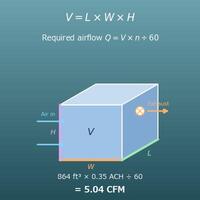
A room that is 12 ft long and 10 ft wide with an 8 ft ceiling holds \(12 \times 10 \times 8 = 960\,\mathrm{ft^3}\) of air.
Fans and air purifiers are rated in cubic feet per minute (CFM). A fan that moves 80 CFM takes \(960 \div 80 = 12\) minutes to move the same amount of air as the whole room, so knowing the room volume lets you read these numbers.
Formulas and figures
Symbols and terms
Symbols
| \(V\) | vee | The usual symbol for volume, from the first letter of "volume". |
| \(l\) | ell | The length of the box, from the first letter of "length". |
| \(w\) | double-u | The width of the box, from the first letter of "width". |
| \(h\) | aitch | The height of the box, from the first letter of "height". |
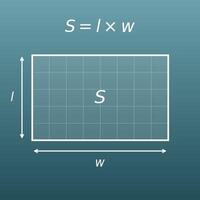
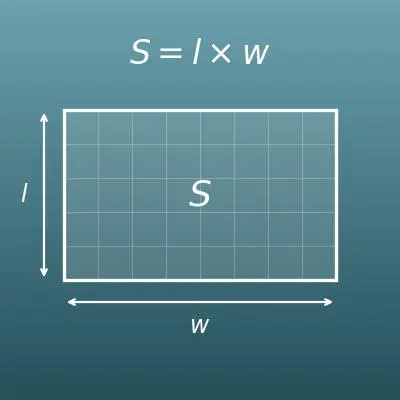
| \(S\) | ess | The area of the base (the rectangle at the bottom). On this page, \(S = l \times w\). Many US textbooks use \(B\) for the same thing. |
| \(\mathrm{in^3}\) | cubic inches | A unit of volume. A cube that is 1 inch on each side has a volume of 1 in³. Do not mix it up with in² (square inches), which is a unit of area. |
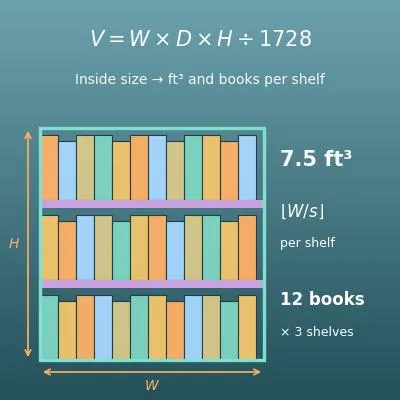
| \(\mathrm{ft^3}\) | cubic feet | A unit of volume. A cube that is 1 foot on each side has a volume of 1 ft³. \(1\,\mathrm{ft^3} = 1728\,\mathrm{in^3} \approx 7.48\) gallons, and \(1\,\mathrm{yd^3} = 27\,\mathrm{ft^3}\). |
| \(\mathrm{gal}\) | gallons | A unit for amounts of liquid such as water. 1 US gallon is exactly \(231\,\mathrm{in^3}\) (about 3.785 liters), and 1 gallon = 4 quarts. |
Terms
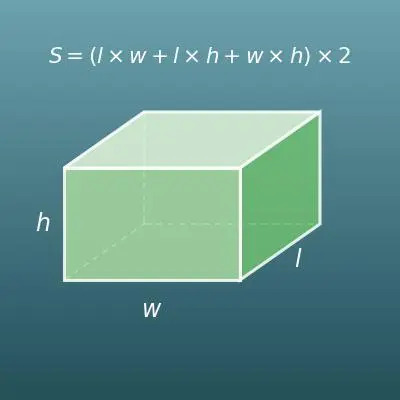
| rectangular prism | A box shape whose 6 faces are all rectangles (some may be squares). Tissue boxes, bricks and fish tanks are all rectangular prisms, the most common solid around us. |
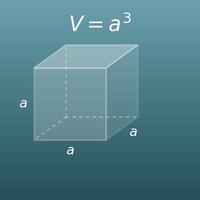
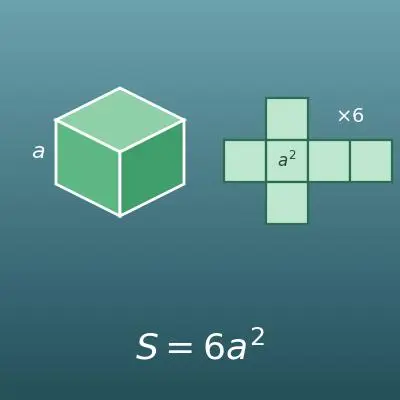
| cube | A solid whose 6 faces are all identical squares, the shape of a die. It is a special rectangular prism whose length, width and height are all equal. |
| volume | The amount of space a solid takes up, given as a number. It is measured by how many unit cubes, such as 1-inch cubes (1 in³), fit inside. |
| area of the base | The area of the bottom face of a solid. For a rectangular prism, it is the area of the bottom rectangle (length × width). "Area of the base × height" is the basic way to find the volume of a prism or cylinder. |
| prism | A solid made by stacking a polygon straight up without changing its shape. A rectangular prism is a prism whose base is a rectangle. |
| unit conversion | Writing the same amount in a different unit. For volume, the key point is that the volume factor is the length factor cubed (1 ft = 12 in, so 1 ft³ = 1728 in³). |
Good to know before you start
Here is what helps you use the calculation on this page with real understanding, not just by pressing the button.
| Multiplication (Grades 3–4) |
|
| Rectangular prisms and cubes (Grades 4–5) |
|
| What volume is and its units (Grade 5) |
|
| Multiplying decimals (Grades 5–6) |
|
How to calculate it in Excel
| Length (in) | 10 |
| Width (in) | 20 |
| Height (in) | 12 |
| Volume (in³) | =B1*B2*B3 |
| Length (in) | 10 |
| Width (in) | 20 |
| Height (in) | 12 |
| Area of the base (in²) | =B1*B2 |
| Volume (in³) | =B4*B3 |
| Volume in in³ | 2400 |
| Volume in ft³ | =B1/1728 |
In a formula, "B1" and "B2" mean "use the number in that cell", "*" is multiplication and "/" is division.
In the first table, for example, B4 shows 10 × 20 × 12 = 2400 (in³, since the inputs are in inches). The second table shows the same 2400 in B5, and the third table shows about 1.39 (ft³) in B2. To get US gallons instead, change "/1728" to "/231" (about 10.39 gallons). Just replace the input numbers with your own lengths.
How to calculate it in Google Sheets
| Length (in) | 10 |
| Width (in) | 20 |
| Height (in) | 12 |
| Volume (in³) | =B1*B2*B3 |
| Length (in) | 10 |
| Width (in) | 20 |
| Height (in) | 12 |
| Area of the base (in²) | =B1*B2 |
| Volume (in³) | =B4*B3 |
| Volume in in³ | 2400 |
| Volume in ft³ | =B1/1728 |
How to calculate it in Python
length = 10   # length (inches in this example)
width = 20    # width (same unit as length)
height = 12   # height (same unit as length)

volume = length * width * height   # volume (input unit cubed, in3 in this example)
volume_gal = volume / 231          # in US gallons (for inputs in inches)
volume_ft3 = volume / 1728         # in cubic feet (for inputs in inches)

print(f"Volume: {volume} in3")
print(f"In US gallons: {volume_gal} gal")
print(f"In cubic feet: {volume_ft3} ft3")
How to write it in LaTeX and other math languages (copy and paste)
V = l × w × h
V = l \times w \times h
<math xmlns="http://www.w3.org/1998/Math/MathML" display="block">
<mrow>
<mi>V</mi>
<mo>=</mo>
<mi>l</mi>
<mo>×</mo>
<mi>w</mi>
<mo>×</mo>
<mi>h</mi>
</mrow>
</math>
V = l xx w xx h
l*w*h
V := l*w*h;
V = l*w*h;
V = l × w × h
V = S × h
V = S \times h
<math xmlns="http://www.w3.org/1998/Math/MathML" display="block">
<mrow>
<mi>V</mi>
<mo>=</mo>
<mi>S</mi>
<mo>×</mo>
<mi>h</mi>
</mrow>
</math>
V = S xx h
s*h
V := S*h;
V = S*h;
V = S × h
V[ft³] = V[in³] ÷ 1728
V_{\mathrm{ft^3}} = V_{\mathrm{in^3}} \div 1728
<math xmlns="http://www.w3.org/1998/Math/MathML" display="block">
<mrow>
<msub><mi>V</mi><mrow><msup><mi mathvariant="normal">ft</mi><mn>3</mn></msup></mrow></msub>
<mo>=</mo>
<msub><mi>V</mi><mrow><msup><mi mathvariant="normal">in</mi><mn>3</mn></msup></mrow></msub>
<mo>÷</mo>
<mn>1728</mn>
</mrow>
</math>
V_(ft^3) = V_(in^3) -: 1728
vIn3/1728
vFt3 := vIn3/1728;
v_ft3 = v_in3/1728;
V(ft³) = V(in³)/1728
How to have ChatGPT do the calculation
You are a math calculation assistant. Do the following calculation by actually running Python code, and base your answer only on the numbers from the execution result (do not answer by mental math or guessing).

An aquarium shaped like a rectangular prism is 20 inches long, 10 inches wide and 12 inches tall.
Find each of the following:
1. The volume of the aquarium in cubic inches (in³)
2. That volume in US gallons (1 gallon = 231 in³)

Show the formulas you used and the numbers from the execution result.
How to Use
-
1Enter your numbersType the numbers you want to calculate with into the input fields
-
2CalculatePress the "Calculate" button
-
3Check the resultThe result appears on the spot. The same page also explains the idea behind the calculation and the formula
DataChef Features

No technical knowledge required.
Intuitive and user-friendly operation.

Can be used without registering personal information.

Automatic file deletion by clicking "download".

and rapid file conversion.

No attribution required.

No need to contact us for commercial use permission.
Related Features
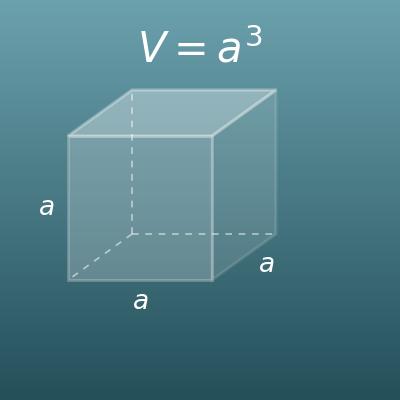
Volume of a Cube Calculator (Side × Side × Side)
Find the volume of a cube, the special box whose length, width and height are all equal, from the length of one side
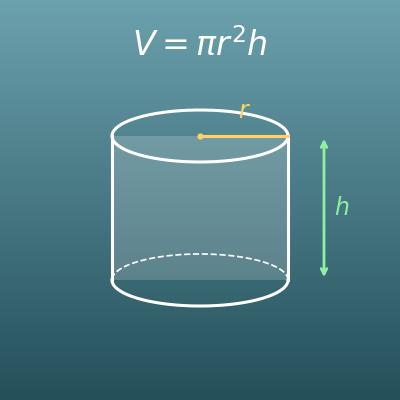
Cylinder Volume Calculator (V = πr²h)
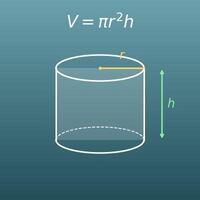
Find the volume of a cylinder (a solid with a circular base) from its radius and height
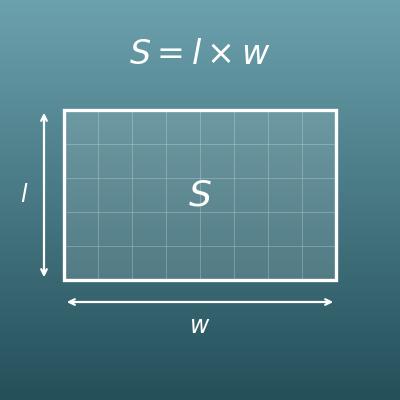
Area of a Rectangle Calculator (Length × Width)
Find the area of the base of the box (a rectangle), with unit conversions
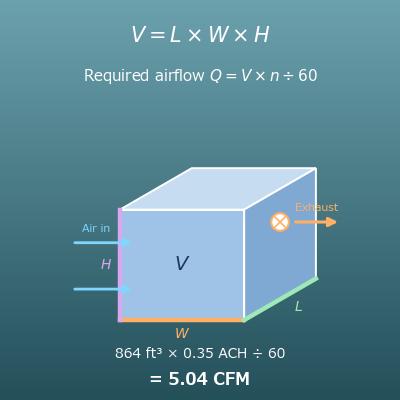
Room Volume and Ventilation Calculator (Air Changes per Hour, CFM)
Treat a room as a box to find its volume, then find the airflow needed for a given number of air changes
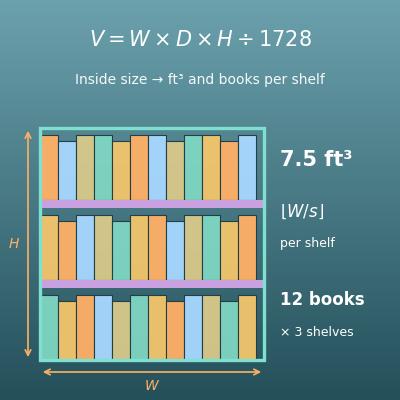
Storage Capacity Calculator (Cubic Feet, How Many Books and Bins Fit)
Find the capacity of a cabinet or shelf from its inside dimensions, and how many boxes or books fit on each shelf