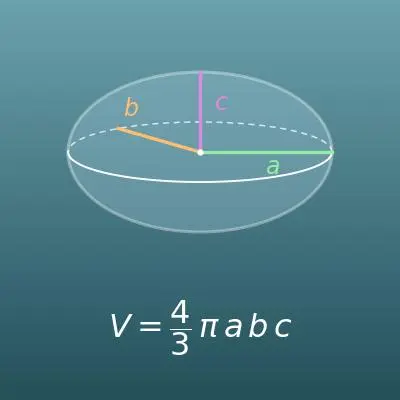
Enter the three semi-axes \(a\), \(b\) and \(c\) of the ellipsoid (the distances from the center to the surface). You get the volume \(V = \dfrac{4}{3}\pi abc\), and the volume in liters if you entered centimeters.
Table of Contents
-
What you can do on this page
-
What is this calculation used for?
-
How to Use
-
Formulas and figures
-
Symbols and terms
-
Good to know before you start
-
How to calculate it in Excel
-
How to calculate it in Google Sheets
-
How to calculate it in Python
-
How to write it in LaTeX and other math languages (copy and paste)
-
How to have ChatGPT do the calculation
-
DataChef Features
-
Related Features
-
NumberChef Calculators List
What you can do on this page
- Just enter the three semi-axes \(a\), \(b\) and \(c\) (the distances from the center to the surface), and you get the volume of the ellipsoid (\(V = \dfrac{4}{3}\pi abc\)) on the spot
- The result is also shown as a 3D figure you can rotate with the mouse, so you can see at a glance which length goes in which direction
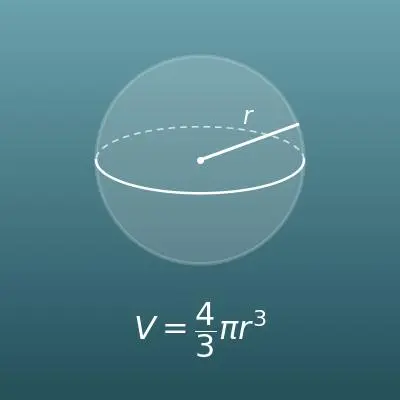
- Enter the same length in all three fields and it works as a sphere volume calculator (\(V = \dfrac{4}{3}\pi r^3\)) too
- If you enter inches, the volume is also converted to US gallons (gal)
- A plain-language explanation of the formulas and copy-and-paste formulas for Excel, Google Sheets and Python are all on this page
What is this calculation used for?
A football is close to a long, stretched spheroid. For a ball about 11 in long and about 7 in thick in the middle, the semi-axes are \(5.5 \times 3.5 \times 3.5\,\mathrm{in}\), so the volume is about \(\dfrac{4}{3}\pi \times 5.5 \times 3.5 \times 3.5 \approx 282\,\mathrm{in^3}\) (about 1.2 gal).
It is a handy formula whenever you want the size of something round that is not a sphere, such as for the amount of air in a ball, buoyancy or storage space (a real ball has seams and pointed ends, so this is only an approximation).
In ultrasound exams at hospitals, a common way to estimate the volume of an organ, a cyst or a tumor is to treat it as an ellipsoid. The three diameters (end to end) are measured at right angles to each other, and each is divided by 2 to get the semi-axes for this formula. This is the same as the "0.52 × length × width × height" rule seen in ultrasound reports, because \(\dfrac{4}{3}\pi \times \dfrac{1}{8} = \dfrac{\pi}{6} \approx 0.52\).
For example, if the diameters are \(4 \times 3 \times 3\,\mathrm{cm}\), the semi-axes are \(2 \times 1.5 \times 1.5\,\mathrm{cm}\), and the volume is \(\dfrac{4}{3}\pi \times 2 \times 1.5 \times 1.5 \approx 18.8\,\mathrm{mL}\) (1 cm³ = 1 mL; medicine uses metric units, even in the US). This calculation supports daily care, such as measuring the volume of the prostate or the bladder (organs are not perfect ellipsoids, so the result is used as an estimate).
Watermelons and melons are close to ellipsoids, so this formula can estimate their volume and weight from their size. For a watermelon with semi-axes of \(6 \times 5 \times 5\,\mathrm{in}\), the volume is \(\dfrac{4}{3}\pi \times 6 \times 5 \times 5 \approx 628\,\mathrm{in^3}\) (about 2.7 gal).
A watermelon is about as dense as water (about 8.3 lb per gallon), so it weighs roughly 23 lb. The same idea helps with designing box sizes and setting grading standards for shipping.
The Earth is a spheroid, slightly flattened by its spin. Put an equatorial radius of about 3,963 mi and a polar radius of about 3,950 mi into this formula, and the volume is \(\dfrac{4}{3}\pi \times 3963 \times 3963 \times 3950 \approx 2.599 \times 10^{11}\,\mathrm{mi^3}\) (about 260 billion cubic miles).
This almost matches the volume of the Earth given in reference books. Astronomers really use this formula for bodies that are not perfect spheres, such as planets flattened by their spin.
A chicken egg is close to an ellipsoid. For an egg about 2.4 in long and about 1.8 in thick, the semi-axes are \(1.2 \times 0.9 \times 0.9\,\mathrm{in}\), and the volume is about \(\dfrac{4}{3}\pi \times 1.2 \times 0.9 \times 0.9 \approx 4.1\,\mathrm{in^3}\) (a real egg is a little lopsided, so the measured value is a bit smaller).
You can roughly estimate the size of any "more or less ellipsoid" food, such as bread rolls or fruit, the container size you need, or how much water a water bath needs, without a scale.
Formulas and figures
Symbols and terms
Symbols
| \(V\) | vee | A common symbol for volume, from the first letter of "volume". On this page it stands for the volume of the ellipsoid (or sphere). |
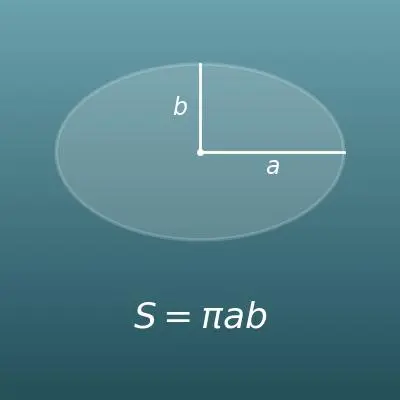
| \(a,\ b,\ c\) | a, b, c | The lengths of the three semi-axes of the ellipsoid. Each is a distance from the center to the surface, like the radius of a sphere. Each is half the length from end to end (the axis). |
| \(\pi\) | pi | The ratio of a circle's circumference to its diameter. It is \(3.14159265\ldots\), a decimal that never ends and never repeats (an irrational number). The "3.14" used in school is an approximation of it. |
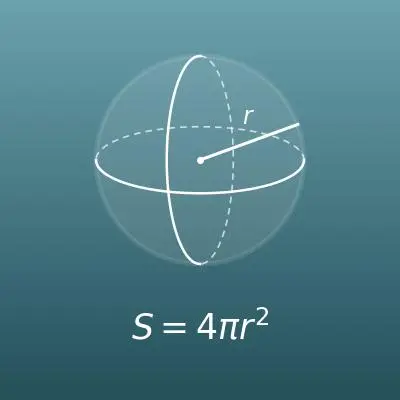
| \(r\) | r | The radius of a sphere, from the first letter of "radius". A sphere is an ellipsoid whose three semi-axes are all \(r\). |
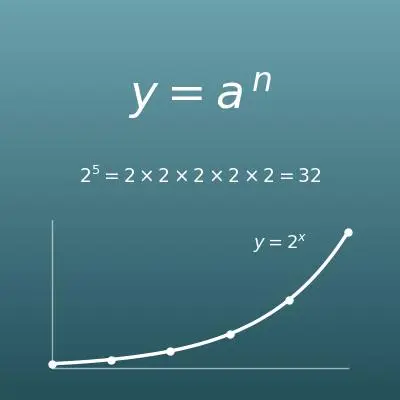
| \(r^3\) | r cubed | The number \(r\) multiplied by itself 3 times (\(r \times r \times r\)). The small 3 at the upper right is an exponent that says "multiply 3 times". |
| \(\mathrm{in^3}\) | cubic inches | A unit of volume. A cube with 1-inch sides has a volume of 1 in³. Do not mix it up with in² (square inches), the unit of area. |
| \(\mathrm{gal}\) | gallons | A unit of volume, mostly used for liquids. One US gallon is \(1\,\mathrm{gal} = 231\,\mathrm{in^3}\). |
Terms
| ellipsoid | A smooth, egg-like solid, the 3D version of an ellipse. Wherever you slice it with a plane, the cross section is an ellipse (or a circle). A football or a watermelon has a shape close to it. |
| semi-axis | A distance from the center of the ellipsoid to its surface, measured in one of three directions of symmetry (at right angles to each other). These three lengths fix the size and shape of the ellipsoid. Each is half the length from end to end (the axis). |
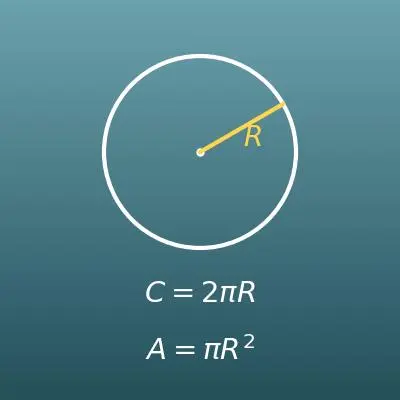
| ellipse | A circle stretched (or squashed) in one direction. It is a rounded, oval curve, like the shadow of a ball seen at a slant. |
| sphere | A special ellipsoid whose three semi-axes are all equal. It looks like a circle of the same size from every direction, and its volume is \(V = \dfrac{4}{3}\pi r^3\). |
| spheroid | The solid you get by spinning an ellipse around one of its axes, that is, an ellipsoid with two of its three semi-axes equal. A football (long, a prolate spheroid) and a mandarin orange (flattened, an oblate spheroid) are examples, and the Earth is a slightly flattened spheroid too. |
| volume | The amount of space a solid takes up, given as a number. It is measured by how many cubes with 1-inch sides (1 in³) would fill it. |
Good to know before you start
Here is what helps you use the calculation on this page with real understanding, not just by pressing the button.
| Multiplying whole numbers and decimals (Grades 3–5) |
|
| What volume is and its units (Grade 5) |
|
| Pi (Grade 7) |
|
| Multiplying fractions (Grade 5) |
|
| Volume of a sphere (Grade 8) |
|
How to calculate it in Excel
| Semi-axis a | 10 |
| Semi-axis b | 5 |
| Semi-axis c | 8 |
| Ellipsoid volume | =4/3*PI()*B1*B2*B3 |
| Radius | 3 |
| Sphere volume | =4/3*PI()*B1^3 |
| Volume in in³ | 462 |
| Volume in gal | =B1/231 |
In a formula, "B1" and "B2" tell Excel to use the number in that cell. "*" is multiplication, "/" is division, "^" is a power (how many times to multiply) and "PI()" is a function that returns pi (π).
In the first table, for example, B4 shows 4/3 × π × 10 × 5 × 8 = about 1675.52 (in³ if you entered inches). The second table shows about 113.10 in B2, and the third table shows 2 in B2. Just replace the input numbers with your own lengths.
How to calculate it in Google Sheets
| Semi-axis a | 10 |
| Semi-axis b | 5 |
| Semi-axis c | 8 |
| Ellipsoid volume | =4/3*PI()*B1*B2*B3 |
| Radius | 3 |
| Sphere volume | =4/3*PI()*B1^3 |
| Volume in in³ | 462 |
| Volume in gal | =B1/231 |
How to calculate it in Python
import math

a = 10   # semi-axis a (in inches in this example; distance from the center to the surface)
b = 5    # semi-axis b (same unit as a)
c = 8    # semi-axis c (same unit as a and b)

volume = 4 / 3 * math.pi * a * b * c   # ellipsoid volume (input unit cubed; in3 in this example)
volume_gal = volume / 231              # volume in US gallons, if you entered inches

print(f"Ellipsoid volume: {volume} in3")
print(f"In gallons: {volume_gal} gal")
How to write it in LaTeX and other math languages (copy and paste)
V = (4/3)πabc
V = \dfrac{4}{3}\pi abc
<math xmlns="http://www.w3.org/1998/Math/MathML" display="block">
<mrow>
<mi>V</mi>
<mo>=</mo>
<mfrac><mn>4</mn><mn>3</mn></mfrac>
<mi>π</mi>
<mi>a</mi>
<mi>b</mi>
<mi>c</mi>
</mrow>
</math>
V = 4/3 pi a b c
(4/3) Pi a b c
V := (4/3)*Pi*a*b*c;
V = 4/3*pi*a*b*c;
V = (4/3)πabc
V = (4/3)πr³
V = \dfrac{4}{3}\pi r^{3}
<math xmlns="http://www.w3.org/1998/Math/MathML" display="block">
<mrow>
<mi>V</mi>
<mo>=</mo>
<mfrac><mn>4</mn><mn>3</mn></mfrac>
<mi>π</mi>
<msup><mi>r</mi><mn>3</mn></msup>
</mrow>
</math>
V = 4/3 pi r^3
(4/3) Pi r^3
V := (4/3)*Pi*r^3;
V = 4/3*pi*r^3;
V = (4/3)πr^3
V[gal] = V[in³] ÷ 231
V_{\mathrm{gal}} = V_{\mathrm{in^3}} \div 231
<math xmlns="http://www.w3.org/1998/Math/MathML" display="block">
<mrow>
<msub><mi>V</mi><mi mathvariant="normal">gal</mi></msub>
<mo>=</mo>
<msub><mi>V</mi><mrow><msup><mi mathvariant="normal">in</mi><mn>3</mn></msup></mrow></msub>
<mo>÷</mo>
<mn>231</mn>
</mrow>
</math>
V_(gal) = V_(in^3) -: 231
vIn3/231
vGal := vIn3/231;
v_gal = v_in3/231;
V(gal) = V(in³)/231
How to have ChatGPT do the calculation
You are a math calculation assistant. Do the following calculation by actually running Python code, and base your answer only on the numbers from the execution result (do not answer by mental math or guessing).

An ellipsoid has semi-axes a = 10 in, b = 5 in and c = 8 in (a semi-axis is the distance from the center to the surface).
Find each of the following:
1. The volume of this ellipsoid in in³ (V = 4/3 × π × a × b × c)
2. That volume in US gallons (1 gal = 231 in³)

Show the formulas you used and the numbers from the execution result.
How to Use
-
1Enter your numbersType the numbers you want to calculate with into the input fields
-
2CalculatePress the "Calculate" button
-
3Check the resultThe result appears on the spot. The same page also explains the idea behind the calculation and the formula
DataChef Features

No technical knowledge required.
Intuitive and user-friendly operation.

Can be used without registering personal information.

Automatic file deletion by clicking "download".

and rapid file conversion.
No attribution required.

No need to contact us for commercial use permission.
Related Features
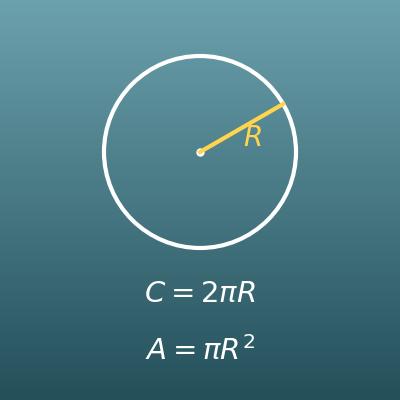
Circle Calculator (Radius, Diameter, Circumference and Area)
Finds the area and circumference of a circle, like the cross sections of a sphere, from one value such as the radius
Exponent Calculator (Powers, a to the nth Power)
Calculates powers (a to the n-th power), such as the "radius cubed" in the volume of a sphere