




















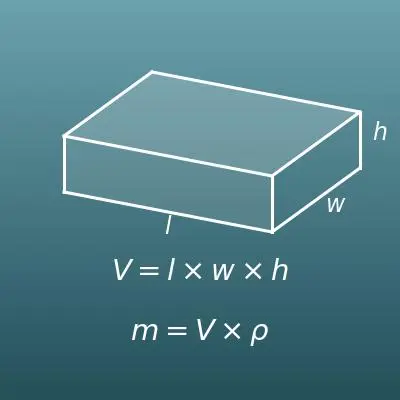
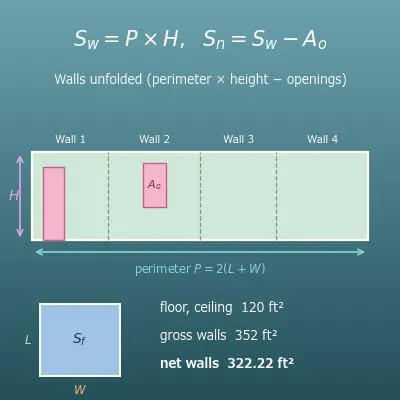
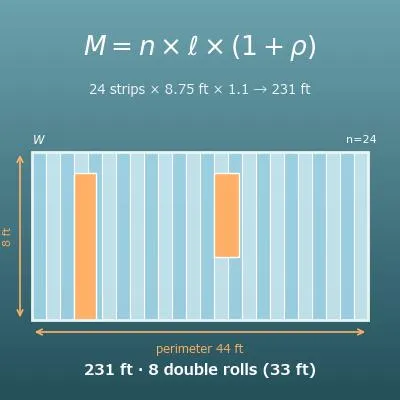
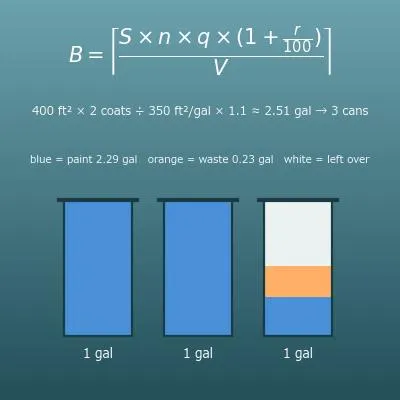
Choose "One frame" or "A row of identical frames", then enter the frame size, the hanger position and the target height in cm. If the target center height is blank, the eye-level guideline of 145 cm is used.
Table of Contents
-
What you can do on this page
-
What is this calculation used for?
-
How to Use
-
Formulas and figures
-
Symbols and terms
-
Good to know before you start
-
How to calculate it in Excel
-
How to calculate it in Google Sheets
-
How to calculate it in Python
-
How to write it in LaTeX and other math languages (copy and paste)
-
How to have ChatGPT do the calculation
-
DataChef Features
-
Related Features
-
NumberChef Calculators List
What you can do on this page
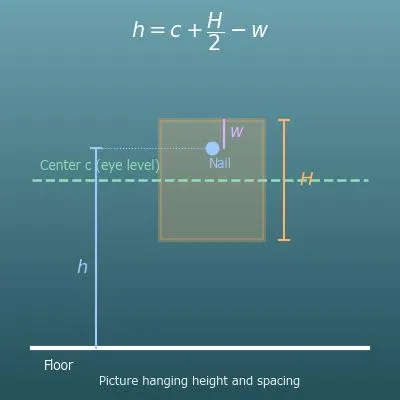
- From the frame height, the hanger position (the distance from the top of the frame to the hanger or the peak of the wire) and the target center height (by default eye level, 57 in from the floor), find the height for the nail or hook and the heights of the top and bottom of the frame
- Above a sofa or a TV stand, set the "bottom of the frame" height (top of the furniture + a gap) instead, and the center, top and nail heights are worked out from it
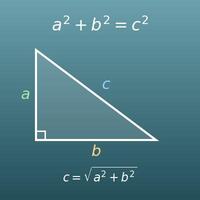
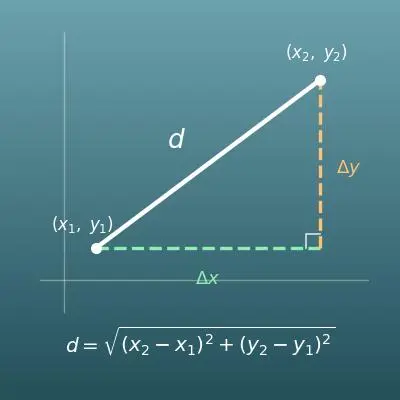
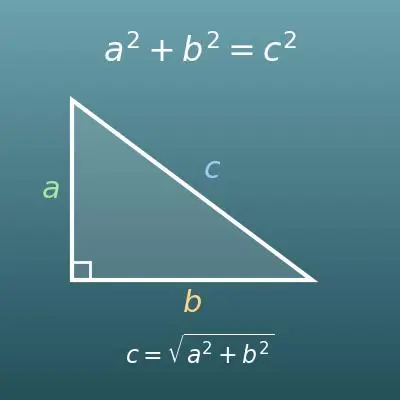
- For a frame hung by a wire, find how high the peak of the wire rises when pulled tight from the D-ring position, the D-ring spacing and the wire length (with the Pythagorean theorem), and get a nail height that allows for the slack
- To hang identical frames in a row, enter the wall width, the number of frames and the frame width, then choose "set the gap and center" or "space evenly across the wall" to get the total width, the side margins and the \(x\) position of each nail (from the left end of the wall)
- Check the result on a front view of the wall (floor, eye level, frames, nails). For a frame hung from two hangers, the positions of both nails are shown
What is this calculation used for?
If the top of the sofa back is 34 in above the floor, putting the bottom of the frame 6 to 10 in above it (40 to 44 in) makes the sofa and the art look like one group. For a 24 in tall frame with its bottom at 42 in, the center is at 54 in and the top at 66 in; with the hanger 3 in below the top, the nail goes at 63 in.
Whether eye level (57 in) or the gap to the furniture comes first depends on the room. In a room where people mostly sit, favor the gap to the furniture, even if the center ends up a little lower.
Three 16 in wide frames with 2 in gaps on a 120 in hallway wall have a total width of 52 in and side margins of 34 in, with frame centers 42, 60 and 78 in from the left end. Write these positions on paper before marking the wall, and you will not end up with extra holes from rehanging.
Even spacing on the same wall gives wide 18 in gaps that can look scattered, so for smaller frames like photos, setting the gap and centering the group makes it read as one piece.
In a rental, every rehang adds holes, so working out the nail height and position first and getting it right the first time pays off. In drywall, picture hooks work and leave holes about the size of a thumbtack.
The calculated height is where the hanger rests on the hook, so the nail itself goes about 1/8 in higher or lower depending on the hook. Hold the hook against the wall so its resting point is at the calculated height, and you will get it right the first time.
If the top of the TV screen is 45 in above the floor, putting the bottom of the frame about 6 in above it (51 in) keeps the TV and the art neither too close nor too far apart. For a 12 in tall frame, the center is at 57 in, right at the eye-level guideline.
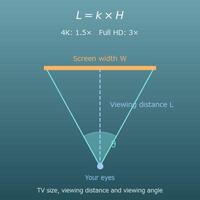
To line frames up across the width of the TV, enter the TV width as the wall width, and the frames will be placed evenly on both sides of the TV's center. The screen width and height come from the screen size in inches (the diagonal) and the aspect ratio.
On a frame with a wire, the slack moves the nail height up. A 20 in wire between D-rings 8 in below the top and 16 in apart rises 6 in above the D-rings, so the peak lands 2 in below the top of the frame. Subtract that 2 in to set the nail height.
If the wire is too long, the peak rises above the top of the frame and the wire shows on the wall. Keep the wire just a little longer than the D-ring spacing, and for heavy frames, use two hooks to share the load or screw into a stud.
Four certificate frames for 8.5 × 11 in paper (about 12.5 in wide and 10 in tall outside, hung sideways) spaced evenly on a 72 in wall have gaps and margins of about 4.4 in, with frame centers starting about 10.65 in from the left end and every 16.9 in after that. On a wall for children, a lower center height (about 48 to 51 in) is easier for them to see.
When you add more frames, just recalculate the spacing with the same formula to rehang them on the same wall.
Museums and galleries widely line up the center height of works at about 57 in above the floor, whatever their size. Measure each work's height \(H\) and hanger position \(w\), and \(h = 57 + H \div 2 - w\) gives the nail height, so large and small works share the same eye line.
If the checklist of works includes the frame size and hanger position, this formula alone is enough to lay out the hanging positions for the show.
Formulas and figures
Symbols and terms
Symbols
| \(c\) | cee | The center height of the frame (from the floor, in), from "center". About 57 in above the floor is a common eye-level guideline and this calculator's default. |
| \(H\) | aitch | The frame height (outside, in), from "height". It is the outside height including the frame; the top and bottom are each \(H \div 2\) from the center. |
| \(T\) | tee | The height of the top of the frame (from the floor, in), from "top". It is found with \(T = c + H \div 2\). |
| \(B\) | bee | The height of the bottom of the frame (from the floor, in), from "bottom". It is found with \(B = c - H \div 2\). Above a sofa or furniture, decide this value first. |
| \(w\) | lowercase double-u | The distance from the top of the frame to the hanging point, where it rests on the nail (in). For a sawtooth hanger, from the top to the hanger; for a wire, to the peak when pulled up tight. |
| \(h\) | lowercase aitch | The nail height (from the floor, in), from "hook". It is found with \(h = T - w\); put the nail or hook here. |
| \(d\) | dee | How far below the top of the frame the D-rings holding the wire are (in), from "depth". It is used to work out \(w\) from the wire length. |
| \(s\) | ess | The spacing between the left and right hangers (in), from "span". For a frame on two hangers, it is also the spacing of the two nails. |
| \(\ell\) | script ell | The wire length (D-ring to D-ring, in), from "length". A cursive \(\ell\) is used so it is not confused with the number 1. |
| \(r\) | ar | How far the peak of the tight wire rises above the D-rings (in), from "rise". It is found with \(r = \sqrt{(\ell \div 2)^{2} - (s \div 2)^{2}}\). |
| \(W\) | capital double-u | The wall width (the space for the row, in), from "wall" or "width". |
| \(n\) | en | The number of frames in the row, from "number". There are \(n - 1\) gaps, and \(n + 1\) spaces with even spacing. |
| \(a\) | ay | The frame width (outside, in). All frames in the row are the same width. |
| \(g\) | gee | The gap between frames (in), from "gap". For frames of the same size, about 2 to 3 in is common. |
| \(T_w\) | tee sub double-u | The total width of the group (in), from "total width": \(n\) frames plus \(n - 1\) gaps. |
| \(m\) | em | The side margin (from the end of the wall to the frame, in), from "margin". When the group is centered, it is the same on both sides. |
| \(x_i\) | ex sub i | The \(x\) position of the center of frame \(i\) (from the left end of the wall, in). The subscript \(i\) is the frame number: \(x_1\), \(x_2\), and so on. |
| \(\sqrt{\ }\) | square root | The square root: the positive number that gives this number when squared. It is used with the Pythagorean theorem to find the height of the wire peak (for example \(\sqrt{36} = 6\)). |
Terms
| Eye level (57-inch rule) | The height of a standing person's eyes. It depends on height, but museums and galleries widely center art about 57 in (145 cm) above the floor; some use 60 in. It is this calculator's default center height. |
| Picture hanger | Any hardware on the back of a frame for hanging it on a nail or hook, such as sawtooth hangers, screw eyes, D-rings and picture wire. The type changes the nail height. |
| Sawtooth hanger | A small toothed metal strip at the top center of the back of a frame. It catches directly on a nail, and the teeth let you shift it a little to level the frame. The distance from the top to the hanger is \(w\). |
| Screw eye | A screw with a ring on the end. Two on the back of a frame hold a wire, or one at the top center hangs directly on a hook. |
| D-ring | A D-shaped ring fixed to the back of a frame on each side. It hangs directly on a hook or holds a picture wire. |
| Picture wire | A wire strung between the left and right D-rings (cord works the same way). On one nail it forms a V, and its peak rests on the nail. The more slack, the higher the peak. |
| Picture hook | A hook held by a thin nail driven into the wall at an angle. It works in drywall and leaves only a small hole, so it is popular in rentals. Load ratings differ by product, so choose one for the frame's weight. |
| Drywall | The board used for most interior walls and ceilings. Plain screws do not hold well; for heavy frames, find a stud (the wood framing inside the wall) or use drywall anchors or hooks. |
| Even spacing | A layout where the side margins and the gaps between frames are all the same within the wall width. There are \(n + 1\) spaces, and the leftover width is divided equally among them. |
| Centering | A layout where you set the gap first and place the whole group in the middle of the wall. The side margins are equal, but they are a different value from the gap. |
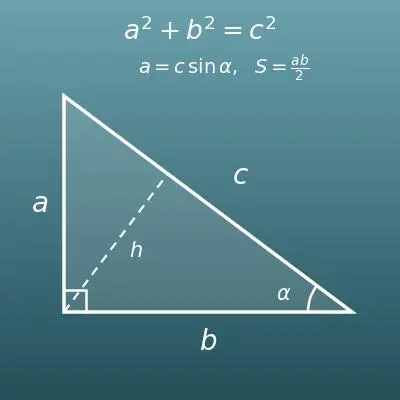
| Pythagorean theorem | In a right triangle, base² + height² = hypotenuse². It is used here with half the wire as the hypotenuse and half the D-ring spacing as the base to find the rise of the peak \(r\). |
| Level | A tool that checks whether something is horizontal. Hold it on the top of the frame after hanging and straighten it. A phone level app works too. |
| Outside dimensions | The size of the frame including the molding. Enter the frame height and width in this calculator as outside dimensions, not the size of the picture or mat opening. |
Good to know before you start
Here is what helps you use the calculation on this page with real understanding, not just by pressing the button.
If you get stuck, going back over these topics is the quickest way forward.
| Units of length and measuring (Grades 2–4) |
|
| Addition, subtraction and halves (Grades 2–3) |
|
| Multiplication and equal sharing (Grades 3–4) |
|
| Expressions with variables (Grade 6) |
|
| Positive and negative numbers (Grades 6–7) |
|
| The Pythagorean theorem and square roots (Grade 8) |
|
How to calculate it in Excel
| Center height c (in) | 57 |
| Frame height H (in) | 24 |
| Top to hanging point w (in) | 2 |
| Top of frame T (in) | =B1+B2/2 |
| Bottom of frame B (in) | =B1-B2/2 |
| Nail height h (in) | =B4-B3 |
| Wire length ℓ (in) | 20 |
| D-ring spacing s (in) | 16 |
| Top to D-rings d (in) | 8 |
| Rise of the peak r (in) | =SQRT((B1/2)^2-(B2/2)^2) |
| Top to hanging point w (in) | =B3-B4 |
| Wall width W (in) | 120 |
| Number of frames n | 3 |
| Frame width a (in) | 16 |
| Gap g (in) | 2 |
| Total width Tw (in) | =B2*B3+(B2-1)*B4 |
| Side margin m (in) | =(B1-B5)/2 |
| Center of frame 1 x1 (in) | =B6+B3/2 |
| Center of frame 2 x2 (in) | =B7+(B3+B4) |
| Center of frame 3 x3 (in) | =B8+(B3+B4) |
| Wall width W (in) | 120 |
| Number of frames n | 3 |
| Frame width a (in) | 16 |
| Gap g (= side margin m) (in) | =(B1-B2*B3)/(B2+1) |
| Center of frame 1 x1 (in) | =B4+B3/2 |
The first table (center 57 in, height 24 in, 2 in to the hanger) gives B4 = 69, B5 = 45 and B6 = 67 (the nail height). The second (20 in wire, 16 in spacing, 8 in to the D-rings) gives B4 = 6 and B5 = 2. The third (120 in wall, 3 frames, 16 in wide, 2 in gaps) gives B5 = 52, B6 = 34 and B7 to B9 = 42, 60, 78. The fourth, even spacing on the same wall, gives B4 = 18 and B5 = 26.
SQRT is the square root and "^2" is squared. For 4 or more frames, add x rows below the third table in the form "row above + (B3+B4)".
How to calculate it in Google Sheets
| Center height c (in) | 57 |
| Frame height H (in) | 24 |
| Top to hanging point w (in) | 2 |
| Top of frame T (in) | =B1+B2/2 |
| Bottom of frame B (in) | =B1-B2/2 |
| Nail height h (in) | =B4-B3 |
| Wire length ℓ (in) | 20 |
| D-ring spacing s (in) | 16 |
| Top to D-rings d (in) | 8 |
| Rise of the peak r (in) | =SQRT((B1/2)^2-(B2/2)^2) |
| Top to hanging point w (in) | =B3-B4 |
| Wall width W (in) | 120 |
| Number of frames n | 3 |
| Frame width a (in) | 16 |
| Gap g (in) | 2 |
| Total width Tw (in) | =B2*B3+(B2-1)*B4 |
| Side margin m (in) | =(B1-B5)/2 |
| Center of frame 1 x1 (in) | =B6+B3/2 |
| Center of frame 2 x2 (in) | =B7+(B3+B4) |
| Center of frame 3 x3 (in) | =B8+(B3+B4) |
| Wall width W (in) | 120 |
| Number of frames n | 3 |
| Frame width a (in) | 16 |
| Gap g (= side margin m) (in) | =(B1-B2*B3)/(B2+1) |
| Center of frame 1 x1 (in) | =B4+B3/2 |
How to calculate it in Python
import math

# ---- One frame: nail height ----
center_height = 57       # target center height c (from the floor, in). Eye level
frame_height = 24        # frame height H (outside, in)
hanger_offset = 2        # top of frame to hanging point w (in)

top = center_height + frame_height / 2
bottom = center_height - frame_height / 2
hook_height = top - hanger_offset
print(f"Top: {top} in, bottom: {bottom} in, nail height: {hook_height} in")

# ---- Height of the wire peak (Pythagorean theorem) ----
wire_length = 20         # wire length l (in)
hanger_span = 16         # D-ring spacing s (in)
hanger_depth = 8         # top of frame to D-rings d (in)

rise = math.sqrt((wire_length / 2) ** 2 - (hanger_span / 2) ** 2)
offset_from_top = hanger_depth - rise
print(f"Rise of the peak: {rise:.1f} in, top to hanging point: {offset_from_top:.1f} in")

# ---- Row: set the gap and center on the wall ----
wall_width = 120         # wall width W (in)
count = 3                # number of frames n
frame_width = 16         # frame width a (in)
gap = 2                  # gap g (in)

total_width = count * frame_width + (count - 1) * gap
margin = (wall_width - total_width) / 2
centers = [margin + frame_width / 2 + i * (frame_width + gap) for i in range(count)]
print(f"Total width: {total_width} in, side margin: {margin} in, frame centers: {centers}")

# ---- Row: space evenly across the wall (side margins = gaps) ----
gap_even = (wall_width - count * frame_width) / (count + 1)
centers_even = [gap_even + frame_width / 2 + i * (frame_width + gap_even) for i in range(count)]
print(f"Even gap: {gap_even} in, frame centers: {centers_even}")
How to write it in LaTeX and other math languages (copy and paste)
T = c + H ÷ 2, B = c − H ÷ 2, h = T − w
T = c + \frac{H}{2},\quad B = c - \frac{H}{2},\quad h = T - w
<math xmlns="http://www.w3.org/1998/Math/MathML" display="block">
<mrow>
<mi>T</mi><mo>=</mo><mi>c</mi><mo>+</mo><mfrac><mi>H</mi><mn>2</mn></mfrac>
<mo>,</mo>
<mi>B</mi><mo>=</mo><mi>c</mi><mo>−</mo><mfrac><mi>H</mi><mn>2</mn></mfrac>
<mo>,</mo>
<mi>h</mi><mo>=</mo><mi>T</mi><mo>−</mo><mi>w</mi>
</mrow>
</math>
T = c + H/2, B = c - H/2, h = T - w
{c + H/2, c - H/2, c + H/2 - w}
T := c + H/2; B := c - H/2; h := T - w;
T = c + H/2; B = c - H/2; h = T - w; % c is the center height, H the frame height, w the top-to-hanging-point distance (in)
T = c + H/2, B = c − H/2, h = T − w
r = √((ℓ ÷ 2)² − (s ÷ 2)²), w = d − r
r = \sqrt{\left(\frac{\ell}{2}\right)^{2} - \left(\frac{s}{2}\right)^{2}},\quad w = d - r
<math xmlns="http://www.w3.org/1998/Math/MathML" display="block">
<mrow>
<mi>r</mi><mo>=</mo>
<msqrt>
<msup><mrow><mo>(</mo><mfrac><mi>ℓ</mi><mn>2</mn></mfrac><mo>)</mo></mrow><mn>2</mn></msup>
<mo>−</mo>
<msup><mrow><mo>(</mo><mfrac><mi>s</mi><mn>2</mn></mfrac><mo>)</mo></mrow><mn>2</mn></msup>
</msqrt>
<mo>,</mo>
<mi>w</mi><mo>=</mo><mi>d</mi><mo>−</mo><mi>r</mi>
</mrow>
</math>
r = sqrt((l/2)^2 - (s/2)^2), w = d - r
r = Sqrt[(l/2)^2 - (s/2)^2]; w = d - r
r := sqrt((l/2)^2 - (s/2)^2); w := d - r;
r = sqrt((l/2)^2 - (s/2)^2); w = d - r; % l is the wire length, s the D-ring spacing, d the top-to-D-ring distance (in)
r = √((ℓ/2)^2 − (s/2)^2), w = d − r
Tw = n × a + (n − 1) × g, m = (W − Tw) ÷ 2
T_{w} = na + (n-1)g,\quad m = \frac{W - T_{w}}{2}
<math xmlns="http://www.w3.org/1998/Math/MathML" display="block">
<mrow>
<msub><mi>T</mi><mi>w</mi></msub><mo>=</mo><mi>n</mi><mo>⁢</mo><mi>a</mi><mo>+</mo>
<mo>(</mo><mi>n</mi><mo>−</mo><mn>1</mn><mo>)</mo><mo>⁢</mo><mi>g</mi>
<mo>,</mo>
<mi>m</mi><mo>=</mo><mfrac><mrow><mi>W</mi><mo>−</mo><msub><mi>T</mi><mi>w</mi></msub></mrow><mn>2</mn></mfrac>
</mrow>
</math>
T_w = n a + (n - 1) g, m = (W - T_w) / 2
Tw = n*a + (n - 1)*g; m = (W - Tw)/2
Tw := n*a + (n - 1)*g; m := (W - Tw)/2;
Tw = n*a + (n - 1)*g; m = (W - Tw)/2; % n is the number of frames, a the frame width, g the gap, W the wall width (in)
T_w = na + (n − 1)g, m = (W − T_w)/2
g = (W − n × a) ÷ (n + 1), m = g
g = \frac{W - na}{n + 1},\quad m = g
<math xmlns="http://www.w3.org/1998/Math/MathML" display="block">
<mrow>
<mi>g</mi><mo>=</mo>
<mfrac><mrow><mi>W</mi><mo>−</mo><mi>n</mi><mo>⁢</mo><mi>a</mi></mrow><mrow><mi>n</mi><mo>+</mo><mn>1</mn></mrow></mfrac>
<mo>,</mo>
<mi>m</mi><mo>=</mo><mi>g</mi>
</mrow>
</math>
g = (W - n a) / (n + 1), m = g
g = (W - n*a)/(n + 1); m = g
g := (W - n*a)/(n + 1); m := g;
g = (W - n*a)/(n + 1); m = g; % W is the wall width, n the number of frames, a the frame width (in)
g = (W − na)/(n + 1), m = g
xᵢ = m + a ÷ 2 + (i − 1) × (a + g)
x_{i} = m + \frac{a}{2} + (i - 1)(a + g)
<math xmlns="http://www.w3.org/1998/Math/MathML" display="block">
<mrow>
<msub><mi>x</mi><mi>i</mi></msub><mo>=</mo><mi>m</mi><mo>+</mo><mfrac><mi>a</mi><mn>2</mn></mfrac><mo>+</mo>
<mo>(</mo><mi>i</mi><mo>−</mo><mn>1</mn><mo>)</mo><mo>⁢</mo>
<mo>(</mo><mi>a</mi><mo>+</mo><mi>g</mi><mo>)</mo>
</mrow>
</math>
x_i = m + a/2 + (i - 1)(a + g)
x[i_] := m + a/2 + (i - 1)*(a + g)
x := i -> m + a/2 + (i - 1)*(a + g);
k = 1:n; x = m + a/2 + (k - 1)*(a + g); % k is the frame number, m the margin, a the frame width, g the gap, n the number of frames
x_i = m + a/2 + (i − 1)(a + g)
How to have ChatGPT do the calculation
You are an assistant for working out where to hang pictures. Do the calculations below by actually running Python code, and base your answer only on the numbers from the output (do not calculate in your head or guess).

I am hanging three frames, each 24 in tall and 16 in wide, in a row on a 120 in wide wall. The frame centers go 57 in above the floor. Each frame has a sawtooth hanger 2 in below the top.
Find each of the following (in inches).
1. The heights of the top and bottom of the frames (top = center + height ÷ 2, bottom = center − height ÷ 2) and the nail height (top − 2)
2. With 2 in gaps and the group centered: the total width (3 × 16 + 2 × 2), the side margins ((120 − total width) ÷ 2) and the x position of each frame center (from the left end of the wall: margin + 8, then every 18)
3. With even spacing, where the side margins and gaps are all the same: the gap ((120 − 3 × 16) ÷ 4) and the x position of each frame center
4. If instead a 20 in wire is strung between D-rings 8 in below the top and 16 in apart, hung on one nail: the rise of the peak above the D-rings (√((20÷2)² − (16÷2)²)), the distance from the top to the peak, and the nail height then

Show the formulas you used and the numbers from the output.
How to Use
-
1Enter your numbersType the numbers you want to calculate with into the input fields
-
2CalculatePress the "Calculate" button
-
3Check the resultThe result appears on the spot. The same page also explains the idea behind the calculation and the formula
DataChef Features

No technical knowledge required.
Intuitive and user-friendly operation.

Can be used without registering personal information.

Automatic file deletion by clicking "download".

and rapid file conversion.

No attribution required.

No need to contact us for commercial use permission.
Related Features
TV Size and Viewing Distance Calculator (4K, Full HD and 8K)
To hang art above a TV, find the screen width and height first to set the bottom height and width of the frames
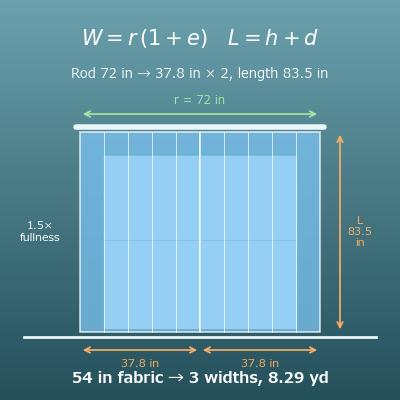
Curtain Size Calculator (Finished Width, Length and Fabric Yardage from Fullness)
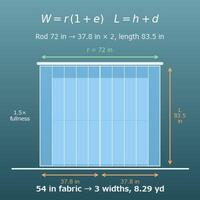
For the same wall. Find the finished curtain width and length and the fabric needed from the rod width and position
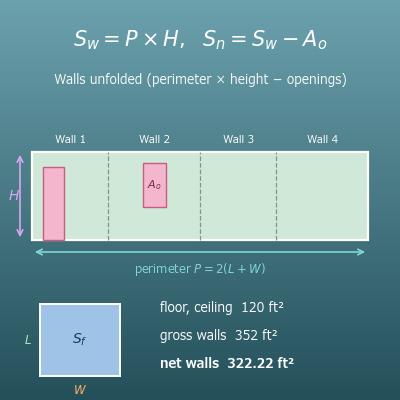
Wall Area Calculator (Wall, Ceiling and Floor Square Footage, with Doors, Windows, Perimeter and Volume)
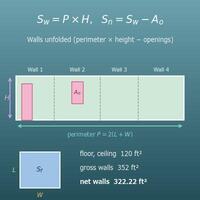
Find the width and height of the wall for your frames, and the wall area minus doors and windows, from the room size
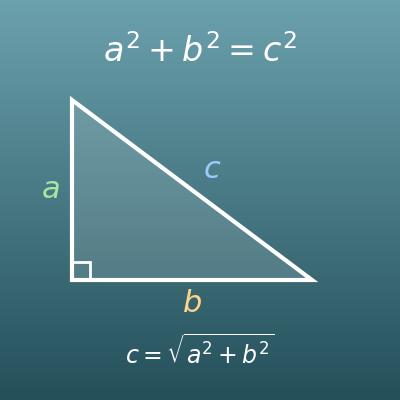
Pythagorean Theorem Calculator (Hypotenuse and Legs of a Right Triangle)
The peak of a stretched picture wire comes from a right triangle with half the wire as the hypotenuse
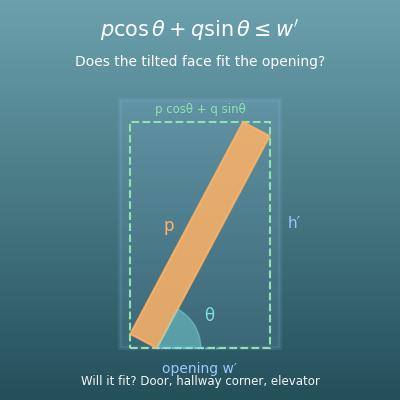
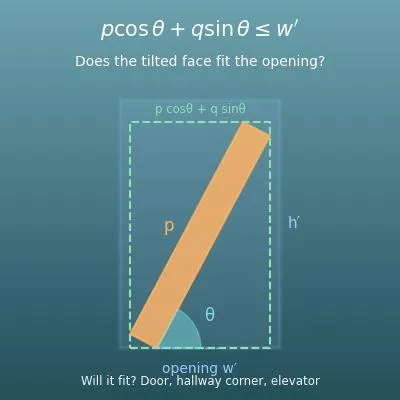
Furniture Fit Calculator (Through a Door, Around a Hallway Corner, Into an Elevator)
Check whether furniture fits through a door, around a hallway corner or into an elevator when you move