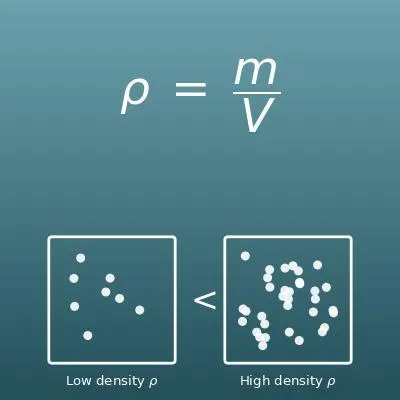


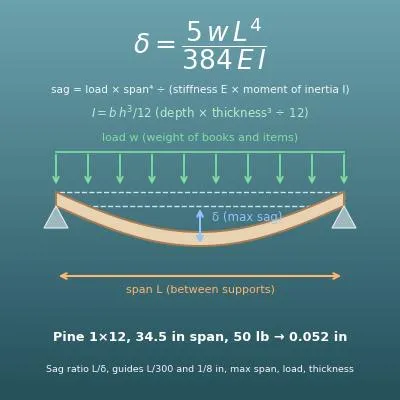
Enter the two values you know out of density ρ, mass m and volume V. The one you leave blank is calculated. Choose a unit for each field (different units are converted automatically).
Table of Contents
-
What you can do on this page
-
What is this calculation used for?
-
How to Use
-
Formula
-
Symbols and terms
-
Good to know before you start
-
How to calculate it in Excel
-
How to calculate it in Google Sheets
-
How to calculate it in Python
-
How to write it in LaTeX and other math languages (copy and paste)
-
How to have ChatGPT do the calculation
-
DataChef Features
-
Related Features
-
NumberChef Calculators List
What you can do on this page
- Enter any two of density \(\rho\), mass \(m\) and volume \(V\), and the one you left blank is calculated
- Each field has its own unit (density: g/cm³, kg/m³, g/L, kg/L; mass: g, kg, mg, t; volume: cm³, mL, L, m³). Mixed units are converted automatically
- Use it for everyday questions such as "How many grams per cm³ is this piece of metal?" or "How many liters is 5 kg of water?"
- A plain-language explanation of the formulas and copy-and-paste formulas for Excel, Google Sheets and Python are all on this page
What is this calculation used for?
Water has a density of about 1 g/cm³. Things with a lower density (ice at about 0.92, most kinds of wood) float, and things with a higher density (iron at about 7.87, aluminum at about 2.7) sink.
Ice floats because water expands when it freezes, so its density drops below that of liquid water. A steel ship floats because it is hollow inside, so the average density of the whole ship is lower than water. Everyday floating and sinking can be explained by density.
Gold has a density of 19.3 g/cm³, far higher than other common metals. Measure the mass and volume, calculate the density, and if it is far from 19.3, another metal may be mixed in.
The story of Archimedes in ancient Greece, who found out whether a crown was pure gold from its volume (the water it pushed out) and its mass without damaging it, is exactly the calculation on this page. Density is still a basic clue in testing precious metals and jewelry today.
Water has a density of almost exactly 1 g/mL, so 1 cup of water (about 237 mL) weighs about 237 g. This is why you can use a kitchen scale instead of a measuring cup.
Other liquids have densities a little different from 1 (oil is lighter than water, syrups are heavier), so for an accurate amount, look up the density of that liquid and convert with mass = density × volume.
1 L of water is about 1 kg (1 m³ is about 1 metric ton), and 1 US gallon of water weighs about 8.3 lb. A standard 20-gallon aquarium holds about 76 L, so the water alone weighs about 76 kg (about 167 lb), as much as an adult.
Before you start worrying about the floor after setting it up, estimate the full mass with volume × density. This is the basic calculation for placing an aquarium, a septic tank or a water storage tank, or for deciding where to keep emergency drinking water.
Aluminum (about 2.7 g/cm³) has only about one third the density of iron (about 7.87 g/cm³). Replace a part with an aluminum part of the same volume, and its mass also drops to about one third.
In car and aircraft design, engineers add up the mass of the whole vehicle from each part's volume × its material's density, and balance fuel economy against strength. Density is the starting point in the search for materials that are both light and strong.
Formula
Symbols and terms
Symbols
| \(\rho\) | rho | The Greek letter used for density. It stands for the mass per unit volume (per 1 cm³ or per 1 m³). (Example - for aluminum, \(\rho = 2.7\) g/cm³) |
| \(m\) | em | Mass, the amount of matter in an object that you can measure on a scale. It comes from the first letter of "mass". |
| \(V\) | vee | Volume, how much space an object takes up. It comes from the first letter of "volume". |
| g/cm³ | grams per cubic centimeter | A unit of density: how many grams there are in 1 cm³. It is the standard unit in school science. 1 g/cm³ = 1,000 kg/m³ = 1 kg/L = 1 g/mL. |
| kg/m³ | kilograms per cubic meter | A unit of density: how many kilograms there are in 1 m³. It is the SI unit and is common in reference tables and engineering. 1,000 kg/m³ = 1 g/cm³. |
Terms
| density | The mass per unit volume (per 1 cm³ or per 1 m³). It shows how tightly packed a material is, and for the same substance it stays the same whatever the size or shape. This is why density can help identify what a substance is. |
| mass | The amount of matter in an object. It is measured with a balance or a digital scale, in units such as g and kg. It does not change with location (it is the same on Earth and on the Moon). |
| weight | The force of gravity acting on an object. Unlike mass, it changes with location - on the Moon it becomes about one sixth. In everyday speech "weight" and "mass" are used interchangeably, but science treats them as different quantities. This page uses mass. |
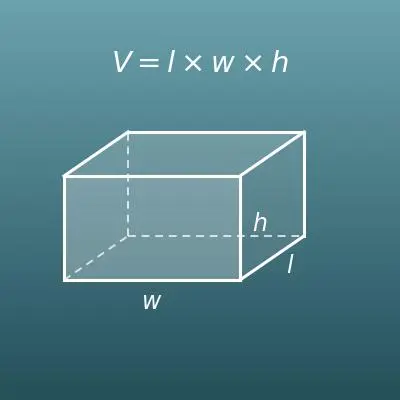
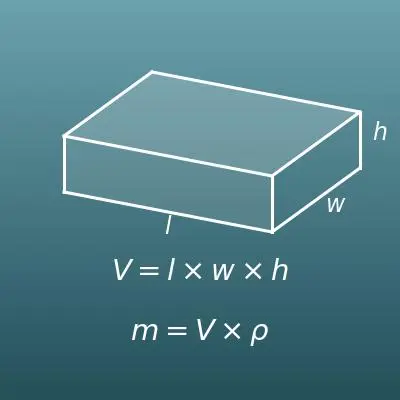
| volume | How much space an object takes up. For a box shape it is length × width × height; for a liquid you can measure it with a graduated cylinder. Units include cm³, mL, L and m³, where 1 mL = 1 cm³ and 1 L = 1,000 cm³. |
| specific gravity | How many times denser a substance is than water (about 1 g/cm³). It has no unit, and it is almost the same number as the density in g/cm³, so you may see "gold, specific gravity 19.3". Also called relative density. Things with a specific gravity below 1 float in water, and things above 1 sink. |
Good to know before you start
Here is what helps you use the calculation on this page with real understanding, not just by pressing the button.
| Unit rates (Grade 6) |
|
| Multiplying and dividing decimals (Grades 5–6) |
|
| Volume and converting units (Grades 5–7) |
|
| Density and properties of matter (middle school physical science) |
|
How to calculate it in Excel
| Mass m (g) | 540 |
| Volume V (cm³) | 200 |
| Density ρ (g/cm³) | =B1/B2 |
| Density ρ (g/cm³) | 1 |
| Volume V (cm³) | 500 |
| Mass m (g) | =B1*B2 |
| Mass m (g) | 193 |
| Density ρ (g/cm³) | 19.3 |
| Volume V (cm³) | =B1/B2 |
"=B1/B2" means "divide B1 by B2", and "=B1*B2" means "multiply B1 by B2".
For example, B3 shows 2.7 (g/cm³) in the first table, 500 (g) in the second and 10 (cm³) in the third. Just replace B1 and B2 with your own numbers. Enter the values in g and cm³ (convert values measured in kg or L first, using 1 kg = 1,000 g and 1 L = 1,000 cm³).
How to calculate it in Google Sheets
| Mass m (g) | 540 |
| Volume V (cm³) | 200 |
| Density ρ (g/cm³) | =B1/B2 |
| Density ρ (g/cm³) | 1 |
| Volume V (cm³) | 500 |
| Mass m (g) | =B1*B2 |
| Mass m (g) | 193 |
| Density ρ (g/cm³) | 19.3 |
| Volume V (cm³) | =B1/B2 |
How to calculate it in Python
mass = 540.0      # mass m (g)
volume = 200.0    # volume V (cm³)

density = mass / volume   # density ρ = m ÷ V (g/cm³)
print(f"Density: {density} g/cm³")

# Check by working backward: mass m = ρ × V, volume V = m ÷ ρ
mass_check = density * volume
volume_check = mass / density
print(f"Check (mass): {mass_check} g")
print(f"Check (volume): {volume_check} cm³")
How to write it in LaTeX and other math languages (copy and paste)
ρ = m ÷ V
\rho = \dfrac{m}{V}
<math xmlns="http://www.w3.org/1998/Math/MathML" display="block">
<mrow>
<mi>ρ</mi>
<mo>=</mo>
<mfrac><mi>m</mi><mi>V</mi></mfrac>
</mrow>
</math>
rho = m/V
m/V
rho := m/V;
rho = m/V;
ρ = m/V
m = ρ × V
m = \rho V
<math xmlns="http://www.w3.org/1998/Math/MathML" display="block">
<mrow>
<mi>m</mi>
<mo>=</mo>
<mi>ρ</mi>
<mo>⁢</mo>
<mi>V</mi>
</mrow>
</math>
m = rho V
rho*V
m := rho*V;
m = rho*V;
m = ρV
V = m ÷ ρ
V = \dfrac{m}{\rho}
<math xmlns="http://www.w3.org/1998/Math/MathML" display="block">
<mrow>
<mi>V</mi>
<mo>=</mo>
<mfrac><mi>m</mi><mi>ρ</mi></mfrac>
</mrow>
</math>
V = m/rho
m/rho
V := m/rho;
V = m/rho;
V = m/ρ
How to have ChatGPT do the calculation
You are a density calculation assistant. Do the following calculation by actually running Python code, and base your answer only on the numbers from the execution result (do not answer by mental math or guessing).

A piece of metal has a mass of 540 g and a volume of 200 cm³.
Using the density formula ρ = m ÷ V, find each of the following:
1. The density of this metal (g/cm³)
2. The mass (g) of a piece of the same metal with a volume of 1,000 cm³
3. The volume (cm³) of a piece of the same metal with a mass of 2,700 g

Show the formulas you used and the numbers from the execution result.
How to Use
-
1Enter your numbersType the numbers you want to calculate with into the input fields
-
2CalculatePress the "Calculate" button
-
3Check the resultThe result appears on the spot. The same page also explains the idea behind the calculation and the formula
DataChef Features

No technical knowledge required.
Intuitive and user-friendly operation.

Can be used without registering personal information.

Automatic file deletion by clicking "download".

and rapid file conversion.

No attribution required.

No need to contact us for commercial use permission.
Related Features
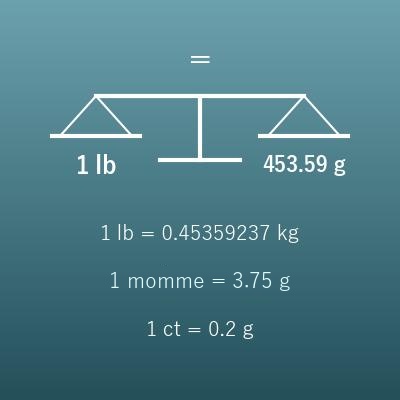
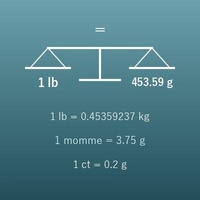
Weight Converter (lb, kg, oz, g, Carats and More)
Convert between units of weight such as g, kg and t. Handy for matching units before and after a density calculation
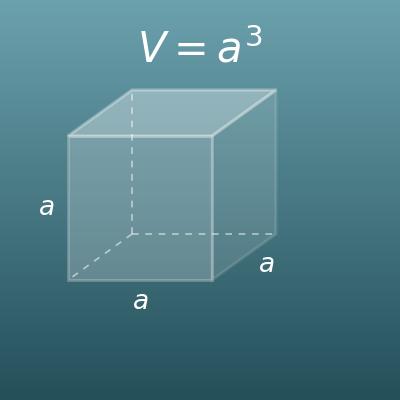
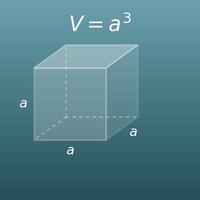
Volume of a Cube Calculator (Side × Side × Side)
Find the volume of a cube from the length of one edge. Once you know the volume, you can find the density or mass
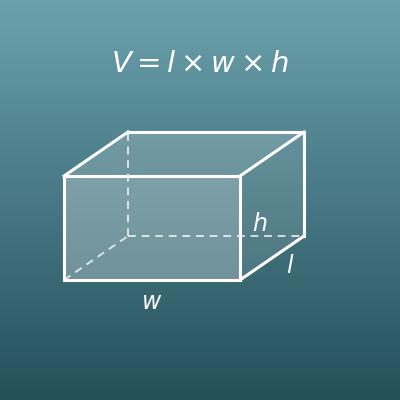
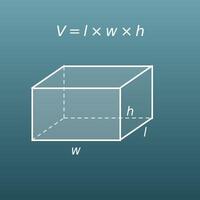
Rectangular Prism Volume Calculator (Length × Width × Height)
Find the volume of a box shape from length × width × height. Useful for estimating the mass of a box or a tank