
Choose a mode and enter the angles you know.
Table of Contents
-
What you can do on this page
-
What is this calculation used for?
-
How to Use
-
Formulas and figures
-
Symbols and terms
-
Good to know before you start
-
How to calculate it in Excel
-
How to calculate it in Google Sheets
-
How to calculate it in Python
-
How to write it in LaTeX and other math languages (copy and paste)
-
How to have ChatGPT do the calculation
-
DataChef Features
-
Related Features
-
NumberChef Calculators List
What you can do on this page
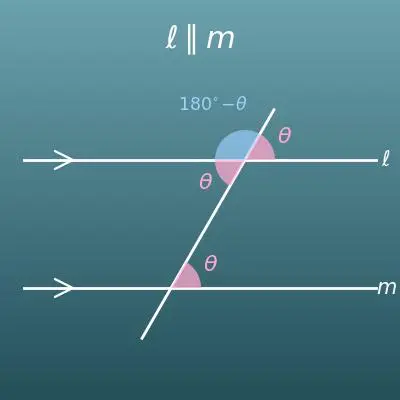
- In the classic figure of two parallel lines cut by a transversal, enter one angle \(\angle a\) and get all eight angles \(\angle a\) to \(\angle h\). Angles that do not divide evenly, such as \(\dfrac{250}{7}^\circ\), are shown both as an exact fraction and as a decimal
- A color-coded figure and table show which pairs are corresponding angles, alternate interior angles, vertical angles and same-side interior angles (angles of the same color are equal)
- In the bent line mode, it finds the angle at the bend of a bent line between two parallel lines, \(\angle x = \angle a + \angle b\), with steps for the standard method: draw an auxiliary line through the bend parallel to both lines and split the angle into alternate interior angles
- Formula cards with figures explain why corresponding angles and alternate interior angles are equal, why vertical angles are equal, and why same-side interior angles add up to \(180^\circ\)
What is this calculation used for?
Sunlight comes from so far away that its rays can be treated as parallel on the ground. About 2,200 years ago, the Greek scholar Eratosthenes knew that on a certain day the sun was directly overhead in the town of Syene. On that day, in Alexandria, far to the north, he measured the angle between the sun's rays and a vertical stick from its shadow (about 7.2°). Because alternate interior angles of parallel lines are equal, this 7.2° is the same as the angle between the two towns seen from the center of the Earth. 7.2° is exactly 1/50 of 360°, so he multiplied the distance between the towns by 50 and estimated the distance around the Earth quite accurately.
Measuring the size of the Earth long before satellites, this is still the most famous use of parallel lines and alternate interior angles in textbooks.
Hold a drafting triangle against a straightedge and slide it along, drawing lines in the same direction as you go: all of those lines are parallel. As the triangle slides, its angle (the angle between the straightedge and the line you draw, a corresponding angle) does not change, so the rule "if corresponding angles are equal, the lines are parallel" becomes a drawing method.
The parallel rule and the drafting machine used in architectural and mechanical drafting work on the same principle, keeping a straightedge parallel as it moves up and down.
A stair handrail is one sloped line, and the balusters that hold it up are many vertical, parallel lines. Because corresponding angles of parallel lines are equal, the angle between the handrail and each baluster is the same, so the tops of all the balusters can be cut at the same angle.
This is why the same part can be cut in quantity without fitting each one by hand.
A periscope, familiar from submarines and science projects, has two mirrors at the top and bottom of a tube, each tilted at 45° and facing each other in parallel. Light turned by the upper mirror is turned again by the lower mirror and reaches your eye. Because the two mirrors are parallel, the light coming in and the light going out are parallel through alternate interior angles, and the view is not tilted.
The path of light, bending twice between parallel lines, looks much like the figure in the bent line mode on this page (the actual direction of light is set by the law of reflection).
Formulas and figures
Symbols and terms
Symbols
| \(\angle\) | angle | The symbol for an angle. \(\angle a\) is "the angle named \(a\)". When three letters are used, as in \(\angle APB\), the middle letter is the vertex of the angle. |
| \(\ell,\ m\) | ell, m | Names for lines. \(\ell\) is a script form of the letter l, from "line", written this way so it is not confused with the number 1 or a capital I. The next lines are named \(m\), \(n\) and so on in alphabetical order. |
| \(\parallel\) | is parallel to | The symbol for parallel. \(\ell \parallel m\) says "line \(\ell\) is parallel to line \(m\)". It is said to come from drawing two parallel lines as two vertical strokes. |
| \(x\) | x | A letter for an unknown number (the angle you want to find). Calling an unknown \(x\) is a familiar habit in textbooks. |
| \(^\circ\) | degree | The symbol for the degree, the unit of angle. One full turn divided into 360 equal parts is \(1^\circ\). The number 360 is said to have been chosen because it has many factors and is easy to divide evenly. |
Terms
| parallel lines | Two lines in the same plane that never meet, however far they are extended. They are written \(\ell \parallel m\). The distance (width) between two parallel lines is the same wherever you measure it. |
| transversal | A line that crosses two other lines. Where a transversal crosses two parallel lines, it makes four angles at each of the two intersections, eight angles in all. |
| vertical angles | Of the four angles formed when two lines cross, a pair of angles opposite each other. Vertical angles are always equal. This holds whenever two lines cross, whether or not any lines are parallel. |
| corresponding angles | When a transversal crosses two lines, a pair of angles in the same position at the two intersections (for example, both at the upper right). If the two lines are parallel, corresponding angles are equal. Conversely, if corresponding angles are equal, the two lines are parallel. |
| alternate interior angles | A pair of angles inside the two lines (between them) and on opposite sides of the transversal. If the two lines are parallel, alternate interior angles are equal. The two angles and the transversal look like a Z, so the "Z shape" is a well-known way to spot them. |
| same-side interior angles | A pair of angles inside the two lines and on the same side of the transversal (also called consecutive interior angles). If the two lines are parallel, same-side interior angles add up to \(180^\circ\). The two neighboring angles between the parallel sides of a trapezoid have exactly this relationship. |
| auxiliary line | A line you add to a figure yourself to solve a problem. For the angle of a bent line between parallel lines, the key step is an auxiliary line through the bend, parallel to the two lines. |
| converse theorems | The theorems that go the other way: "if corresponding angles are equal, the lines are parallel" and "if alternate interior angles are equal, the lines are parallel". They are used to prove that two lines are parallel from the sizes of angles. |
| straight angle (linear pair) | A straight angle is half a turn, \(180^\circ\). Around a point on a straight line, the angles on one side always add up to \(180^\circ\); two adjacent angles that do this form a linear pair. This is the basis of "adjacent angles add up to \(180^\circ\)" and "vertical angles are equal". |
Good to know before you start
Here is what helps you use the calculation on this page with real understanding, not just by pressing the button.
If you get stuck, going back to the topics in this list is the quickest way forward.
| Angles and turns (Grade 4) |
|
| Perpendicular and parallel lines (Grade 4) |
|
| Straight angles and supplementary angles (Grades 4–7) |
|
| Expressions with letters (Grades 6–7) |
|
| Subtraction and fractions (Grades 5–6) |
|
How to calculate it in Excel
| Angle ∠a (degrees) | 60 |
| ∠c, ∠e, ∠g (equal to ∠a) (degrees) | =B1 |
| ∠b, ∠d, ∠f, ∠h (degrees) | =180-B1 |
| Angle at the upper line ∠a (degrees) | 35 |
| Angle at the lower line ∠b (degrees) | 25 |
| Angle at the bend ∠x (degrees) | =B1+B2 |
"-" is subtraction and "+" is addition.
The first table enters 60 for ∠a. The angles equal to ∠a through vertical, corresponding and alternate interior angles (∠c, ∠e, ∠g) are 60, and the other four angles (∠b, ∠d, ∠f, ∠h) are 180 − 60 = 120.
The second table is the bent line example. Enter 35 for ∠a and 25 for ∠b, and the angle at the bend ∠x is 35 + 25 = 60.
How to calculate it in Google Sheets
| Angle ∠a (degrees) | 60 |
| ∠c, ∠e, ∠g (equal to ∠a) (degrees) | =B1 |
| ∠b, ∠d, ∠f, ∠h (degrees) | =180-B1 |
| Angle at the upper line ∠a (degrees) | 35 |
| Angle at the lower line ∠b (degrees) | 25 |
| Angle at the bend ∠x (degrees) | =B1+B2 |
How to calculate it in Python
from fractions import Fraction

# Parallel lines and a transversal: all 8 angles from one angle
angle_a = Fraction(60)        # a fraction such as 250/7° can be written Fraction(250, 7)
angle_b = 180 - angle_a       # adjacent angle (subtract from the straight angle 180°)
print(f"∠a = ∠c = ∠e = ∠g = {angle_a}° (equal as vertical, corresponding and alternate interior angles)")
print(f"∠b = ∠d = ∠f = ∠h = {angle_b}°")
print(f"Check same-side interior angles: {angle_a}° + {angle_b}° = {angle_a + angle_b}°")

# Bent line between parallel lines: the angle at the bend
bend_a = Fraction(35)
bend_b = Fraction(25)
angle_x = bend_a + bend_b
print(f"Angle at the bend ∠x = {bend_a}° + {bend_b}° = {angle_x}°")
How to write it in LaTeX and other math languages (copy and paste)
∠a = ∠c
\angle a = \angle c
<math xmlns="http://www.w3.org/1998/Math/MathML" display="block">
<mrow>
<mo>∠</mo><mi>a</mi>
<mo>=</mo>
<mo>∠</mo><mi>c</mi>
</mrow>
</math>
/_ a = /_ c
angleA == angleC
angleA = angleC;
angleA == angleC
∠a = ∠c
∠a = ∠e
\angle a = \angle e
<math xmlns="http://www.w3.org/1998/Math/MathML" display="block">
<mrow>
<mo>∠</mo><mi>a</mi>
<mo>=</mo>
<mo>∠</mo><mi>e</mi>
</mrow>
</math>
/_ a = /_ e
angleA == angleE
angleA = angleE;
angleA == angleE
∠a = ∠e
∠c = ∠e
\angle c = \angle e
<math xmlns="http://www.w3.org/1998/Math/MathML" display="block">
<mrow>
<mo>∠</mo><mi>c</mi>
<mo>=</mo>
<mo>∠</mo><mi>e</mi>
</mrow>
</math>
/_ c = /_ e
angleC == angleE
angleC = angleE;
angleC == angleE
∠c = ∠e
∠c + ∠f = 180°
\angle c + \angle f = 180^{\circ}
<math xmlns="http://www.w3.org/1998/Math/MathML" display="block">
<mrow>
<mo>∠</mo><mi>c</mi>
<mo>+</mo>
<mo>∠</mo><mi>f</mi>
<mo>=</mo>
<msup><mn>180</mn><mo>°</mo></msup>
</mrow>
</math>
/_ c + /_ f = 180^circ
angleC + angleF == 180 Degree
angleC + angleF = 180;
angleC + angleF == 180
∠c + ∠f = 180°
∠x = ∠a + ∠b
\angle x = \angle a + \angle b
<math xmlns="http://www.w3.org/1998/Math/MathML" display="block">
<mrow>
<mo>∠</mo><mi>x</mi>
<mo>=</mo>
<mo>∠</mo><mi>a</mi>
<mo>+</mo>
<mo>∠</mo><mi>b</mi>
</mrow>
</math>
/_ x = /_ a + /_ b
angleX == angleA + angleB
angleX = angleA + angleB;
angleX == angleA + angleB
∠x = ∠a + ∠b
How to have ChatGPT do the calculation
You are a math (plane geometry, parallel lines and angles) calculation assistant. Do the following calculation by actually running Python code, and base your answer only on the numbers from the execution result (do not answer by mental math or guessing).

For the eight angles formed when a transversal crosses two parallel lines, show each of the following:
1. The sizes of all eight angles when one angle is 250/7° (also group the equal angles; give each as a fraction in lowest terms and as a decimal)
2. A check that same-side interior angles add up to 180°
3. For a line that bends between the parallel lines, the angle at the bend when the angle at the upper line is 35° and the angle at the lower line is 25°

In Python, use the fractions module from the standard library to calculate exactly, and show the formulas you used and the numbers from the execution result.
How to Use
-
1Enter your numbersType the numbers you want to calculate with into the input fields
-
2CalculatePress the "Calculate" button
-
3Check the resultThe result appears on the spot. The same page also explains the idea behind the calculation and the formula
DataChef Features

No technical knowledge required.
Intuitive and user-friendly operation.

Can be used without registering personal information.

Automatic file deletion by clicking "download".

and rapid file conversion.
No attribution required.

No need to contact us for commercial use permission.
Related Features
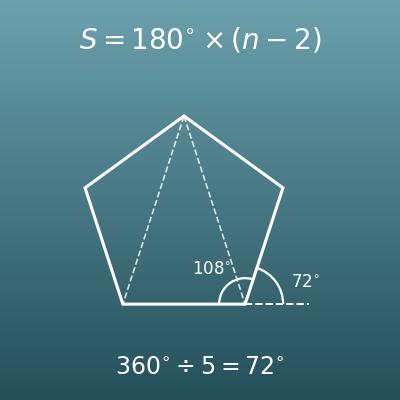
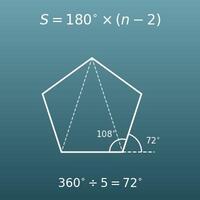
Polygon Angle Calculator (Sum of Interior and Exterior Angles, Regular Polygons)
Finds the interior angle sum 180°×(n−2), the exterior angle sum 360° and each angle of a regular n-gon, with a figure that splits the polygon into triangles
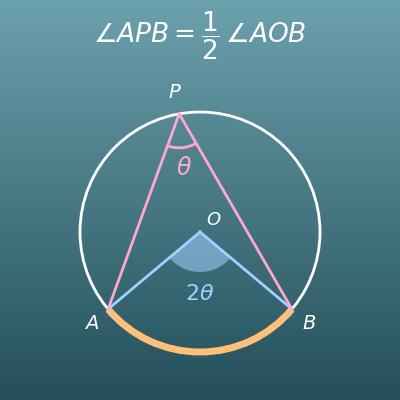
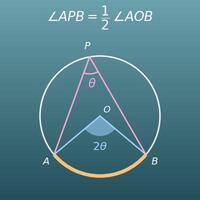
Inscribed Angle Theorem Calculator (Central Angle, Arc Ratio, Inscribed Quadrilateral)
Uses the angle rules of a circle, such as an inscribed angle is half the central angle, inscribed angles on the same arc are equal, and an angle in a semicircle is 90°, with a figure
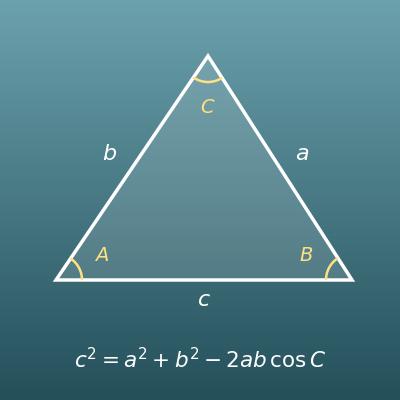
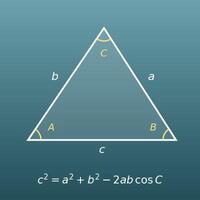
Triangle Calculator (Solve for Sides, Angles, Area and More)
Finds the remaining sides and angles of a triangle from the ones you know. Why the angles of a triangle add up to 180° can be explained with alternate interior angles