
















































Enter the length and height of the wall (or the number of courses), the block size and the joint width. The core fill, rebar and price fields can be left blank (then they are not calculated).
Table of Contents
-
What you can do on this page
-
What is this calculation used for?
-
How to Use
-
Formulas and figures
-
Symbols and terms
-
Good to know before you start
-
How to calculate it in Excel
-
How to calculate it in Google Sheets
-
How to calculate it in Python
-
How to write it in LaTeX and other math languages (copy and paste)
-
How to have ChatGPT do the calculation
-
DataChef Features
-
Related Features
-
NumberChef Calculators List
What you can do on this page
- Enter the length and height of the wall (or the number of courses), choose the block size (8, 6 or 12 in CMU, or your own size) and the joint width, and you get the number of courses, the blocks per course and the blocks needed with waste on the spot
- The mortar for the joints is found as "bed joints + head joints" and shown in ft³, pounds and bags (such as 80 lb bags; the bag size can be changed). The number of bags before rounding up is shown too, so you can see where the count comes from
- Optionally, you can also get the grout for the cores with vertical rebar (enter the share of cores to fill), the number of vertical bars, the courses with horizontal reinforcement, and the rough total length of rebar
- You can switch to the reverse: the length of wall you can build with the blocks you have. Handy for seeing how far leftover blocks will go
- Enter the price per block and per bag to get an estimated cost. The page also draws the wall in running bond (courses × blocks). A plain-language explanation of the formulas and copy-and-paste formulas for Excel, Google Sheets and Python are also on this page
What is this calculation used for?
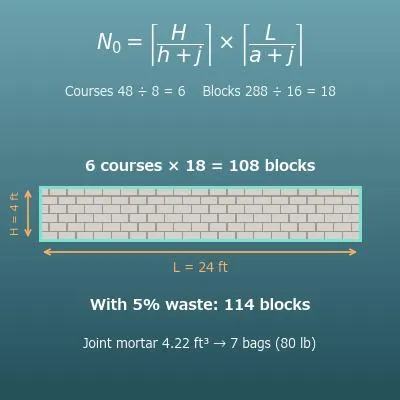
For example, for a wall 24 ft long and 4 ft (6 courses) high in 8 in CMU, each course takes \(24 \times 12 \div 16 = 18\) blocks, the base count is \(6 \times 18 = 108\), and with a 5% waste factor you need \(\lceil 108 \times 1.05 \rceil = 114\) blocks.
The joint mortar is \(108 \times 0.0391 \approx 4.22\) ft³, about 4.43 ft³ with waste, or about 554 lb of dry mix, so seven 80 lb bags of mortar mix. Working this out before you go to the store also helps you plan the delivery: an 8 in block weighs roughly 30 to 40 lb, so 114 blocks weigh about 2 tons.
Walls two or three courses high are a DIY classic. An 8 ft wall two courses high takes 6 blocks × 2 = 12, or 13 with a 5% waste factor. The joint mortar is \(12 \times 0.0391 \approx 0.47\) ft³ (about 0.49 ft³ or 62 lb with waste), so one 80 lb bag of mortar mix is enough.
Small jobs are where people most often buy an extra bag they do not need, so a calculation you can follow from ft³ to pounds to bags is useful.
A quote lists the spec and length, such as "8 in CMU, 5 courses, 32 LF". Counting with these formulas gives 24 blocks per course × 5 courses = 120, or \(\lceil 120 \times 1.05 \rceil = 126\) with a 5% waste factor.
If the quote is very different, you can ask how the corners, half blocks, pilasters and ends were counted. (A real quote also includes the footing, rebar, grout, the cap, labor and cleanup, so the block count alone cannot tell you whether the price is fair.)
For a wall 20 ft long and 5 courses high with vertical bars every 32 in and horizontal reinforcement every 2 courses, there are \(\lfloor 240 \div 32 \rfloor + 1 = 8\) vertical bars and \(\lceil 5 \div 2 \rceil = 3\) reinforced courses, about \(8 \times 3.333 + 3 \times 20 \approx 86.7\) ft in all. The grout for the cores with bars (25% of all cores), at 0.25 ft³ of core per block, is \(75 \times 0.25 \times 0.25 \approx 4.69\) ft³ (about 0.17 yd³).
Rebar is sold in set lengths (often 10 ft or 20 ft), and embedment and lap splices add more, so allow extra when you decide how many bars to buy. The reinforcement design itself (spacing, bar size, embedment) follows the local building code and the designer.
With 40 blocks left from a job (no waste factor) and a 3-course (24 in) edge wall, each course gets \(\lfloor 40 \div 3 \rfloor = 13\) blocks, so you can build \(13 \times 16 = 208\) in, about 17.3 ft, with 1 block left over.
Since "how many blocks for how many feet" comes out right away, it helps when you look for a use for leftovers or decide how many more blocks to buy.
Formulas and figures
Symbols and terms
Symbols
| \(a\) | ay | The length of one block. 15.625 in (15-5/8 in) for a standard CMU. Use the same unit as the wall when calculating. |
| \(h\) | aitch | The height of one block. 7.625 in (7-5/8 in) for a standard CMU. From the first letter of "height". |
| \(t\) | tee | The block thickness (the wall thickness). 7.625 in for an 8 in CMU (5.625 in for 6 in, 11.625 in for 12 in). From the first letter of "thickness"; it is also the width of the mortar joint. |
| \(j\) | jay | The joint width (the thickness of mortar between blocks). 3/8 in (0.375 in) is standard for blockwork. From the first letter of "joint". |
| \(L\) | el | The wall length (ft), from the first letter of "length". For a wall that turns corners, the total of all sides. |
| \(H\) | capital aitch | The wall height (ft): the height of the blockwork above the footing. |
| \(n_h\) | n sub h | The number of courses (how many rows high). It is found with \(n_h = \lceil H \div (h + j) \rceil\). |
| \(n_l\) | n sub l | The blocks per course (how many in a row). It is found with \(n_l = \lceil L \div (a + j) \rceil\). |
| \(N_0\) | N sub zero | The base count: courses × blocks per course, counting the wall as a rectangle. |
| \(r\) | ar | The waste factor (%): the extra for half blocks, corners and breakage, applied to both the blocks and the mortar. From the first letter of "rate". |
| \(N\) | en | The blocks needed with waste. It is found with \(N = \lceil N_0 (1 + r \div 100) \rceil\). |
| \(L'\), \(H'\) | L prime, H prime | The built length and height (with joints). \(L' = n_l (a + j)\) and \(H' = n_h (h + j)\); the real size when laid with the rounded-up blocks and courses. |
| \(V_1\) | V sub one | The joint mortar volume (ft³): bed joints plus head joints, found with \(V_1 = N_0 \, t \, j \{(a + j) + h\}\). From the first letter of "volume". |
| \(c\) | see | The volume of the holes (cores) in one block (ft³). It varies by product, so the value filled in for each size is a rough guide. From the first letter of "cavity". |
| \(f\) | ef | The share of cores to fill (%). 25% for vertical bars every 32 in with only those cores filled, 100% for all cores. From the first letter of "fill". |
| \(V_2\) | V sub two | The core fill volume (ft³). It is found with \(V_2 = N_0 \, c \, f \div 100\). |
| \(V'\) | V prime | The mortar with waste (ft³). It is found with \(V' = (V_1 + V_2)(1 + r \div 100)\). |
| \(\rho\) | rho | The weight of dry mix needed for 1 ft³ of mixed mortar (lb/ft³). The default is 125. It is the Greek letter rho, often used for density in physics. |
| \(W\) | double-u | The weight of dry mix (lb). It is found with \(W = V' \rho\). From the first letter of "weight". |
| \(b\) | bee | The weight of one bag (lb). The default is 80 lb. From the first letter of "bag". |
| \(B\) | capital bee | The bags needed. It is found with \(B = \lceil W \div b \rceil\). |
| \(p\) | pee | The vertical bar spacing (in), from the first letter of "pitch". |
| \(m_v\) | m sub v | The number of vertical bars. It is found with \(m_v = \lfloor L' \div p \rfloor + 1\); v is for "vertical". |
| \(k\) | kay | How many courses apart the horizontal reinforcement goes. |
| \(m_h\) | m sub h | The number of courses with horizontal reinforcement. It is found with \(m_h = \lceil n_h \div k \rceil\); h is for "horizontal". |
| \(\ell\) | script el | The rough total rebar length (ft), found with \(\ell = m_v H' + m_h L'\). Embedment and lap splices are not included. It is a script l, from "length". |
| \(u_1\), \(u_2\) | u sub one, u sub two | The price per block and per bag of mortar mix ($), from the first letter of "unit price". |
| \(T\) | tee | The estimated cost ($), found with \(T = N u_1 + B u_2\). From the first letter of "total". |
| \(M\) | em | In the reverse mode, the number of blocks you have. |
| \(M'\) | M prime | In the reverse mode, the usable blocks after setting aside the waste factor as spares. It is found with \(M' = \lfloor M \div (1 + r \div 100) \rfloor\). |
| \(L_{\max}\) | L max | In the reverse mode, the wall length you can build with the blocks you have (with joints). |
| \(\lceil x \rceil\) | ceiling of x | The symbol for rounding up to a whole number, called the ceiling function. (Example - \(\lceil 16.5 \rceil = 17\), \(\lceil 6 \rceil = 6\)) |
| \(\lfloor x \rfloor\) | floor of x | The symbol for rounding down to a whole number, called the floor function. (Example - \(\lfloor 95.23 \rfloor = 95\), \(\lfloor 10 \rfloor = 10\)) |
Terms
| concrete block (CMU) | A building block made of cement, sand and fine gravel, used for walls, planter edges and shed foundations. In the US it is called a concrete masonry unit (CMU), and informally a cinder block. The common size is 8 × 8 × 16 in nominal (7-5/8 × 7-5/8 × 15-5/8 in actual), with 6 in and 12 in widths too. |
| hollow block | A concrete block with holes (cores) running from top to bottom. Most wall blocks are this type. Running rebar through the cores and filling them with grout ties the blocks and the footing together. Hollow units (ASTM C90) are roughly half open space, though the core volume varies by size and product. |
| stretcher block | The most common shape of concrete block, 15-5/8 × 7-5/8 in on the face with cores running through it. Other shapes include bond beam blocks (with a channel for horizontal bars), corner blocks with one flat end, and half blocks. |
| mortar joint | The layer of mortar between blocks. 3/8 in is standard for blockwork, and a 15-5/8 × 7-5/8 in block plus a 3/8 in joint makes a neat 16 × 8 in. Horizontal joints are bed joints and vertical ones are head joints. |
| bed joint | The horizontal layer of mortar between courses. It is spread before the next block is set on top. On this page, each block has one bed joint under it (as long as the block plus the joint). |
| head joint | The vertical layer of mortar between blocks side by side in a course. On this page, each block has one head joint beside it (as tall as the block). |
| running bond | Laying each course offset by half a block from the one below, so the head joints do not line up in a straight vertical line. The load spreads out and the wall is stronger. It is the standard for block walls, with a half block at each end of every other course. Lining up the head joints vertically is called stack bond. |
| module | The block size plus the joint width, the unit that repeats. A standard CMU with a 3/8 in joint makes a 16 × 8 in module; divide the wall length and height by it to get the blocks and courses. |
| course | One row of blocks in a wall. Courses × the module height (8 in) is the built height. |
| half block | A block half as long as a stretcher (7-5/8 in), used at the ends of every other course in running bond. You can buy half blocks or cut full blocks. This page does not count them one by one; they are covered by the waste factor. |
| waste factor | How much more than the net amount you buy, in percent. For a block wall it covers half blocks at the ends, corners, blocks broken in delivery or during the work, and mortar that is dropped or squeezed out. 3 to 5% is common, but it depends on the wall shape and your experience. |
| grout | A fluid mix of cement, sand and small gravel poured into the cores of a block wall to lock the rebar and blocks together. Which cores are filled (the bar spacing) is set by the reinforcement design. Some small projects fill the cores with mortar instead. |
| vertical rebar | Steel reinforcing bars running up the wall. They rise from the footing through the block cores, and the cores are then filled with grout. The spacing, bar size and embedment follow the local building code and the designer. |
| horizontal reinforcement | Steel running along the length of the wall every few courses. It is either ladder- or truss-type joint reinforcement laid in the bed joints, or rebar in bond beam blocks filled with grout. How often it goes in is part of the reinforcement design. |
| reinforcement design | Where the rebar goes, what size and at what spacing. For block walls it is set by local building codes and the designer; the counts on this page are only a rough materials estimate. |
| embedment | Setting the end of a rebar far enough into the concrete of the footing that it cannot pull out. Vertical bars are embedded in the footing, so they need to be longer than the wall is high. |
| lap splice | Joining two rebars by overlapping them by a required length and tying them together. Each splice takes extra steel, which is not included in the rough total length on this page. |
| mixed volume | Mortar after water is added and it is mixed. The mortar amounts on this page are mixed volumes; multiply by the dry mix per ft³ (lb/ft³) to get the weight of the bagged material. |
| mortar mix | A bagged dry mix of cement, lime and sand. Just add water and mix. 80 lb bags are common, and the bag shows about how much mortar it makes. To mix cement and sand yourself, use the "Mortar and Concrete Mix Calculator" for the amounts. |
| footing | The concrete base at the bottom of the wall that carries the blocks. A block wall sits on a continuous footing along its length, with the vertical bars rising from it. Work out the concrete for it with the "Concrete Calculator". |
| pilaster | A thickened column built into a long or tall wall at intervals to help keep it from falling over. Whether pilasters are needed, and how far apart, is set by local building codes; they are not included in the block count on this page. |
| cap | The top of a wall or footing. A block wall is often finished with solid cap blocks or a mortar top. |
| rounding up | Changing a number with a decimal part to the next whole number. Blocks and bags are sold one at a time, so blocks, courses and bags are rounded up. |
| rounding down | Dropping the decimal part to get a whole number. In the reverse (the length you can build with the blocks you have), round down so you do not run short. |
Good to know before you start
Here is what helps you use the calculation on this page with real understanding, not just by pressing the button.
| Converting units of length (Grades 4–5) |
|
| Volume and its units (Grades 5–6) |
|
| Multiplying and dividing decimals (Grade 5) |
|
| Percents (Grade 6) |
|
| Rounding (Grades 3–4) |
|
How to calculate it in Excel
| Wall height (in) | 40 |
| Block height (in) | 7.625 |
| Joint width (in) | 0.375 |
| Courses | =ROUNDUP(B1/(B2+B3),0) |
| Wall length (ft) | 20 |
| Block length (in) | 15.625 |
| Joint width (in) | 0.375 |
| Blocks per course | =ROUNDUP(B1*12/(B2+B3),0) |
| Courses | 5 |
| Blocks per course | 15 |
| Waste factor (%) | 5 |
| Base count | =B1*B2 |
| Blocks needed with waste | =ROUNDUP(B4*(1+B3/100),0) |
| Base count | 75 |
| Block length (in) | 15.625 |
| Block height (in) | 7.625 |
| Block thickness (in) | 7.625 |
| Joint width (in) | 0.375 |
| Joint mortar (ft³) | =B1*B4*B5*((B2+B5)+B3)/1728 |
| Base count | 75 |
| Core volume per block (ft³) | 0.25 |
| Share of cores to fill (%) | 25 |
| Core fill (ft³) | =B1*B2*B3/100 |
| Joint mortar (ft³) | 2.932 |
| Core fill (ft³) | 4.6875 |
| Waste factor (%) | 5 |
| Dry mix per ft³ (lb/ft³) | 125 |
| Bag weight (lb) | 80 |
| Mortar with waste (ft³) | =(B1+B2)*(1+B3/100) |
| Weight of dry mix (lb) | =B6*B4 |
| Bags | =ROUNDUP(B7/B5,0) |
| Built length (in) | 240 |
| Built height (in) | 40 |
| Courses | 5 |
| Vertical bar spacing (in) | 32 |
| Horizontal reinforcement every (courses) | 2 |
| Vertical bars | =ROUNDDOWN(B1/B4,0)+1 |
| Courses with horizontal reinforcement | =ROUNDUP(B3/B5,0) |
| Rough total rebar length (ft) | =(B6*B2+B7*B1)/12 |
| Blocks needed with waste | 79 |
| Price per block ($) | 2.5 |
| Bags | 13 |
| Price per bag ($) | 10 |
| Estimated cost ($) | =B1*B2+B3*B4 |
| Blocks you have | 100 |
| Waste factor (%) | 5 |
| Courses | 5 |
| Block length (in) | 15.625 |
| Joint width (in) | 0.375 |
| Usable blocks | =ROUNDDOWN(B1/(1+B2/100),0) |
| Blocks per course | =ROUNDDOWN(B6/B3,0) |
| Wall length you can build (ft) | =B7*(B4+B5)/12 |
"ROUNDUP(value, 0)" rounds up and "ROUNDDOWN(value, 0)" rounds down to a whole number (the ⌈ ⌉ and ⌊ ⌋ in the formulas).
Feet are turned into inches with "*12", and cubic inches into cubic feet with "/1728" (12 × 12 × 12). B4 in the first table is 5 courses, B4 in the second is 15 blocks, B5 in the third is 79 blocks, B6 in the fourth is about 2.932 ft³, B4 in the fifth is 4.6875 ft³, B8 in the sixth is 13 bags, B8 in the seventh is about 86.7 ft, B5 in the eighth is $327.50, and B8 in the ninth is about 25.3 ft. Just change column B to your own numbers.
How to calculate it in Google Sheets
| Wall height (in) | 40 |
| Block height (in) | 7.625 |
| Joint width (in) | 0.375 |
| Courses | =ROUNDUP(B1/(B2+B3),0) |
| Wall length (ft) | 20 |
| Block length (in) | 15.625 |
| Joint width (in) | 0.375 |
| Blocks per course | =ROUNDUP(B1*12/(B2+B3),0) |
| Courses | 5 |
| Blocks per course | 15 |
| Waste factor (%) | 5 |
| Base count | =B1*B2 |
| Blocks needed with waste | =ROUNDUP(B4*(1+B3/100),0) |
| Base count | 75 |
| Block length (in) | 15.625 |
| Block height (in) | 7.625 |
| Block thickness (in) | 7.625 |
| Joint width (in) | 0.375 |
| Joint mortar (ft³) | =B1*B4*B5*((B2+B5)+B3)/1728 |
| Base count | 75 |
| Core volume per block (ft³) | 0.25 |
| Share of cores to fill (%) | 25 |
| Core fill (ft³) | =B1*B2*B3/100 |
| Joint mortar (ft³) | 2.932 |
| Core fill (ft³) | 4.6875 |
| Waste factor (%) | 5 |
| Dry mix per ft³ (lb/ft³) | 125 |
| Bag weight (lb) | 80 |
| Mortar with waste (ft³) | =(B1+B2)*(1+B3/100) |
| Weight of dry mix (lb) | =B6*B4 |
| Bags | =ROUNDUP(B7/B5,0) |
| Built length (in) | 240 |
| Built height (in) | 40 |
| Courses | 5 |
| Vertical bar spacing (in) | 32 |
| Horizontal reinforcement every (courses) | 2 |
| Vertical bars | =ROUNDDOWN(B1/B4,0)+1 |
| Courses with horizontal reinforcement | =ROUNDUP(B3/B5,0) |
| Rough total rebar length (ft) | =(B6*B2+B7*B1)/12 |
| Blocks needed with waste | 79 |
| Price per block ($) | 2.5 |
| Bags | 13 |
| Price per bag ($) | 10 |
| Estimated cost ($) | =B1*B2+B3*B4 |
| Blocks you have | 100 |
| Waste factor (%) | 5 |
| Courses | 5 |
| Block length (in) | 15.625 |
| Joint width (in) | 0.375 |
| Usable blocks | =ROUNDDOWN(B1/(1+B2/100),0) |
| Blocks per course | =ROUNDDOWN(B6/B3,0) |
| Wall length you can build (ft) | =B7*(B4+B5)/12 |
How to calculate it in Python
import math

wall_length_ft = 20.0      # wall length (ft)
wall_height_in = 40.0      # wall height (in)
block_length_in = 15.625   # block length (in), 15-5/8
block_height_in = 7.625    # block height (in), 7-5/8
block_thickness_in = 7.625 # block thickness (in), 8 in CMU
joint_in = 0.375           # joint width (in), 3/8
loss_rate = 5              # waste factor (%)
core_ft3 = 0.25            # core volume per block (ft3)
fill_ratio = 25            # share of cores to fill (%)
lb_per_ft3 = 125           # dry mix per ft3 of mortar (lb/ft3)
bag_lb = 80                # bag weight (lb)
rebar_pitch_in = 32        # vertical bar spacing (in)
rebar_every = 2            # horizontal reinforcement every (courses)
price_block = 2.50         # price per block ($)
price_bag = 10             # price per bag ($)

# Put everything in inches and make the module sizes (block + joint)
a = block_length_in
h = block_height_in
t = block_thickness_in
j = joint_in
module_l = a + j
module_h = h + j
wall_length_in = wall_length_ft * 12

courses = math.ceil(wall_height_in / module_h)           # courses (rounded up)
per_course = math.ceil(wall_length_in / module_l)        # blocks per course (rounded up)
blocks_base = courses * per_course                       # base count
blocks_needed = math.ceil(blocks_base * (1 + loss_rate / 100))   # blocks needed with waste
length_actual_in = per_course * module_l                 # built length (in)
height_actual_in = courses * module_h                    # built height (in)

# Joint mortar: each block has a bed joint (length a+j) and a head joint (height h), cross-section t x j. in3 -> ft3 is / 1728
joint_mortar_ft3 = blocks_base * t * j * ((a + j) + h) / 1728
fill_ft3 = blocks_base * core_ft3 * fill_ratio / 100     # core fill
mortar_with_loss_ft3 = (joint_mortar_ft3 + fill_ft3) * (1 + loss_rate / 100)
mortar_lb = mortar_with_loss_ft3 * lb_per_ft3
bags = math.ceil(mortar_lb / bag_lb)                     # bags (rounded up)

# Rough rebar (embedment and lap splices extra)
rebar_v = math.floor(length_actual_in / rebar_pitch_in) + 1
rebar_h = math.ceil(courses / rebar_every)
rebar_length_ft = (rebar_v * height_actual_in + rebar_h * length_actual_in) / 12

cost = blocks_needed * price_block + bags * price_bag

print(f"Courses: {courses}, blocks per course: {per_course}, base count: {blocks_base}")
print(f"Blocks needed with waste: {blocks_needed}")
print(f"Joint mortar: {joint_mortar_ft3:.2f} ft3, core fill: {fill_ft3:.2f} ft3")
print(f"Mortar with waste: {mortar_with_loss_ft3:.2f} ft3 = {mortar_lb:.2f} lb -> {bags} bags")
print(f"Vertical bars: {rebar_v}, horizontal: {rebar_h} courses, rough total: {rebar_length_ft:.1f} ft")
print(f"Estimated cost: ${cost:.2f}")
How to write it in LaTeX and other math languages (copy and paste)
nₕ = ⌈H ÷ (h + j)⌉
n_h = \left\lceil \frac{H}{h + j} \right\rceil
<math xmlns="http://www.w3.org/1998/Math/MathML" display="block">
<mrow>
<msub><mi>n</mi><mi>h</mi></msub>
<mo>=</mo>
<mo>⌈</mo>
<mfrac><mi>H</mi><mrow><mi>h</mi><mo>+</mo><mi>j</mi></mrow></mfrac>
<mo>⌉</mo>
</mrow>
</math>
n_h = |~ H / (h + j) ~|
Ceiling[H/(h + j)]
n_h := ceil(H/(h + j));
n_h = ceil(H/(h + j));
n_h = ⌈H/(h + j)⌉
nₗ = ⌈L ÷ (a + j)⌉
n_l = \left\lceil \frac{L}{a + j} \right\rceil
<math xmlns="http://www.w3.org/1998/Math/MathML" display="block">
<mrow>
<msub><mi>n</mi><mi>l</mi></msub>
<mo>=</mo>
<mo>⌈</mo>
<mfrac><mi>L</mi><mrow><mi>a</mi><mo>+</mo><mi>j</mi></mrow></mfrac>
<mo>⌉</mo>
</mrow>
</math>
n_l = |~ L / (a + j) ~|
Ceiling[L/(a + j)]
n_l := ceil(L/(a + j));
n_l = ceil(L/(a + j));
n_l = ⌈L/(a + j)⌉
N₀ = nₕ × nₗ, N = ⌈N₀ × (1 + r ÷ 100)⌉
N_0 = n_h \times n_l,\quad N = \left\lceil N_0 \left( 1 + \frac{r}{100} \right) \right\rceil
<math xmlns="http://www.w3.org/1998/Math/MathML" display="block">
<mrow>
<msub><mi>N</mi><mn>0</mn></msub>
<mo>=</mo>
<msub><mi>n</mi><mi>h</mi></msub>
<mo>×</mo>
<msub><mi>n</mi><mi>l</mi></msub>
<mo>,</mo>
<mi>N</mi>
<mo>=</mo>
<mo>⌈</mo>
<msub><mi>N</mi><mn>0</mn></msub>
<mrow><mo>(</mo><mn>1</mn><mo>+</mo><mfrac><mi>r</mi><mn>100</mn></mfrac><mo>)</mo></mrow>
<mo>⌉</mo>
</mrow>
</math>
N_0 = n_h xx n_l, N = |~ N_0 (1 + r/100) ~|
N0 = nh*nl; Ceiling[N0*(1 + r/100)]
N0 := n_h*n_l; N := ceil(N0*(1 + r/100));
N0 = n_h*n_l; N = ceil(N0*(1 + r/100));
N_0 = n_h × n_l, N = ⌈N_0 (1 + r/100)⌉
V₁ = N₀ × t × j × {(a + j) + h}
V_1 = N_0 \, t \, j \left\{ (a + j) + h \right\}
<math xmlns="http://www.w3.org/1998/Math/MathML" display="block">
<mrow>
<msub><mi>V</mi><mn>1</mn></msub>
<mo>=</mo>
<msub><mi>N</mi><mn>0</mn></msub>
<mo>×</mo>
<mi>t</mi>
<mo>×</mo>
<mi>j</mi>
<mo>×</mo>
<mrow><mo>{</mo><mrow><mo>(</mo><mi>a</mi><mo>+</mo><mi>j</mi><mo>)</mo></mrow><mo>+</mo><mi>h</mi><mo>}</mo></mrow>
</mrow>
</math>
V_1 = N_0 * t * j * ((a + j) + h)
N0*t*j*((a + j) + h)
V1 := N0*t*j*((a + j) + h);
V1 = N0*t*j*((a + j) + h);
V_1 = N_0 t j {(a + j) + h}
V₂ = N₀ × c × f ÷ 100
V_2 = N_0 \, c \, \frac{f}{100}
<math xmlns="http://www.w3.org/1998/Math/MathML" display="block">
<mrow>
<msub><mi>V</mi><mn>2</mn></msub>
<mo>=</mo>
<msub><mi>N</mi><mn>0</mn></msub>
<mo>×</mo>
<mi>c</mi>
<mo>×</mo>
<mfrac><mi>f</mi><mn>100</mn></mfrac>
</mrow>
</math>
V_2 = N_0 * c * f / 100
N0*c*f/100
V2 := N0*c*f/100;
V2 = N0*c*f/100;
V_2 = N_0 c f/100
V′ = (V₁ + V₂) × (1 + r ÷ 100), W = V′ × ρ, B = ⌈W ÷ b⌉
V' = (V_1 + V_2)\left( 1 + \frac{r}{100} \right),\quad W = V' \rho,\quad B = \left\lceil \frac{W}{b} \right\rceil
<math xmlns="http://www.w3.org/1998/Math/MathML" display="block">
<mrow>
<msup><mi>V</mi><mo>′</mo></msup>
<mo>=</mo>
<mrow><mo>(</mo><msub><mi>V</mi><mn>1</mn></msub><mo>+</mo><msub><mi>V</mi><mn>2</mn></msub><mo>)</mo></mrow>
<mrow><mo>(</mo><mn>1</mn><mo>+</mo><mfrac><mi>r</mi><mn>100</mn></mfrac><mo>)</mo></mrow>
<mo>,</mo>
<mi>W</mi>
<mo>=</mo>
<msup><mi>V</mi><mo>′</mo></msup>
<mo>×</mo>
<mi>ρ</mi>
<mo>,</mo>
<mi>B</mi>
<mo>=</mo>
<mo>⌈</mo>
<mfrac><mi>W</mi><mi>b</mi></mfrac>
<mo>⌉</mo>
</mrow>
</math>
V' = (V_1 + V_2)(1 + r/100), W = V' * rho, B = |~ W / b ~|
Vd = (V1 + V2)*(1 + r/100); W = Vd*rho; Ceiling[W/b]
Vd := (V1 + V2)*(1 + r/100); W := Vd*rho; B := ceil(W/b);
Vd = (V1 + V2)*(1 + r/100); W = Vd*rho; B = ceil(W/b);
V′ = (V_1 + V_2)(1 + r/100), W = V′ ρ, B = ⌈W/b⌉
mᵥ = ⌊L′ ÷ p⌋ + 1, mₕ = ⌈nₕ ÷ k⌉, ℓ = mᵥ × H′ + mₕ × L′
m_v = \left\lfloor \frac{L'}{p} \right\rfloor + 1,\quad m_h = \left\lceil \frac{n_h}{k} \right\rceil,\quad \ell = m_v H' + m_h L'
<math xmlns="http://www.w3.org/1998/Math/MathML" display="block">
<mrow>
<msub><mi>m</mi><mi>v</mi></msub>
<mo>=</mo>
<mo>⌊</mo>
<mfrac><msup><mi>L</mi><mo>′</mo></msup><mi>p</mi></mfrac>
<mo>⌋</mo>
<mo>+</mo>
<mn>1</mn>
<mo>,</mo>
<msub><mi>m</mi><mi>h</mi></msub>
<mo>=</mo>
<mo>⌈</mo>
<mfrac><msub><mi>n</mi><mi>h</mi></msub><mi>k</mi></mfrac>
<mo>⌉</mo>
<mo>,</mo>
<mi>ℓ</mi>
<mo>=</mo>
<msub><mi>m</mi><mi>v</mi></msub>
<msup><mi>H</mi><mo>′</mo></msup>
<mo>+</mo>
<msub><mi>m</mi><mi>h</mi></msub>
<msup><mi>L</mi><mo>′</mo></msup>
</mrow>
</math>
m_v = |__ L' / p __| + 1, m_h = |~ n_h / k ~|, l = m_v * H' + m_h * L'
mv = Floor[Lp/p] + 1; mh = Ceiling[nh/k]; mv*Hp + mh*Lp
m_v := floor(Lp/p) + 1; m_h := ceil(n_h/k); l := m_v*Hp + m_h*Lp;
m_v = floor(Lp/p) + 1; m_h = ceil(n_h/k); l = m_v*Hp + m_h*Lp;
m_v = ⌊L′/p⌋ + 1, m_h = ⌈n_h/k⌉, ℓ = m_v H′ + m_h L′
T = N × u₁ + B × u₂
T = N u_1 + B u_2
<math xmlns="http://www.w3.org/1998/Math/MathML" display="block">
<mrow>
<mi>T</mi>
<mo>=</mo>
<mi>N</mi>
<mo>×</mo>
<msub><mi>u</mi><mn>1</mn></msub>
<mo>+</mo>
<mi>B</mi>
<mo>×</mo>
<msub><mi>u</mi><mn>2</mn></msub>
</mrow>
</math>
T = N * u_1 + B * u_2
n*u1 + b*u2
T := N*u1 + B*u2;
T = N*u1 + B*u2;
T = N u_1 + B u_2
M′ = ⌊M ÷ (1 + r ÷ 100)⌋, Lmax = ⌊M′ ÷ nₕ⌋ × (a + j)
M' = \left\lfloor \frac{M}{1 + r/100} \right\rfloor,\quad L_{\max} = \left\lfloor \frac{M'}{n_h} \right\rfloor (a + j)
<math xmlns="http://www.w3.org/1998/Math/MathML" display="block">
<mrow>
<msup><mi>M</mi><mo>′</mo></msup>
<mo>=</mo>
<mo>⌊</mo>
<mfrac><mi>M</mi><mrow><mn>1</mn><mo>+</mo><mi>r</mi><mo>/</mo><mn>100</mn></mrow></mfrac>
<mo>⌋</mo>
<mo>,</mo>
<msub><mi>L</mi><mi>max</mi></msub>
<mo>=</mo>
<mo>⌊</mo>
<mfrac><msup><mi>M</mi><mo>′</mo></msup><msub><mi>n</mi><mi>h</mi></msub></mfrac>
<mo>⌋</mo>
<mrow><mo>(</mo><mi>a</mi><mo>+</mo><mi>j</mi><mo>)</mo></mrow>
</mrow>
</math>
M' = |__ M / (1 + r/100) __|, L_max = |__ M' / n_h __| * (a + j)
Mp = Floor[M/(1 + r/100)]; Floor[Mp/nh]*(a + j)
Mp := floor(M/(1 + r/100)); Lmax := floor(Mp/n_h)*(a + j);
Mp = floor(M/(1 + r/100)); Lmax = floor(Mp/n_h)*(a + j);
M′ = ⌊M/(1 + r/100)⌋, L_max = ⌊M′/n_h⌋ (a + j)
How to have ChatGPT do the calculation
You are a quantity calculation assistant for outdoor construction. Do the following calculation by actually running Python code, and base your answer only on the numbers from the execution result (do not answer by mental math or guessing).

I am building a block wall 20 ft long and 40 in high with standard 8 in CMU (actual size 15-5/8 in long × 7-5/8 in high × 7-5/8 in thick) and 3/8 in mortar joints.
Find each of the following:
1. The number of courses (height ÷ (block height + joint), rounded up) and the blocks per course (length ÷ (block length + joint), rounded up)
2. The base count (courses × blocks per course) and the blocks needed with a 5% waste factor (rounded up)
3. The joint mortar (ft³): for each block in the base count, "thickness × joint × {(block length + joint) + block height}" in cubic inches, divided by 1,728
4. With a 5% waste factor on the joint mortar and 125 lb of dry mix per ft³, how many 80 lb bags of mortar mix are needed (rounded up)

Show the formulas you used and the numbers from the execution result.
How to Use
-
1Enter your numbersType the numbers you want to calculate with into the input fields
-
2CalculatePress the "Calculate" button
-
3Check the resultThe result appears on the spot. The same page also explains the idea behind the calculation and the formula
DataChef Features

No technical knowledge required.
Intuitive and user-friendly operation.

Can be used without registering personal information.

Automatic file deletion by clicking "download".

and rapid file conversion.

No attribution required.

No need to contact us for commercial use permission.
Related Features
Mortar and Concrete Mix Calculator (Cement, Sand, Gravel, Water and Bags)
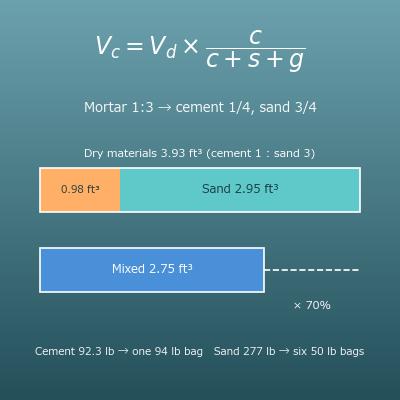
From the amount of mortar found here, work out the cement, sand and bags by mix ratio
Concrete Calculator (Cubic Yards, Weight and Bags)
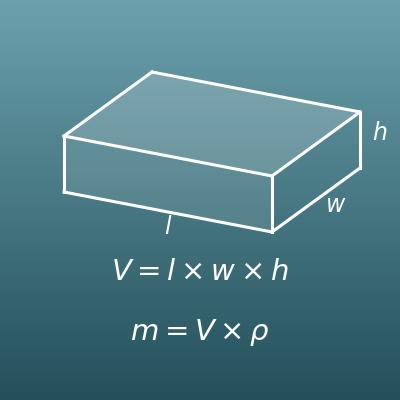
For the volume, weight and bags of concrete for the footing under a block wall
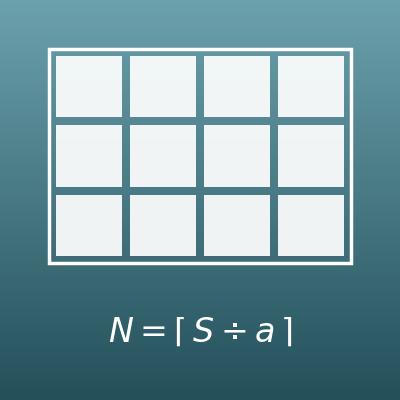
Tile Calculator (How Many Tiles, Boxes and Cost)
The same idea for tiles - divide the area by the area of one tile including the joint
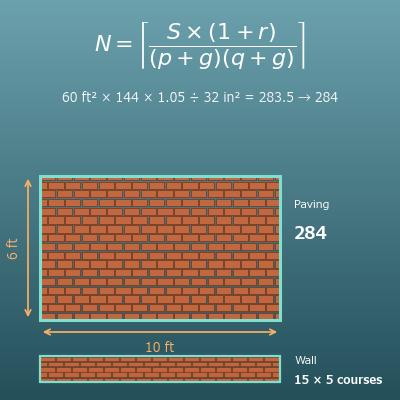
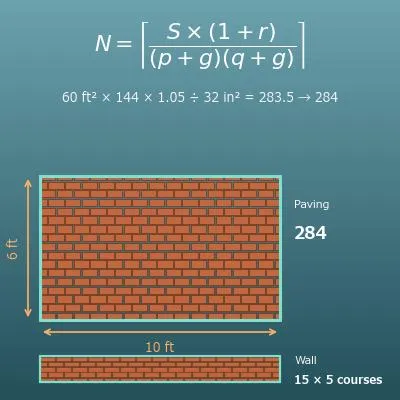
Brick Calculator (Patios, Paths, Garden Edges and Low Walls)
Find the number of bricks and the mortar for laying or stacking bricks, for garden edges and paths
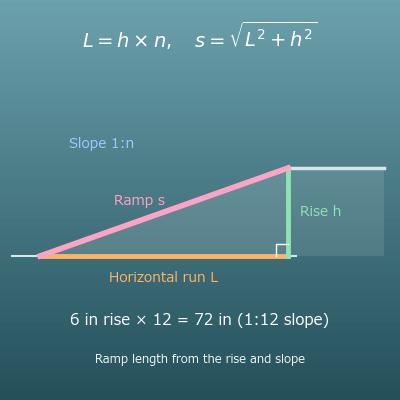
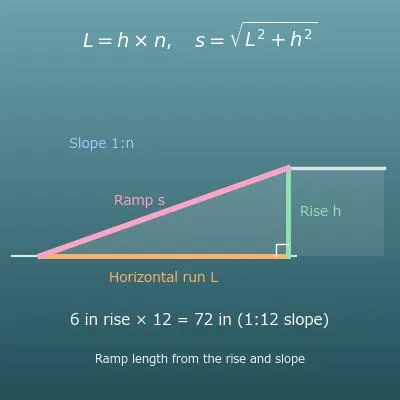
Ramp Length Calculator (Rise and Slope, ADA 1:12)
Get over a step outdoors. Find the ramp length you need from the rise and the slope
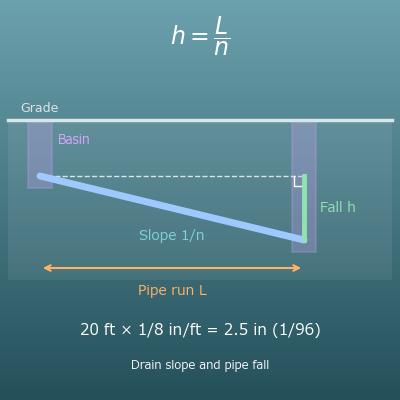
Drain Slope and Pipe Fall Calculator (Inches per Foot, 1/n, Percent)
Find the slope and drop of a drain pipe for outdoor work