Enter the yearly kWh from the appliance's EnergyGuide label or spec sheet and your electricity rate. Enter the yearly kWh of a second appliance (Appliance B) to also see the cost difference when you replace or choose a model.
Table of Contents
-
What you can do on this page
-
What is this calculation used for?
-
How to Use
-
Formulas and figures
-
Symbols and terms
-
Good to know before you start
-
How to calculate it in Excel
-
How to calculate it in Google Sheets
-
How to calculate it in Python
-
How to write it in LaTeX and other math languages (copy and paste)
-
How to have ChatGPT do the calculation
-
DataChef Features
-
Related Features
-
NumberChef Calculators List
What you can do on this page
- Enter the "Estimated Yearly Electricity Use" (kWh per year) from an appliance's EnergyGuide label or spec sheet and your electricity rate, and you get the cost and energy use per year, month and day on the spot
- Enter the yearly kWh of a second appliance to compare the cost difference (per year, month and day, and over 10 years) between your old and new model, or between two models you are choosing from
- Also enter the prices of the two models to see how many years the energy savings take to cover the price difference (the simple payback period)
- A bar graph of the cost over 1, 5 and 10 years shows the difference at a glance
- A plain-language explanation of the formulas and copy-and-paste formulas for Excel, Google Sheets and Python are all on this page
What is this calculation used for?
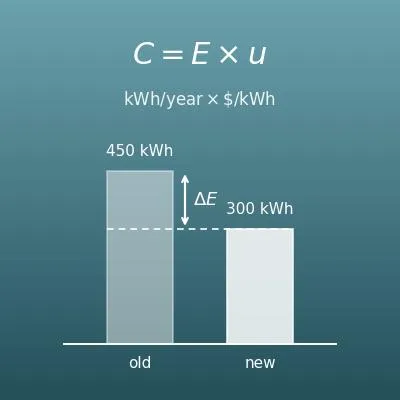
A refrigerator runs 24 hours a day, 365 days a year, so the difference in yearly kWh becomes the difference in cost every year. For example, if you replace an older refrigerator that uses 450 kWh per year with a new model that uses 300 kWh, the difference is 150 kWh. At $0.17 per kWh, that is $25.50 a year, or $255 over 10 years (both are results for the values entered).
With the price of the appliance and the energy savings in the same unit, dollars, you can think about replacing it with numbers instead of feelings like "it still works" or "the new one is efficient". An old model may use more than its label says because of wear, so the real difference may be even larger.
A TV's yearly kWh usually goes up with screen size. For example, if a 55-inch model uses 100 kWh per year and a 75-inch model uses 200 kWh, the difference is 100 kWh, or $17 a year and about $1.42 a month at $0.17 per kWh (values differ by model).
Knowing how much more a bigger screen costs each month helps you decide calmly how much that difference matters to you. The yearly kWh on a TV's EnergyGuide label assumes a set number of viewing hours per day, printed on the label, so if you watch more than that, the real use will be higher.
When you move into a new place, add up the yearly kWh on the labels to get a rough monthly cost for your appliances. For example, a refrigerator (400 kWh/yr), a chest freezer (250 kWh/yr) and a TV (100 kWh/yr) come to 750 kWh per year. At $0.17 per kWh, that is $127.50 a year, or about $10.63 a month for these three.
Your real bill also includes the customer charge and the cost of lighting, heating and cooling, and cooking, so it will be higher. Still, knowing "the appliances that are always on cost about this much" gives you a base for planning your budget.
The Estimated Yearly Energy Cost on an EnergyGuide label is the yearly kWh times a national average price printed on the label. If your rate is different, your cost is different too. For example, a refrigerator that uses 300 kWh per year costs $51 a year at $0.17 per kWh, but $90 a year where electricity costs $0.30 per kWh, as in some parts of the country.
You can find your rate on your electric bill or on your utility's website. Dividing the total of your bill by the kWh used gives a rough "real rate" that also includes the customer charge and other charges.
Some appliances list energy use per load instead of per year, and electric clothes dryers do not carry an EnergyGuide label at all. In that case, multiply the energy per load by the number of loads to get a yearly value. For example, if an electric dryer uses 3 kWh per load and you run 4 loads a week, 3 × 4 × 52 = 624 kWh per year, or about $106.08 a year at $0.17 per kWh.
With this formula you can also put a price on habits, such as "how much does one dryer load cost" or "how much do I save a year by hanging clothes to dry on some days".
Water heaters carry an EnergyGuide label, and the yearly kWh of a standard electric tank and a heat pump (hybrid) water heater are very different. For example, if a standard model uses 4,500 kWh per year and a heat pump model uses 1,300 kWh, the difference is 3,200 kWh, or $544 a year at $0.17 per kWh (values differ by model).
A heat pump water heater usually costs more to buy. If it costs $1,200 more, dividing by $544 a year gives a simple payback period of about 2.2 years. Rebates and tax credits can shorten it further. Comparing this number with how many years you plan to use the heater is the basic way to include energy cost when you choose a model.
Formulas and figures
Symbols and terms
Symbols
| \(E\) | Yearly energy use. The electricity the appliance uses in one year, in kWh per year. From the word "energy". It is shown on the EnergyGuide label and in spec sheets. | |
| \(E_{\mathrm{A}},\ E_{\mathrm{B}}\) | The yearly energy use (kWh/yr) of Appliance A and Appliance B when you compare two. The small A and B at the lower right are subscripts that show which appliance the value belongs to. | |
| \(u\) | Electricity rate. The price of 1 kWh ($/kWh). From "unit price". It depends on your utility and plan. | |
| \(C\) | Cost per year ($). From the word "cost". | |
| \(C_{\text{month}},\ C_{\text{day}}\) | The cost per month and per day ($). The words "month" and "day" at the lower right are subscripts that show the period. They are the yearly cost \(C\) divided by 12 and by 365. | |
| \(\Delta\) | delta | The Greek capital letter delta, used for "difference" or "change". It is said to come from D, as in "difference". \(\Delta C\) is read "the difference in cost \(C\)". |
| \(\Delta C\) | delta C | The yearly cost difference between two appliances ($). Appliance A's yearly cost minus Appliance B's. If it is negative, Appliance A costs less. |
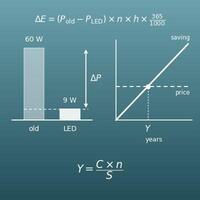
| \(\Delta P\) | delta P | The price difference between two appliances ($). P is from "price". It is how much more the model with the lower energy cost costs to buy. |
| \(Y\) | Simple payback period (years). From the word "year". A rough guide to how many years the energy savings take to cover the price difference. | |
| \(\approx\) | approximately equal to | The symbol for "approximately equal to". It is used to show a rounded value when a division does not come out even (for example, \(51 \div 365 \approx 0.14\)). |
Terms
| Estimated Yearly Electricity Use | The electricity (kWh per year) an appliance uses in one year, as shown on the EnergyGuide label. It is measured with a standard test method set by the U.S. Department of Energy (DOE); for example, a refrigerator is tested with a set room temperature and set compartment temperatures. Because it is "the value under standard conditions", real use goes up or down with how and where you use the appliance and the season. Think of it as a ruler for comparing models under the same conditions. |
| EnergyGuide label | The yellow label required by the Federal Trade Commission (FTC) on many home appliances, such as refrigerators, freezers, dishwashers, clothes washers, water heaters, room air conditioners and TVs. It shows the Estimated Yearly Energy Cost, a bar with the cost range of similar models, and usually the Estimated Yearly Electricity Use in kWh. The yearly kWh used on this page comes from this label or the spec sheet. |
| Estimated Yearly Energy Cost | The dollar amount in large type on the EnergyGuide label, a rough guide to what the appliance costs to run for a year. It is the yearly kWh times a national average electricity price printed on the label, the same calculation as formula 1 on this page. If your rate is different, enter your rate in this calculator to get the cost for your home. |
| Label electricity price | The electricity price the FTC sets for calculating the cost on EnergyGuide labels, so that every label uses the same price. It is updated from time to time, and the value used is printed on the label. Your real rate depends on your state, utility, plan and usage. |
| ENERGY STAR | A program run by the U.S. Environmental Protection Agency (EPA) that certifies products that use less energy than set levels. Certified models carry the ENERGY STAR logo, and the logo may also appear on the EnergyGuide label. |
| Cost range of similar models | The bar on the EnergyGuide label that shows where this model's yearly cost sits between the lowest and highest cost among similar models (similar size and features). The further left the marker, the less energy the model uses compared with similar models. |
| kWh (kilowatt-hour) | The unit of energy, or the total amount of electricity used. Using 1 kW (1000 W) of power for 1 hour uses 1 kWh, and electric bills are based on kWh. "300 kWh per year" is the same amount of electricity as running a 1000 W appliance for 300 hours in a year. |
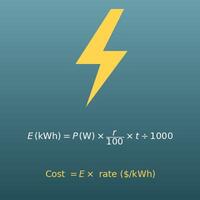
| Wattage | The power (W) an appliance uses at any moment while it runs. It is a rate, not an amount, so to get a cost you first multiply it by hours of use to get kWh (the formula on the related electricity cost page). Yearly kWh, on the other hand, is already an amount for one year, so you only multiply it by the rate. |
| DOE test procedure | The standard test method, set by the U.S. Department of Energy for each kind of appliance, used to measure the energy use shown on labels and spec sheets. Because every model is tested the same way, you can compare their yearly kWh fairly. |
| Energy use per load | The electricity (Wh or kWh) used for one run of an appliance such as a clothes dryer or a dishwasher. To get a yearly value, multiply it by the number of runs in a year (for example 3 kWh × 4 loads a week × 52 weeks = 624 kWh per year). If it is given in Wh, divide by 1000 to change it into kWh before you enter it. |
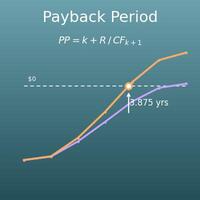
| Simple payback period | The extra upfront cost (here, the price difference) divided by the yearly savings (here, the yearly cost difference). It is the simplest guide to "how many years until it pays for itself", and it ignores discounts, rate changes and the time value of money. The general form of this calculation is on the related page "Payback Period Calculator". |
| Distributive property | The rule that when you multiply a sum or difference in parentheses by a number, you can multiply each number inside first and then add or subtract, and get the same result, as in \((a - b) \times u = a \times u - b \times u\). It is why "difference in energy × rate" and "difference of the two costs" give the same answer. |
| Wear with age | The loss of performance over years of use, from worn parts, dirt and similar causes. An old refrigerator or air conditioner may use more electricity than its label says, and then the real savings from replacing it are larger than the difference between the label values. |
Good to know before you start
Here is what helps you understand the calculations on this page, not just use them.
If you get stuck, going back over the topics in this table is the quickest way forward.
| Multiplying and dividing decimals (Grade 5) |
|
| Converting units (Grades 4 to 7) |
|
| Power and energy (middle school physical science) |
|
| Positive and negative numbers (Grade 6 to 7) |
|
| The distributive property (Grades 6 to 7) |
|
How to calculate it in Excel
| Yearly energy use (kWh/yr) | 300 |
| Electricity rate ($/kWh) | 0.17 |
| Cost per year ($) | =B1*B2 |
| Yearly energy use (kWh/yr) | 300 |
| Electricity rate ($/kWh) | 0.17 |
| Energy use per month (kWh) | =B1/12 |
| Cost per month ($) | =B1*B2/12 |
| Energy use per day (kWh) | =B1/365 |
| Cost per day ($) | =B1*B2/365 |
| Appliance A yearly use (kWh/yr) | 300 |
| Appliance B yearly use (kWh/yr) | 450 |
| Electricity rate ($/kWh) | 0.17 |
| Yearly cost difference ($, negative if A costs less) | =(B1-B2)*B3 |
| Difference over 10 years ($) | =B4*10 |
| Price of the model with lower energy cost ($) | 1000 |
| Price of the other model ($) | 850 |
| Yearly cost difference ($, absolute value) | 25.5 |
| Price difference ($) | =B1-B2 |
| Simple payback period (years) | =B4/B3 |
The first table is the example of 300 kWh/yr at $0.17/kWh, and B3 shows 51 ($). The second table changes the same values into a month and a day: the cost per month (B4) is $4.25 and the cost per day (B6) is about $0.14.
The third table is the difference between two appliances, and B4 shows -25.5 ($). The minus sign tells you that Appliance A costs less. The fourth table finds how long a yearly difference of $25.50 takes to cover a price difference of $150, and B5 shows about 5.88 (years). Just change the numbers in column B to your own appliances' values.
How to calculate it in Google Sheets
| Yearly energy use (kWh/yr) | 300 |
| Electricity rate ($/kWh) | 0.17 |
| Cost per year ($) | =B1*B2 |
| Yearly energy use (kWh/yr) | 300 |
| Electricity rate ($/kWh) | 0.17 |
| Energy use per month (kWh) | =B1/12 |
| Cost per month ($) | =B1*B2/12 |
| Energy use per day (kWh) | =B1/365 |
| Cost per day ($) | =B1*B2/365 |
| Appliance A yearly use (kWh/yr) | 300 |
| Appliance B yearly use (kWh/yr) | 450 |
| Electricity rate ($/kWh) | 0.17 |
| Yearly cost difference ($, negative if A costs less) | =(B1-B2)*B3 |
| Difference over 10 years ($) | =B4*10 |
| Price of the model with lower energy cost ($) | 1000 |
| Price of the other model ($) | 850 |
| Yearly cost difference ($, absolute value) | 25.5 |
| Price difference ($) | =B1-B2 |
| Simple payback period (years) | =B4/B3 |
How to calculate it in Python
annual_kwh_a = 300        # Appliance A yearly energy use (kWh/yr)
annual_kwh_b = 450        # Appliance B yearly energy use (kWh/yr). None if not comparing
price_per_kwh = 0.17      # Electricity rate ($/kWh)
body_price_a = 1000       # Appliance A price ($). None if you do not need the payback period
body_price_b = 850        # Appliance B price ($)

# Cost per year = yearly kWh x rate. Divide by 12 for a month and by 365 for a day
annual_cost_a = annual_kwh_a * price_per_kwh
print(f"Appliance A, 1 year: {annual_kwh_a} kWh / ${annual_cost_a:.2f}")
print(f"Appliance A, 1 month: {annual_kwh_a / 12:.1f} kWh / ${annual_cost_a / 12:.2f}")
print(f"Appliance A, 1 day: {annual_kwh_a / 365:.2f} kWh / ${annual_cost_a / 365:.2f}")

if annual_kwh_b is not None:
    # Difference = (A - B) x rate. Negative means Appliance A costs less
    cost_diff = (annual_kwh_a - annual_kwh_b) * price_per_kwh
    cheaper = "Appliance A" if cost_diff < 0 else "Appliance B"
    print(f"Yearly cost difference: ${abs(cost_diff):.2f} ({cheaper} costs less)")
    print(f"Difference over 10 years: ${abs(cost_diff) * 10:.2f}")

    if body_price_a is not None and cost_diff != 0:
        # Simple payback = extra price of the cheaper-to-run model / yearly difference
        cheaper_price, other_price = (body_price_a, body_price_b) if cost_diff < 0 else (body_price_b, body_price_a)
        extra_price = cheaper_price - other_price
        if extra_price > 0:
            print(f"Simple payback period: {extra_price / abs(cost_diff):.1f} years")
        else:
            print("The cheaper-to-run model is also the same price or cheaper, so no payback period is needed")
How to write it in LaTeX and other math languages (copy and paste)
C = E × u
C = E \times u
<math xmlns="http://www.w3.org/1998/Math/MathML" display="block">
<mrow>
<mi>C</mi>
<mo>=</mo>
<mi>E</mi>
<mo>×</mo>
<mi>u</mi>
</mrow>
</math>
C = E * u
annualCost = annualKwh*unitPrice
annualCost := E*u;
C = E*u;
C = E×u
C_month = E × u ÷ 12, C_day = E × u ÷ 365
C_{\text{month}} = \frac{E \times u}{12}, \quad C_{\text{day}} = \frac{E \times u}{365}
<math xmlns="http://www.w3.org/1998/Math/MathML" display="block">
<mrow>
<msub><mi>C</mi><mtext>month</mtext></msub>
<mo>=</mo>
<mfrac><mrow><mi>E</mi><mo>×</mo><mi>u</mi></mrow><mn>12</mn></mfrac>
<mo>,</mo>
<msub><mi>C</mi><mtext>day</mtext></msub>
<mo>=</mo>
<mfrac><mrow><mi>E</mi><mo>×</mo><mi>u</mi></mrow><mn>365</mn></mfrac>
</mrow>
</math>
C_"month" = (E * u) / 12, C_"day" = (E * u) / 365
monthlyCost = annualKwh*unitPrice/12; dailyCost = annualKwh*unitPrice/365
monthlyCost := E*u/12; dailyCost := E*u/365;
C_month = E*u/12; C_day = E*u/365;
C_month = (E×u)/12, C_day = (E×u)/365
ΔC = (E_A − E_B) × u
\Delta C = (E_{\mathrm{A}} - E_{\mathrm{B}}) \times u
<math xmlns="http://www.w3.org/1998/Math/MathML" display="block">
<mrow>
<mi>Δ</mi><mi>C</mi>
<mo>=</mo>
<mo>(</mo>
<msub><mi>E</mi><mi mathvariant="normal">A</mi></msub>
<mo>−</mo>
<msub><mi>E</mi><mi mathvariant="normal">B</mi></msub>
<mo>)</mo>
<mo>×</mo>
<mi>u</mi>
</mrow>
</math>
Delta C = (E_A - E_B) * u
costDiff = (annualKwhA - annualKwhB)*unitPrice
costDiff := (E_A - E_B)*u;
dC = (E_A - E_B)*u;
ΔC = (E_A − E_B)×u
Y = ΔP ÷ ΔC
Y = \frac{\Delta P}{\Delta C}
<math xmlns="http://www.w3.org/1998/Math/MathML" display="block">
<mrow>
<mi>Y</mi>
<mo>=</mo>
<mfrac>
<mrow><mi>Δ</mi><mi>P</mi></mrow>
<mrow><mi>Δ</mi><mi>C</mi></mrow>
</mfrac>
</mrow>
</math>
Y = (Delta P) / (Delta C)
paybackYears = priceDiff/costDiff
paybackYears := priceDiff/costDiff;
Y = dP/dC;
Y = ΔP/ΔC
How to have ChatGPT do the calculation
You are an electricity cost assistant. Do the calculation below by actually running Python code, and base your answer only on the numbers from the output (do not calculate in your head or guess).

There is a refrigerator whose EnergyGuide label says 300 kWh per year (Appliance A, price $1,000) and one that says 450 kWh per year (Appliance B, price $850). The electricity rate is $0.17 per kWh.
Find the cost per year with "yearly kWh × rate ($/kWh)", the cost per month by dividing that by 12, and the cost per day by dividing it by 365.
Find each of the following.
1. Appliance A's cost ($) and energy use (kWh) per year, per month and per day
2. The yearly cost difference between the two ($) and which one costs less
3. How many years it takes for the yearly difference to cover the extra price of the model that costs less to run (the simple payback period)

Show the formulas you used and the numbers from the output.
How to Use
-
1Enter your numbersType the numbers you want to calculate with into the input fields
-
2CalculatePress the "Calculate" button
-
3Check the resultThe result appears on the spot. The same page also explains the idea behind the calculation and the formula
DataChef Features

No technical knowledge required.
Intuitive and user-friendly operation.

Can be used without registering personal information.

Automatic file deletion by clicking "download".

and rapid file conversion.

No attribution required.

No need to contact us for commercial use permission.
Related Features
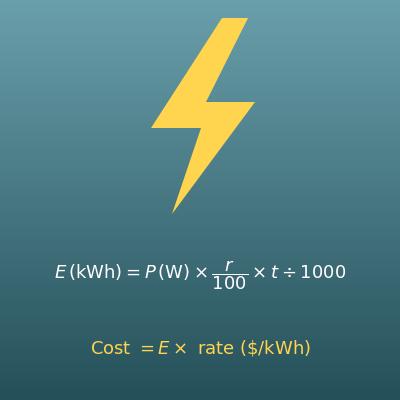
Electricity Cost Calculator (Appliance Energy Use and Cost)
Finds the energy use and cost per day, week, month and year from an appliance's wattage, duty cycle and hours of use
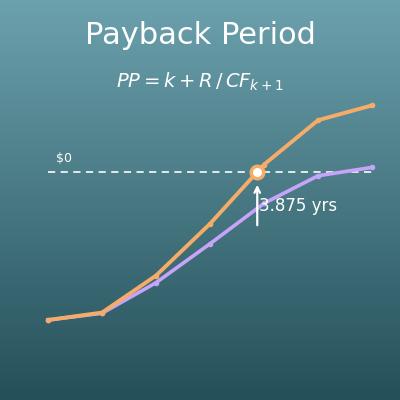
Payback Period Calculator (Simple and Discounted Payback)
Finds how many years it takes to earn back an investment from the yearly cash flow
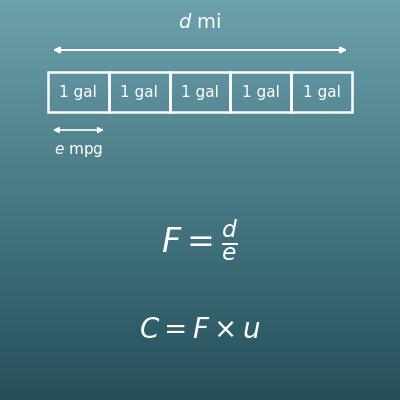
Gas Cost Calculator (Trip Fuel Cost from Distance, MPG and Gas Price)
Finds the fuel used and the fuel cost from the distance, fuel economy and gas price
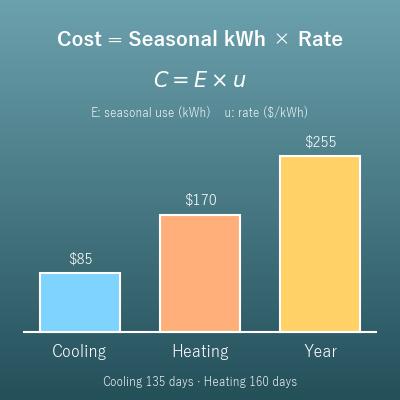
Air Conditioner Running Cost Calculator (Cooling, Heating and Yearly Cost from kWh)
Finds the cooling-season, heating-season and yearly cost of an air conditioner, and the savings from changing the thermostat
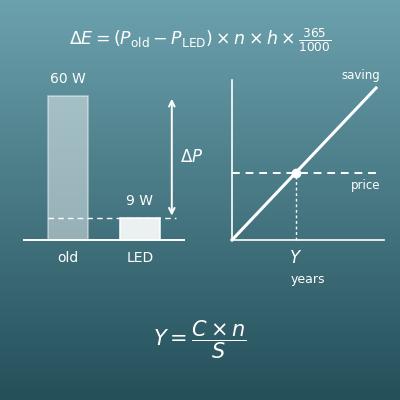
LED Savings Calculator (Yearly Savings and Payback from Switching to LED)
Finds the yearly savings from switching incandescent or fluorescent lights to LEDs, and how long the bulbs take to pay for themselves