
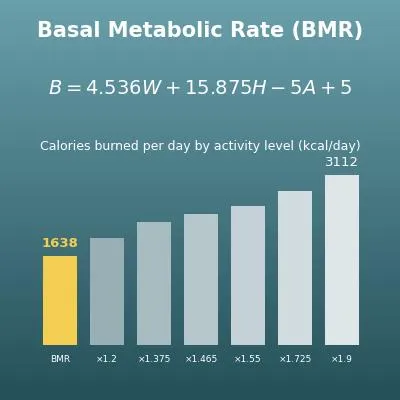
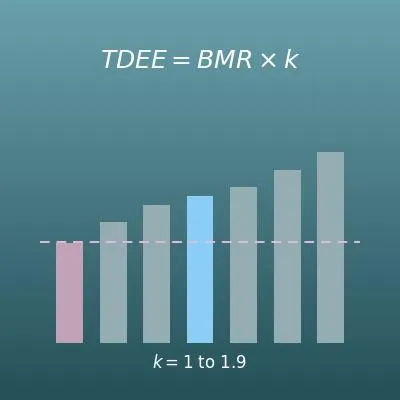
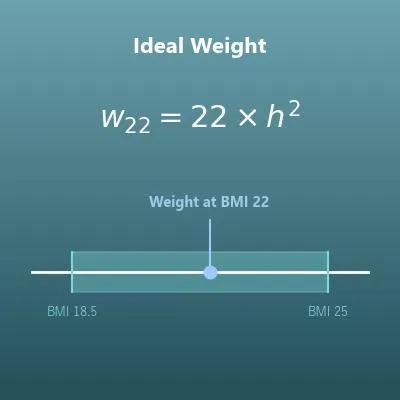
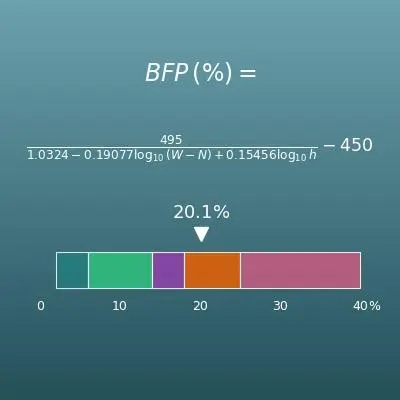


Enter your age, sex, height, weight and activity level. Your TDEE (total daily energy expenditure) and BMR are calculated, and a bar graph compares TDEE across activity levels.
Table of Contents
-
What you can do on this page
-
What is this calculation used for?
-
How to Use
-
Formula and figures
-
Symbols and terms
-
Good to know before you start
-
How to calculate it in Excel
-
How to calculate it in Google Sheets
-
How to calculate it in Python
-
How to write it in LaTeX and other math languages (copy and paste)
-
How to have ChatGPT do the calculation
-
DataChef Features
-
Related Features
-
NumberChef Calculators List
What you can do on this page
- Enter your age, sex, height, weight and activity level to see your TDEE (total daily energy expenditure, the total calories you burn in a day) on the spot
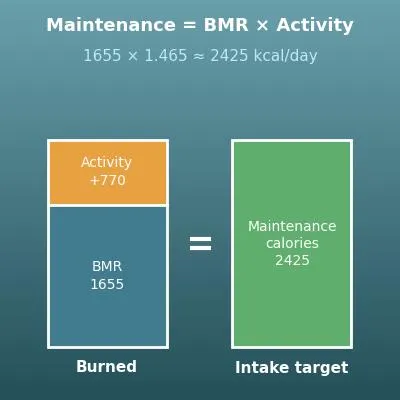
- Formulas and figures explain how TDEE = BMR × activity factor works and how to choose the activity factor (activity level) that fits you
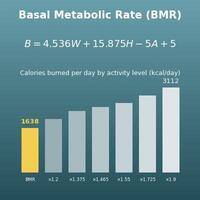
- A bar graph by activity level shows how your TDEE changes when your activity level changes
- If you know your body fat percentage, you can also use the Katch-McArdle formula, which works from lean body mass
- A plain-language explanation of the formulas and copy-and-paste formulas for Excel, Google Sheets and Python are all on this page
What is this calculation used for?
Without a reference of your own, the calories on a food label do not tell you whether that is a lot or a little. TDEE is the theoretical baseline at which your weight stays the same, so if your TDEE is 2,400 kcal, you can see that "this 900-Calorie restaurant meal is nearly 40% of my day".
Whether you want to lose or gain weight, the first step is to estimate your TDEE. Only once you know the baseline can you plan how much to go above or below it (there is a standard way to set a daily calorie target for each rate of loss or gain, and the Calorie Calculator in the related pages uses it).
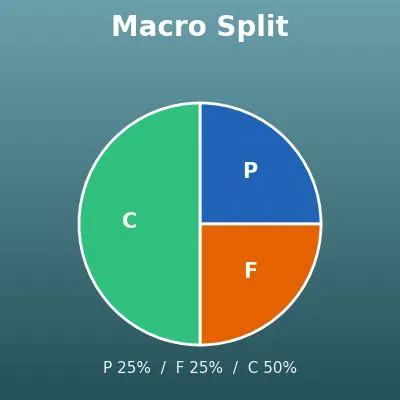
In meal plans for building muscle (such as setting your macros), the usual steps are to estimate your TDEE first and then split it into protein, fat and carbohydrates.
Personal trainers and sports dietitians also start from a formula with the same structure, "TDEE = BMR × activity factor". Once you understand this structure, it feels natural to choose a new activity factor when your training schedule changes.
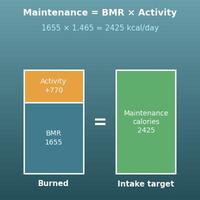
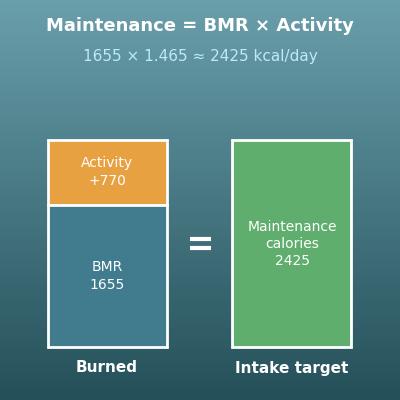
For a person with a BMR of 1655 kcal, TDEE is about 1986 kcal when sedentary (×1.2) and about 2276 kcal with light exercise 1–3 times a week (×1.375). The difference is only about 290 kcal a day, roughly one slice of frosted cake.
Comparing TDEE across activity levels shows in numbers how easily a "reward treat" after every workout cancels out the exercise. It also shows the well-known point that, for weight loss, managing how much you eat tends to work better than burning more (exercise still has great value beyond calories, for fitness and health).
To estimate how much energy a hospital patient or an older adult needs in a day, dietitians and doctors have long used a BMR formula multiplied by factors for activity and medical condition. It is the same "base metabolism × factor" structure as this page.
In the US, the Dietary Reference Intakes from the National Academies estimate energy needs with Estimated Energy Requirement (EER) equations that include your physical activity level, so the idea behind TDEE is also part of official nutrition guidance. Real clinical nutrition includes professional adjustments based on the patient's condition and measurements, so always consult a professional about decisions related to treatment or care.
Formula and figures
Symbols and terms
Symbols
| \(T\) | tee | TDEE, total daily energy expenditure (kcal/day). This page uses T, the first letter of "total". |
| \(B\) | bee | Basal metabolic rate (BMR), the estimated calories you burn in a day at complete rest (kcal/day). This page uses B, the first letter of "basal". |
| \(k\) | kay | The activity factor, a multiplier that shows how many times your BMR you burn in a day. This page uses 1 (no activity) and 6 levels from 1.2 to 1.9. |
| \(W\) | double-u | Weight in kg, from the first letter of "weight" (kg = lb × 0.4536). |
| \(H\) | aitch | Height in cm, from the first letter of "height" (cm = in × 2.54, so 5 ft 11 in = 71 in ≈ 180 cm). |
| \(A\) | a | Age in years, from the first letter of "age". The older you are, the lower the estimated BMR. |
| \(F\) | ef | Body fat percentage written as a decimal (for example, 15% → 0.15). It is used in the Katch-McArdle formula. F stands for "fat". |
Terms
| TDEE (total daily energy expenditure) | The total calories you burn in a day (kcal/day), your BMR plus the calories for exercise and daily activities. It is usually estimated as "BMR × activity factor" and is the main number on this page. |
| maintenance calories | The estimated calories per day that keep your current weight. In theory it is the same number as TDEE, and the two terms are often used for the same thing. The Calorie Calculator in the related pages uses it to set weight loss and weight gain targets. |
| BMR (basal metabolic rate) | The energy you use just to stay alive, for things like keeping your body warm, breathing and keeping your heart beating (kcal/day). It is thought to make up about 60–70% of TDEE. It changes with muscle mass, age, body size and so on. |
| activity factor | A multiplier for the extra calories you use for exercise and daily activities. You multiply your BMR by it to estimate TDEE. This page uses 1 (no activity) and 6 levels from 1.2 to 1.9. |
| PAL (physical activity level) | Total daily energy expenditure divided by BMR. It plays the same role as the activity factor on this page. The idea is used by FAO/WHO and in the US Dietary Reference Intakes, which group people into activity categories such as inactive, low active, active and very active. |
| body fat percentage | The share of your body weight that is fat (%). You can measure it with a home body composition scale or similar. The Katch-McArdle formula uses it to estimate BMR. |
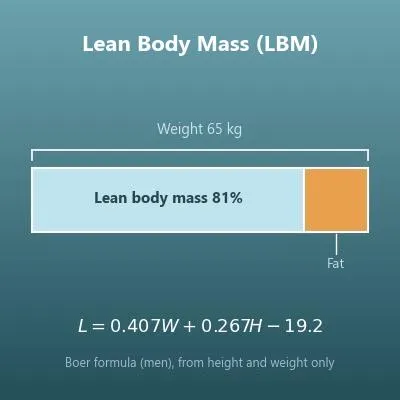
| lean body mass | Your body weight minus the fat (muscle, bone, organs and so on). It is found as "(1 − body fat percentage as a decimal) × weight". The Katch-McArdle formula is based on the idea that BMR is roughly proportional to lean body mass. |
| Mifflin-St Jeor equation | A formula for estimating BMR, published in 1990. It is often found to be fairly close to measured values in people today and is widely used, including by dietitians in the US. It is the default formula in this calculator. |
| Katch-McArdle formula | A formula that estimates BMR from lean body mass. It is considered accurate for people who know their body fat percentage well. Its strength is that it reflects differences in muscle mass. |
Good to know before you start
Here is what helps you use the calculation on this page with real understanding, not just by pressing the button.
| Multiplying decimals (Grades 5–6) |
|
| Percentages (Grade 6) |
|
| Rounding (Grade 4) |
|
| Adding and subtracting larger numbers (Grades 3–4) |
|
How to calculate it in Excel
| Sex (M or F) | M |
| Weight (lb) | 143 |
| Height (in) | 71 |
| Age (years) | 25 |
| Activity factor | 1.465 |
| BMR (kcal/day) | =4.536*B2+15.875*B3-5*B4+IF(B1="M",5,-161) |
| TDEE (kcal/day) | =ROUND(B6*B5,0) |
| Weight (lb) | 176 |
| Body fat (%) | 15 |
| Activity factor | 1.55 |
| BMR (kcal/day) | =370+21.6*(1-B2/100)*B1*0.4536 |
| TDEE (kcal/day) | =ROUND(B4*B3,0) |
The IF function in the first table switches the constant by sex: if B1 is "M" it adds 5, otherwise (F) it subtracts 161. The first table uses the Mifflin-St Jeor equation rewritten for pounds and inches (height is your total height in inches: 5 ft 11 in = 71). In the second table, "*0.4536" turns pounds into kg, because the Katch-McArdle formula uses kg. ROUND rounds to a whole number.
With the example numbers, the first table gives a BMR of about 1655.8 and a TDEE of 2426, and the second gives a BMR of about 1835.7 and a TDEE of 2845. Just replace the numbers in column B with your own. For the activity factor, enter the value that matches how much you usually exercise, from 1.2 (sedentary) to 1.9 (very intense exercise).
How to calculate it in Google Sheets
| Sex (M or F) | M |
| Weight (lb) | 143 |
| Height (in) | 71 |
| Age (years) | 25 |
| Activity factor | 1.465 |
| BMR (kcal/day) | =4.536*B2+15.875*B3-5*B4+IF(B1="M",5,-161) |
| TDEE (kcal/day) | =ROUND(B6*B5,0) |
| Weight (lb) | 176 |
| Body fat (%) | 15 |
| Activity factor | 1.55 |
| BMR (kcal/day) | =370+21.6*(1-B2/100)*B1*0.4536 |
| TDEE (kcal/day) | =ROUND(B4*B3,0) |
How to calculate it in Python
sex = "male"             # "male" or "female"
age = 25                 # age (years)
height_in = 71           # height (total inches: 5 ft 11 in = 71)
weight_lb = 143          # weight (lb)
activity_factor = 1.465  # activity factor (1.2 to 1.9; see the "Formula and figures" section)

# The formulas use kg and cm, so convert first
weight_kg = weight_lb * 0.45359237
height_cm = height_in * 2.54

# BMR (Mifflin-St Jeor equation)
bmr = 10 * weight_kg + 6.25 * height_cm - 5 * age
bmr = bmr + 5 if sex == "male" else bmr - 161

# TDEE = BMR x activity factor
tdee = bmr * activity_factor

print(f"BMR: {round(bmr)} kcal/day")
print(f"Total daily energy expenditure (TDEE): {round(tdee)} kcal/day")

# If you know your body fat percentage (Katch-McArdle formula), replace the two lines that find bmr with these two
# body_fat_percent = 15
# bmr = 370 + 21.6 * (1 - body_fat_percent / 100) * weight_kg
How to write it in LaTeX and other math languages (copy and paste)
T = B × k
T = B \times k
<math xmlns="http://www.w3.org/1998/Math/MathML" display="block">
<mrow>
<mi>T</mi><mo>=</mo>
<mi>B</mi><mo>×</mo><mi>k</mi>
</mrow>
</math>
T = B xx k
b*k
T := B*k;
T = B*k;
T = B × k
B = 10W + 6.25H − 5A + 5 (men), B = 10W + 6.25H − 5A − 161 (women)
B_{m} = 10W + 6.25H - 5A + 5, \quad B_{f} = 10W + 6.25H - 5A - 161
<math xmlns="http://www.w3.org/1998/Math/MathML" display="block">
<mrow>
<msub><mi>B</mi><mi>m</mi></msub>
<mo>=</mo>
<mn>10</mn><mi>W</mi>
<mo>+</mo>
<mn>6.25</mn><mi>H</mi>
<mo>−</mo>
<mn>5</mn><mi>A</mi>
<mo>+</mo>
<mn>5</mn>
<mo>,</mo>
<msub><mi>B</mi><mi>f</mi></msub>
<mo>=</mo>
<mn>10</mn><mi>W</mi>
<mo>+</mo>
<mn>6.25</mn><mi>H</mi>
<mo>−</mo>
<mn>5</mn><mi>A</mi>
<mo>−</mo>
<mn>161</mn>
</mrow>
</math>
B_m = 10W + 6.25H - 5A + 5, B_f = 10W + 6.25H - 5A - 161
{10*w + 6.25*h - 5*a + 5, 10*w + 6.25*h - 5*a - 161}
Bm := 10*W + 6.25*H - 5*A + 5; Bf := 10*W + 6.25*H - 5*A - 161;
B_m = 10*W + 6.25*H - 5*A + 5; B_f = 10*W + 6.25*H - 5*A - 161;
B_m = 10W + 6.25H - 5A + 5, B_f = 10W + 6.25H - 5A - 161
B = 370 + 21.6(1 − F)W
B = 370 + 21.6(1-F)W
<math xmlns="http://www.w3.org/1998/Math/MathML" display="block">
<mrow>
<mi>B</mi>
<mo>=</mo>
<mn>370</mn>
<mo>+</mo>
<mn>21.6</mn>
<mo>(</mo><mn>1</mn><mo>−</mo><mi>F</mi><mo>)</mo>
<mi>W</mi>
</mrow>
</math>
B = 370 + 21.6(1 - F)W
370 + 21.6*(1 - f)*w
B := 370 + 21.6*(1 - F)*W;
B = 370 + 21.6*(1 - F)*W;
B = 370 + 21.6(1 − F)W
How to have ChatGPT do the calculation
You are a TDEE (total daily energy expenditure) calculation assistant. Do the following calculation by actually running Python code, and base your answer only on the numbers from the execution result (do not answer by mental math or guessing).

A 25-year-old man is 5 ft 11 in tall and weighs 143 lb.
1. Convert his weight to kg (1 lb = 0.45359237 kg) and his height to cm (1 in = 2.54 cm), then find his basal metabolic rate (BMR) with the Mifflin-St Jeor equation (men: BMR = 10 × weight in kg + 6.25 × height in cm − 5 × age + 5).
2. He does moderate exercise 4–5 times a week (activity factor 1.465). Calculate TDEE = BMR × activity factor and round it to the nearest whole number.
3. For reference, find his TDEE in the same way with activity factors of 1.2 (sedentary) and 1.725 (intense exercise, 6–7 times a week).

Show the formulas you used and the numbers from the execution result. Also note that these are estimates from formulas and not medical advice.
How to Use
-
1Enter your numbersType the numbers you want to calculate with into the input fields
-
2CalculatePress the "Calculate" button
-
3Check the resultThe result appears on the spot. The same page also explains the idea behind the calculation and the formula
DataChef Features

No technical knowledge required.
Intuitive and user-friendly operation.

Can be used without registering personal information.

Automatic file deletion by clicking "download".

and rapid file conversion.

No attribution required.

No need to contact us for commercial use permission.
Related Features
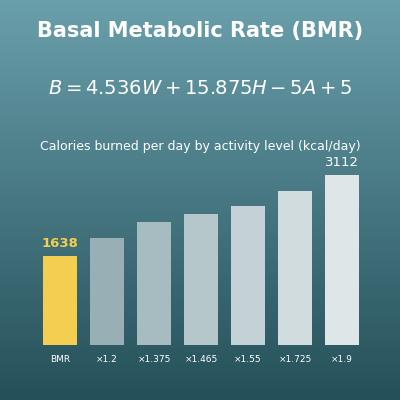
BMR Calculator (Basal Metabolic Rate and Daily Calories by Activity Level)
Estimate BMR, the base of TDEE, with three formulas and see a list for 6 activity levels
Calorie Calculator (Maintenance Calories and Weight Loss or Gain Plans)
Find daily calorie targets for losing or gaining weight at different rates
BMI Calculator (Body Mass Index and Healthy Weight Range)
Find your BMI and weight category from your height and weight