

Enter your age and press "Calculate". If you enter your resting heart rate, the Karvonen formula, which reflects your own fitness, is used (if not, a simple percentage of your maximum heart rate). If you have a maximum heart rate measured in an exercise stress test or similar, you can use it instead of your age.
Table of Contents
-
What you can do on this page
-
What is this calculation used for?
-
How to Use
-
Formulas and graphs
-
Symbols and terms
-
Good to know before you start
-
How to calculate it in Excel
-
How to calculate it in Google Sheets
-
How to calculate it in Python
-
How to write it in LaTeX and other math languages (copy and paste)
-
How to have ChatGPT do the calculation
-
DataChef Features
-
Related Features
-
NumberChef Calculators List
What you can do on this page
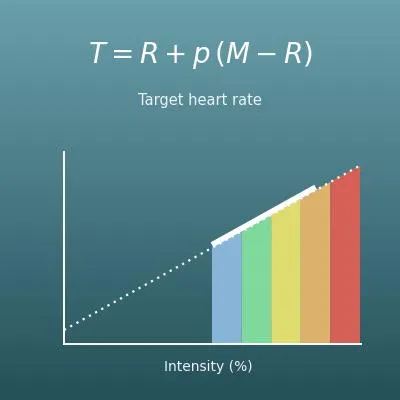
- Enter your age, and you see on the spot your target heart rate zone for exercise (50–85% of your maximum heart rate, the range used by the American Heart Association)
- A table and a graph show your target heart rate for 5 zones from 50% to 100% intensity. They help you choose the right intensity for your goal, such as warming up, burning fat or building endurance
- If you enter your resting heart rate, it uses the Karvonen formula, which reflects your own fitness (if you leave it blank, it uses a simple percentage of your maximum heart rate)
- To estimate your maximum heart rate, you can choose "220 − age" (the standard) or the Tanaka or Nes formula, and if you have a measured value, you can use it as is
- A plain-language explanation of the formulas and copy-and-paste formulas for Excel, Google Sheets and Python are all on this page
What is this calculation used for?
Keeping a pace that is "not too breathless, but still a workout" by feel alone is harder than it sounds. With a target heart rate, you just check your heart rate as you go and adjust your pace objectively.
For example, a 30-year-old with a resting heart rate of 70 bpm who wants to build a base of endurance at 60–70% intensity should aim for 142–154 bpm by the Karvonen formula. You speed up or slow down to stay in that range.
Fat is said to be used for energy most easily at a moderate intensity where you can still talk comfortably (around 60–70% of your maximum heart rate). If you push too hard, you cannot keep going for long, and your total calories burned may end up lower.
For example, for a 50-year-old (estimated maximum heart rate 170 bpm), this zone is about 102–119 bpm by the percent of max method. This calculation lets you check with numbers the intensity that "is not hard but still works".
Many running watches and smartwatches show your heart rate in color-coded zones such as "Zone 1 to 5". The dividing lines behind them come from the same idea as this page, "a percentage of your maximum heart rate".
Once you understand how it works, you can use the display with good reasons, such as "long and easy in Zone 2 today" or "up to Zone 4 in intervals". If you set your own maximum and resting heart rate in the watch settings, the zones also become more accurate.
If you push hard right away after a long break from exercise, you are less likely to stick with it and you put more strain on your body. When you are just starting, the usual advice is to begin at an easy intensity, around the warm-up zone (50–60% of your maximum heart rate).
For example, at 40, the estimated maximum heart rate is 180 bpm, and this zone is about 90–108 bpm. Having an upper limit in numbers, "I will not go above this", works as a safety net when you are tempted to overdo it. If you have a health condition or any health concerns, talk with your doctor before you start.
In endurance sports, athletes commonly use heart rate zones to separate "long, slow days" from "hard days". By not relying on feel to judge intensity, they can build up training that targets the ability they want to improve.
For example, for a 25-year-old athlete with a resting heart rate of 60 bpm, the anaerobic zone (80–90%) by the Karvonen formula is 168–182 bpm. Coaches use this to plan workouts, such as pushing into this range in interval runs and keeping recovery runs in the lower zones.
Formulas and graphs
Symbols and terms
Symbols
| \(T\) | The target heart rate you want to find (bpm). From the first letter of "target". |
| \(M\) | Maximum heart rate (bpm), the highest heart rate you can reach during all-out exercise. From the first letter of "maximum". |
| \(A\) | Age in years. From the first letter of "age". |
| \(R\) | Resting heart rate (bpm). From the first letter of "rest". |
| \(p\) | Intensity, how hard you exercise as a share of the maximum, written as a decimal (0.50 for 50%). From "percent". |
| \(M - R\) | Heart rate reserve (maximum heart rate − resting heart rate). It is the room your heart rate has to rise during exercise, and it is the base of the Karvonen formula. |
Terms
| heart rate | How many times your heart beats in 1 minute. The unit is bpm (beats per minute). You can also measure it by counting your pulse at the wrist for 15 seconds and multiplying by 4. |
| maximum heart rate | The highest heart rate you can reach during all-out exercise. It tends to go down with age and is estimated with formulas such as "220 − age" (people of the same age can differ by about ±10 bpm). |
| resting heart rate | Your heart rate when you are calm and at rest. For adults it is usually about 60 to 100 bpm, and people who do regular endurance exercise often have lower rates. It is best measured right after you wake up in the morning. |
| heart rate reserve (HRR) | Maximum heart rate minus resting heart rate. It is the room your heart rate has to rise during exercise, and it is the base of the Karvonen formula. |
| Karvonen formula | A common method for target heart rate that multiplies the heart rate reserve by the intensity and adds back the resting heart rate. It was proposed by the Finnish physiologist Martti Karvonen and is widely used by fitness professionals. |
| target heart rate (THR) | The heart rate to aim for during exercise so that you stay at the right intensity for your goal. It is the value this page finds. |
| intensity | How hard the exercise is. On this page it is written as a percentage of your maximum heart rate (or of your heart rate reserve). |
| bpm | Short for beats per minute, the unit of heart rate. |
| beta blocker | A medicine that slows the heart rate, used to treat high blood pressure and heart disease. When you take one, your heart rate rises less during exercise, so the numbers on this page do not apply. Ask your doctor how hard you should exercise. |
Good to know before you start
Here is what helps you use the calculation on this page with real understanding, not just by pressing the button.
| Percents (Grade 6) |
|
| Order of operations (Grades 5–6) |
|
| Rounding (Grades 4–5) |
|
| Evaluating expressions (Grades 6–7) |
|
How to calculate it in Excel
| Age A (years) | 30 |
| Maximum heart rate M (bpm) | =220-B1 |
| Age A (years) | 40 |
| Max heart rate by Tanaka (bpm) | =ROUND(208-0.7*B1,0) |
| Max heart rate by Nes (bpm) | =ROUND(211-0.64*B1,0) |
| Maximum heart rate M (bpm) | 195 |
| Intensity p (for 60%, enter 0.6) | 0.6 |
| Target heart rate T (bpm) | =ROUND(B1*B2,0) |
| Maximum heart rate M (bpm) | 190 |
| Resting heart rate R (bpm) | 70 |
| Intensity p (for 50%, enter 0.5) | 0.5 |
| Target heart rate T (bpm) | =ROUND(B2+B3*(B1-B2),0) |
"ROUND(value,0)" rounds to a whole number. With the example numbers, the first table shows 190, the second 180 and 185, the third 117 and the fourth 130. Just replace the age and heart rates with your own.
How to calculate it in Google Sheets
| Age A (years) | 30 |
| Maximum heart rate M (bpm) | =220-B1 |
| Age A (years) | 40 |
| Max heart rate by Tanaka (bpm) | =ROUND(208-0.7*B1,0) |
| Max heart rate by Nes (bpm) | =ROUND(211-0.64*B1,0) |
| Maximum heart rate M (bpm) | 195 |
| Intensity p (for 60%, enter 0.6) | 0.6 |
| Target heart rate T (bpm) | =ROUND(B1*B2,0) |
| Maximum heart rate M (bpm) | 190 |
| Resting heart rate R (bpm) | 70 |
| Intensity p (for 50%, enter 0.5) | 0.5 |
| Target heart rate T (bpm) | =ROUND(B2+B3*(B1-B2),0) |
How to calculate it in Python
age = 30                # age (years)
resting_hr = 70         # resting heart rate (bpm). Set to None if unknown
measured_max_hr = None  # measured maximum heart rate (bpm). Enter a number if you have one

# Maximum heart rate (use the measured value if there is one; otherwise estimate with 220 - age)
if measured_max_hr is not None:
    max_hr = measured_max_hr
else:
    max_hr = 220 - age

def round_half_up(x):
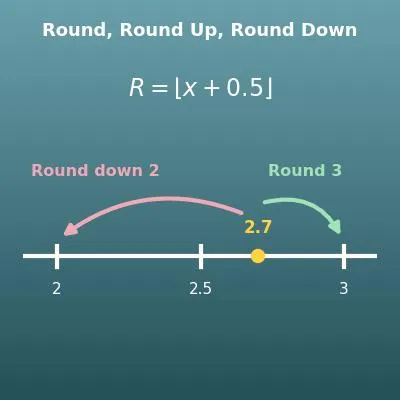
    # Round half up by adding 0.5 and cutting off the decimals (Python's round() rounds 0.5 to even, so it is not used)
    return int(x + 0.5)

def target_hr(intensity_percent):
    # Karvonen formula if there is a resting heart rate; otherwise the percent of max method
    if resting_hr is not None:
        return round_half_up(resting_hr + intensity_percent / 100 * (max_hr - resting_hr))
    return round_half_up(max_hr * intensity_percent / 100)

print(f"Maximum heart rate: {round_half_up(max_hr)} bpm")
print(f"Target heart rate (50-85% intensity): {target_hr(50)}-{target_hr(85)} bpm")
for lower, upper in [(50, 60), (60, 70), (70, 80), (80, 90), (90, 100)]:
    print(f"Intensity {lower}-{upper}%: {target_hr(lower)}-{target_hr(upper)} bpm")
How to write it in LaTeX and other math languages (copy and paste)
M = 220 − A
M = 220 - A
<math xmlns="http://www.w3.org/1998/Math/MathML" display="block">
<mrow>
<mi>M</mi>
<mo>=</mo>
<mn>220</mn>
<mo>−</mo>
<mi>A</mi>
</mrow>
</math>
M = 220 - A
220 - A
M := 220 - A;
M = 220 - A;
M = 220 - A
M = 208 − 0.7 × A, M = 211 − 0.64 × A
M = 208 - 0.7A, \quad M = 211 - 0.64A
<math xmlns="http://www.w3.org/1998/Math/MathML" display="block">
<mrow>
<mi>M</mi>
<mo>=</mo>
<mn>208</mn>
<mo>−</mo>
<mn>0.7</mn>
<mi>A</mi>
<mo>,</mo>
<mi>M</mi>
<mo>=</mo>
<mn>211</mn>
<mo>−</mo>
<mn>0.64</mn>
<mi>A</mi>
</mrow>
</math>
M = 208 - 0.7A, M = 211 - 0.64A
{208 - 0.7*A, 211 - 0.64*A}
M1 := 208 - 0.7*A; M2 := 211 - 0.64*A;
M1 = 208 - 0.7*A; M2 = 211 - 0.64*A;
M = 208 - 0.7A, M = 211 - 0.64A
T = M × p
T = M \times p
<math xmlns="http://www.w3.org/1998/Math/MathML" display="block">
<mrow>
<mi>T</mi>
<mo>=</mo>
<mi>M</mi>
<mo>×</mo>
<mi>p</mi>
</mrow>
</math>
T = M p
M*p
T := M*p;
T = M*p;
T = M p
T = R + p × (M − R)
T = R + p \times (M - R)
<math xmlns="http://www.w3.org/1998/Math/MathML" display="block">
<mrow>
<mi>T</mi>
<mo>=</mo>
<mi>R</mi>
<mo>+</mo>
<mi>p</mi>
<mo>×</mo>
<mrow>
<mo>(</mo>
<mi>M</mi>
<mo>−</mo>
<mi>R</mi>
<mo>)</mo>
</mrow>
</mrow>
</math>
T = R + p xx (M - R)
R + p*(M - R)
T := R + p*(M - R);
T = R + p*(M - R);
T = R + p(M - R)
How to have ChatGPT do the calculation
You are a calculation assistant for exercise physiology. Do the following calculation by actually running Python code, and base your answer only on the numbers from the execution result (do not answer by mental math or guessing).

Find the target heart rate for a 30-year-old with a resting heart rate of 70 bpm.
1. Estimate the maximum heart rate with "220 − age".
2. With the Karvonen formula, T = resting heart rate + intensity × (maximum heart rate − resting heart rate), list the target heart rate at 50%, 60%, 70%, 80%, 90% and 100% intensity.
3. Round each heart rate to a whole number of bpm (round 0.5 up).

Show the formulas you used and the numbers from the execution result. Also add a note that these are general guides for healthy adults, and that people with heart disease or who take medicine that affects heart rate should talk with their doctor.
How to Use
-
1Enter your numbersType the numbers you want to calculate with into the input fields
-
2CalculatePress the "Calculate" button
-
3Check the resultThe result appears on the spot. The same page also explains the idea behind the calculation and the formula
DataChef Features

No technical knowledge required.
Intuitive and user-friendly operation.

Can be used without registering personal information.

Automatic file deletion by clicking "download".

and rapid file conversion.

No attribution required.

No need to contact us for commercial use permission.
Related Features
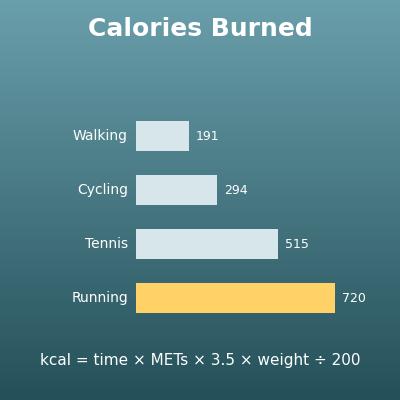
Calories Burned Calculator (Walking, Running, Chores and More with METs)
Calculates the calories burned in 44 activities, such as walking and running, from your weight and the time
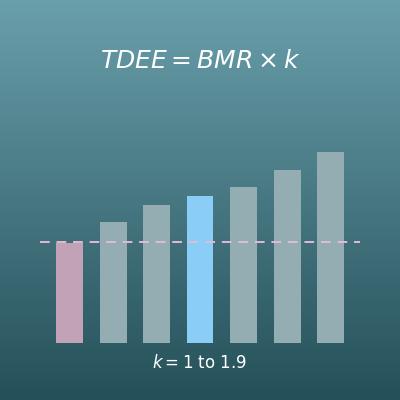
TDEE Calculator (Total Daily Energy Expenditure and How to Choose Your Activity Level)
Calculates your total daily energy expenditure (TDEE) from your BMR and activity level
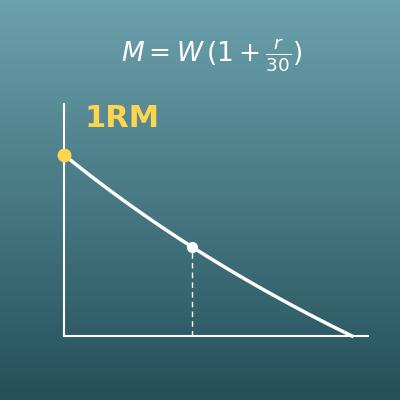
One Rep Max Calculator (Estimate Your 1RM for Bench Press, Squat and More from Reps)
Estimates the most weight you can lift for one rep (1RM) from your bench press or other lifts