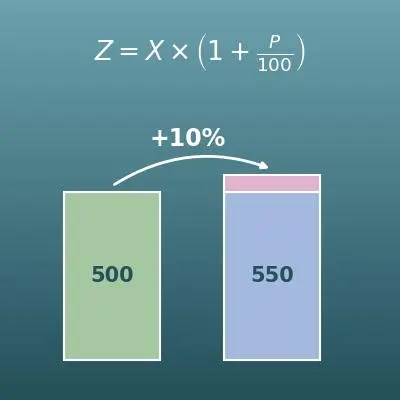
Enter the two values you know out of percent, whole and part, leave the one you want to find blank, and press "Calculate". The blank one is calculated.
Table of Contents
-
What you can do on this page
-
What is this calculation used for?
-
How to Use
-
Formula
-
Symbols and terms
-
Good to know before you start
-
How to calculate it in Excel
-
How to calculate it in Google Sheets
-
How to calculate it in Python
-
How to write it in LaTeX and other math languages (copy and paste)
-
How to have ChatGPT do the calculation
-
DataChef Features
-
Related Features
-
NumberChef Calculators List
What you can do on this page
- Enter any two of the whole, the part and the percent, and the third is calculated on the spot
- "What is 20% of $80?", "10 correct out of 50 is what percent?", "25 students are 10% of the school, so how many students are there?" This one tool answers all three kinds of percent questions
- Use it as is for everyday percentages such as sales tax, discounts, test scores, salt concentration and batting averages
- A plain-language explanation of the formulas and copy-and-paste formulas for Excel, Google Sheets and Python are all on this page
What is this calculation used for?
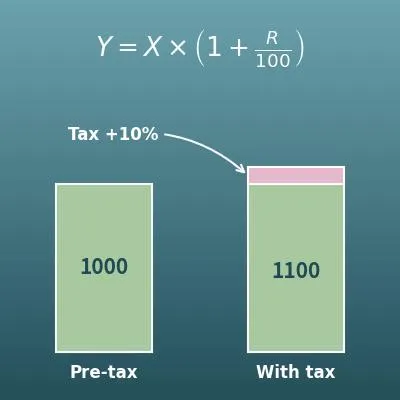
In a state with a 7% sales tax, the tax on a $40 item is \(40 \times 0.07 = 2.80\), or $2.80, so you pay $42.80. Tax rates differ by state and city, and many states tax groceries at a lower rate or not at all.
"Whole × rate" is the math you use most often in everyday shopping.
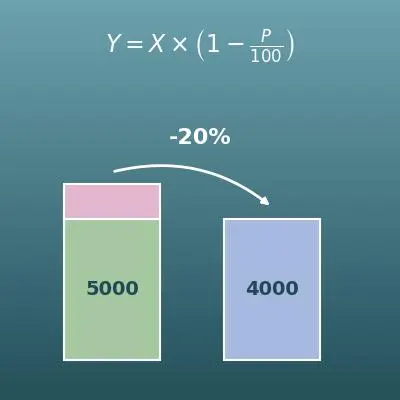
If a $60 jacket is 30% off, the discount is \(60 \times 0.3 = 18\), or $18, so you pay $42.
Once you can quickly work out the price from a "% off" sign, you can also decide for yourself which is cheaper, such as "30% off $50 or 20% off $45".
If you get 42 out of 50 questions right, your score is \(42 \div 50 \times 100 = 84\%\).
Many tests and certification exams set the passing score as a percent, such as "70% or higher to pass". This percent calculation is also the basis for working out how many more correct answers you need.
Dissolve 20 g of salt in 180 g of water and you get 200 g of salt water. Its concentration is \(20 \div 200 \times 100 = 10\%\).
The most common mistake on science tests is forgetting that the whole is all of the salt water (salt + water), not just the water. The same calculation is used when making a brine for cooking.
A batter with 36 hits in 120 at-bats has a batting average of \(36 \div 120 = 0.300\), which is 30% as a percent. In baseball it is written as .300 and read "three hundred" (batting average is hits divided by at-bats).
Batting averages, winning percentages, free-throw percentages and many other sports stats are rates, so this calculation helps you understand the numbers when you watch a game.
The Daily Value for sodium on US food labels is 2,300 mg. A cup of instant noodles with 1,380 mg of sodium gives you \(1380 \div 2300 \times 100 = 60\%\) of that in one serving.
The "% Daily Value" column on the Nutrition Facts label is this same calculation. Once you can compare amounts as percents, you can look after your health with numbers instead of guesses.
Formula
Symbols and terms
Symbols
| \(a\) | a | The whole. It is the amount you compare against, like the $80 in "20% of $80". |
| \(x\) | x | The part. It is the actual amount that the percent stands for, like the $16 in "20% of $80 is $16". |
| \(P\) | P | The percent, written as a number without the % sign (for 20%, \(P = 20\)). It is the first letter of "percent". |
| \(P \div 100\) | P divided by 100 | The rate as a decimal (20% → 0.2). This decimal is what you multiply the whole by. |
| \(\%\) | percent | The percent sign. It shows how many out of 100. The word comes from the Latin per centum, "for each hundred". |
Terms
| rate | A number that shows how large the part is when the whole counts as 1. It can be written as a decimal such as 0.2, as a fraction such as 1/5, or as a percent (20%). |
| percent | A rate written with the whole counted as 100. The sign is %. Multiply a decimal rate by 100 to get the percent (0.2 → 20%). |
| whole | The amount you compare against, also called the base. In "30% off the list price" it is the list price, and in "40% of the class" it is the number of students in the class. Look for the amount that comes right after "of". |
| part | The actual amount that the percent stands for. In "30% off a $60 price", the $18 discount is the part. |
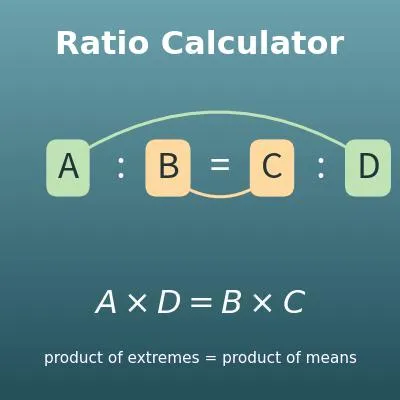
| percent proportion | The equation part / whole = percent / 100, taught in US middle school. It is often remembered as "is over of equals percent over 100": in "20% of 80 is 16", 16 is the "is" number and 80 is the "of" number. Solve it by cross-multiplying. |
Good to know before you start
Here is what helps you use the calculation on this page with real understanding, not just by pressing the button.
If you get stuck, going back over these topics is the quickest way forward.
| Percents (Grade 6) |
|
| Percents, decimals and fractions (Grade 6) |
|
| Multiplying and dividing decimals (Grades 5–6) |
|
How to calculate it in Excel
| Whole | 5000 |
| Percent (%) | 20 |
| Part | =B1*B2/100 |
| Part | 10 |
| Whole | 50 |
| Percent (%) | =B1/B2*100 |
| Part | 25 |
| Percent (%) | 10 |
| Whole | =B1/B2*100 |
"B1" and "B2" in a formula tell Excel to use the number in that cell. "*" is multiplication and "/" is division.
For example, B3 shows 1000 in the first table, 20 in the second and 250 in the third. Just replace B1 and B2 with your own numbers.
How to calculate it in Google Sheets
| Whole | 5000 |
| Percent (%) | 20 |
| Part | =B1*B2/100 |
| Part | 10 |
| Whole | 50 |
| Percent (%) | =B1/B2*100 |
| Part | 25 |
| Percent (%) | 10 |
| Whole | =B1/B2*100 |
How to calculate it in Python
# Find the part (what is 20% of 5000?)
base = 5000     # whole
percent = 20    # percent (%)
part = base * percent / 100
print(f"{percent}% of {base} is {part}")

# Find the percent (10 is what percent of 50?)
part = 10       # part
base = 50       # whole
percent = part / base * 100
print(f"{part} out of {base} is {percent}%")

# Find the whole (25 is 10% of what?)
part = 25       # part
percent = 10    # percent (%)
base = part / percent * 100
print(f"If {part} is {percent}%, the whole is {base}")
How to write it in LaTeX and other math languages (copy and paste)
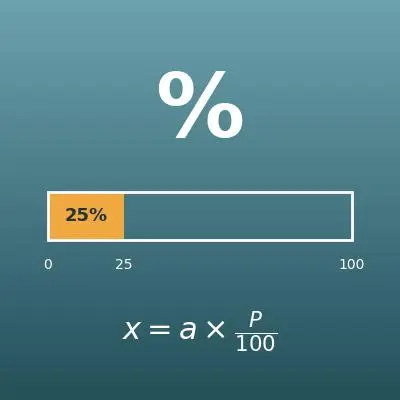
x = a × P ÷ 100
x = a \times \frac{P}{100}
<math xmlns="http://www.w3.org/1998/Math/MathML" display="block">
<mrow>
<mi>x</mi>
<mo>=</mo>
<mi>a</mi>
<mo>×</mo>
<mfrac><mi>P</mi><mn>100</mn></mfrac>
</mrow>
</math>
x = a xx P/100
base*(percent/100)
part := base*(percent/100);
part = base*(percent/100);
x = a × P/100
P = x ÷ a × 100
P = \frac{x}{a} \times 100
<math xmlns="http://www.w3.org/1998/Math/MathML" display="block">
<mrow>
<mi>P</mi>
<mo>=</mo>
<mfrac><mi>x</mi><mi>a</mi></mfrac>
<mo>×</mo>
<mn>100</mn>
</mrow>
</math>
P = x/a xx 100
part/base*100
percent := part/base*100;
percent = part/base*100;
P = x/a × 100
a = x ÷ P × 100
a = \frac{x}{P} \times 100
<math xmlns="http://www.w3.org/1998/Math/MathML" display="block">
<mrow>
<mi>a</mi>
<mo>=</mo>
<mfrac><mi>x</mi><mi>P</mi></mfrac>
<mo>×</mo>
<mn>100</mn>
</mrow>
</math>
a = x/P xx 100
part/percent*100
base := part/percent*100;
base = part/percent*100;
a = x/P × 100
How to have ChatGPT do the calculation
You are a percent calculation assistant. Do the following calculations by actually running Python code, and base your answer only on the numbers from the execution result (do not answer by mental math or guessing).

1. The amount that is 20% of $80
2. The percent correct when you get 10 out of 50 questions right
3. The total number of people when 25 people are 10% of the total

Show the formulas you used and the numbers from the execution result.
How to Use
-
1Enter your numbersType the numbers you want to calculate with into the input fields
-
2CalculatePress the "Calculate" button
-
3Check the resultThe result appears on the spot. The same page also explains the idea behind the calculation and the formula
DataChef Features

No technical knowledge required.
Intuitive and user-friendly operation.

Can be used without registering personal information.

Automatic file deletion by clicking "download".

and rapid file conversion.
No attribution required.
No need to contact us for commercial use permission.
Related Features
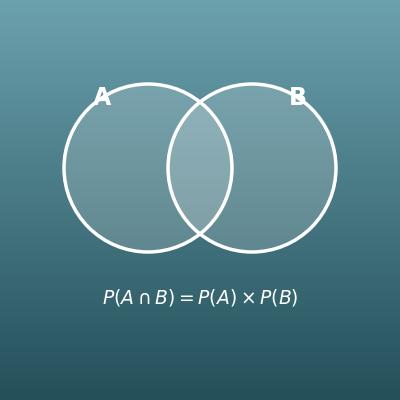
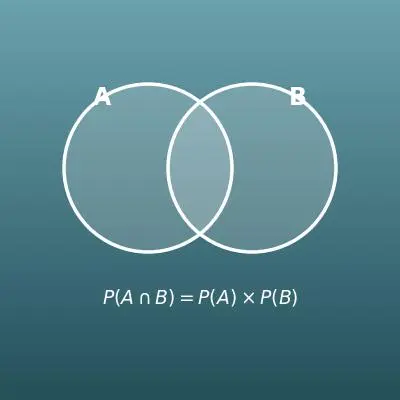
Probability of Two Events (And, Or, Neither)
From two probabilities, find the chance that both happen, that at least one happens, and more
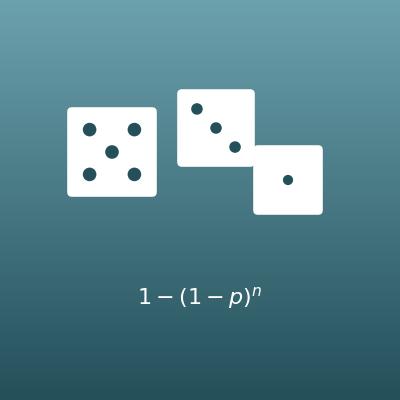
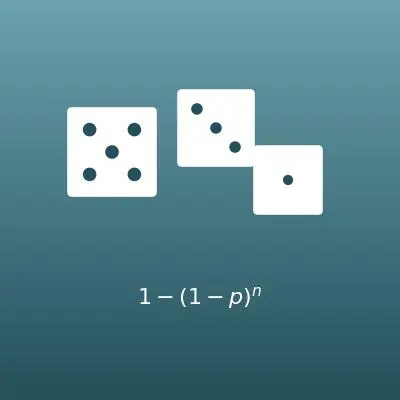
Probability of Repeated Trials (n in a Row, At Least Once)
Find the chance that something happens n times in a row, or at least once in n tries
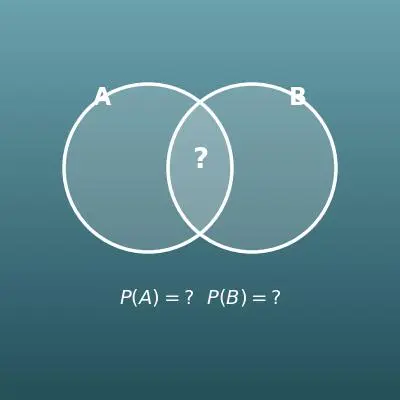
Probability of Two Events Solver
From two probabilities you know, work out all the remaining ones at once
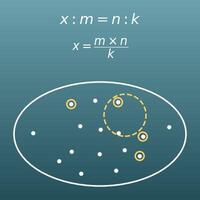
Population Estimate Calculator (Mark and Recapture, Random Samples)
Estimate a whole population by assuming the proportion in the sample matches the proportion in the population. Also covers the capture-recapture method