






























Enter the average order value (revenue per conversion) and gross margin to get the break-even CPA. Add a target profit (as a % of revenue or a dollar amount per conversion) for the target CPA, and an expected conversion rate for the max CPC. To include repeat purchases, choose "Enter gross profit directly" and enter the lifetime gross profit of one customer.
Table of Contents
-
What you can do on this page
-
What is this calculation used for?
-
How to Use
-
Formulas and figures
-
Symbols and terms
-
Good to know before you start
-
How to calculate it in Excel
-
How to calculate it in Google Sheets
-
How to calculate it in Python
-
How to write it in LaTeX and other math languages (copy and paste)
-
How to have ChatGPT do the calculation
-
DataChef Features
-
Related Features
-
NumberChef Calculators List
What you can do on this page
- From the average order value (revenue per conversion) and gross margin (%), it calculates the most you can spend on ads to win one conversion: the break-even CPA (= gross profit per conversion)
- Enter a target profit margin such as "I want to keep 15% of revenue as profit" (or a target profit per conversion in dollars), and it calculates the target CPA (gross profit minus target profit) and the max ad spend as a percentage of revenue
- Enter an expected conversion rate (%), and it works back from the target CPA to the max CPC (the most you can pay per click, a guide for your bids)
- There is also a mode where you enter the gross profit per customer directly, including repeat purchases (the gross profit from customer lifetime value)
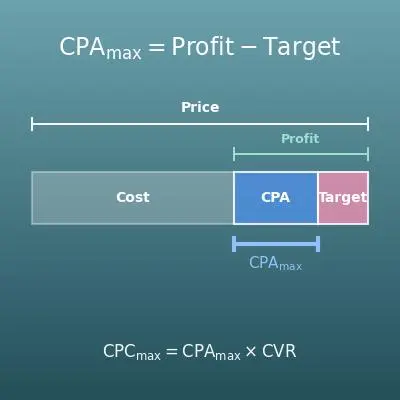
- A single bar shows how the order value splits into cost of goods, target CPA and target profit. An explanation of the formulas and copy-and-paste formulas for Excel, Google Sheets and Python are also on this page
What is this calculation used for?
With an average order of $120 and a gross margin of 35%, each order leaves \(120 \times 0.35 = 42\) dollars of gross profit, and that is the break-even CPA. If the CPA in your ads dashboard is above $42, those ads lose money on every sale.
If you want to keep 10% of revenue ($12) as profit, the target CPA is \(42 - 12 = 30\) dollars. Before you launch, you can draw the lines in numbers: "keep running while CPA is $30 or less, stop if it goes over $42".
If the target CPA is $30 and the product page converts at 2% based on past results, the max CPC is \(30 \times 0.02 = 0.60\) dollars. A 2% conversion rate is "1 in 50 clicks", so $30 shared by 50 clicks is $0.60 per click.
Marketers use this max CPC as the max CPC bid in their settings. If competition is so strong that a $0.60 bid barely gets shown, it tells you what to consider next: raise the conversion rate (improve the page) or shift ads to products with larger gross profit.
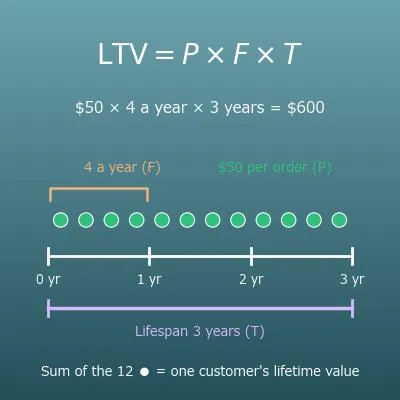
For a $50/month service with an 80% gross margin that customers keep for 12 months on average, the lifetime gross profit per customer is \(50 \times 0.8 \times 12 = 480\) dollars. If you look only at the first month's $40 of gross profit, you can barely advertise, but if you enter the lifetime gross profit as the gross profit per conversion, the break-even CPA grows to $480.
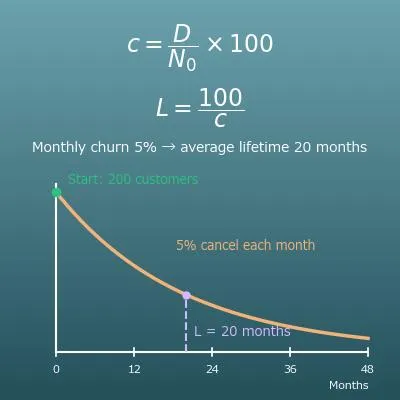
If your policy is to keep $200 per customer as profit, the target CPA is $280, and at a 1.5% conversion rate the max CPC is \(280 \times 0.015 = 4.20\) dollars. The 12 months is only an estimate, though, so recalculate regularly using your actual churn rate.
For high-ticket products such as cars, solar panels or home remodeling, the ad conversion is often a lead (a quote request), and the sale comes later through a sales team. First estimate the gross profit per lead. If one sale brings $5,000 of gross profit and 5% of leads become sales, each lead is worth \(5000 \times 0.05 = 250\) dollars of gross profit.
Enter this $250 as the gross profit per conversion, and the break-even CPA per lead is $250. With a target profit of $100, the target CPA is $150. Like the conversion rate, the close rate is an assumption, so update it with actual results.
If one enrollment brings $2,400 in tuition for the first year and the gross margin after materials and other direct costs is 60%, each enrollment leaves \(2400 \times 0.6 = 1440\) dollars of gross profit. If your policy is to keep 30% of revenue ($720) as profit, the target CPA per enrollment is \(1440 - 720 = 720\) dollars.
If the ad conversion is an intro lesson sign-up and half of those students enroll, the target CPA per intro lesson sign-up is half of that, $360. The gut-feeling debate "Is $300 per intro lesson sign-up too much?" becomes a calculation from gross profit.
Formulas and figures
Symbols and terms
Symbols
| \(\mathrm{CPA}_{\text{BE}}\) | C-P-A sub B-E | Break-even CPA. CPA stands for cost per acquisition (also cost per action). The subscript BE stands for break-even. It is the most you can spend on ads to win one conversion without losing money, which equals the gross profit per conversion. |
| \(\mathrm{CPA}_{\max}\) | C-P-A sub max | Target CPA. The subscript max is short for maximum: the most you can spend on ads per conversion while keeping your profit goal. Found with \(\mathrm{CPA}_{\max} = \mathrm{CPA}_{\text{BE}} - G\). |
| \(P\) | pee | Average order value (revenue per conversion), from the first letter of "price". In dollars. |
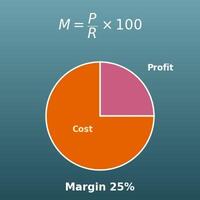
| \(M\) | em | Gross margin (%), from the first letter of "margin". Gross profit as a share of revenue, not as a share of cost (markup). |
| \(T\) | tee | Target profit margin (%), from the first letter of "target". What percentage of revenue you want to keep as profit after paying for ads. |
| \(G\) | gee | Target profit per conversion (in dollars), from the first letter of "goal". Found with \(G = P \times T \div 100\), or set directly as a dollar amount. |
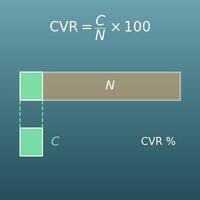
| \(\mathrm{CVR}\) | C-V-R | Conversion rate (%). The share of people who clicked the ad and then converted. In the formulas, divide it by 100 to make it a decimal before multiplying. |
| \(\mathrm{CPC}_{\max}\) | C-P-C sub max | Max CPC. CPC stands for cost per click, and max is short for maximum. The most you can pay per click and still stay within the target CPA: \(\mathrm{CPC}_{\max} = \mathrm{CPA}_{\max} \times \mathrm{CVR} \div 100\). |
Terms
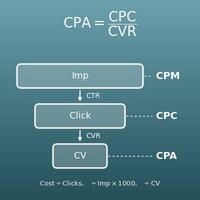
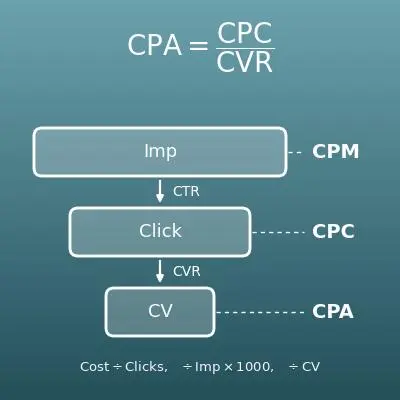
| CPA (cost per acquisition) | The ad spend per conversion, or "how much it cost to win one customer". It is the central metric for judging whether ads pay off. Your actual CPA is "ad spend ÷ conversions", but this page deals with the ceiling (break-even CPA and target CPA), not the actual value. |
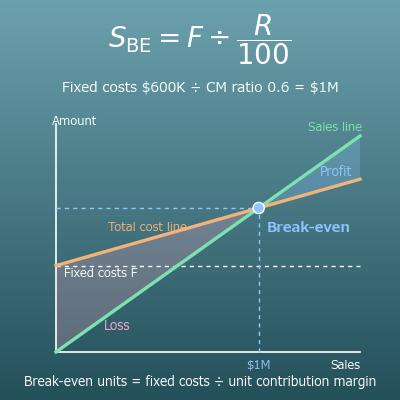
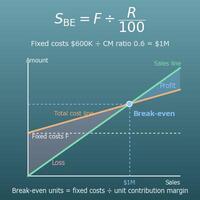
| break-even CPA | The most you can spend on ads to win one conversion without losing money. It equals the gross profit left by one conversion. "Break-even" is the line where you neither make nor lose money; if you spend this much, the profit on that conversion is zero. |
| target CPA (allowable CPA) | The most you can spend on ads to win one conversion while keeping your profit goal. Found with "gross profit − target profit". This is the value marketers use as the "Target CPA" for bids and budgets, and it is smaller than the break-even CPA. |
| gross profit | Revenue minus only the cost of goods (costs that come with each sale, such as the purchase price, manufacturing cost and shipping). It is the profit before costs such as salaries and rent, and ad spend is also paid out of it. |
| gross margin | Gross profit as a percentage of revenue ("gross profit ÷ revenue × 100"). On this page, gross margin is always a percentage of revenue. Markup (the amount added on top of cost, as a percentage of cost) has a different base, so the numbers differ for the same product. Do not mix them up. |
| average order value (AOV) | Revenue per customer (per order). On this page it is the revenue you get from one conversion. Enter the average order amount or the contract value of one sign-up. |
| target profit margin | What percentage of revenue you want to keep as profit after paying for ads. On this page it is set as a percentage of revenue. It must not exceed the gross margin, and the gap between the two is the share you can put into ads (the max ad spend as a % of revenue). |
| max ad spend as a % of revenue | The largest share of revenue you can put into ads (%). Found with "target CPA ÷ order value × 100" or "gross margin − target profit margin". Ad spend ÷ revenue × 100 is called the advertising cost of sales (ACoS, a common metric in Amazon Ads), and this value is its ceiling. |
| conversion rate (CVR) | The share of people who clicked the ad and then converted (bought, signed up and so on). It is also the reciprocal of "clicks needed per conversion" (at 2%, 1 conversion per 50 clicks), and it is used to find the max CPC from the target CPA. |
| max CPC | The most you can pay per click and still stay within the target CPA. Found with "target CPA × conversion rate (as a decimal)". If you keep the max CPC bid in search ads at or below this value, the CPA stays within the target as long as the conversion rate matches your expectation. |
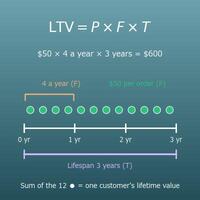
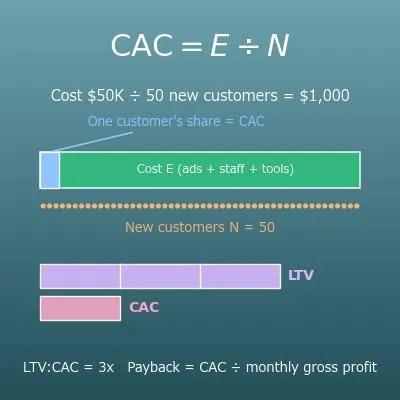
| customer lifetime value (LTV) | The total revenue or gross profit one customer brings while they keep buying from you. In businesses with repeat purchases, the target CPA is sometimes based on the lifetime gross profit rather than the first-order gross profit. Because it includes future estimates, it is less certain than using the first order alone. |
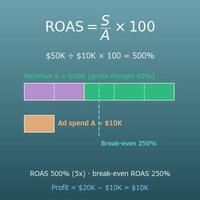
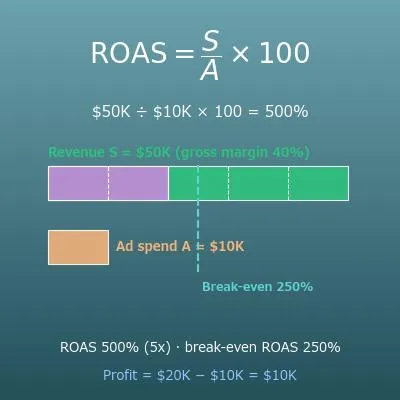
| break-even ROAS | The lowest ROAS (revenue as a percentage of ad spend) that does not lose money. It is 100 divided by the gross margin as a decimal (at a 40% gross margin, \(100 \div 0.4 = 250\)%). The break-even CPA says it as an amount per conversion, and the break-even ROAS says it as a ratio of revenue to ad spend, but the idea is the same. |
Good to know before you start
Here is what helps you use the calculation on this page with real understanding, not just by pressing the button.
| Percents (Grades 6–7) |
|
| The percent equation (Grade 7) |
|
| Unit rates (Grade 6) |
|
| Revenue, cost and profit (personal finance and business basics) |
|
| Variables and rearranging equations (Grades 7–8) |
|
How to calculate it in Excel
| Order value P ($) | 80 |
| Gross margin M (%) | 40 |
| Break-even CPA ($) | =B1*B2/100 |
| Order value P ($) | 80 |
| Gross margin M (%) | 40 |
| Target profit margin T (%) | 15 |
| Target profit G ($) | =B1*B3/100 |
| Target CPA ($) | =B1*B2/100-B4 |
| Max ad spend (% of revenue) | =B5/B1*100 |
| Gross profit per conversion ($) | 288 |
| Target profit per conversion G ($) | 120 |
| Target CPA ($) | =B1-B2 |
| Target CPA ($) | 20 |
| Expected CVR (%) | 2 |
| Max CPC ($) | =B1*B2/100 |
B3 of the first table shows 32 (break-even CPA). In the second table, B4 shows 12 (target profit), B5 shows 20 (target CPA) and B6 shows 25 (max ad spend as a % of revenue). B3 of the third table shows 168 (target CPA), and B3 of the fourth shows 0.4 (max CPC). Just replace the inputs with your own numbers.
How to calculate it in Google Sheets
| Order value P ($) | 80 |
| Gross margin M (%) | 40 |
| Break-even CPA ($) | =B1*B2/100 |
| Order value P ($) | 80 |
| Gross margin M (%) | 40 |
| Target profit margin T (%) | 15 |
| Target profit G ($) | =B1*B3/100 |
| Target CPA ($) | =B1*B2/100-B4 |
| Max ad spend (% of revenue) | =B5/B1*100 |
| Gross profit per conversion ($) | 288 |
| Target profit per conversion G ($) | 120 |
| Target CPA ($) | =B1-B2 |
| Target CPA ($) | 20 |
| Expected CVR (%) | 2 |
| Max CPC ($) | =B1*B2/100 |
How to calculate it in Python
price = 80          # average order value (revenue per conversion, $)
margin_rate = 40    # gross margin (% of revenue)
target_rate = 15    # target profit margin (% of revenue)
cvr = 2             # expected conversion rate (%)

gross_profit = price * margin_rate / 100      # gross profit per conversion
break_even_cpa = gross_profit                 # break-even CPA (= gross profit)
target_profit = price * target_rate / 100     # target profit per conversion
max_cpa = break_even_cpa - target_profit      # target CPA
max_cpa_rate = max_cpa / price * 100          # max ad spend as a % of revenue
max_cpc = max_cpa * cvr / 100                 # max CPC

print(f"Break-even CPA: ${break_even_cpa}")
print(f"Target profit: ${target_profit}  Target CPA: ${max_cpa}  Max ad spend: {max_cpa_rate}% of revenue")
print(f"Max CPC: ${max_cpc}")

# When you enter gross profit directly (lifetime gross profit per customer, and a target profit amount)
gross_profit2 = 288      # gross profit per customer ($)
target_amount2 = 120     # target profit per conversion ($)
max_cpa2 = gross_profit2 - target_amount2
print(f"Target CPA (gross profit entered directly): ${max_cpa2}")
How to write it in LaTeX and other math languages (copy and paste)
CPA_be = P × (M/100)
\mathrm{CPA}_{\mathrm{BE}} = P \times \dfrac{M}{100}
<math xmlns="http://www.w3.org/1998/Math/MathML" display="block">
<mrow>
<msub><mi mathvariant="normal">CPA</mi><mi>BE</mi></msub>
<mo>=</mo>
<mi>P</mi>
<mo>×</mo>
<mfrac><mi>M</mi><mn>100</mn></mfrac>
</mrow>
</math>
CPA_be = P xx (M/100)
p*m/100
CPAbe := P*M/100;
CPAbe = P*M/100;
CPA_be = P × (M/100)
G = P × (T/100)
G = P \times \dfrac{T}{100}
<math xmlns="http://www.w3.org/1998/Math/MathML" display="block">
<mrow>
<mi>G</mi>
<mo>=</mo>
<mi>P</mi>
<mo>×</mo>
<mfrac><mi>T</mi><mn>100</mn></mfrac>
</mrow>
</math>
G = P xx (T/100)
p*t/100
G := P*T/100;
G = P*T/100;
G = P × (T/100)
CPA_max = CPA_be − G
\mathrm{CPA}_{\max} = \mathrm{CPA}_{\mathrm{BE}} - G
<math xmlns="http://www.w3.org/1998/Math/MathML" display="block">
<mrow>
<msub><mi mathvariant="normal">CPA</mi><mi>max</mi></msub>
<mo>=</mo>
<msub><mi mathvariant="normal">CPA</mi><mi>BE</mi></msub>
<mo>−</mo>
<mi>G</mi>
</mrow>
</math>
CPA_max = CPA_be - G
cpaBe - g
CPAmax := CPAbe - G;
CPAmax = CPAbe - G;
CPA_max = CPA_be - G
CPC_max = CPA_max × (CVR/100)
\mathrm{CPC}_{\max} = \mathrm{CPA}_{\max} \times \dfrac{\mathrm{CVR}}{100}
<math xmlns="http://www.w3.org/1998/Math/MathML" display="block">
<mrow>
<msub><mi mathvariant="normal">CPC</mi><mi>max</mi></msub>
<mo>=</mo>
<msub><mi mathvariant="normal">CPA</mi><mi>max</mi></msub>
<mo>×</mo>
<mfrac><mi mathvariant="normal">CVR</mi><mn>100</mn></mfrac>
</mrow>
</math>
CPC_max = CPA_max xx (CVR/100)
cpaMax*cvr/100
CPCmax := CPAmax*CVR/100;
CPCmax = CPAmax*CVR/100;
CPC_max = CPA_max × (CVR/100)
How to have ChatGPT do the calculation
You are a calculation assistant for online advertising. Do the following calculation by actually running Python code, and base your answer only on the numbers from the execution result (do not answer by mental math or guessing).

I sell a product through ads. The average order value (revenue per conversion) is $80, and the gross margin (as a % of revenue) is 40%.
Find each of the following:
1. Break-even CPA (order value × gross margin ÷ 100, the gross profit per conversion)
2. If I want to keep 15% of revenue as profit: the target profit per conversion (order value × 15 ÷ 100) and the target CPA (break-even CPA − target profit)
3. Max ad spend as a % of revenue (target CPA ÷ order value × 100)
4. With an expected conversion rate of 2%: the max CPC (target CPA × 2 ÷ 100) and the break-even CPC (break-even CPA × 2 ÷ 100)
5. For a different service: the target CPA when the gross profit per customer, including repeat purchases, is $288 and the target profit per conversion is $120 (gross profit − target profit)

Show the formulas you used and the numbers from the execution result.
How to Use
-
1Enter your numbersType the numbers you want to calculate with into the input fields
-
2CalculatePress the "Calculate" button
-
3Check the resultThe result appears on the spot. The same page also explains the idea behind the calculation and the formula
DataChef Features

No technical knowledge required.
Intuitive and user-friendly operation.

Can be used without registering personal information.

Automatic file deletion by clicking "download".

and rapid file conversion.

No attribution required.
No need to contact us for commercial use permission.
Related Features
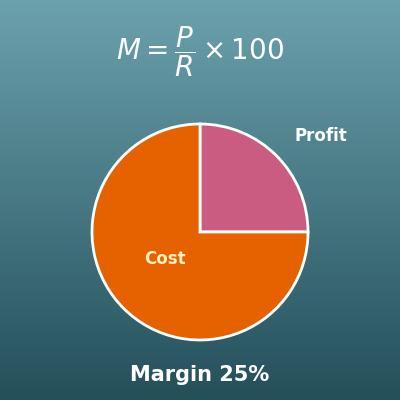
Profit Margin Calculator (Cost, Revenue, Profit and Markup)
Enter two of cost, revenue, margin and profit to get the rest. If you do not know the gross margin for this page, find it here from cost and price first
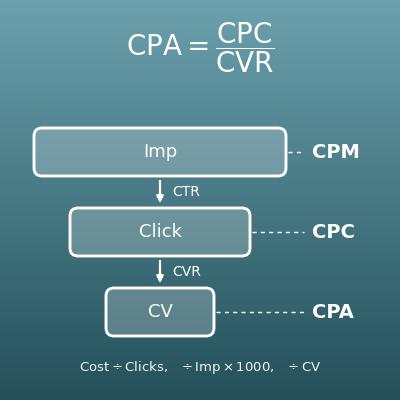
CPC, CPM and CPA Calculator (Ad Cost Metrics and Budget from Target CPA)
Calculates your actual CPC, CPM and CPA from spend, impressions, clicks and conversions. Use it to compare your actual CPA with the target CPA from this page
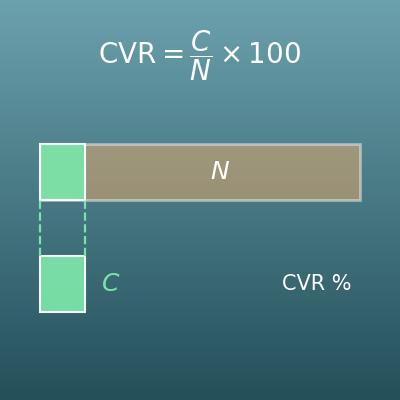
Conversion Rate Calculator (CVR, Visitors Needed and Expected Conversions)
Calculates the conversion rate from visits and conversions. Use it to find the expected conversion rate for the max CPC from past results
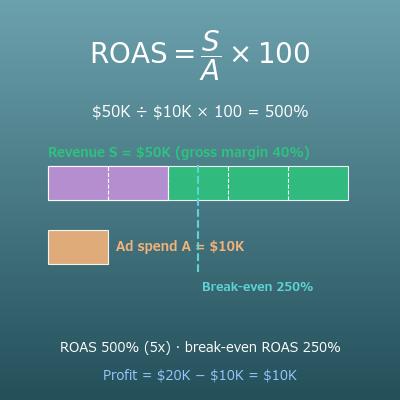
ROAS Calculator (Return on Ad Spend and Break-Even ROAS)
Calculates ROAS from revenue and ad spend, and finds the break-even ROAS and profit after ad spend from gross margin
Customer Lifetime Value (LTV) Calculator for E-Commerce and Subscriptions
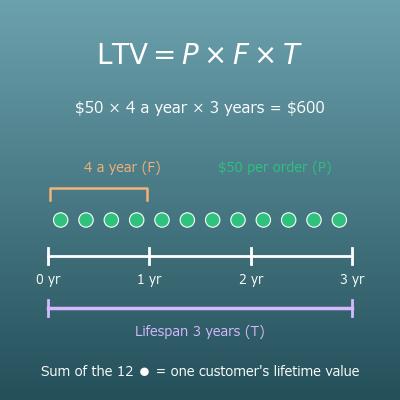
Calculates the revenue and gross profit one customer brings over their lifetime, for e-commerce (order value × frequency × years) and subscriptions (ARPU × gross margin ÷ churn rate)