



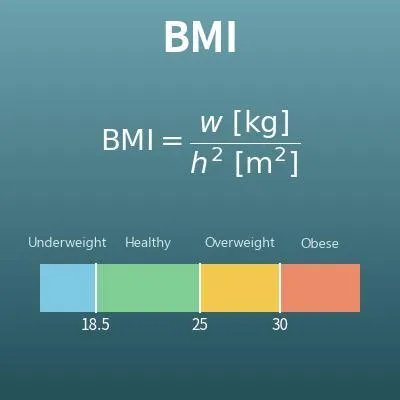



Enter your height and weight. Your BMI (body mass index), your weight category based on the WHO and CDC adult cut-offs, the healthy weight range for your height and more are calculated together.
Table of Contents
-
What you can do on this page
-
What is this calculation used for?
-
How to Use
-
Formula
-
Symbols and terms
-
Good to know before you start
-
How to calculate it in Excel
-
How to calculate it in Google Sheets
-
How to calculate it in Python
-
How to write it in LaTeX and other math languages (copy and paste)
-
How to have ChatGPT do the calculation
-
DataChef Features
-
Related Features
-
NumberChef Calculators List
What you can do on this page
- Enter your height (feet and inches) and weight (pounds), and get your BMI (body mass index) on the spot. Switch "Units" to Metric to use centimeters and kilograms
- Your weight category for adults (from underweight to obesity class 3), based on the World Health Organization (WHO) and CDC cut-offs, is shown at the same time
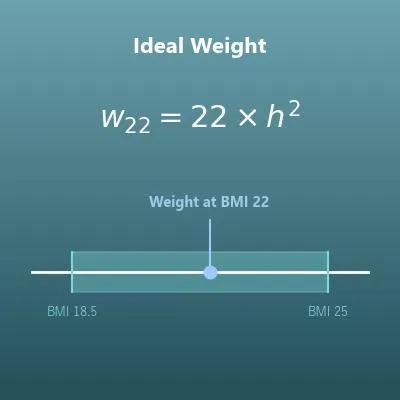
- It also calculates the healthy weight range for your height, the weight at BMI 22 (near the middle of that range), BMI Prime (BMI ÷ 25) and the ponderal index (weight divided by height cubed)
- A plain-language explanation of the formulas and copy-and-paste formulas for Excel, Google Sheets and Python are all on this page
What is this calculation used for?
BMI is often listed in the results of an annual physical, a workplace health screening or a wellness program. Doctors use it as a quick first check, together with other measures such as waist size and blood tests.
When you know how the BMI number is calculated, you can understand your own results instead of leaving them to others, and discuss any follow-up advice calmly with your doctor.
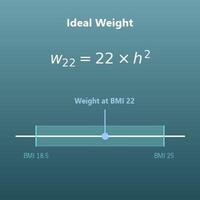
Before deciding to "lose 10 pounds" with no basis, it helps to know the healthy weight range for your height. For someone who is 5 ft 7 in tall, the weight at BMI 22 is \(22 \times 67^2 \div 703 \approx 140.5\) lb, and the healthy range is about 118.1 to 159.6 lb.
Aiming below the range through extreme dieting is said to harm your health. Checking a goal against this range is a number-based, safe way to think about it.
How much weight gain is recommended during pregnancy depends on BMI before pregnancy. Under the widely used US guidelines, the recommended total gain is 28 to 40 lb for a pre-pregnancy BMI below 18.5, 25 to 35 lb for 18.5 to 24.9, 15 to 25 lb for 25 to 29.9, and 11 to 20 lb for 30 or more, so the BMI group is the starting point of the advice.
Being able to calculate your pre-pregnancy BMI makes it easier to follow what your doctor or midwife explains (always follow their advice for your own care).
Being underweight (a BMI below 18.5) has been linked to risks such as lower bone density, anemia, irregular periods and a weaker immune system, and in pregnancy to a higher chance of a low-birth-weight baby.
BMI can check not only "Am I carrying too much weight?" but also "Am I too thin?" This is an important use that is easy to overlook.
When you apply for life insurance, the insurer may use the BMI calculated from the height and weight you report as one reference measure of health risk. If BMI is very high or very low, the policy may be offered on special terms.
Knowing your BMI in advance lets you go through quotes and health questions understanding what the number means.
Formula
Symbols and terms
Symbols
| \(\mathrm{BMI}\) | B-M-I | Short for body mass index. Weight (kg) divided by height (m) squared, or 703 × weight (lb) ÷ height (in) squared. It is used around the world as a guide to weight relative to height. |
| \(w\) | double-u | Weight (lb in the BMI formulas, kg in the ponderal index). It is the first letter of "weight". |
| \(h\) | aitch | Height (inches in the BMI formulas, meters in the ponderal index). It is the first letter of "height". Use inches only, not feet and inches (5 ft 7 in → 67). |
| \(h^{2}\) | aitch squared | Height multiplied by itself. The small raised 2 is an exponent meaning "multiply two of them together". (Example - \(67^2 = 67 \times 67 = 4{,}489\)) |
| \(w_{22}\) | double-u sub twenty-two | The symbol used on this page for the weight at which BMI is exactly 22. |
| \(w_{\mathrm{min}},\ w_{\mathrm{max}}\) | double-u min, double-u max | The symbols used on this page for the low end (BMI 18.5) and high end (BMI 25) of the healthy weight range. |
| \(\mathrm{PI}\) | P-I | Ponderal index. Weight (kg) divided by height (m) cubed. |
Terms
| body mass index | The full name of BMI. It compares weight with height and is also called the Quetelet index, after the Belgian scientist who first described it in the 1830s. |
| BMI category | The groups adults are placed in by BMI. The WHO and CDC groups are - below 18.5 underweight, 18.5 to less than 25 healthy weight, 25 to less than 30 overweight, and 30 or more obesity (class 1 from 30, class 2 from 35, class 3 from 40). Some countries use stricter cut-offs; Japan, for example, counts 25 or more as obesity. |
| healthy weight range | The range of weights that gives a BMI from 18.5 to less than 25 for your height. It is a guide based on statistics, not a target you must hit. |
| BMI Prime | BMI divided by 25, the upper limit of the healthy range. Above 1 means above the limit; below 1 shows what fraction of the limit you are at. |
| ponderal index | Weight (kg) divided by height (m) cubed. It aims to correct the distortion BMI tends to show for very tall or very short people. |
| BMI-for-age percentile | How children and teens (ages 2 to 19) are checked in the United States. The BMI is calculated the same way, then compared with other children of the same age and sex on CDC growth charts, because healthy BMI changes as children grow. |
| Rohrer's index | An index used for school-age children in some countries, such as Japan. It is weight (kg) ÷ height (cm) cubed × 10 to the 7th power, the same "divide by height cubed" idea as the ponderal index. |
Good to know before you start
Here is what helps you use the calculation on this page with real understanding, not just by pressing the button.
| Converting feet and inches (Grade 4) |
|
| Multiplying and dividing with decimals (Grades 5–6) |
|
| Exponents (Grade 6) |
|
| Ratios and inequalities (Grade 6) |
|
How to calculate it in Excel
| Height (ft) | 5 |
| Height (in) | 7 |
| Weight (lb) | 143 |
| BMI | =703*B3/(B1*12+B2)^2 |
| Height (ft) | 5 |
| Height (in) | 7 |
| Weight at BMI 22 (lb) | =22*(B1*12+B2)^2/703 |
| Height (ft) | 5 |
| Height (in) | 7 |
| Low end (lb, BMI 18.5) | =18.5*(B1*12+B2)^2/703 |
| High end (lb, BMI 25) | =25*(B1*12+B2)^2/703 |
| BMI | 22.4 |
| BMI Prime | =B1/25 |
| Height (ft) | 5 |
| Height (in) | 7 |
| Weight (lb) | 143 |
| Ponderal index (kg/m³) | =(B3*0.45359237)/((B1*12+B2)*0.0254)^3 |
"B1*12+B2" turns feet and inches into inches only, and "^" is the exponent symbol (how many times to multiply). "=703*B3/(B1*12+B2)^2" means "703 times the weight, divided by the height in inches squared". In the last table, 0.45359237 and 0.0254 convert pounds to kilograms and inches to meters.
In the first table, for example, B4 shows about 22.39 (a BMI of about 22.4). Just replace the height and weight with your own numbers.
How to calculate it in Google Sheets
| Height (ft) | 5 |
| Height (in) | 7 |
| Weight (lb) | 143 |
| BMI | =703*B3/(B1*12+B2)^2 |
| Height (ft) | 5 |
| Height (in) | 7 |
| Weight at BMI 22 (lb) | =22*(B1*12+B2)^2/703 |
| Height (ft) | 5 |
| Height (in) | 7 |
| Low end (lb, BMI 18.5) | =18.5*(B1*12+B2)^2/703 |
| High end (lb, BMI 25) | =25*(B1*12+B2)^2/703 |
| BMI | 22.4 |
| BMI Prime | =B1/25 |
| Height (ft) | 5 |
| Height (in) | 7 |
| Weight (lb) | 143 |
| Ponderal index (kg/m³) | =(B3*0.45359237)/((B1*12+B2)*0.0254)^3 |
How to calculate it in Python
height_ft = 5      # height (feet)
height_in = 7      # height (inches)
weight_lb = 143    # weight (pounds)

height_total_in = height_ft * 12 + height_in           # height in inches only
bmi = 703 * weight_lb / height_total_in ** 2           # BMI (body mass index)
weight_bmi22 = 22 * height_total_in ** 2 / 703         # weight at BMI 22
healthy_min = 18.5 * height_total_in ** 2 / 703        # low end of the healthy range
healthy_max = 25 * height_total_in ** 2 / 703          # high end of the healthy range
bmi_prime = bmi / 25                                   # BMI Prime
weight_kg = weight_lb * 0.45359237                     # lb -> kg
height_m = height_total_in * 0.0254                    # in -> m
ponderal_index = weight_kg / height_m ** 3             # ponderal index (kg/m3)

print(f"BMI: {round(bmi, 1)}")
print(f"Weight at BMI 22: {round(weight_bmi22, 1)} lb")
print(f"Healthy weight range: {round(healthy_min, 1)} - {round(healthy_max, 1)} lb")
print(f"BMI Prime: {round(bmi_prime, 2)}")
print(f"Ponderal index: {round(ponderal_index, 1)} kg/m3")
How to write it in LaTeX and other math languages (copy and paste)
BMI = w ÷ h² × 703
\mathrm{BMI} = \dfrac{w}{h^{2}} \times 703
<math xmlns="http://www.w3.org/1998/Math/MathML" display="block">
<mrow>
<mi>BMI</mi>
<mo>=</mo>
<mfrac>
<mi>w</mi>
<msup><mi>h</mi><mn>2</mn></msup>
</mfrac>
<mo>×</mo>
<mn>703</mn>
</mrow>
</math>
BMI = w / h^2 xx 703
w/h^2*703
BMI := w/h^2*703;
bmi = w/h^2*703;
BMI = w/h^2 × 703
w₂₂ = 22 × h² ÷ 703
w_{22} = \dfrac{22 \times h^{2}}{703}
<math xmlns="http://www.w3.org/1998/Math/MathML" display="block">
<mrow>
<msub><mi>w</mi><mn>22</mn></msub>
<mo>=</mo>
<mfrac>
<mrow><mn>22</mn><mo>×</mo><msup><mi>h</mi><mn>2</mn></msup></mrow>
<mn>703</mn>
</mfrac>
</mrow>
</math>
w_(22) = (22 xx h^2) / 703
22*h^2/703
w22 := 22*h^2/703;
w22 = 22*h^2/703;
w_22 = (22 × h^2)/703
wmin = 18.5 × h² ÷ 703, wmax = 25 × h² ÷ 703
w_{\mathrm{min}} = \dfrac{18.5 \times h^{2}}{703}, \quad w_{\mathrm{max}} = \dfrac{25 \times h^{2}}{703}
<math xmlns="http://www.w3.org/1998/Math/MathML" display="block">
<mrow>
<msub><mi>w</mi><mi>min</mi></msub>
<mo>=</mo>
<mfrac>
<mrow><mn>18.5</mn><mo>×</mo><msup><mi>h</mi><mn>2</mn></msup></mrow>
<mn>703</mn>
</mfrac>
<mo>,</mo>
<msub><mi>w</mi><mi>max</mi></msub>
<mo>=</mo>
<mfrac>
<mrow><mn>25</mn><mo>×</mo><msup><mi>h</mi><mn>2</mn></msup></mrow>
<mn>703</mn>
</mfrac>
</mrow>
</math>
w_(min) = (18.5 xx h^2) / 703, w_(max) = (25 xx h^2) / 703
{18.5*h^2/703, 25*h^2/703}
wmin := 18.5*h^2/703; wmax := 25*h^2/703;
w_min = 18.5*h^2/703; w_max = 25*h^2/703;
w_min = (18.5 × h^2)/703, w_max = (25 × h^2)/703
BMI′ = BMI ÷ 25
\mathrm{BMI}' = \dfrac{\mathrm{BMI}}{25}
<math xmlns="http://www.w3.org/1998/Math/MathML" display="block">
<mrow>
<msup><mi>BMI</mi><mo>′</mo></msup>
<mo>=</mo>
<mfrac>
<mi>BMI</mi>
<mn>25</mn>
</mfrac>
</mrow>
</math>
"BMI Prime" = "BMI"/25
bmi/25
bmiPrime := bmi/25;
bmi_prime = bmi/25;
BMI Prime = BMI/25
PI = w ÷ h³
\mathrm{PI} = \dfrac{w}{h^{3}}
<math xmlns="http://www.w3.org/1998/Math/MathML" display="block">
  <mrow>
    <mi>PI</mi>
    <mo>=</mo>
    <mfrac>
      <mi>w</mi>
      <msup><mi>h</mi><mn>3</mn></msup>
    </mfrac>
  </mrow>
</math>
PI = w / h^3
w/h^3
ponderal := w/h^3;
pi_index = w/h^3;
PI = w/h^3
How to have ChatGPT do the calculation
You are a calculation assistant for health measures. Do the following calculation by actually running Python code, and base your answer only on the numbers from the execution result (do not answer by mental math or guessing).

For an adult who is 5 ft 7 in tall and weighs 143 lb, find each of the following:
1. BMI (703 × weight in lb ÷ height in inches squared; convert the height to inches first)
2. The weight category using the WHO and CDC adult cut-offs (below 18.5 = underweight, 18.5 to less than 25 = healthy weight, 25 to less than 30 = overweight, 30 to less than 35 = obesity class 1, 35 to less than 40 = obesity class 2, 40 or more = obesity class 3)
3. The weight at BMI 22 (22 × height in inches squared ÷ 703)
4. The healthy weight range (18.5 × height in inches squared ÷ 703 to 25 × height in inches squared ÷ 703)
5. BMI Prime (BMI ÷ 25) and the ponderal index (weight in kg ÷ height in m cubed; 1 lb = 0.45359237 kg, 1 in = 0.0254 m)

Show the formulas you used and the numbers from the execution result. Also add a note that this is a statistical guide, not a medical diagnosis.
How to Use
-
1Enter your numbersType the numbers you want to calculate with into the input fields
-
2CalculatePress the "Calculate" button
-
3Check the resultThe result appears on the spot. The same page also explains the idea behind the calculation and the formula
DataChef Features

No technical knowledge required.
Intuitive and user-friendly operation.

Can be used without registering personal information.

Automatic file deletion by clicking "download".

and rapid file conversion.

No attribution required.

No need to contact us for commercial use permission.
Related Features
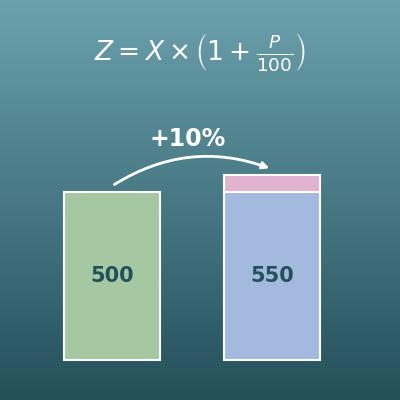
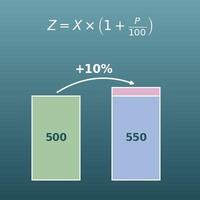
Percentage Change Calculator (Increase and Decrease)
Calculates percentage changes such as "if my weight went from 160 lb to 152 lb, what percent did I lose?"
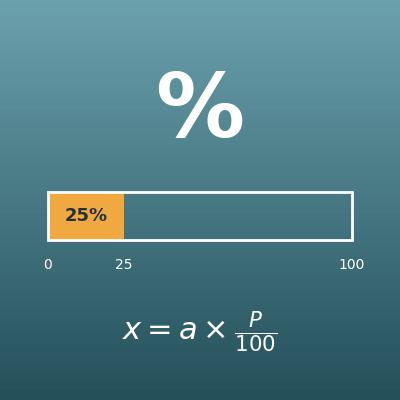
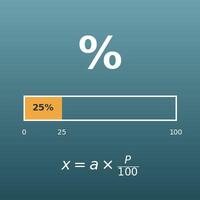
Percentage Calculator (Percent, Part and Whole)
Finds the percent, the part or the whole from the other two
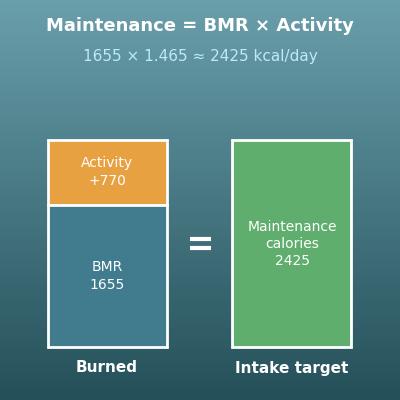
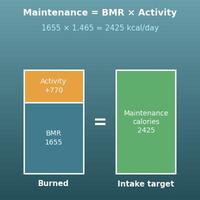
Calorie Calculator (Maintenance Calories and Weight Loss or Gain Plans)
Estimates your daily maintenance calories and calorie targets for losing or gaining weight from your age, sex, height and weight
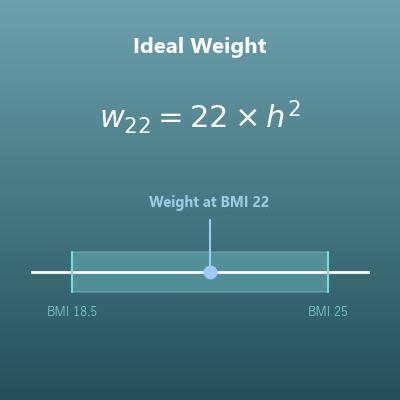
Ideal Weight Calculator (Devine, Robinson, Miller and Hamwi Formulas)
Works out your ideal body weight from your height with four medical formulas and the healthy BMI range