






Choose "Simplify one radical" or "Two radicals", then enter the number in front of the radical and the number under it. The formula below is linked to the input fields, so you can also edit the numbers in the formula directly.
Table of Contents
-
What you can do on this page
-
What is this calculation used for?
-
How to Use
-
Formulas and figures
-
Symbols and terms
-
Good to know before you start
-
How to calculate it in Excel
-
How to calculate it in Google Sheets
-
How to calculate it in Python
-
How to write it in LaTeX and other math languages (copy and paste)
-
How to have ChatGPT do the calculation
-
DataChef Features
-
Related Features
-
NumberChef Calculators List
What you can do on this page
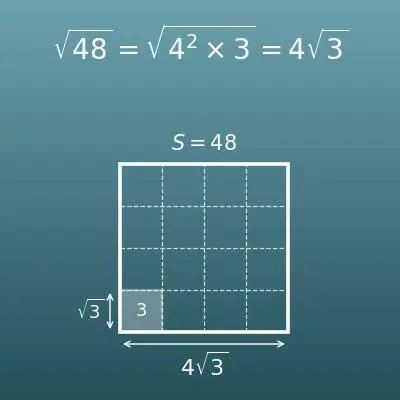
- Simplify a square root such as \(\sqrt{48}\) to \(4\sqrt{3}\) (the form with the smallest possible whole number under the radical). The steps show the prime factorization of the radicand and how the perfect square comes out
- You can also see that when the radicand is a perfect square, the radical goes away and you get a whole number, as in \(\sqrt{36} = 6\)
- Add, subtract, multiply and divide radicals such as \(3\sqrt{2} + 5\sqrt{2}\) and \(2\sqrt{6} \times 3\sqrt{2}\), with exact answers in simplest form
- When a division leaves a radical in the denominator, the answer is given with the denominator rationalized. Example: \(6 \div \sqrt{3} = 2\sqrt{3}\)
- The exact form is the main answer, along with its decimal value and the two whole numbers it lies between. A number line shows its size too
- The calculator shows the radical just as you would write it by hand, and you can edit the numbers inside or in front of it directly
What is this calculation used for?
The f-numbers on a camera lens go 1.4, 2, 2.8, 4, 5.6, 8, 11, 16. Each step lets in half as much light, which means the area of the lens opening halves, so its diameter shrinks by a factor of \(\sqrt{2}\). That is why each f-number is about \(\sqrt{2} \approx 1.414\) times the one before.
In fact, f/1.4 is \(\sqrt{2}\), f/2.8 is \(2\sqrt{2} \approx 2.83\), f/5.6 is \(4\sqrt{2} \approx 5.66\) and f/11 is \(8\sqrt{2} \approx 11.3\), rounded for the lens markings. Simplified radicals show the pattern hidden in the numbers.
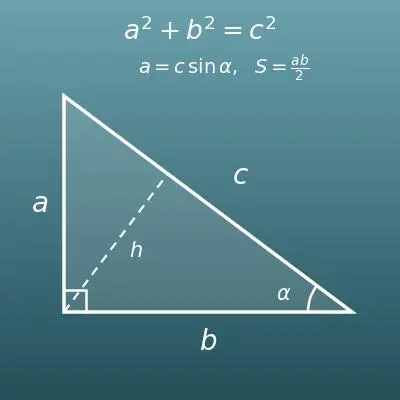
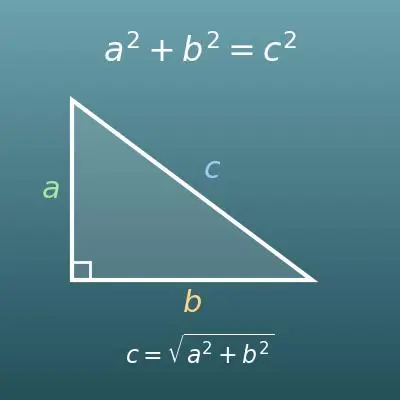
When you find a diagonal from two sides that meet at a right angle (the Pythagorean theorem), the answer is often a radical. The diagonal of a square 1 ft on each side is \(\sqrt{2} \approx 1.414\) ft, and for sides of 3 ft and 4 ft it is \(\sqrt{25} = 5\) ft.
Carpenters and builders measure this diagonal to check that a corner is square (the 3-4-5 rule). On a plan, instead of writing a value like \(\sqrt{18}\) ft, write it simplified as \(3\sqrt{2}\) ft, and you can tell at once that it is 3 times \(\sqrt{2} \approx 1.414\), about 4.24 ft.
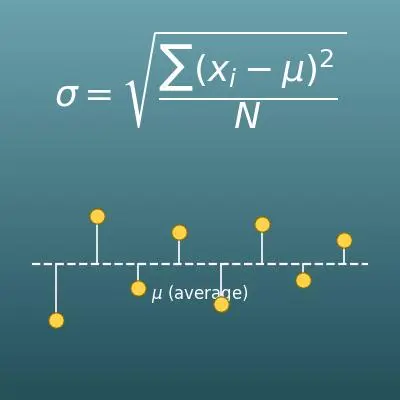
The standard deviation is the square root of the average of the squared distances from the mean (the variance). Squaring and then taking the square root brings the result back to the same units as the original data.
For example, the five values 4, 6, 8, 10, 12 have a mean of 8 and a variance of 8, so the standard deviation is \(\sqrt{8} = 2\sqrt{2} \approx 2.83\). Test scores, product variation in factories, reference ranges in medical checkups: square roots appear wherever data is handled.
An object dropped from a height of \(h\) feet reaches the ground in \(\sqrt{\dfrac{2h}{g}}\) seconds (\(g\), the acceleration of gravity, is about 32.2 ft/s²). From 16 ft, that is about 1.0 second. The time for one full swing of a pendulum is also proportional to the square root of its length (about 2.0 seconds for a pendulum 1 m, or about 39 inches, long).
This rule, "time is proportional to the square root of distance", is used in everyday settings such as designing clocks and playground equipment and investigating falls.
From the length of the skid marks a car leaves on the road, investigators in the US estimate the speed when braking began with \(\sqrt{30df}\) mph (\(d\) is the skid length in feet and \(f\) is the drag factor between the tires and the road). On dry pavement with \(f = 0.7\) and skid marks 66 ft long, that is \(\sqrt{1386} \approx 37.2\) mph.
This estimate is really used in crash investigations. It also explains a key safe-driving fact: doubling your speed makes the braking distance (from when the brakes start working until you stop) four times as long, because braking distance is proportional to the square of the speed.
Formulas and figures
Symbols and terms
Symbols
| \(\sqrt{\phantom{a}}\) | square root (radical sign) | The symbol for a square root, called the radical sign. It is said to come from a stylized r, the first letter of the Latin word radix, meaning "root". It stands for the positive number whose square is the number under it, as in \(\sqrt{9} = 3\). |
| \(\sqrt{a}\) | square root of a | The positive square root of \(a\). Squaring it gives back \(a\) (\(\left(\sqrt{a}\right)^2 = a\)). The number \(a\) under the radical must be 0 or more. |
| \(a\sqrt{b}\) | a root b | \(a\) times \(\sqrt{b}\) (the multiplication sign is left out). A simplified radical has this form: \(a\) is the number that came outside, and \(b\) is the number left inside. |
| \(a^2\) | a squared | \(a\) multiplied by itself (\(a \times a\)). The small 2 at the upper right shows how many times to multiply. The first job in simplifying a radical is to find this form inside it. |
| \(\approx\) | is approximately equal to | The symbol for "about equal". The value of a radical does not come out even, so when you write it as a decimal you use this symbol, as in \(\sqrt{2} \approx 1.41421356\). |
| \(p, q\) | p, q | Letters often used for the numbers in front of radicals. On this page, as in \(p\sqrt{a} + q\sqrt{a}\), they tell how many copies of \(\sqrt{a}\) there are. |
| \(<\) | is less than | The symbol meaning the left side is smaller than the right side. On this page it shows which two whole numbers a radical lies between, as in \(6 < 4\sqrt{3} < 7\). |
Terms
| square root | A number whose square is the given number. \(9\) has two square roots, \(3\) and \(-3\). The positive one is written \(\sqrt{9}\) and the negative one \(-\sqrt{9}\). |
| radical sign | The symbol √ for a square root. An expression such as \(\sqrt{5}\) is called a radical, and it stands for the positive square root of the number inside. |
| radicand | The number under the radical sign. In \(\sqrt{48}\), the radicand is 48. |
| simplest radical form | The form you get by simplifying a radical without changing its value: the perfect squares are taken outside so the radicand is the smallest possible whole number (\(\sqrt{48} \to 4\sqrt{3}\)). It also has no radical in a denominator. |
| perfect square | A number you get by squaring a whole number, such as \(1, 4, 9, 16, 25, 36, \dots\). If the radicand is a perfect square, the radical goes away and you get a whole number (\(\sqrt{36} = 6\)). |
| perfect square factor | A factor of a number that is a perfect square. \(48\) has the perfect square factor \(16 = 4^2\), so \(\sqrt{48} = 4\sqrt{3}\). Numbers whose only perfect square factor is \(1\) (\(2, 3, 5, 6, 7, 10, \dots\)) cannot be simplified further. |
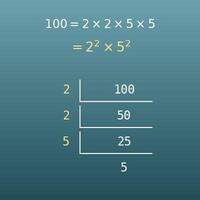
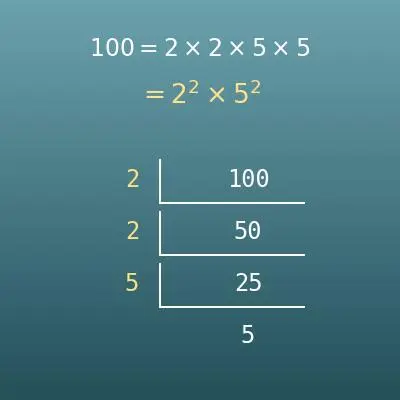
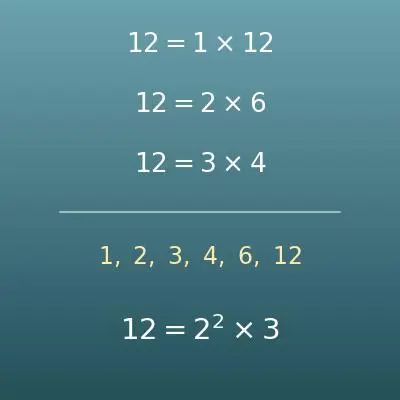
| prime factorization | Writing a whole number as a product of primes only (\(48 = 2^4 \times 3\)). Each pair of a prime factor lets one copy come outside the radical, so primes with an even exponent come out completely, and primes with an odd exponent leave one copy inside. It is the sure way to find perfect squares. |
| prime number | A whole number of 2 or more that can be divided evenly only by 1 and itself, such as \(2, 3, 5, 7, 11, \dots\). Primes are the building blocks of prime factorization. |
| like terms | Terms whose variable parts are exactly the same, like \(3x\) and \(5x\). For radicals, terms with the same radicand, like \(3\sqrt{2}\) and \(5\sqrt{2}\), are like terms (also called like radicals), and only these can be combined. |
| rationalizing the denominator | Rewriting a fraction with a radical in the denominator by multiplying the numerator and denominator by the same number, so that no radical is left in the denominator. The value does not change (\(\dfrac{1}{\sqrt{3}} = \dfrac{\sqrt{3}}{3}\)). |
| rational number | A number that can be written as a fraction of two whole numbers. Whole numbers, terminating decimals and repeating decimals are all rational. "Rational" comes from "ratio". |
| irrational number | A number that cannot be written as a fraction. As a decimal it never ends and never repeats. \(\sqrt{2}\), \(\sqrt{3}\) and \(\pi\) are irrational. |
| real number | All the rational and irrational numbers together, which match the points on the number line. This page works with square roots within the real numbers. |
| approximation | A value close to the exact value, used in its place. In \(\sqrt{2} \approx 1.414\), the right side is an approximation. A radical never comes out even, so any decimal you write for it is an approximation. |
| imaginary number | A number that is not real. If \(i\) is the number whose square is \(-1\), the square roots of \(-4\) are \(2i\) and \(-2i\). Square roots of negative numbers are imaginary and cannot be placed on the number line. In the US they are taught with complex numbers in Algebra 2. |
| nested radical | A radical with another radical inside it, such as \(\sqrt{5 + 2\sqrt{6}}\). When the conditions are right, it can be rewritten without the nesting, as \(\sqrt{3} + \sqrt{2}\). This calculator does not handle them. |
| number line | Numbers laid out as points on a straight line. It lets you see how large a radical is and which two whole numbers it lies between. |
Good to know before you start
Here is what helps you use the calculation on this page with real understanding, not just by pressing the button.
If you get stuck, going back over these topics is the quickest way forward.
| Powers and squares (Grades 6–8) |
|
| Prime factorization (Grade 6) |
|
| What a square root means (Grade 8) |
|
| Like terms in algebra (Grades 6–7) |
|
| Fractions and simplifying them (Grades 5–6) |
|
| The Pythagorean theorem (Grade 8) |
|
How to calculate it in Excel
| Number under the radical a | 3 |
| Value of √a | =SQRT(B1) |
| √a squared (back to B1) | =B2^2 |
| Number that comes outside a | 4 |
| Number left inside b | 3 |
| Original number a²×b | =B1^2*B2 |
| Value of √(a²b) | =SQRT(B3) |
| Value of a√b (the same) | =B1*SQRT(B2) |
| Number under the radical a | 2 |
| First coefficient p | 3 |
| Second coefficient q | 5 |
| Value of p√a + q√a | =B2*SQRT(B1)+B3*SQRT(B1) |
| Value of (p+q)√a (the same) | =(B2+B3)*SQRT(B1) |
| First number under the radical a | 3 |
| Second number under the radical b | 6 |
| Value of √a × √b | =SQRT(B1)*SQRT(B2) |
| Value of √(ab) (the same) | =SQRT(B1*B2) |
| Value of the simplified 3√2 (the same) | =3*SQRT(2) |
| Number under the radical b | 3 |
| Value of 1 ÷ √b | =1/SQRT(B1) |
| Value of √b ÷ b (the same) | =SQRT(B1)/B1 |
The first table puts 3 in a: √3 is 1.732050808…, and squaring it gives back 3.
The second table puts 4 in a and 3 in b. The original number is 48, and √48 and 4√3 both come out as 6.928203230….
The third table is 3√2 + 5√2, and both calculations give 11.31370850…. The fourth table is √3 × √6, and all three formulas give 4.242640687….
The fifth table is 1 ÷ √3, and the rationalized √3 ÷ 3 gives the same 0.5773502692…. Change the values, and you can check that it works for any combination.
Note that Excel shows decimal approximations. Use the calculator on this page to see exact forms such as 4√3.
How to calculate it in Google Sheets
| Number under the radical a | 3 |
| Value of √a | =SQRT(B1) |
| √a squared (back to B1) | =B2^2 |
| Number that comes outside a | 4 |
| Number left inside b | 3 |
| Original number a²×b | =B1^2*B2 |
| Value of √(a²b) | =SQRT(B3) |
| Value of a√b (the same) | =B1*SQRT(B2) |
| Number under the radical a | 2 |
| First coefficient p | 3 |
| Second coefficient q | 5 |
| Value of p√a + q√a | =B2*SQRT(B1)+B3*SQRT(B1) |
| Value of (p+q)√a (the same) | =(B2+B3)*SQRT(B1) |
| First number under the radical a | 3 |
| Second number under the radical b | 6 |
| Value of √a × √b | =SQRT(B1)*SQRT(B2) |
| Value of √(ab) (the same) | =SQRT(B1*B2) |
| Value of the simplified 3√2 (the same) | =3*SQRT(2) |
| Number under the radical b | 3 |
| Value of 1 ÷ √b | =1/SQRT(B1) |
| Value of √b ÷ b (the same) | =SQRT(B1)/B1 |
How to calculate it in Python
from math import isqrt

def simplify_radical(n):
    # Rewrite √n as a√b (b has no perfect square factor) and return (a, b)
    outside = 1
    inside = n
    d = 2
    while d * d <= inside:
        while inside % (d * d) == 0:
            inside //= d * d
            outside *= d
        d += 1
    return outside, inside

outside, inside = simplify_radical(48)
if inside == 1:
    print(f"√48 = {outside}")
else:
    print(f"√48 = {outside}√{inside}")

# Check with decimal values too (they are the same)
print(48 ** 0.5, outside * inside ** 0.5)

# If the radicand is a perfect square, the radical goes away
print(simplify_radical(36), isqrt(36))
How to write it in LaTeX and other math languages (copy and paste)
(√a)² = a
\left(\sqrt{a}\right)^{2} = a
<math xmlns="http://www.w3.org/1998/Math/MathML" display="block">
  <mrow>
    <msup>
      <mrow><mo>(</mo><msqrt><mi>a</mi></msqrt><mo>)</mo></mrow>
      <mn>2</mn>
    </msup>
    <mo>=</mo>
    <mi>a</mi>
  </mrow>
</math>
(sqrt(a))^2 = a
Sqrt[a]^2 == a
sqrt(a)^2 = a;
sqrt(a)^2 == a
(√a)^2 = a
√(a²b) = a√b
\sqrt{a^{2}b} = a\sqrt{b}
<math xmlns="http://www.w3.org/1998/Math/MathML" display="block">
  <mrow>
    <msqrt><mrow><msup><mi>a</mi><mn>2</mn></msup><mi>b</mi></mrow></msqrt>
    <mo>=</mo>
    <mi>a</mi>
    <msqrt><mi>b</mi></msqrt>
  </mrow>
</math>
sqrt(a^2 b) = a sqrt(b)
Sqrt[a^2 b] == a Sqrt[b]
sqrt(a^2*b) = a*sqrt(b);
sqrt(a^2*b) == a*sqrt(b)
√(a^2 b) = a√b
p√a + q√a = (p + q)√a
p\sqrt{a} + q\sqrt{a} = \left(p + q\right)\sqrt{a}
<math xmlns="http://www.w3.org/1998/Math/MathML" display="block">
  <mrow>
    <mi>p</mi><msqrt><mi>a</mi></msqrt>
    <mo>+</mo>
    <mi>q</mi><msqrt><mi>a</mi></msqrt>
    <mo>=</mo>
    <mo>(</mo><mi>p</mi><mo>+</mo><mi>q</mi><mo>)</mo>
    <msqrt><mi>a</mi></msqrt>
  </mrow>
</math>
p sqrt(a) + q sqrt(a) = (p + q) sqrt(a)
p Sqrt[a] + q Sqrt[a] == (p + q) Sqrt[a]
p*sqrt(a) + q*sqrt(a) = (p + q)*sqrt(a);
p*sqrt(a) + q*sqrt(a) == (p + q)*sqrt(a)
p√a + q√a = (p + q)√a
√a × √b = √(ab)
\sqrt{a} \times \sqrt{b} = \sqrt{ab}
<math xmlns="http://www.w3.org/1998/Math/MathML" display="block">
<mrow>
<msqrt><mi>a</mi></msqrt>
<mo>×</mo>
<msqrt><mi>b</mi></msqrt>
<mo>=</mo>
<msqrt><mrow><mi>a</mi><mi>b</mi></mrow></msqrt>
</mrow>
</math>
sqrt(a) * sqrt(b) = sqrt(a b)
Sqrt[a] Sqrt[b] == Sqrt[a b]
sqrt(a)*sqrt(b) = sqrt(a*b);
sqrt(a)*sqrt(b) == sqrt(a*b)
√a × √b = √(ab)
√a ÷ √b = √(ab) / b
\frac{\sqrt{a}}{\sqrt{b}} = \frac{\sqrt{a}\sqrt{b}}{\sqrt{b}\sqrt{b}} = \frac{\sqrt{ab}}{b}
<math xmlns="http://www.w3.org/1998/Math/MathML" display="block">
  <mrow>
    <mfrac><msqrt><mi>a</mi></msqrt><msqrt><mi>b</mi></msqrt></mfrac>
    <mo>=</mo>
    <mfrac>
      <mrow><msqrt><mi>a</mi></msqrt><msqrt><mi>b</mi></msqrt></mrow>
      <mrow><msqrt><mi>b</mi></msqrt><msqrt><mi>b</mi></msqrt></mrow>
    </mfrac>
    <mo>=</mo>
    <mfrac><msqrt><mrow><mi>a</mi><mi>b</mi></mrow></msqrt><mi>b</mi></mfrac>
  </mrow>
</math>
sqrt(a)/sqrt(b) = (sqrt(a) sqrt(b))/(sqrt(b) sqrt(b)) = sqrt(a b)/b
Sqrt[a]/Sqrt[b] == Sqrt[a b]/b
sqrt(a)/sqrt(b) = sqrt(a*b)/b;
sqrt(a)/sqrt(b) == sqrt(a*b)/b
√a/√b = √(ab)/b
How to have ChatGPT do the calculation
You are a math calculation assistant for square roots. Do the following calculation by actually running Python code, and base your answer only on the numbers from the execution result (do not answer by mental math or guessing).

1. Simplify √48 so that the number under the radical is the smallest possible whole number.
2. Also show the prime factorization of 48 used along the way.
3. Give 3√2 + 5√2, 2√6 × 3√2 and 6 ÷ √3 each in simplest radical form (for division, with no radical in the denominator).

In Python, write your own function that factors the radicand into primes and takes out the perfect squares, and check that the decimal values before and after simplifying match. Show the code you used and the numbers from the execution result.
How to Use
-
1Enter your numbersType the numbers you want to calculate with into the input fields
-
2CalculatePress the "Calculate" button
-
3Check the resultThe result appears on the spot. The same page also explains the idea behind the calculation and the formula
DataChef Features

No technical knowledge required.
Intuitive and user-friendly operation.

Can be used without registering personal information.

Automatic file deletion by clicking "download".

and rapid file conversion.

No attribution required.

No need to contact us for commercial use permission.
Related Features
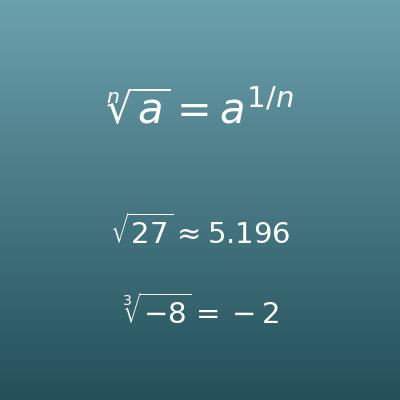
Nth Root Calculator (Square Root, Cube Root, nth Root)
Find square roots such as √27, cube roots and nth roots as decimals. Odd roots of negative numbers work too
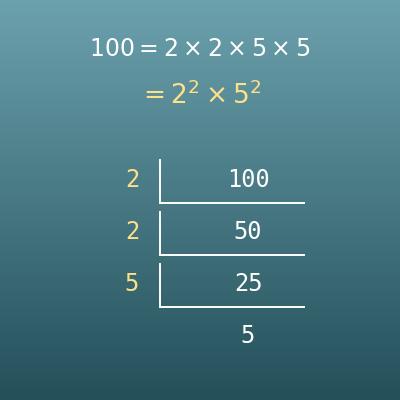
Prime Factorization Calculator
Break a whole number into prime factors. It is the basis for finding the perfect squares used to simplify radicals
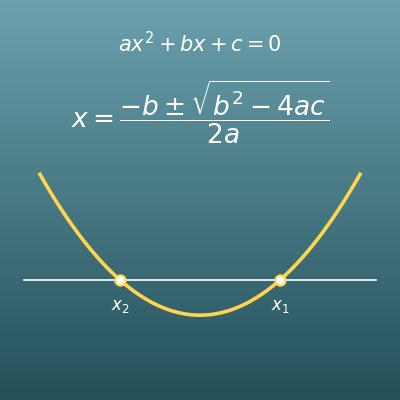
Quadratic Formula Calculator (Discriminant and Complex Roots)
Enter the coefficients a, b and c to solve a quadratic equation. Radicals in the answer are shown in simplest form