Enter your sex, age, weight and height, plus your neck and waist (and hips for women) measured with a tape measure. Your estimated body fat percentage, fat mass, lean body mass and category are calculated together.
Table of Contents
-
What you can do on this page
-
What is this calculation used for?
-
How to Use
-
Formulas and figures
-
Symbols and terms
-
Good to know before you start
-
How to calculate it in Excel
-
How to calculate it in Google Sheets
-
How to calculate it in Python
-
How to write it in LaTeX and other math languages (copy and paste)
-
How to have ChatGPT do the calculation
-
DataChef Features
-
Related Features
-
NumberChef Calculators List
What you can do on this page
- No body fat scale needed - all you need is a tape measure. Measure only your neck, your waist (and hips for women) and your height, and your body fat percentage is estimated with a statistical formula
- Combined with your weight, it also calculates your fat mass and lean body mass (in pounds, or kilograms in Metric)
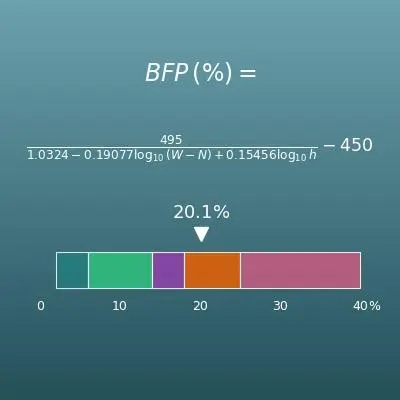
- It shows where your estimate falls in the American Council on Exercise (ACE) categories, such as "Athletes" or "Average", on a number line
- The ideal body fat percentage for your age (Jackson & Pollock, ages 20 to 55) and a reference value estimated from your BMI are shown as well
What is this calculation used for?
If you lose 5 pounds, the scale alone cannot tell you whether you lost fat or muscle and water. Recording your body fat percentage and lean body mass together shows the quality of the weight loss: are you losing fat while keeping muscle?
Because the formula has some error, the practical way to use it is to watch the direction of change when you measure the same way over time, rather than a single reading.
Once you set a goal such as "from 20% body fat to 15%", the fat mass formula gives you a rough idea of how many pounds of fat to lose. For example, a person who weighs 180 lb at 20% body fat and wants to reach 15% while keeping the same lean mass would need to lose about 10.6 lb of fat.
That makes it easier to build a plan with a real basis than simply chasing a lower number on the scale.
Fat stored around the belly (visceral fat) is linked to a higher risk of conditions such as type 2 diabetes and heart disease. US health guidelines treat a waist of more than 40 inches for men or more than 35 inches for women as a sign of higher risk, which shows that simply measuring your waist is a first step in looking after your health.
The formula on this page focuses on exactly the difference between waist and neck, so measuring regularly and watching the change can help you notice risks early (always get a diagnosis from a medical professional).
The U.S. Navy developed this formula to judge the body fat of its personnel fairly without special equipment (which is why it is called the "Navy method"). Tape-measure methods of the same kind are still used today to check body composition standards in the US military.
Measuring large numbers of people by the same standard, cheaply and anywhere: that is why tape-measure methods like this one keep being chosen in practice.
In sports with weight classes, such as boxing and wrestling, athletes need to cut down to make weight while keeping as much lean body mass (muscle) as possible. Knowing fat mass and lean body mass separately helps estimate how much room is left to cut.
Cutting below essential fat (2–5% for men, 10–13% for women) harms health, so it is done under the guidance of professionals.
Formulas and figures
Symbols and terms
Symbols
| \(P\) | pee | Body fat percentage - the share of your weight that is fat. On this page it stands for the estimate from either the tape-measure formula or the BMI method. |
| \(W\) | double-u | Waist circumference (in). Men measure level at the navel, women at the narrowest point of the waist. |
| \(N\) | en | Neck circumference (in), measured at the narrowest point just below the Adam's apple. |
| \(H\) | capital aitch | Hip circumference (in), measured at the widest part of the buttocks. It is used only in the formula for women (the same place as the hip size for clothing). |
| \(h\) | small aitch | Height, in inches in both the body fat formulas and the BMI formula on this page (5 ft 10 in = 70 in). |
| \(m\) | em | Weight (lb). It is the same symbol m that physics uses for mass. |
| \(F\) | ef | Fat mass (lb) - the part of your weight that is fat (the first letter of "fat"). |
| \(L\) | el | Lean body mass (lb) - your weight minus your fat mass (the first letter of "lean"). |
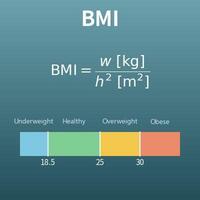
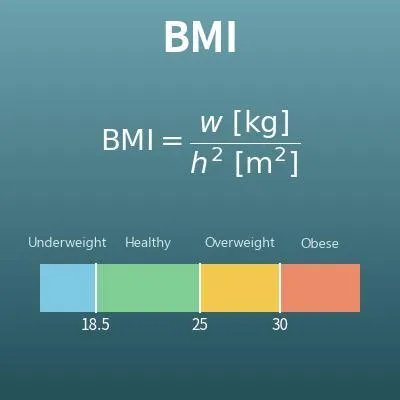
| \(\mathrm{BMI}\) | B-M-I | Body mass index. In US units it is weight (lb) ÷ height (in) squared × 703. (Example - for 176 lb and 70 in, \(176 \div 70^2 \times 703 \approx 25.3\)) |
| \(A\) | ay | Age (years). It is used only in the BMI method and for the ideal body fat for your age, not in the main formula. |
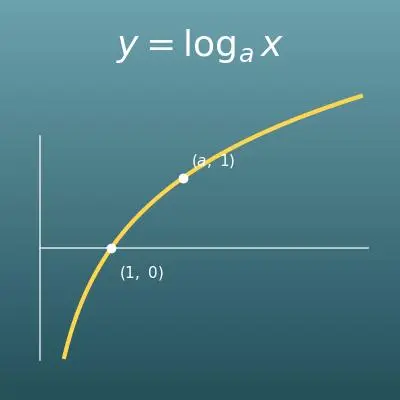
| \(\log_{10}\) | log base 10 | The logarithm with base 10. It tells you "10 to what power gives this number". (Example - \(\log_{10} 100 = 2\), \(\log_{10} 20.5 \approx 1.312\)) |
Terms
| body fat percentage | The share of your body weight that is fat (%). Appearance and health risks are said to relate more closely to body fat percentage than to weight itself; two people with the same weight can be very different depending on how much is muscle and how much is fat. |
| Navy method | The common name for the main formula in this calculator. It was developed by the U.S. Navy (Hodgdon and Beckett, 1984) to manage the body fat of its personnel. Because it needs only a tape measure and your height, it is now widely used in general health and fitness as well. |
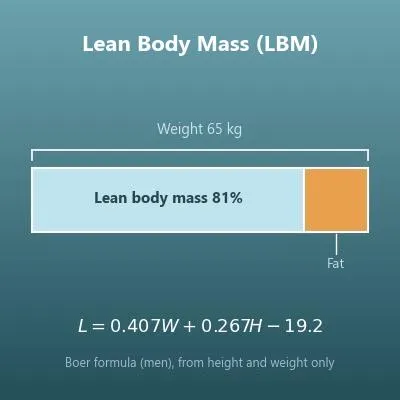
| lean body mass | Your weight minus your fat mass - the combined weight of muscle, bone, water, organs and so on. It is also called LBM. |
| common logarithm | The logarithm with base 10, \(\log_{10}\). It is taught in high school (Algebra 2). For this page, a scientific calculator or Excel's LOG10 function works it out even if you do not remember the details. |
| essential fat | The minimum fat the body needs to stay alive and healthy, for example for hormones and to protect the organs. ACE puts it at 2–5% for men and 10–13% for women, and going below it is dangerous to health. Women need more because the body needs extra fat to support pregnancy, breastfeeding and female hormones. |
| ACE (American Council on Exercise) | A US nonprofit organization that certifies fitness professionals. The categories on this page (from essential fat to obese) are based on the groups ACE publishes. |
| bioelectrical impedance | The method used by home body fat scales. They send a weak electric current through the body and estimate body fat from how easily it passes. The reading is easily affected by things such as how much water is in the body, and it measures in a completely different way from the tape-measure formula on this page, so it is normal for the numbers to differ. |
| visceral fat | Fat stored deep inside the belly, around the organs. Too much of it is linked to a higher risk of conditions such as type 2 diabetes and heart disease, which is why doctors often measure waist size at checkups. |
Good to know before you start
Here is what helps you use the calculation on this page with real understanding, not just by pressing the button.
Only the common logarithm is high school math, and a calculator or Excel works it out for you, so you do not need to worry about it just to use the page.
| Percentages (Grade 6) |
|
| Multiplying and dividing with decimals (Grades 5–6) |
|
| Exponents (Grade 6) |
|
| Common logarithms (Algebra 2) |
|
How to calculate it in Excel
| Height (in) | 70 |
| Neck (in) | 15 |
| Waist (in) | 35.5 |
| Body fat (%) | =86.010*LOG10(B3-B2)-70.041*LOG10(B1)+36.76 |
| Height (in) | 64 |
| Neck (in) | 13 |
| Waist (in) | 31.5 |
| Hips (in) | 39.5 |
| Body fat (%) | =163.205*LOG10(B3+B4-B2)-97.684*LOG10(B1)-78.387 |
| Weight (lb) | 176 |
| Body fat (%) | 20.4 |
| Fat mass (lb) | =B1*B2/100 |
| Lean body mass (lb) | =B1-B3 |
| Weight (lb) | 176 |
| Height (in) | 70 |
| Age (years) | 35 |
| BMI | =703*B1/B2^2 |
| Body fat (%, men) | =1.2*B4+0.23*B3-16.2 |
| Body fat (%, women) | =1.2*B4+0.23*B3-5.4 |
LOG10 is the Excel function for the common logarithm (10 to what power gives this number). All lengths are in inches (5 ft 10 in = 70 in).
In the first table, for example, the body fat cell shows about 20.4 (%). Just replace the numbers in column B with your own measurements.
How to calculate it in Google Sheets
| Height (in) | 70 |
| Neck (in) | 15 |
| Waist (in) | 35.5 |
| Body fat (%) | =86.010*LOG10(B3-B2)-70.041*LOG10(B1)+36.76 |
| Height (in) | 64 |
| Neck (in) | 13 |
| Waist (in) | 31.5 |
| Hips (in) | 39.5 |
| Body fat (%) | =163.205*LOG10(B3+B4-B2)-97.684*LOG10(B1)-78.387 |
| Weight (lb) | 176 |
| Body fat (%) | 20.4 |
| Fat mass (lb) | =B1*B2/100 |
| Lean body mass (lb) | =B1-B3 |
| Weight (lb) | 176 |
| Height (in) | 70 |
| Age (years) | 35 |
| BMI | =703*B1/B2^2 |
| Body fat (%, men) | =1.2*B4+0.23*B3-16.2 |
| Body fat (%, women) | =1.2*B4+0.23*B3-5.4 |
How to calculate it in Python
import math

sex = "m"          # "m" for male, "f" for female
age = 35           # age (years)
weight_lb = 176    # weight (lb)
height_in = 70     # height (inches), 5 ft 10 in
neck_in = 15       # neck (inches)
waist_in = 35.5    # waist (inches)
hip_in = 36        # hips (inches, used only in the formula for women)

# body fat formula (different for men and women), inch version
if sex == "m":
    body_fat_percent = 86.010 * math.log10(waist_in - neck_in) - 70.041 * math.log10(height_in) + 36.76
else:
    body_fat_percent = 163.205 * math.log10(waist_in + hip_in - neck_in) - 97.684 * math.log10(height_in) - 78.387

# fat mass and lean body mass
fat_mass_lb = weight_lb * body_fat_percent / 100
lean_body_mass_lb = weight_lb - fat_mass_lb

# BMI method (for reference)
bmi = 703 * weight_lb / height_in ** 2
bmi_method_percent = 1.20 * bmi + 0.23 * age - (16.2 if sex == "m" else 5.4)

print(f"Body fat (tape measure estimate): {body_fat_percent:.1f} %")
print(f"Fat mass: {fat_mass_lb:.1f} lb / Lean body mass: {lean_body_mass_lb:.1f} lb")
print(f"Body fat (BMI method, for reference): {bmi_method_percent:.1f} %")
How to write it in LaTeX and other math languages (copy and paste)
P = 86.010 × log₁₀(W − N) − 70.041 × log₁₀ h + 36.76
P = 86.010\log_{10}(W - N) - 70.041\log_{10} h + 36.76
<math xmlns="http://www.w3.org/1998/Math/MathML" display="block">
<mrow>
<mi>P</mi>
<mo>=</mo>
<mn>86.010</mn>
<msub><mi>log</mi><mn>10</mn></msub>
<mo>⁡</mo>
<mrow><mo>(</mo><mi>W</mi><mo>−</mo><mi>N</mi><mo>)</mo></mrow>
<mo>−</mo>
<mn>70.041</mn>
<msub><mi>log</mi><mn>10</mn></msub>
<mo>⁡</mo>
<mi>h</mi>
<mo>+</mo>
<mn>36.76</mn>
</mrow>
</math>
P = 86.010 log_(10)(W - N) - 70.041 log_(10)(h) + 36.76
bfp = 86.010*Log10[waist - neck] - 70.041*Log10[height] + 36.76
bfp := 86.010*log10(waist - neck) - 70.041*log10(height) + 36.76;
bfp = 86.010*log10(waist - neck) - 70.041*log10(height) + 36.76;
P = 86.010 log_10 (W - N) - 70.041 log_10 h + 36.76
P = 163.205 × log₁₀(W + H − N) − 97.684 × log₁₀ h − 78.387
P = 163.205\log_{10}(W + H - N) - 97.684\log_{10} h - 78.387
<math xmlns="http://www.w3.org/1998/Math/MathML" display="block">
<mrow>
<mi>P</mi>
<mo>=</mo>
<mn>163.205</mn>
<msub><mi>log</mi><mn>10</mn></msub>
<mo>⁡</mo>
<mrow><mo>(</mo><mi>W</mi><mo>+</mo><mi>H</mi><mo>−</mo><mi>N</mi><mo>)</mo></mrow>
<mo>−</mo>
<mn>97.684</mn>
<msub><mi>log</mi><mn>10</mn></msub>
<mo>⁡</mo>
<mi>h</mi>
<mo>−</mo>
<mn>78.387</mn>
</mrow>
</math>
P = 163.205 log_(10)(W + H - N) - 97.684 log_(10)(h) - 78.387
bfp = 163.205*Log10[waist + hip - neck] - 97.684*Log10[height] - 78.387
bfp := 163.205*log10(waist + hip - neck) - 97.684*log10(height) - 78.387;
bfp = 163.205*log10(waist + hip - neck) - 97.684*log10(height) - 78.387;
P = 163.205 log_10 (W + H - N) - 97.684 log_10 h - 78.387
F = m × P ÷ 100, L = m − F
F = m \times \dfrac{P}{100}, \quad L = m - F
<math xmlns="http://www.w3.org/1998/Math/MathML" display="block">
<mrow>
<mi>F</mi>
<mo>=</mo>
<mi>m</mi>
<mo>×</mo>
<mfrac><mi>P</mi><mn>100</mn></mfrac>
<mo>,</mo>
<mspace width="1em"/>
<mi>L</mi>
<mo>=</mo>
<mi>m</mi>
<mo>−</mo>
<mi>F</mi>
</mrow>
</math>
F = m xx P/100, L = m - F
fatMass = weight*bfp/100; leanMass = weight - fatMass
fatMass := weight*bfp/100; leanMass := weight - fatMass;
fat_mass = weight*bfp/100; lean_mass = weight - fat_mass;
F = m × P/100, L = m - F
P = 1.20 × BMI + 0.23 × A − 16.2 (male), P = 1.20 × BMI + 0.23 × A − 5.4 (female)
P_{\text{male}} = 1.20\,\mathrm{BMI} + 0.23A - 16.2, \quad P_{\text{female}} = 1.20\,\mathrm{BMI} + 0.23A - 5.4
<math xmlns="http://www.w3.org/1998/Math/MathML" display="block">
<mrow>
<msub><mi>P</mi><mtext>male</mtext></msub>
<mo>=</mo>
<mn>1.20</mn>
<mo>×</mo>
<mi>BMI</mi>
<mo>+</mo>
<mn>0.23</mn>
<mo>×</mo>
<mi>A</mi>
<mo>−</mo>
<mn>16.2</mn>
<mo>,</mo>
<mspace width="1em"/>
<msub><mi>P</mi><mtext>female</mtext></msub>
<mo>=</mo>
<mn>1.20</mn>
<mo>×</mo>
<mi>BMI</mi>
<mo>+</mo>
<mn>0.23</mn>
<mo>×</mo>
<mi>A</mi>
<mo>−</mo>
<mn>5.4</mn>
</mrow>
</math>
P = 1.20 BMI + 0.23 A - 16.2 (male), P = 1.20 BMI + 0.23 A - 5.4 (female)
bfpMale = 1.20*bmi + 0.23*age - 16.2; bfpFemale = 1.20*bmi + 0.23*age - 5.4
bfpMale := 1.20*bmi + 0.23*age - 16.2; bfpFemale := 1.20*bmi + 0.23*age - 5.4;
bfp_male = 1.20*bmi + 0.23*age - 16.2; bfp_female = 1.20*bmi + 0.23*age - 5.4;
P = 1.20 BMI + 0.23 A - 16.2 (male), P = 1.20 BMI + 0.23 A - 5.4 (female)
How to have ChatGPT do the calculation
You are a calculation assistant for health measures. Do the following calculation by actually running Python code, and base your answer only on the numbers from the execution result (do not answer by mental math or guessing).

Use the following formulas, which estimate body fat from tape measurements and height (all lengths in inches):
- Men: body fat (%) = 86.010 × log10(waist − neck) − 70.041 × log10(height) + 36.76
- Women: body fat (%) = 163.205 × log10(waist + hips − neck) − 97.684 × log10(height) − 78.387

Person: male, height 5 ft 10 in (70 in), weight 176 lb, neck 15 in, waist 35.5 in
Find each of the following:
1. Body fat percentage (%, to one decimal place)
2. Fat mass (lb) = weight × body fat % / 100
3. Lean body mass (lb) = weight − fat mass

Show the formulas you used and the numbers from the execution result. Also add a short note that the result is an estimate from a formula, not a medical diagnosis.
How to Use
-
1Enter your numbersType the numbers you want to calculate with into the input fields
-
2CalculatePress the "Calculate" button
-
3Check the resultThe result appears on the spot. The same page also explains the idea behind the calculation and the formula
DataChef Features

No technical knowledge required.
Intuitive and user-friendly operation.

Can be used without registering personal information.

Automatic file deletion by clicking "download".

and rapid file conversion.
No attribution required.

No need to contact us for commercial use permission.
Related Features
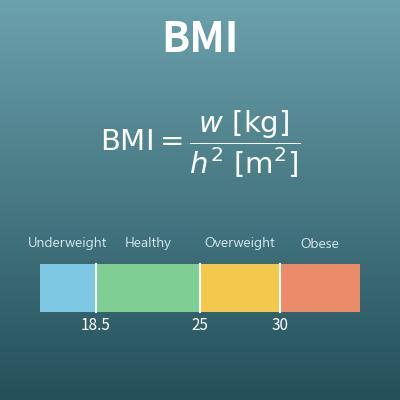
BMI Calculator (Body Mass Index and Healthy Weight Range)
Calculates your BMI (body mass index) and weight category from your height and weight
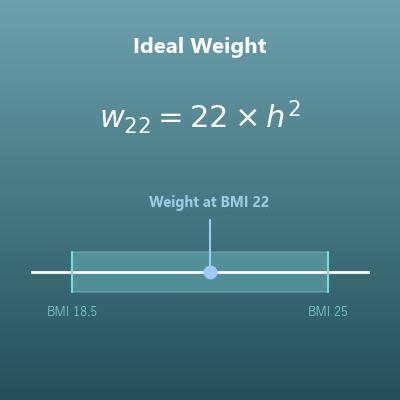
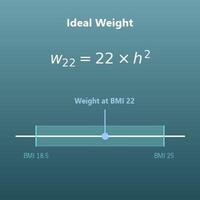
Ideal Weight Calculator (Devine, Robinson, Miller and Hamwi Formulas)
Works out your ideal body weight from your height with medical formulas and the healthy BMI range
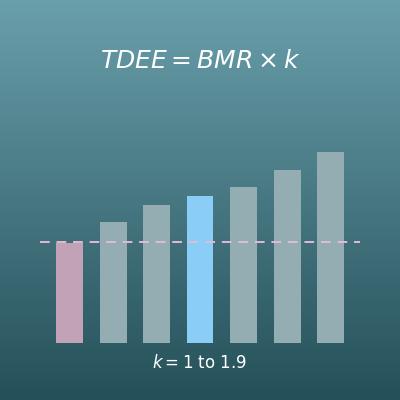
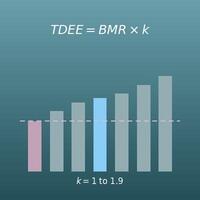
TDEE Calculator (Total Daily Energy Expenditure and How to Choose Your Activity Level)
Calculates how many calories you burn in a day from your age, sex, height, weight and activity level