Choose what to calculate. "Compound growth" finds the final amount and interest from the principal, annual rate and time. "Convert a rate" restates the same rate for a different compounding frequency.
Table of Contents
-
What you can do on this page
-
What is this calculation used for?
-
How to Use
-
Formulas and graphs
-
Symbols and terms
-
Good to know before you start
-
How to calculate it in Excel
-
How to calculate it in Google Sheets
-
How to calculate it in Python
-
How to write it in LaTeX and other math languages (copy and paste)
-
How to have ChatGPT do the calculation
-
DataChef Features
-
Related Features
-
NumberChef Calculators List
What you can do on this page
- Enter the principal, annual rate and time, and you get the final amount with compound interest, \(A = A_0\left(1 + \dfrac{r}{n}\right)^{nt}\), and the total interest right away (compounded annually, semiannually, quarterly, monthly, daily or continuously)
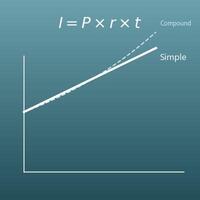
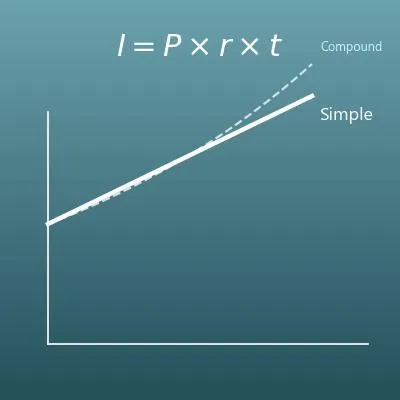
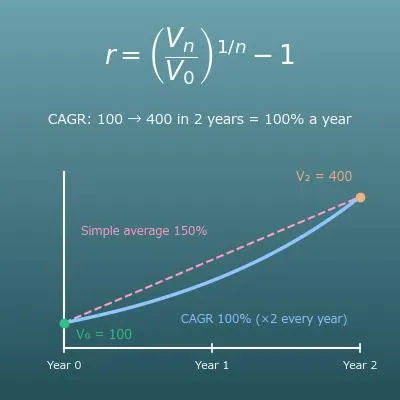
- The result also shows the final amount with simple interest under the same terms and the difference from compound interest. A graph shows how the gap grows over the years
- Switch to "Convert a rate to another compounding frequency" to restate a rate for a different compounding frequency, such as turning an APR compounded monthly into an APY (5 decimal places)
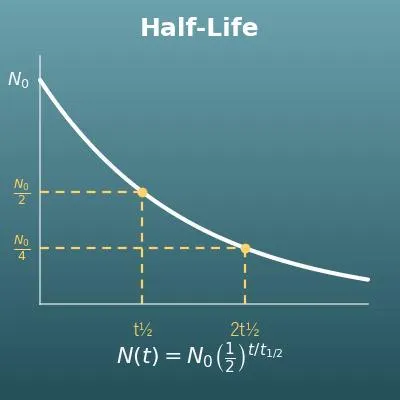
- The Rule of 72, a quick way to estimate how many years it takes for money to double, is explained in plain words in the formula section
- A plain-language explanation of the formulas and copy-and-paste formulas for Excel, Google Sheets and Python are all on this page
What is this calculation used for?
For example, $10,000 in a savings account at 4% APY for 10 years grows to \(10000 \times 1.04^{10} \approx 14802\) dollars, about $4,802 of interest. At 0.5% a year, the same 10 years gives only about $10,511. Compounding makes the difference between rates much bigger over time.
In real life, interest is generally taxable and savings rates change over time. Use this calculation as an estimate that assumes "before taxes, with a fixed rate".
Compounding works against you when you borrow. If a $5,000 credit card balance at 20% a year is left unpaid for 5 years, compounded once a year for simplicity, it grows to \(5000 \times 1.2^{5} \approx 12442\) dollars, more than double. Credit cards usually compound daily or monthly, which makes it grow even faster (about $13,480 with monthly compounding), and late fees can add more.
Knowing in advance how fast debt grows is one of the best ways to avoid borrowing too much.
On most mortgages, car loans and credit cards, interest is calculated with a monthly rate equal to "the stated annual rate ÷ 12". Adding that interest each month is exactly monthly compounding, so an APR of 12% works out to \((1 + 0.01)^{12} - 1 \approx 12.68\%\) as a rate compounded once a year. The "Convert a rate" mode on this page does exactly this calculation.
Note that the APR a lender discloses under the US Truth in Lending Act can also include certain fees, so it is not only about compounding. The monthly payment on a loan you pay down each month is found with a different formula (amortization) that combines compounding with payments, but compound interest is its foundation.
If prices rise 2% every year (the long-run goal of the US Federal Reserve), the rise follows the same math as compound interest, and prices double in about \(72 \div 2 = 36\) years. Prices doubling means the same money buys half as much, in other words, the real value of cash is cut in half.
Being able to grasp the long-term effect of a small number like "2% a year" with numbers instead of gut feeling is one of the great uses of compound interest math.
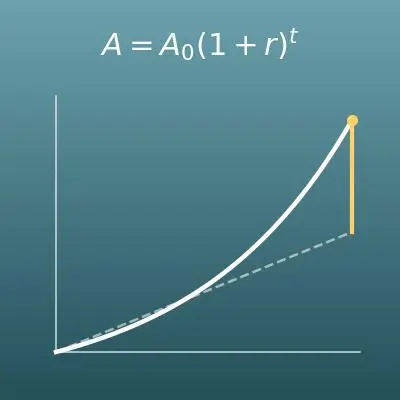
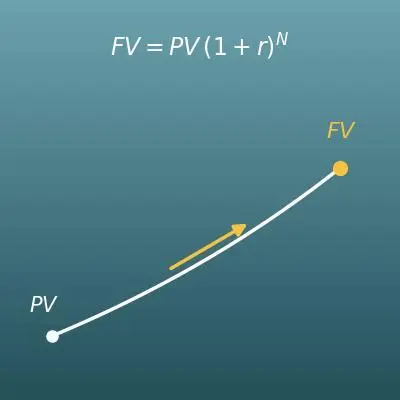
Anything that grows by the same percentage every year (or every hour) follows the compound interest formula \(A = A_0(1 + r)^t\), even if it is not money. For example, if a population keeps growing 1% a year, it doubles in about 70 years (the exact doubling time is \(\ln 2 \div \ln 1.01 \approx 69.7\) years).
The same idea is widely used to estimate anything where growth builds on growth, such as a bacteria culture, the spread of a virus or social media followers (in reality, the formula stops applying once the growth rate is no longer constant).
Formulas and graphs
Symbols and terms
Symbols
| \(A_0\) | A naught (A sub zero) | The principal, the amount you deposit (or borrow) at the start. (Example - $10,000) |
| \(A\) | A | The final amount, the principal plus the interest. |
| \(r\) | r | The annual interest rate, written as a decimal. (Example - for 3%, \(r = 0.03\)) |
| \(t\) | t | The time in years, how long the money is saved or borrowed. |
| \(n\) | n | The compounding frequency, the number of times per year interest is added. (Example - for monthly compounding, \(n = 12\)) |
| \(m\) | m | In the rate conversion formula, the compounding frequency of the rate you start with, in times per year. (Example - for monthly compounding, \(m = 12\)) |
| \(r_{\mathrm{in}}\) | r in | In the rate conversion formula, the rate you start with (before converting). |
| \(r_{\mathrm{out}}\) | r out | In the rate conversion formula, the rate you find (after converting). |
| \(Y\) | Y | The doubling time, about how many years it takes the principal to double. It is what the Rule of 72 estimates. |
| \(F\) | F | The annual growth factor, how many times larger the money gets in 1 year. (Example - at 6% compounded monthly, \(F \approx 1.0617\)) |
| \(e\) | e (Euler's number) | Euler's number, the base of the natural logarithm, about 2.71828. It appears as the limit when interest is compounded more and more often (continuous compounding), and it was first found by Jacob Bernoulli while he studied compound interest. |
| \(\ln\) | natural log (L N) | The natural logarithm, the logarithm with base \(e\). It appears in the exact doubling time \(\ln 2 \div \ln(1+r)\). |
Terms
| compound interest | Interest that is added to the principal, so the next interest is paid on the total. Because interest earns interest, it grows much more than simple interest over a long time. |
| simple interest | Interest paid only on the original principal. The interest is the same every year, so the growth is a straight line. |
| principal | The money you deposit or borrow at the start. Interest is calculated from it. |
| final amount | The principal plus the interest, also called the future value or ending balance. It is what the compound growth mode on this page finds. |
| interest | Money paid in return for depositing or lending money. It is the final amount minus the principal. |
| compounding frequency | How often interest is added to the principal (annually, semiannually, monthly and so on). At the same annual rate, more frequent compounding grows the money slightly more. |
| continuous compounding | The theoretical limit of compounding infinitely often. The final amount becomes \(A = A_0 e^{rt}\). It is often used in theoretical finance. |
| APR | Annual Percentage Rate. A nominal yearly rate that does not include the effect of compounding. For loans, the APR that lenders must disclose under the US Truth in Lending Act also includes certain fees, so it can be higher than the interest rate alone. |
| APY | Annual Percentage Yield. The effective yearly rate that includes the effect of compounding. At the same nominal rate (APR), the more often interest compounds, the higher the APY. US banks show the APY on savings accounts and CDs so that accounts can be compared. |
| effective annual rate | A rate compounded semiannually, monthly and so on, restated as the rate compounded once a year. It lets you compare products with different compounding frequencies fairly. For savings, it is the same idea as the APY. |
| Rule of 72 | A mental math shortcut that estimates the years it takes money to double as "72 ÷ annual rate (%)". At 6% a year, it is about 12 years. |
Good to know before you start
Here is what helps you use the calculation on this page with real understanding, not just by pressing the button.
| Percents (Grade 6) |
|
| Exponents (Grades 6–8) |
|
| Geometric sequences (Algebra 1 and 2, going further) |
|
| Exponential and logarithmic functions and e (Algebra 2 and precalculus, going further) |
|
How to calculate it in Excel
| Principal | 10000 |
| Annual rate (decimal; 3% is 0.03) | 0.03 |
| Time (years) | 10 |
| Final amount (compound) | =B1*(1+B2)^B3 |
| Principal | 10000 |
| Annual rate (decimal; 3% is 0.03) | 0.03 |
| Times per year (12 for monthly) | 12 |
| Time (years) | 10 |
| Final amount (compound) | =B1*(1+B2/B3)^(B3*B4) |
| Rate to convert (decimal; 6% is 0.06) | 0.06 |
| Times per year, input rate (12 for monthly) | 12 |
| Times per year, target (1 for annual) | 1 |
| Annual growth factor F | =(1+B1/B2)^B2 |
| Converted rate (decimal) | =B3*(B4^(1/B3)-1) |
| Annual rate (the percentage as it is) | 6 |
| Approximate years to double | =72/B1 |
"^" means "to the power of" (multiply this many times), "*" is multiplication and "/" is division.
The first table shows about 13,439.16 (dollars), the second about 13,493.54 (dollars), the third about 0.0617 (= 6.16778%) and the fourth 12 (years). Note that rates are entered as decimals, the percentage divided by 100 (3% is 0.03), not as the percentage itself.
How to calculate it in Google Sheets
| Principal | 10000 |
| Annual rate (decimal; 3% is 0.03) | 0.03 |
| Time (years) | 10 |
| Final amount (compound) | =B1*(1+B2)^B3 |
| Principal | 10000 |
| Annual rate (decimal; 3% is 0.03) | 0.03 |
| Times per year (12 for monthly) | 12 |
| Time (years) | 10 |
| Final amount (compound) | =B1*(1+B2/B3)^(B3*B4) |
| Rate to convert (decimal; 6% is 0.06) | 0.06 |
| Times per year, input rate (12 for monthly) | 12 |
| Times per year, target (1 for annual) | 1 |
| Annual growth factor F | =(1+B1/B2)^B2 |
| Converted rate (decimal) | =B3*(B4^(1/B3)-1) |
| Annual rate (the percentage as it is) | 6 |
| Approximate years to double | =72/B1 |
How to calculate it in Python
principal = 10000        # principal (dollars)
annual_rate = 0.03       # annual rate (0.03 for 3%)
years = 10               # time (years)
times_per_year = 1       # compounding frequency (annually=1, semiannually=2, monthly=12, daily=365)

compound_amount = principal * (1 + annual_rate / times_per_year) ** (times_per_year * years)
simple_amount = principal * (1 + annual_rate * years)

print(f"Final amount (compound): ${compound_amount:,.2f}")
print(f"Final amount (simple): ${simple_amount:,.2f}")
print(f"Compound minus simple: ${compound_amount - simple_amount:,.2f}")
How to write it in LaTeX and other math languages (copy and paste)
A = A₀(1 + r)ᵗ
A = A_0 (1 + r)^{t}
<math xmlns="http://www.w3.org/1998/Math/MathML" display="block">
  <mrow>
    <mi>A</mi>
    <mo>=</mo>
    <msub><mi>A</mi><mn>0</mn></msub>
    <msup>
      <mrow><mo>(</mo><mn>1</mn><mo>+</mo><mi>r</mi><mo>)</mo></mrow>
      <mi>t</mi>
    </msup>
  </mrow>
</math>
A = A_0 (1 + r)^t
a0 (1 + r)^t
A := A0*(1 + r)^t;
A = A0*(1 + r)^t;
A = A_0 (1 + r)^t
A = A₀(1 + r/n)ⁿᵗ
A = A_0 \left(1 + \dfrac{r}{n}\right)^{nt}
<math xmlns="http://www.w3.org/1998/Math/MathML" display="block">
  <mrow>
    <mi>A</mi>
    <mo>=</mo>
    <msub><mi>A</mi><mn>0</mn></msub>
    <msup>
      <mrow><mo>(</mo><mn>1</mn><mo>+</mo><mfrac><mi>r</mi><mi>n</mi></mfrac><mo>)</mo></mrow>
      <mrow><mi>n</mi><mi>t</mi></mrow>
    </msup>
  </mrow>
</math>
A = A_0 (1 + r/n)^(n t)
a0 (1 + r/n)^(n t)
A := A0*(1 + r/n)^(n*t);
A = A0*(1 + r/n)^(n*t);
A = A_0 (1 + r/n)^(nt)
F = \left(1 + \dfrac{r_{\mathrm{in}}}{m}\right)^{m}, \quad r_{\mathrm{out}} = n\left(F^{1/n} - 1\right)
<math xmlns="http://www.w3.org/1998/Math/MathML" display="block">
<mrow>
<mi>F</mi>
<mo>=</mo>
<msup>
<mrow><mo>(</mo><mn>1</mn><mo>+</mo><mfrac><msub><mi>r</mi><mtext>in</mtext></msub><mi>m</mi></mfrac><mo>)</mo></mrow>
<mi>m</mi>
</msup>
<mo>,</mo>
<msub><mi>r</mi><mtext>out</mtext></msub>
<mo>=</mo>
<mi>n</mi>
<mrow>
<mo>(</mo>
<msup><mi>F</mi><mrow><mn>1</mn><mo>/</mo><mi>n</mi></mrow></msup>
<mo>−</mo>
<mn>1</mn>
<mo>)</mo>
</mrow>
</mrow>
</math>
F = (1 + r_(in)/m)^m, r_(out) = n(F^(1/n) - 1)
f = (1 + rin/m)^m; rout = n (f^(1/n) - 1)
F := (1 + r_in/m)^m; r_out := n*(F^(1/n) - 1);
F = (1 + r_in/m)^m; r_out = n*(F^(1/n) - 1);
F = (1 + r_in/m)^m, r_out = n(F^(1/n) - 1)
Y ≈ 72 ÷ r
Y \approx \dfrac{72}{r}
<math xmlns="http://www.w3.org/1998/Math/MathML" display="block">
<mrow>
<mi>Y</mi>
<mo>≈</mo>
<mfrac><mn>72</mn><mi>r</mi></mfrac>
</mrow>
</math>
Y ~~ 72 / r
72 / r
Y := 72 / r;
Y = 72 / r;
Y ≈ 72/r
How to have ChatGPT do the calculation
You are an interest calculation assistant. Do the following calculation by actually running Python code, and base your answer only on the numbers from the execution result (do not answer by mental math or guessing).

1. Find the final amount and the total interest when $10,000 is deposited at 3% a year, compounded once a year, for 10 years.
2. Also find the final amount with simple interest under the same terms, and the difference from compound interest.
3. What is 6% a year compounded monthly as an annual rate compounded once a year (APY)? Give it to 5 decimal places.

Show the formulas you used and the numbers from the execution result.
How to Use
-
1Enter your numbersType the numbers you want to calculate with into the input fields
-
2CalculatePress the "Calculate" button
-
3Check the resultThe result appears on the spot. The same page also explains the idea behind the calculation and the formula
DataChef Features

No technical knowledge required.
Intuitive and user-friendly operation.

Can be used without registering personal information.

Automatic file deletion by clicking "download".

and rapid file conversion.

No attribution required.
No need to contact us for commercial use permission.
Related Features
Percentage Change Calculator (Increase and Decrease)
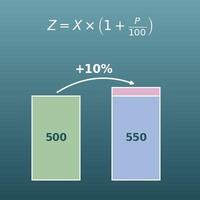
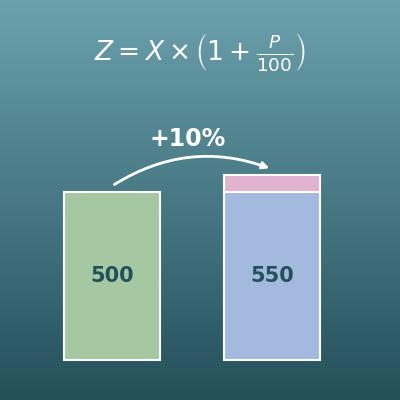
"Up 3%" means "× 1.03". This percentage change is one step of compound interest
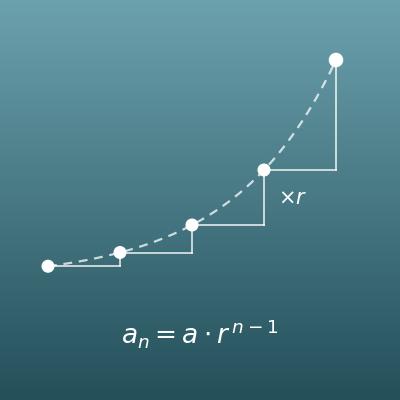
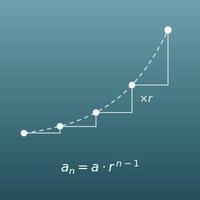
Geometric Sequence Calculator (nth Term and Sum)
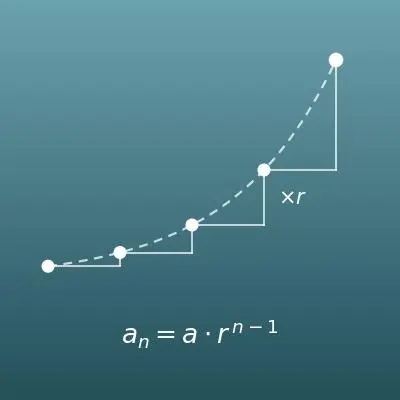
Money growing at compound interest forms a geometric sequence with common ratio 1 + r
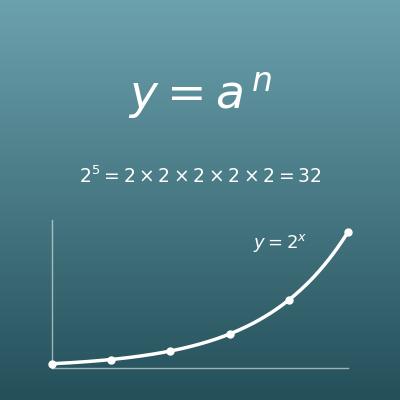
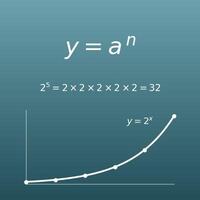
Exponent Calculator (Powers, a to the nth Power)
Does the core step of compound interest on its own - multiplying the same number many times
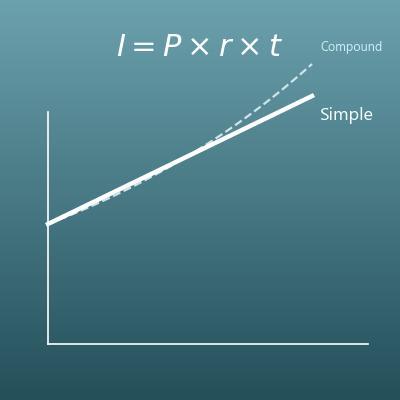
Simple Interest Calculator (Interest, Principal, Rate and Time)
Simple interest, where interest is earned only on the original principal. It can also solve for the principal, rate or time
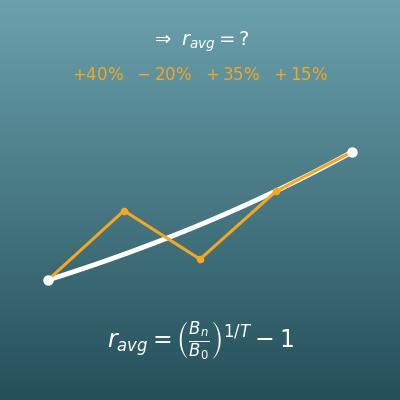
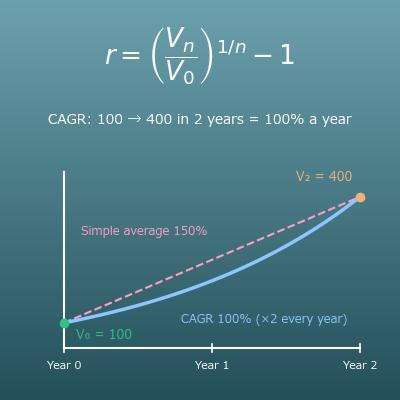
Average Return Calculator (Annualized Geometric Average and Cumulative Return)
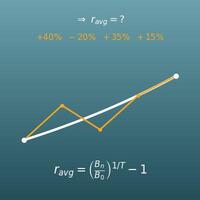
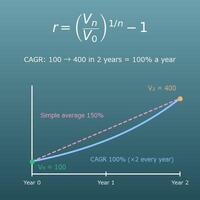
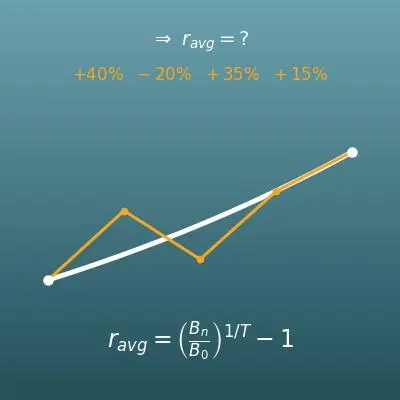
When returns differ from year to year, finds the single yearly compound rate that gives the same result