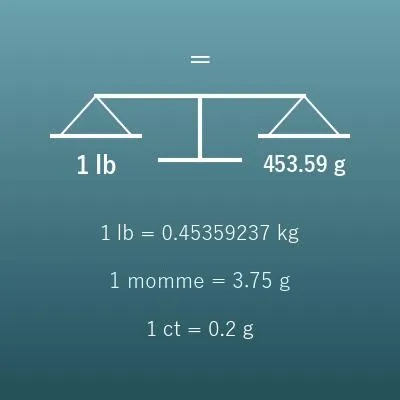



Enter a weight and choose its unit. It is converted into all 12 units (lb, oz, st, short ton, long ton, kg, g, mg, t, ct, momme and kan) at once, with the steps shown.
Table of Contents
-
What you can do on this page
-
What is this calculation used for?
-
How to Use
-
Formula
-
Symbols and terms
-
Good to know before you start
-
How to calculate it in Excel
-
How to calculate it in Google Sheets
-
How to calculate it in Python
-
How to write it in LaTeX and other math languages (copy and paste)
-
How to have ChatGPT do the calculation
-
DataChef Features
-
Related Features
-
NumberChef Calculators List
What you can do on this page
- Enter a weight and its unit, and see it converted into 12 units at once: pounds (lb), ounces (oz), stones (st), US short tons, UK long tons, kilograms (kg), grams (g), milligrams (mg), metric tons (t), carats (ct), and the traditional Japanese momme and kan
- Answer questions like "How many pounds is 70 kg?", "How many ounces is 250 g of butter?" or "How many grams is 1 carat?" in one step
- Conversions use exact defined factors such as "1 lb = 0.45359237 kg" and "1 oz = 1/16 lb", and the steps are shown
- A plain-language explanation of the formulas and copy-and-paste formulas for Excel, Google Sheets and Python are all on this page
What is this calculation used for?
Recipes from other countries and imported foods list amounts in grams and kilograms, such as "250 g of butter" or "1 kg of flour". Since 1 oz is about 28.35 g, 250 g is about 8.8 oz, and 1 kg is about 2.2 lb.
With this conversion, you can follow a metric recipe with a US kitchen scale.
Many international airlines state the checked-bag limit as "23 kg". 23 kg is about 50.7 lb, so it is almost the same as the common US limit of 50 lb (about 22.7 kg).
Outside the US, body weight is given in kilograms on scales, in medical forms and in the news. Knowing that 70 kg is about 154 lb lets you picture those numbers right away.
The carat, the usual measure of a diamond's size, is really a unit of weight: 1 carat is exactly 0.2 g. A US nickel weighs 5 g, which is 25 carats, so even a 1-carat diamond weighs only a twenty-fifth of a nickel.
Once you turn carats into grams, you can see in numbers that a gem's price depends on the weight of the stone, and how tiny a difference of a few tenths of a carat really is.
The momme, a traditional Japanese unit, is still the international unit for weighing pearls in the pearl trade. 1 momme is exactly 3.75 g, so a 10-momme strand of pearls weighs 37.5 g.
You may also see the word on silk sheets and pillowcases ("19 momme", "22 momme"), where it describes how heavy the silk fabric is. Knowing the unit helps you read these labels correctly.
The amounts in medicines and supplements are written in milligrams, such as "vitamin C 1,000 mg". 1,000 mg is 1 g, which is about the weight of a single US dollar bill.
Once you are used to converting between mg and g, you will not be misled by numbers that only look big, and you can compare amounts calmly.
US postage rates depend on weight in ounces and pounds. For example, a First-Class Mail letter can weigh up to 3.5 oz, which is about 99.2 g. Shipping sites and online stores outside the US often give weights in grams or kilograms.
Converting between oz, lb, g and kg lets you check whether a letter or package fits under a price limit before you go to the post office.
Formula
Symbols and terms
Symbols
| \(x\) | x | The weight you want to convert. (Example - for "500 g", 500) |
| \(a\) | a | The weight of one of the input unit, in kg. (Example - 0.45359237 for a pound, 0.00375 for a momme) |
| \(b\) | b | The weight of one of the new unit, in kg. (Example - 0.001 for a gram, 0.0002 for a carat) |
| \(R\) | R | The result of the conversion: the weight in the new unit. |
| \(K\) | K | A weight in kilograms (kg). (Example - a body weight of 68 kg) |
| \(L\) | L | A weight in pounds (lb), from the Latin "libra". (Example - 150 lb on a bathroom scale) |
| \(G\) | G | A weight in grams (g). (Example - a 500 g package) |
| \(M\) | M | A weight in momme. (Example - a 10-momme pearl necklace) |
| \(C\) | C | A weight in carats (ct). (Example - a 1.5-carat diamond) |
Terms
| mass | Strictly, the amount of matter in an object, measured in kg and similar units. In everyday language, "weight" is used for mass, and the conversions on this page are conversions between units of mass. Mass does not change even if you take the object to the Moon. |
| weight | Strictly, the force of gravity on an object, measured in the force unit newton, which is a different idea from mass. In everyday language, though, "weight" is used for mass, and this page uses it that way too. On the Moon, an object's weight (the pull of gravity) is about one-sixth of what it is on Earth. |
| metric system (SI) | The international system of units that includes mg, g, kg and t. Its units of mass change by factors of 1,000 (1 g = 1,000 mg, 1 kg = 1,000 g, 1 t = 1,000 kg). It is used in science and in most countries. |
| metric ton | The ton (t) on this page is the metric ton (also called a tonne), 1 t = 1,000 kg. In the US, "ton" usually means the short ton of 2,000 lb (about 907.18 kg), and the UK long ton is 2,240 lb (about 1,016.05 kg), so check which ton a text is using. |
| US customary units | The system of units used every day in the US, with pounds, ounces, feet, inches and so on (the UK imperial system is closely related). Since the 1959 international agreement, "1 lb = 0.45359237 kg" exactly, so it connects to the metric system precisely. |
| pound (lb) | The US customary unit of weight. 1 lb = 0.45359237 kg (about 453.6 g) = 16 oz. The symbol lb comes from the Latin "libra", meaning scales. |
| ounce (oz) | 1 oz = 1/16 lb = 28.349523125 g (about 28.35 g). This avoirdupois ounce is the one used for food and packages. It is different from the troy ounce (about 31.1035 g) used for gold and silver, and from the fluid ounce (fl oz), which measures volume. |
| carat (ct) | The unit of weight for gemstones such as diamonds. 1 carat = exactly 0.2 g (the metric carat). It is not the same as the karat (K, as in 24K) used for the purity of gold. |
| momme | A traditional Japanese unit of weight. 1 momme = exactly 3.75 g, the same as one Japanese 5-yen coin. It is still the international unit for weighing pearls, and the word is also used for the weight of silk fabric. |
| kan | A traditional Japanese unit of weight. 1 kan = 1,000 momme = exactly 3.75 kg. It is rarely used today, but it appears in older Japanese records and stories. |
| stone | A unit used in the UK and Ireland for body weight. 1 stone = 14 lb = 6.35029318 kg. Choose "st (stones)" as the unit to convert it on this page. |
| shakkanho | The traditional Japanese system of units, with the shaku for length, the kan and momme for weight and the tsubo for area. Japan replaced it with the metric system for official use, but some fields still use it, such as the momme for pearls. |
Good to know before you start
Here is what helps you use the calculation on this page with real understanding, not just by pressing the button.
| Units of weight (Grades 3–5) |
|
| Multiplying and dividing decimals (Grades 5–6) |
|
| Unit rates (Grade 6) |
|
| Powers of ten (Grades 5–8) |
|
How to calculate it in Excel
| Weight to convert | 500 |
| kg in 1 input unit | 0.001 |
| kg in 1 new unit | 0.45359237 |
| Result | =B1*B2/B3 |
| Weight in pounds | 150 |
| Kilograms | =B1*0.45359237 |
| Weight in momme | 10 |
| Grams | =B1*3.75 |
| Weight in carats | 1.5 |
| Grams | =B1*0.2 |
The first table converts 500 g to pounds and shows about 1.1023 lb. The second shows 150 lb as 68.0388555 kg, the third shows 10 momme as 37.5 g, and the fourth shows 1.5 carats as 0.3 g.
In the first table, B2 and B3 are the "kg in 1 unit" factors. Change them to mg = 0.000001, g = 0.001, kg = 1, t = 1000, lb = 0.45359237, oz = 0.028349523125, st = 6.35029318, short ton = 907.18474, long ton = 1016.0469088, ct = 0.0002, momme = 0.00375 or kan = 3.75, and the table works for any pair of the 12 units.
How to calculate it in Google Sheets
| Weight to convert | 500 |
| kg in 1 input unit | 0.001 |
| kg in 1 new unit | 0.45359237 |
| Result | =B1*B2/B3 |
| Weight in pounds | 150 |
| Kilograms | =B1*0.45359237 |
| Weight in momme | 10 |
| Grams | =B1*3.75 |
| Weight in carats | 1.5 |
| Grams | =B1*0.2 |
How to calculate it in Python
from fractions import Fraction

weight_value = Fraction("150")  # the weight to convert
from_unit = "lb"                # input unit: mg / g / kg / t / lb / oz / ct / monme / kan

LB_KG = Fraction("0.45359237")  # 1 lb = 0.45359237 kg (exact by international definition)
OZ_KG = LB_KG / 16              # 1 oz = 1/16 lb = 0.028349523125 kg
TO_KG = {"mg": Fraction(1, 1000000), "g": Fraction(1, 1000), "kg": Fraction(1),
         "t": Fraction(1000), "lb": LB_KG, "oz": OZ_KG,
         "ct": Fraction("0.0002"), "monme": Fraction("0.00375"), "kan": Fraction("3.75")}

kilograms = weight_value * TO_KG[from_unit]   # first, turn it into kg

print(f"Milligrams: {float(kilograms / TO_KG['mg'])}")
print(f"Grams: {float(kilograms / TO_KG['g'])}")
print(f"Kilograms: {float(kilograms)}")
print(f"Metric tons: {float(kilograms / TO_KG['t'])}")
print(f"Pounds: {float(kilograms / TO_KG['lb'])}")
print(f"Ounces: {float(kilograms / TO_KG['oz'])}")
print(f"Carats: {float(kilograms / TO_KG['ct'])}")
print(f"Momme: {float(kilograms / TO_KG['monme'])}")
print(f"Kan: {float(kilograms / TO_KG['kan'])}")
How to write it in LaTeX and other math languages (copy and paste)
R = x × a ÷ b
R = x \times a \div b
<math xmlns="http://www.w3.org/1998/Math/MathML" display="block">
<mrow>
<mi>R</mi>
<mo>=</mo>
<mi>x</mi>
<mo>×</mo>
<mi>a</mi>
<mo>÷</mo>
<mi>b</mi>
</mrow>
</math>
R = x xx a -: b
x*a/b
R := x*a/b;
R = x*a/b;
R = x × a ÷ b
K = L × 0.45359237
K = L \times 0.45359237
<math xmlns="http://www.w3.org/1998/Math/MathML" display="block">
<mrow>
<mi>K</mi>
<mo>=</mo>
<mi>L</mi>
<mo>×</mo>
<mn>0.45359237</mn>
</mrow>
</math>
K = L xx 0.45359237
L*0.45359237
K := L*0.45359237;
K = L*0.45359237;
K = L × 0.45359237
G = M × 3.75
G = M \times 3.75
<math xmlns="http://www.w3.org/1998/Math/MathML" display="block">
<mrow>
<mi>G</mi>
<mo>=</mo>
<mi>M</mi>
<mo>×</mo>
<mn>3.75</mn>
</mrow>
</math>
G = M xx 3.75
M*3.75
G := M*3.75;
G = M*3.75;
G = M × 3.75
G = C × 0.2
G = C \times 0.2
<math xmlns="http://www.w3.org/1998/Math/MathML" display="block">
<mrow>
<mi>G</mi>
<mo>=</mo>
<mi>C</mi>
<mo>×</mo>
<mn>0.2</mn>
</mrow>
</math>
G = C xx 0.2
carat*0.2
G := C*0.2;
G = C*0.2;
G = C × 0.2
How to have ChatGPT do the calculation
You are an assistant for converting units of weight. Do the following calculation by actually running Python code, and base your answer only on the numbers from the execution result (do not answer by mental math or guessing).

Convert a body weight of 150 lb into each of the following units:
1. Kilograms (use the exact definition 1 lb = 0.45359237 kg)
2. Ounces (1 lb = 16 oz)
3. Grams

Show the formulas you used and the numbers from the execution result.
How to Use
-
1Enter your numbersType the numbers you want to calculate with into the input fields
-
2CalculatePress the "Calculate" button
-
3Check the resultThe result appears on the spot. The same page also explains the idea behind the calculation and the formula
DataChef Features

No technical knowledge required.
Intuitive and user-friendly operation.

Can be used without registering personal information.

Automatic file deletion by clicking "download".

and rapid file conversion.
No attribution required.

No need to contact us for commercial use permission.
Related Features
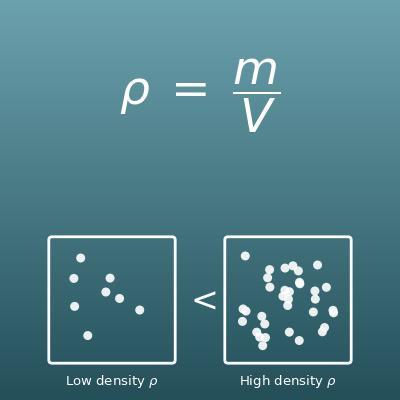
Density Calculator (Density, Mass and Volume)
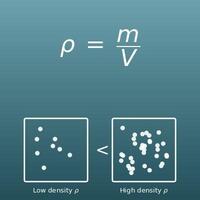
Finds density, mass or volume from the other two. You can convert the units of mass on this page