








Enter the power, duty cycle, hours of use and electricity rate. If you pick an appliance preset, typical values for a US household are filled in.
Table of Contents
-
What you can do on this page
-
What is this calculation used for?
-
How to Use
-
Formula
-
Symbols and terms
-
Good to know before you start
-
How to calculate it in Excel
-
How to calculate it in Google Sheets
-
How to calculate it in Python
-
How to write it in LaTeX and other math languages (copy and paste)
-
How to have ChatGPT do the calculation
-
DataChef Features
-
Related Features
-
NumberChef Calculators List
What you can do on this page
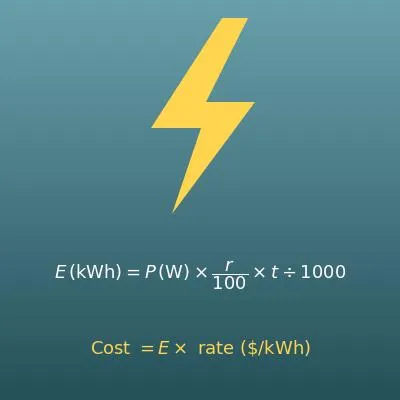
- Enter the power (W or kW), duty cycle, hours of use and your electricity rate, and you get the energy use (kWh) and cost per day, week, month and year on the spot
- Pick a common household appliance, such as a central air conditioner, a refrigerator or a hair dryer, and typical power, duty cycle and hours of use are filled in for you
- Hours of use can be entered in 8 kinds of units, such as "min/day", "hours/week" and "days/month" (1 month = 30.44 days and 1 year = 365.25 days)
- A plain-language explanation of the formulas and copy-and-paste formulas for Excel, Google Sheets and Python are all on this page
What is this calculation used for?
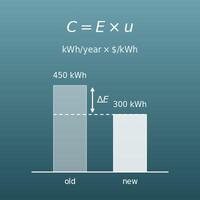
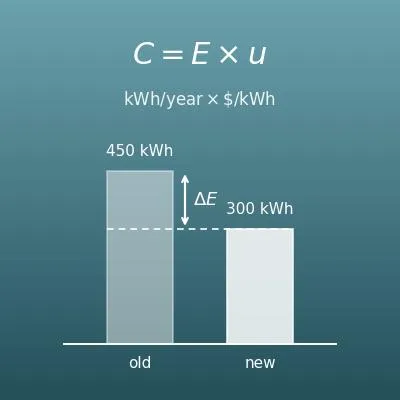
A refrigerator runs 24 hours a day, 365 days a year, so a difference in efficiency turns straight into a difference in cost. For example, if you replace an old refrigerator that uses 700 kWh a year with a newer, more efficient model that uses about 400 kWh, the difference is 300 kWh. At $0.17 per kWh, that saves about $51 a year, or about $510 over 10 years (all rough estimates).
When you can compare "the extra price of the new model" with "the money saved on electricity" in numbers, you can decide on a replacement by calculation instead of by feel.
A 3-ton central air conditioner draws about 3,500 W. Running at a 50% duty cycle for 8 hours a day, it uses 14 kWh a day, which costs about $2.38 a day and about $72 a month at $0.17 per kWh.
An air conditioner cycles on and off once the house reaches the set temperature, so it is not running at full power all the time. This is the idea behind the duty cycle. Knowing what each hour costs helps you save energy without being too hot.
A 150 W desktop computer used 8 hours a day costs about $6.21 a month. A 30 W laptop costs only about $1.24 (both at $0.17 per kWh).
If you work from home or play PC games for long hours, this difference helps when you choose a computer or estimate your bill. A high-end gaming PC can draw 300 to 500 W or more under load, so the cost changes a lot with how you use it.
A 30 W air purifier left on 24 hours a day costs about $3.73 a month. A 1,500 W space heater at a 50% duty cycle for 5 hours a day costs about $19.41 a month (both at $0.17 per kWh).
The hours of use of a high-wattage appliance matter far more than a small device left on. With this in numbers, you can put your energy-saving efforts in the right order.
A phone battery holds about 0.015 kWh (15 Wh), so even a full charge every day costs less than $1 a year (about $0.93 at $0.17 per kWh, not counting charger losses). The worry that overnight charging adds a lot to your bill turns out to be almost nothing once you calculate it.
To really cut your bill, look at the appliances where "wattage × hours of use" is large: air conditioning, heating, water heating and clothes drying.
Formula
Symbols and terms
Symbols
| \(P\) | Power. How much electric power the appliance draws, in W (watts). From the word "power". |
| \(r\) | Duty cycle. The share (%) of the rated power that is actually used. From the word "rate". |
| \(t\) | Hours of use per day. From the word "time". |
| \(E\) | Energy use per day, in kWh (kilowatt-hours). From the word "energy". |
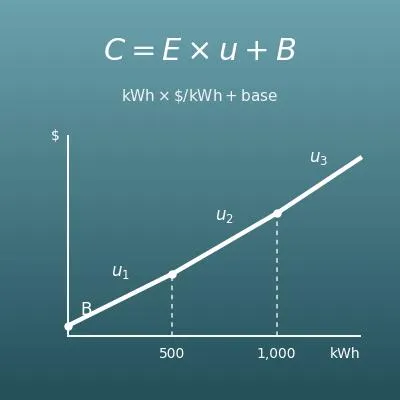
| \(u\) | Electricity rate. The price of 1 kWh ($/kWh). From "unit price". |
| \(C\) | Electricity cost ($). From the word "cost". |
| \(n\) | Number of days in the period. This calculator uses 1 week = 7 days, 1 month = 30.44 days and 1 year = 365.25 days. |
| \(E_n\) | Energy use for \(n\) days (kWh). The small \(n\) at the lower right is a subscript that shows how many days. |
Terms
| Watt | The unit of power, or how fast electricity is being used. You see it on appliance labels, such as "1500 W". 1000 W is written as 1 kW (kilowatt). |
| kWh (kilowatt-hour) | The unit of energy, or the total amount of electricity used. Using 1 kW of power for 1 hour uses 1 kWh. Your electric bill is based on kWh. |
| Power rating (wattage) | The power an appliance uses while it runs. The number on the label or in the catalog is often the maximum (rated) power, and the real average can be lower. |
| Duty cycle | The share of the rated power that is actually used over time. It is below 100% for appliances that cycle on and off to hold a temperature, such as air conditioners and refrigerators. |
| Average residential electricity rate | The average price US households pay for 1 kWh, published by the U.S. Energy Information Administration (EIA). It was about $0.17/kWh in 2025. Your own rate depends on your state, utility, plan and usage. |
| Standby power | Power an appliance uses while it is switched off but still plugged in, for things like a remote-control receiver or a clock display. Also called "phantom load". Enter the standby wattage and 24 hours/day in this calculator to estimate its cost. |
| Rated power | The power the maker states for the appliance running at full capacity. The wattage on the label or in the catalog is usually this value. |
Good to know before you start
Here is what helps you understand the calculations on this page, not just use them.
If you get stuck, going back over the topics in this table is the quickest way forward.
| Multiplying and dividing decimals (Grade 5) |
|
| Percents (Grade 6) |
|
| Converting units (Grades 4 to 7) |
|
| Power and energy (middle school physical science) |
|
How to calculate it in Excel
| Power (W) | 1500 |
| Duty cycle (%) | 50 |
| Hours of use per day | 2 |
| Energy use per day (kWh) | =B1*B2/100*B3/1000 |
| Energy use per day (kWh) | 1.5 |
| Electricity rate ($/kWh) | 0.17 |
| Cost per day ($) | =B1*B2 |
| Energy use per day (kWh) | 1.5 |
| Electricity rate ($/kWh) | 0.17 |
| Energy use per week (kWh) | =B1*7 |
| Cost per week ($) | =B3*B2 |
| Energy use per month, 30.44 days (kWh) | =B1*30.44 |
| Cost per month ($) | =B5*B2 |
| Energy use per year, 365.25 days (kWh) | =B1*365.25 |
| Cost per year ($) | =B7*B2 |
The first table is the example of 1,500 W at a 50% duty cycle for 2 hours a day, and B4 shows 1.5 (kWh). The second table multiplies that 1.5 kWh by a rate of $0.17, and B3 shows 0.255 ($).
The third table converts the daily values to a week, a month and a year. The cost per month (B6) is about $7.76 and the cost per year (B8) is about $93.14. Just change the numbers in column B to your own appliance's values.
How to calculate it in Google Sheets
| Power (W) | 1500 |
| Duty cycle (%) | 50 |
| Hours of use per day | 2 |
| Energy use per day (kWh) | =B1*B2/100*B3/1000 |
| Energy use per day (kWh) | 1.5 |
| Electricity rate ($/kWh) | 0.17 |
| Cost per day ($) | =B1*B2 |
| Energy use per day (kWh) | 1.5 |
| Electricity rate ($/kWh) | 0.17 |
| Energy use per week (kWh) | =B1*7 |
| Cost per week ($) | =B3*B2 |
| Energy use per month, 30.44 days (kWh) | =B1*30.44 |
| Cost per month ($) | =B5*B2 |
| Energy use per year, 365.25 days (kWh) | =B1*365.25 |
| Cost per year ($) | =B7*B2 |
How to calculate it in Python
power_watts = 1500          # Power (W)
capacity_percent = 50       # Duty cycle (%)
hours_per_day = 2           # Hours of use per day
price_per_kwh = 0.17        # Electricity rate ($/kWh)

# Energy use per day (kWh) = W x duty cycle / 100 x hours / 1000
kwh_per_day = power_watts * capacity_percent / 100 * hours_per_day / 1000

# Energy use (kWh) and cost ($) for each period. 1 month = 30.44 days, 1 year = 365.25 days
for label, days in [("1 day", 1), ("1 week", 7), ("1 month", 30.44), ("1 year", 365.25)]:
    kwh = kwh_per_day * days
    cost = kwh * price_per_kwh
    print(f"{label}: {kwh:.2f} kWh / ${cost:.2f}")
How to write it in LaTeX and other math languages (copy and paste)
E = P × (r ÷ 100) × t ÷ 1000
E = P \times \frac{r}{100} \times t \div 1000
<math xmlns="http://www.w3.org/1998/Math/MathML" display="block">
<mrow>
<mi>E</mi>
<mo>=</mo>
<mi>P</mi>
<mo>×</mo>
<mfrac><mi>r</mi><mn>100</mn></mfrac>
<mo>×</mo>
<mi>t</mi>
<mo>÷</mo>
<mn>1000</mn>
</mrow>
</math>
E = P * (r/100) * t / 1000
energy = power*(capacity/100)*hours/1000
E := P*(r/100)*t/1000;
E = P*(r/100)*t/1000;
E = P×(r/100)×t/1000
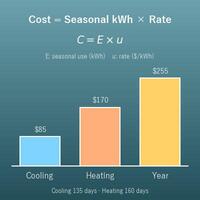
C = E × u
C = E \times u
<math xmlns="http://www.w3.org/1998/Math/MathML" display="block">
<mrow>
<mi>C</mi>
<mo>=</mo>
<mi>E</mi>
<mo>×</mo>
<mi>u</mi>
</mrow>
</math>
C = E * u
cost = energy*price
C := E*u;
C = E*u;
C = E×u
Eₙ = E × n
E_n = E \times n
<math xmlns="http://www.w3.org/1998/Math/MathML" display="block">
<mrow>
<msub><mi>E</mi><mi>n</mi></msub>
<mo>=</mo>
<mi>E</mi>
<mo>×</mo>
<mi>n</mi>
</mrow>
</math>
E_n = E * n
periodEnergy = energy*days
E_n := E*n;
E_n = E*n;
E_n = E×n
How to have ChatGPT do the calculation
You are an electricity cost assistant. Do the calculation below by actually running Python code, and base your answer only on the numbers from the output (do not calculate in your head or guess).

A 1,500 W space heater runs at a 50% duty cycle for 2 hours a day. The electricity rate is $0.17 per kWh.
Find the energy use per day (kWh) with "power (W) × duty cycle ÷ 100 × hours of use ÷ 1000".
Find each of the following (use 1 month = 30.44 days and 1 year = 365.25 days).
1. Energy use (kWh) and cost ($) per day
2. Energy use (kWh) and cost ($) per week, per month and per year

Show the formulas you used and the numbers from the output.
How to Use
-
1Enter your numbersType the numbers you want to calculate with into the input fields
-
2CalculatePress the "Calculate" button
-
3Check the resultThe result appears on the spot. The same page also explains the idea behind the calculation and the formula
DataChef Features

No technical knowledge required.
Intuitive and user-friendly operation.

Can be used without registering personal information.

Automatic file deletion by clicking "download".

and rapid file conversion.

No attribution required.

No need to contact us for commercial use permission.
Related Features
Percentage Calculator (Percent, Part and Whole)
Works out the percent, the part or the whole from the other two

Discount Calculator (Sale Price, Amount Off and Percent Off)
Finds the sale price and the amount saved from the original price and the discount rate
Sales Tax Calculator (Add or Remove Sales Tax and VAT)
Adds sales tax to a price or takes it out of a total
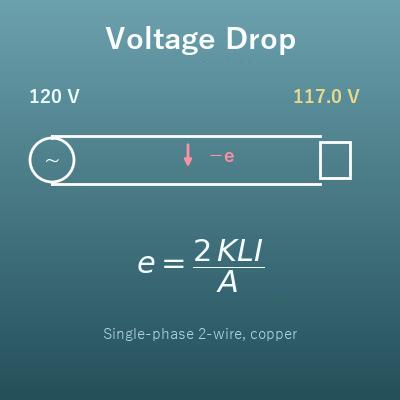
Voltage Drop Calculator (Wire Size, Length and Current)
Finds the voltage drop and percent drop in a wire run from the wire size, length and current
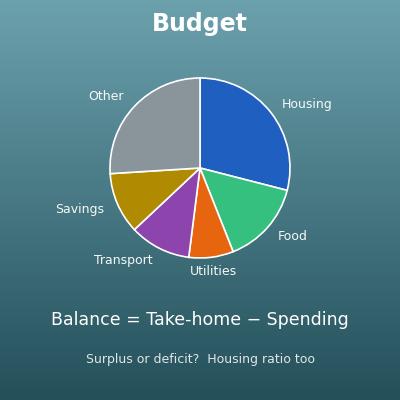
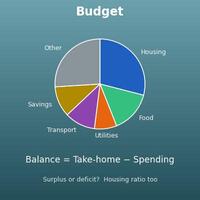
Monthly Budget Calculator (Income, Expenses and Housing Ratio)
Shows your monthly surplus or shortfall and the breakdown of spending, including utilities such as electricity
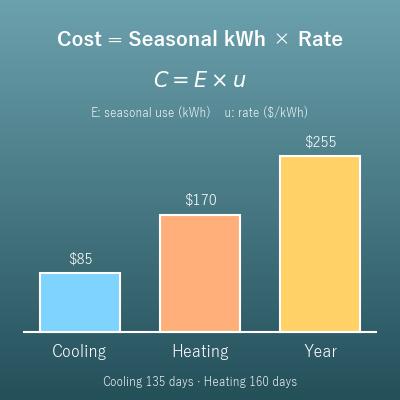
Air Conditioner Running Cost Calculator (Cooling, Heating and Yearly Cost from kWh)
Finds the cooling-season, heating-season and yearly cost of an air conditioner, and the savings from changing the thermostat
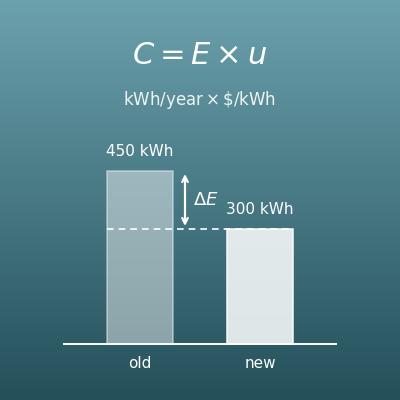
Annual kWh to Cost Calculator (EnergyGuide Label)
Turns the yearly kWh on an EnergyGuide label into the yearly, monthly and daily cost, and compares two models
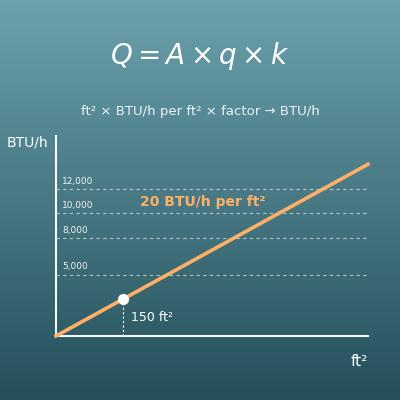
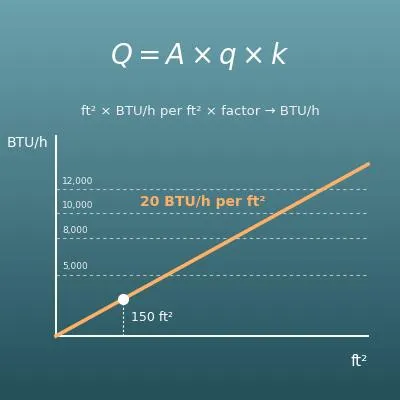
Air Conditioner Size Calculator (BTU per Square Foot)
Estimates the cooling and heating capacity a room needs from its size
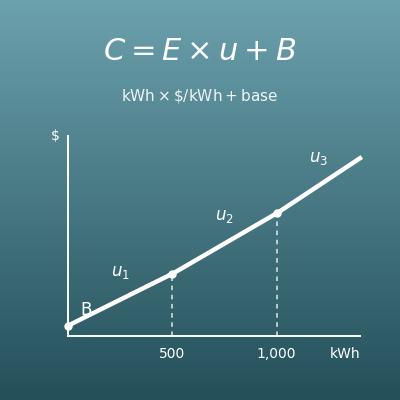
Electric Bill Calculator (kWh to Cost and Back)
Finds your electric bill from the kWh used and your rates (flat or tiered, customer charge, per-kWh charges), and the kWh a budget allows
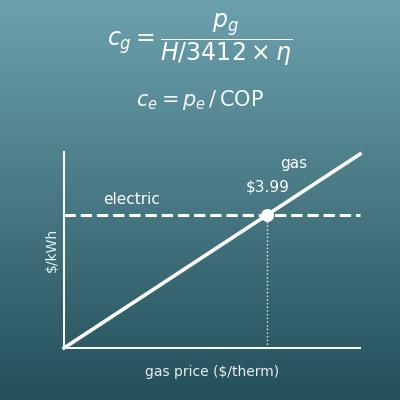
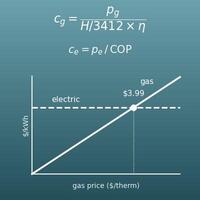
Gas vs Electric Cost Calculator (Cost per Unit of Heat for Water Heating, Cooking and Heating)
Compares the cost of the same amount of heat from natural gas and from electricity, using prices, efficiency and COP