










































































































































































Choose what you want to find, then enter the rise and the slope (or the length you have). Landings, width and price can be left blank.
Table of Contents
-
What you can do on this page
-
What is this calculation used for?
-
How to Use
-
Formulas and figures
-
Symbols and terms
-
Good to know before you start
-
How to calculate it in Excel
-
How to calculate it in Google Sheets
-
How to calculate it in Python
-
How to write it in LaTeX and other math languages (copy and paste)
-
How to have ChatGPT do the calculation
-
DataChef Features
-
Related Features
-
NumberChef Calculators List
What you can do on this page
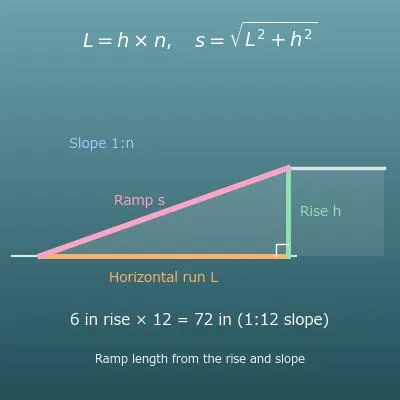
- Enter the rise (the height of the step) and the slope (a ratio such as 1:12 or 1:15, a percent, or an angle), and you get the horizontal run the ramp needs and the length along the slope (the length of the ramp itself)
- Or enter the rise and the length you have room for, and you get the actual slope (1:n, % and degrees) and a table of the length needed at common slopes (1:8, 1:10, 1:12, 1:15 and 1:20)
- When you choose a ready-made threshold ramp (rubber, plastic or aluminum), enter the rise and the length of the product, and you get the slope it will have
- You can also get the total length with landings (the flat parts), the area from the ramp width, and an estimated cost if you enter a price (optional)
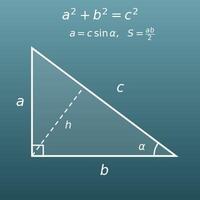
- The page draws the right triangle of rise, run and slope with a line for the slope you compare against. A plain-language explanation of the formulas and copy-and-paste formulas for Excel, Google Sheets and Python are also on this page
What is this calculation used for?
If the porch is 24 in above the ground, a 1:12 ramp needs \(24 \times 12 = 288\) in (24 ft) of horizontal run, and a 1:15 ramp needs 360 in (30 ft). Before you talk to a contractor, you can check whether the yard has that much room, or whether you need a switchback ramp that turns around at a landing.
A person who pushes their own wheelchair needs a gentler slope than one who is pushed, and 1:12 to 1:15 is a common guide, but it also depends on the user's strength and on whether the chair is powered. For a ramp at home, check the local building code and whether a permit is needed.
Threshold ramps are sold by rise, such as "for a 2 in rise, 12 in long". The length ÷ the rise gives \(n\): here \(12 \div 2 = 6\), so the slope is 1:6 (about 9.5°), which is quite steep.
For a small step inside the house, a short product can be fine, but if the wheelchair user pushes on their own, this calculation shows that a longer product is better (a 1:12 slope over the same 2 in rise needs a 24 in long ramp). Follow the maker's listed rise range and weight limit.
If there is a 6 in step from the sidewalk to the door, a 1:12 ramp needs 72 in (6 ft) of horizontal run and a 1:8 ramp needs 48 in (4 ft). Working out first how much room there is in front of the door (without blocking the sidewalk) helps you decide between a permanent ramp and a portable one you set out when needed.
A customer entrance must serve many people, including self-propelled wheelchair users, strollers and older adults, and in the US it falls under the ADA Standards (1:12 or gentler). For existing buildings where space is tight, the ADA allows a steeper slope only for a very small rise (1:10 for a rise of 6 in or less, 1:8 for 3 in or less). Check with a designer or the local building department before building a permanent ramp.
To roll a hand truck or equipment cases over a step at a loading door, people often lay a plywood board or aluminum ramp across it. Lay an 8 ft (96 in) board over a 10 in step and the horizontal run is \(\sqrt{96^{2} - 10^{2}} \approx 95.5\) in, a slope of about 1:9.5 (about 6.0°).
A heavily loaded hand truck takes a lot of force to push up a steep slope, and on the way down it can pull away from you, which is dangerous. For a hand truck pushed by hand, 1:8 to 1:10 is common, and heavy or powered carts need a gentler slope. Also check that the board does not bend too much and is not slippery.
A ramp over a garage or shed step (about 6 to 8 in high) lets you roll a bicycle or motorcycle in and out without lifting it. When a person walks the bike up, slopes of about 1:6 to 1:8 are used. For a 7 in step at 1:8, the horizontal run is 56 in and the board along the slope is about 56.4 in.
The board (the length along the slope) is a little longer than the horizontal run, so check the "length along the slope" on this page before buying lumber. For a heavy motorcycle, the strength of the board and a non-slip surface also matter.
Older dogs and cats, and short-legged breeds, can hurt their joints jumping on and off a sofa, a bed or the back of a car. For an 18 in high sofa with a 1:3 ramp (about 18.4°), the horizontal run is \(18 \times 3 = 54\) in and the board is about 56.9 in long.
How steep a ramp an animal will climb varies, and small or older animals do better with a gentler slope. For the same height, you decide by trying different values of \(n\), balancing "how long can the ramp be" against "how steep will my pet still climb".
Finding the board length from the horizontal run and the rise is exactly the Pythagorean theorem from 8th grade math. Finding "how many degrees is a 1:12 slope" uses \(\tan\) backward (the inverse trig function \(\arctan\)) from high school geometry and precalculus, and it is one of the most familiar places it shows up.
Try connecting the textbook formulas to real measurements, such as a ramp at the front door or a board for moving heavy things.
Formulas and figures
Symbols and terms
Symbols
| \(h\) | aitch | The rise (the difference in height), from the first letter of "height". It is the height the ramp has to climb, such as from the ground to a porch or over a door threshold. |
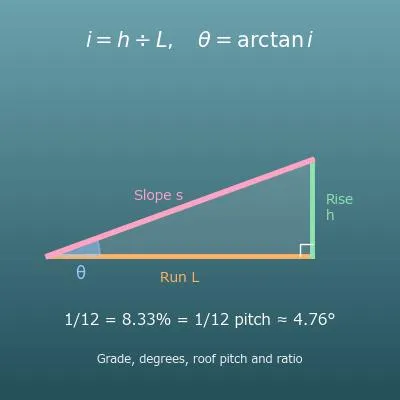
| \(n\) | en | The slope ratio: the \(n\) when the slope is written 1:\(n\). It is a slope that rises 1 for every \(n\) of horizontal run, and \(n = L \div h\) (\(n = 12\) for 1:12). The larger \(n\) is, the gentler the slope. |
| \(L\) | el | The horizontal run. This page uses the first letter of "length". It is the length of the ramp seen from above, from the edge of the step to the end of the ramp, and \(L = h \times n\). |
| \(s\) | ess | The length along the slope (the true length). This page uses the first letter of "slope". It is the length of the ramp board or surface itself, found with \(s = \sqrt{L^{2} + h^{2}}\). |
| \(i\) | eye | The slope as a number (rise ÷ horizontal run), from the first letter of "inclination". \(i = 1/n\), and it has no unit. |
| \(p\) | pee | The percent slope, from the first letter of "percent". \(p = h \div L \times 100\), which is how much the ramp rises for every 100 of horizontal run (1:12 is about 8.33%). |
| \(\theta\) | theta | The angle of the ramp from the horizontal. Theta is the Greek letter often used for angles. It is found with \(\theta = \arctan(h \div L)\) (1:12 is about 4.76°). |
| \(T\) | tee | The total length with landings, from the first letter of "total". \(T = L + d \times m\), the horizontal length the whole ramp takes up. |
| \(d\) | dee | The length of one landing. This page uses the first letter of "depth" (how deep the landing is). |
| \(m\) | em | The number of landings. This page uses it as a count (it is not the unit meter, m). |
| \(w\) | double-u | The ramp width, from the first letter of "width". It is used for the area \(A = s \times w\). |
| \(A\) | ay | The ramp area, from the first letter of "area". It is the length along the slope × the width. |
| \(C\) | see | The estimated cost, from the first letter of "cost". It is the length along the slope (or the area) × the unit price. |
| \(u\) | you | The unit price, from the first letter of "unit price". Enter the price per ft, or per ft². |
| \(\tan\) | tangent | Tangent. In a right triangle it is height ÷ base. The slope \(i\) is exactly \(\tan\theta\). |
| \(\arctan\) | arctangent, inverse tangent (\(\tan^{-1}\)) | The inverse of tangent. It returns the angle whose \(\tan\) is a given value, and is also written \(\tan^{-1}\). It is used to find the angle from the slope. |
| \(\sqrt{\ }\) | square root | Square root: the positive number that gives this number when squared. It is used with the Pythagorean theorem to find the length along the slope (example: \(\sqrt{25} = 5\)). |
| \(\approx\) | approximately equal to | The sign for "approximately equal". It is used when a value that does not come out evenly, such as a square root or an \(\arctan\), is rounded to a decimal. |
Terms
| ramp | A sloped surface that connects two levels instead of steps. It lets wheelchairs, strollers, hand trucks and bicycles get over a step. The gentler the slope, the easier it is to climb, but the more room it needs. |
| rise | The difference in height between two floors or ground levels, such as from the ground to a porch, over a door threshold, or from the sidewalk to a store entrance. This page writes it \(h\). If there are several steps, the rise is the total height from the bottom to the top. |
| slope | How much a surface goes up (or down) for the horizontal distance it covers, found as rise ÷ horizontal run. Ramp slopes are usually written as a ratio such as 1:12 or 1:15, and the same slope can also be shown as a percent (%) or an angle (°). |
| slope ratio | Writing a slope that rises 1 for every \(n\) of horizontal run as 1:\(n\), as in "a 1:12 ramp". The larger \(n\) is, the gentler the slope, and the horizontal run needed is \(n\) times the rise. (Drain pipes are usually given in inches per foot instead, such as 1/4 in per ft.) |
| percent slope | A way of giving a slope as how much it rises for every 100 of horizontal run, also called percent grade. It is rise ÷ horizontal run × 100. 1:12 is about 8.33%, and 1:8 is 12.5%. |
| angle of slope | The angle of the sloped surface from the horizontal. It is the slope shown in degrees (°) and is found with \(\arctan\). Percent slope and angle are not proportional (10% is about 5.7°, but 100% is 45°). |
| horizontal run | The length of the ramp seen from directly above, from the edge of the step to the end of the ramp. How much room the ramp takes up on the site is set by this length. It is always shorter than the length along the slope. |
| length along the slope | The length of the ramp board or surface itself, sometimes called the true length. This is the length you actually need in materials, and it is found from the horizontal run and the rise with the Pythagorean theorem. |
| landing | A flat area at the top, bottom or middle of a ramp or stairs, or where it turns, for resting or changing direction. Its height does not change, so it is not part of the slope calculation; it is added to the horizontal run for the total length. The ADA Standards require landings at least 60 in long. |
| threshold ramp | A ready-made ramp that you simply place over a door threshold, a small step or a store entrance. They are made of rubber, plastic or aluminum, and each size has a set length (the horizontal length when installed) for a certain rise. The length ÷ the rise is the \(n\) of its slope. |
| ADA Standards | The 2010 ADA Standards for Accessible Design, the design rules under the Americans with Disabilities Act. For ramps at public and commercial buildings they require a slope of 1:12 or gentler, no more than 30 in of rise per sloped section, landings at least 60 in long, and a clear width of at least 36 in, among other things. Homes are usually not covered, but many people use the same numbers as a guide. |
| self-propelled | A wheelchair user moving by turning the wheels with their own arms, without a helper pushing. A self-propelled wheelchair needs a gentler slope than one pushed by a helper, so this is a key point when choosing a slope. |
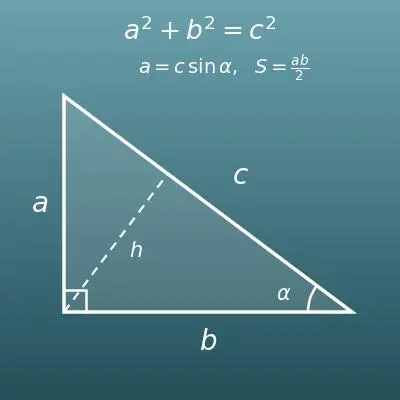
| Pythagorean theorem | The rule that in a right triangle, base squared + height squared = hypotenuse squared. It is used to find the length along the slope from the horizontal run and the rise. |
| arctangent | The inverse of \(\tan\) (\(\arctan\)). It answers "what angle has this value of \(\tan\)?" On a scientific calculator it is the \(\tan^{-1}\) key, and in Excel it is the ATAN function. |
| unit price | The price for one unit of amount, such as per ft or per ft². On this page you can enter a material or installation price, and it is multiplied by the length along the slope or the area to give an estimated cost. |
Good to know before you start
Here is what helps you use the calculation on this page with real understanding, not just by pressing the button.
If you get stuck, going back over these topics is the fastest way forward.
| Ratios and percents (Grade 6) |
|
| Fractions and reciprocals (Grades 5–6) |
|
| Converting units of length (Grades 4–5) |
|
| Square roots (Grade 8) |
|
| Right triangles and the Pythagorean theorem (Grade 8) |
|
| Tangent and inverse tangent (high school Geometry and Precalculus) |
|
How to calculate it in Excel
| Rise h (in) | 6 |
| Slope ratio n (slope 1:n) | 12 |
| Horizontal run needed L (in) | =B1*B2 |
| Rise h (in) | 6 |
| Horizontal run L (in) | 72 |
| Length along the slope s (in) | =SQRT(B2^2+B1^2) |
| Rise h (in) | 12 |
| Horizontal run L (in) | 120 |
| Slope ratio n (slope 1:n) | =B2/B1 |
| Percent slope p (%) | =B1/B2*100 |
| Angle θ (°) | =DEGREES(ATAN(B1/B2)) |
| Horizontal run needed L (in) | 432 |
| Length of one landing d (in) | 60 |
| Number of landings m | 1 |
| Total length T (in) | =B1+B2*B3 |
| Length along the slope s (ft) | 6.021 |
| Ramp width w (ft) | 3 |
| Area A (ft²) | =B1*B2 |
| Unit price u ($ per ft) | 150 |
| Estimated cost C ($) | =B1*B4 |
B3 in the first table shows 72, B3 in the second about 72.25, B3 to B5 in the third 10, 10 and about 5.71, B4 in the fourth 492, and B3 and B5 in the fifth about 18.06 and 903.15.
"SQRT" is the square root and "^2" squares a number. "ATAN" returns the arctangent, and because its answer is in radians, "DEGREES" turns it into degrees.
To use a price "per ft²" in the fifth table, change the formula in B5 to "=B3*B4".
How to calculate it in Google Sheets
| Rise h (in) | 6 |
| Slope ratio n (slope 1:n) | 12 |
| Horizontal run needed L (in) | =B1*B2 |
| Rise h (in) | 6 |
| Horizontal run L (in) | 72 |
| Length along the slope s (in) | =SQRT(B2^2+B1^2) |
| Rise h (in) | 12 |
| Horizontal run L (in) | 120 |
| Slope ratio n (slope 1:n) | =B2/B1 |
| Percent slope p (%) | =B1/B2*100 |
| Angle θ (°) | =DEGREES(ATAN(B1/B2)) |
| Horizontal run needed L (in) | 432 |
| Length of one landing d (in) | 60 |
| Number of landings m | 1 |
| Total length T (in) | =B1+B2*B3 |
| Length along the slope s (ft) | 6.021 |
| Ramp width w (ft) | 3 |
| Area A (ft²) | =B1*B2 |
| Unit price u ($ per ft) | 150 |
| Estimated cost C ($) | =B1*B4 |
How to calculate it in Python
import math

rise = 6           # rise h (in)
denominator = 12   # slope ratio n (slope 1:n)

run = rise * denominator                          # horizontal run needed L (in)
slope = math.sqrt(run ** 2 + rise ** 2)           # length along the slope s (in)
percent = rise / run * 100                        # percent slope (%)
angle_deg = math.degrees(math.atan(rise / run))   # angle (degrees). atan returns radians, so convert to degrees

print(f"Horizontal run needed: {run:.1f} in")
print(f"Length along the slope: {slope:.1f} in")
print(f"Slope: 1:{denominator} = {percent:.2f} % = {angle_deg:.2f} °")

# Going the other way: find the actual slope from the horizontal run you have, and compare it with 1:12
rise2 = 12            # rise (in)
available_run = 120   # horizontal run you have (in)
actual_n = available_run / rise2
target_n = 12
needed_run = rise2 * target_n
print(f"Actual slope: 1:{actual_n:.1f} (1:{target_n} needs {needed_run:.1f} in, difference {available_run - needed_run:.1f} in; negative means short)")

# Total length with landings
landing_len = 60     # length of one landing (in)
landing_count = 1    # number of landings
total = 432 + landing_len * landing_count
print(f"Total length with landings: {total:.1f} in")
How to write it in LaTeX and other math languages (copy and paste)
L = h × n
L = h\,n
<math xmlns="http://www.w3.org/1998/Math/MathML" display="block">
<mrow>
<mi>L</mi>
<mo>=</mo>
<mi>h</mi>
<mo>⁢</mo>
<mi>n</mi>
</mrow>
</math>
L = h n
h*n
L := h*n;
L = h*n;
L = hn
s = √(L² + h²), L = √(s² − h²)
s = \sqrt{L^{2} + h^{2}},\quad L = \sqrt{s^{2} - h^{2}}
<math xmlns="http://www.w3.org/1998/Math/MathML" display="block">
  <mrow>
    <mi>s</mi><mo>=</mo>
    <msqrt><msup><mi>L</mi><mn>2</mn></msup><mo>+</mo><msup><mi>h</mi><mn>2</mn></msup></msqrt>
    <mo>,</mo>
    <mi>L</mi><mo>=</mo>
    <msqrt><msup><mi>s</mi><mn>2</mn></msup><mo>-</mo><msup><mi>h</mi><mn>2</mn></msup></msqrt>
  </mrow>
</math>
s = sqrt(L^2 + h^2), L = sqrt(s^2 - h^2)
{Sqrt[L^2 + h^2], Sqrt[s^2 - h^2]}
s := sqrt(L^2 + h^2); L := sqrt(s^2 - h^2);
s = sqrt(L^2 + h^2); L = sqrt(s^2 - h^2);
s = √(L^2 + h^2), L = √(s^2 − h^2)
n = L ÷ h, p = h ÷ L × 100, θ = arctan(h ÷ L)
n = \frac{L}{h},\quad p = \frac{h}{L} \times 100,\quad \theta = \arctan\frac{h}{L}
<math xmlns="http://www.w3.org/1998/Math/MathML" display="block">
<mrow>
<mi>n</mi><mo>=</mo><mfrac><mi>L</mi><mi>h</mi></mfrac>
<mo>,</mo>
<mi>p</mi><mo>=</mo><mfrac><mi>h</mi><mi>L</mi></mfrac><mo>×</mo><mn>100</mn>
<mo>,</mo>
<mi>θ</mi><mo>=</mo><mi>arctan</mi><mo>⁡</mo><mfrac><mi>h</mi><mi>L</mi></mfrac>
</mrow>
</math>
n = L / h, p = h / L * 100, theta = arctan(h / L)
{L/h, h/L*100, ArcTan[h/L]*180/Pi}
n := L/h; p := h/L*100; theta := arctan(h/L)*180/Pi;
n = L/h; p = h/L*100; theta = atand(h/L);
n = L/h, p = h/L × 100, θ = tan^(-1)(h/L)
T = L + d × m
T = L + d\,m
<math xmlns="http://www.w3.org/1998/Math/MathML" display="block">
<mrow>
<mi>T</mi><mo>=</mo><mi>L</mi><mo>+</mo><mi>d</mi><mo>⁢</mo><mi>m</mi>
</mrow>
</math>
T = L + d m
L + d*m
T := L + d*m;
T = L + d*m;
T = L + dm
A = s × w, C = s × u (or A × u)
A = s\,w,\quad C = s\,u\ (\text{or}\ A\,u)
<math xmlns="http://www.w3.org/1998/Math/MathML" display="block">
<mrow>
<mi>A</mi><mo>=</mo><mi>s</mi><mo>⁢</mo><mi>w</mi>
<mo>,</mo>
<mi>C</mi><mo>=</mo><mi>s</mi><mo>⁢</mo><mi>u</mi>
</mrow>
</math>
A = s w, C = s u
{s*w, s*u}
A := s*w; C := s*u;
A = s*w; C = s*u;
A = sw, C = su
How to have ChatGPT do the calculation
You are an assistant for measurements in accessibility remodeling and outdoor construction. Do the following calculation by actually running Python code, and base your answer only on the numbers from the execution result (do not answer by mental math or guessing).

I am building a ramp over a 6 in rise. The slope will be 1:12.
Find each of the following:
1. The horizontal run needed (rise × slope ratio)
2. The length along the slope (Pythagorean theorem)
3. This slope as a percent and as an angle (use arctan and convert radians to degrees)
4. If I only have 60 in of horizontal run, the actual slope (the n in 1:n) and how much shorter that is than the run needed for 1:12

Show the formulas you used and the numbers from the execution result.
How to Use
-
1Enter your numbersType the numbers you want to calculate with into the input fields
-
2CalculatePress the "Calculate" button
-
3Check the resultThe result appears on the spot. The same page also explains the idea behind the calculation and the formula
DataChef Features

No technical knowledge required.
Intuitive and user-friendly operation.

Can be used without registering personal information.

Automatic file deletion by clicking "download".

and rapid file conversion.

No attribution required.

No need to contact us for commercial use permission.
Related Features
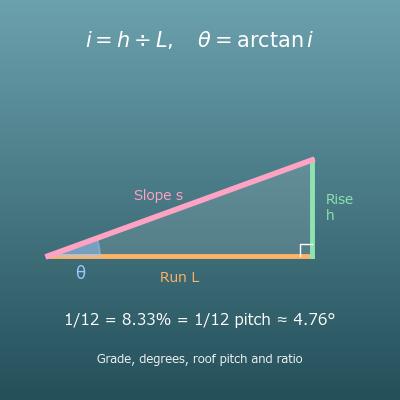
Grade and Slope Calculator (Percent, Degrees, Roof Pitch and Ratio, with Lengths)
To convert a slope between percent, degrees and ratio. Also for drainage and roof pitch

Stair Calculator (Rise, Run, Number of Steps, Stringer Length and Angle)
For the riser height, number of steps and angle when you use stairs instead of a ramp
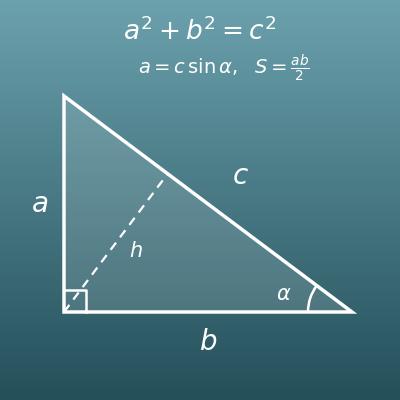
Right Triangle Calculator (Sides, Angles, Area and Height from Any Two Values)
A ramp is a right triangle. Find its sides, angles and area from any two values
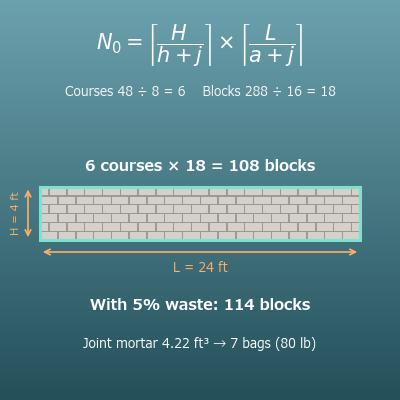
Concrete Block Calculator (Blocks, Mortar Bags and Rebar for a Block Wall)
For the number of blocks and the mortar when you build a block curb or wall along a ramp
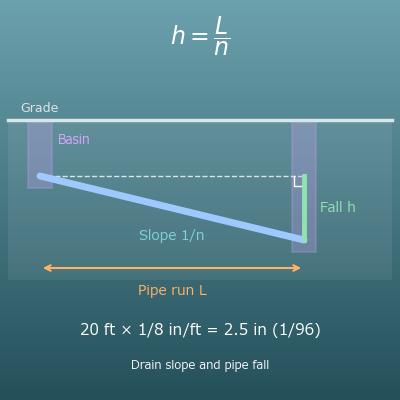
Drain Slope and Pipe Fall Calculator (Inches per Foot, 1/n, Percent)
For the slope that makes water flow in a drain pipe or on a floor (such as 1/4 in per ft) and the drop it needs