Enter the size of the area and the depth, and choose a material. The waste factor and the price can be left blank (then no waste is added and no cost is calculated).
Choosing a material fills in a typical bulk density. If the product label gives values such as "20 kg (about 13 L)", replace it with the value calculated from them (kg ÷ L) for a more accurate result.
Result and figure
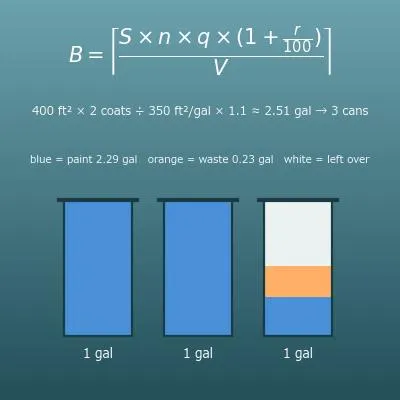
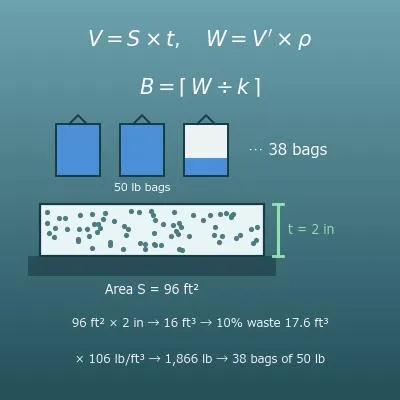
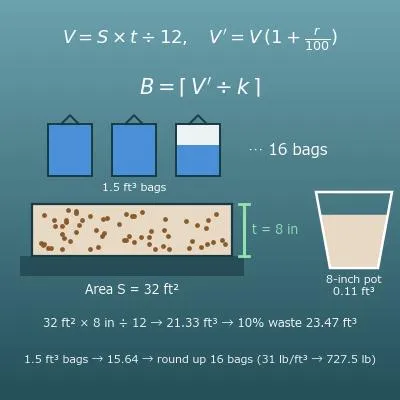
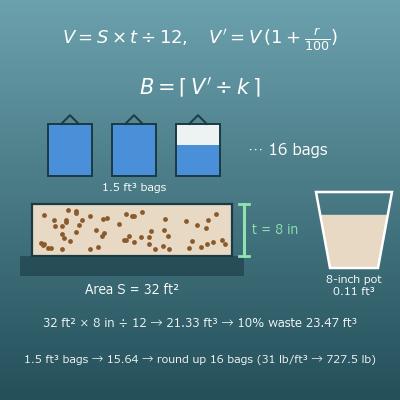
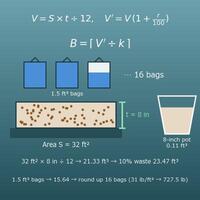
The figure shows a cross section of the layer (depth exaggerated for clarity) and the bags. Blue is the part used, and the white part is what is left in the last bag. The bag shape and size do not match real bags.
Enter the area and the depth on the left and press "Calculate". The result will appear here.
Enter the size of the area (length × width, square feet, or the diameter of a circle) and the depth (in), and you get the volume of gravel or crushed stone you need (ft³ and cubic yards) on the spot
Choose a material (crushed stone, gravel, decorative gravel, lava rock, sand, decomposed granite or topsoil), and a typical bulk density (lb/ft³) is filled in and the weight is shown in pounds and tons. You can change the bulk density yourself
Enter the bag size, such as a 50 lb bag or a 0.5 ft³ bag, and you get the number of bags (rounded up), the total amount you buy and how much is left over
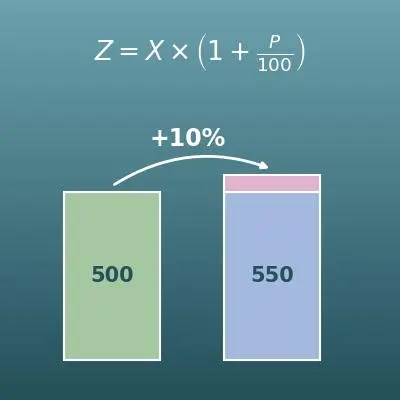
You can enter a waste factor (%) for settling, compaction and uneven spreading. The formula "amount needed = net amount × (1 + waste factor)" shows why you buy a little extra
You can also work backward: the area or the depth you can cover with the bags you have. Enter a price (per bag, per ton or per cubic yard) to get the estimated cost. A plain-language explanation of the formulas and copy-and-paste formulas for Excel, Google Sheets and Python are all on this page
The volume, weight and number of bags are estimates. Bulk density changes with the type of stone, the particle size and moisture, and the amount in a bag varies by product, so check against the product label. For concrete, which sets hard, use the "Concrete Calculator". This page is for loose materials that are spread without setting, such as gravel, crushed stone, sand and soil.
What is this calculation used for?
Landscape fabric and decorative gravel around the house
A classic way to stop weeds is landscape fabric covered with 2–3 in of decorative gravel. For example, spreading marble chips (bulk density 94 lb/ft³) 2 in deep along a 3 ft × 30 ft strip beside the house (90 ft²) gives a net volume of \(90 \times 2 \div 12 = 15\) ft³, 16.5 ft³ with a 10% waste factor, and a weight of \(16.5 \times 94 = 1551\) lb. In 50 lb bags that is \(\lceil 1551 \div 50 \rceil = 32\) bags. Too thin and the fabric shows through; too thick and the bags and cost jump. Checking first how many bags one more inch adds helps you plan the trips to the store and the budget.
A crushed stone parking pad or driveway base
For a 10 ft × 20 ft parking pad (200 ft²) with crushed stone (106 lb/ft³) 4 in deep, the net volume is about 66.7 ft³. With a 15% waste factor for compaction, that is about 76.7 ft³, or about 2.84 cubic yards, weighing about 8,127 lb (about 4.06 tons). In 50 lb bags that would be 163 bags, so at this size people normally order bulk delivery by the yard or the ton. Suppliers ask "how many yards?", so you can give them the cubic yard figure directly. The volume and weight also tell you how much work it will be to unload and move it with a wheelbarrow.
Lightweight lava rock in a planting bed
Lava rock is much lighter than ordinary gravel, so bags are often labeled by volume, such as "0.5 cu ft", rather than by weight. For a 2 ft × 25 ft bed (50 ft²) 2 in deep, the volume is \(50 \times 2 \div 12 \approx 8.33\) ft³, about 9.17 ft³ with a 10% waste factor, and in 0.5 ft³ bags that is \(\lceil 9.17 \div 0.5 \rceil = 19\) bags. With bags sold by volume, the count is simply "volume ÷ bag size", so you do not even need the bulk density. You only need it when you want the weight, and you can find it from the "about ... lb" on the bag.
Replacing the soil in a flower bed
To fill a round flower bed 4 ft across with topsoil (69 lb/ft³) 8 in deep, the area is \(\pi \times 2^{2} \approx 12.57\) ft², the volume is about 8.38 ft³, the weight is about 578 lb, and in 40 lb bags that is 15 bags. Soils vary a lot in bulk density from bag to bag (topsoil is about 69 lb/ft³, while potting mix is much lighter), so replacing the value with the numbers on the bag ("... cu ft, about ... lb") brings the result closer to reality. If you mix in compost, reduce the soil by that amount.
Checking the quantities on a landscaping estimate
A landscaping estimate may list "crushed stone base, 200 sq ft, 4 in, 3 cu yd". Area × depth gives \(200 \times 4 \div 12 \div 27 \approx 2.47\) cubic yards, so you can ask the contractor whether the difference from 3 cubic yards is a waste factor (about 21% more here) or a thicker base. Once you understand where the quantities come from, you can look at the material cost (quantity × price) separately from labor and delivery, and comparing bids becomes easier. (In real jobs, soil conditions and the amount of compaction can increase the amount needed, so the quantity alone cannot tell you whether the price is fair.)
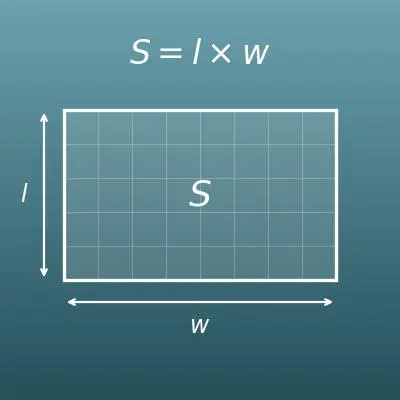
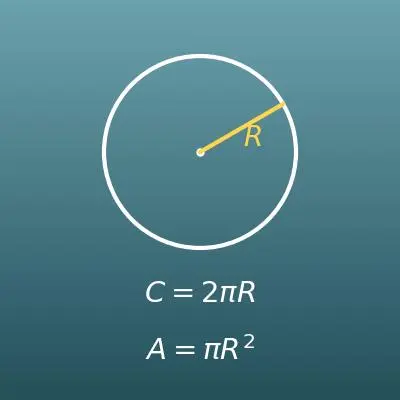
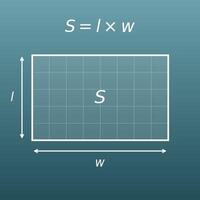
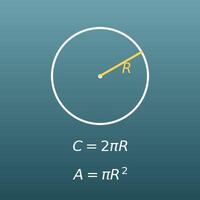
The area, "how much ground you cover", is the starting point for the amount of gravel. For an L-shaped or irregular area, split it into rectangles and add their areas, or enter the square footage from a drawing or estimate with "Enter the area". For a round flower bed or the ground around a pond, measure the diameter: the area is the radius (half the diameter) squared, times pi.
③\(V\): net volume (ft³)
\(=\)
①\(S\): area (ft²)
\(\times\)
②\(t\): depth (in)
\(\div\)
\(12\)
The formula in words
①Multiply the\(S\): area (ft²)
②by the\(t\): depth (in)and divide by 12 to change the depth from inches to feet
③to get the\(V\): net volume (ft³)
Quick example
The net volume of gravel spread 2 in deep over 96 ft² is
\(V\): net volume
\(=\)
area (96 ft²)
\(\times\)
depth (2 in)
\(\div\)
\(12\)
\(96 \times 2 \div 12 = 16\,\mathrm{ft^3}\)
\(16 \div 27 \approx 0.593\,\mathrm{yd^3}\)
Key idea
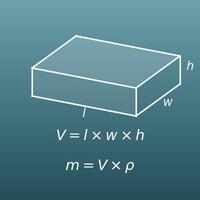
Volume is "area × depth". The area is in square feet but the depth is in inches, so divide the depth by 12 to turn it into feet before multiplying (2 in = 2/12 ft). Bulk gravel is sold by the cubic yard, and 1 yd³ = 3 ft × 3 ft × 3 ft = 27 ft³, so divide cubic feet by 27 to get cubic yards.
This volume is the "net" amount that exactly fills the space. In practice some gravel settles into the ground and compaction shrinks it, so the next formula adds extra.
After gravel or crushed stone is spread, some of it sinks into the ground, and compacting it (by walking on it or with a plate compactor) closes the gaps so the volume shrinks. Uneven spreading and spills also use some up, so the exact net amount usually falls short. That is why estimators buy "net amount × (1 + waste factor)", and 10–20% extra is common.
Allow more (toward 20%) when spreading directly on soft soil or laying a thick layer that will be compacted, and less (10% or under) when only spreading a thin layer of decorative gravel over landscape fabric. Setting the waste factor to 0 gives the net amount itself.
Converting the amount needed to weight (lb)
Standard notation(the usual math form)
\(W\)
\(=\)
\(V'\)
\(\times\)
\(\rho\)
In words(symbols replaced with words)
③\(W\): weight (lb)
\(=\)
①\(V'\): volume with waste (ft³)
\(\times\)
②\(\rho\): bulk density (lb/ft³)
The formula in words
①Multiply the\(V'\): volume with waste (ft³)
②by the\(\rho\): bulk density (lb/ft³)(pounds per cubic foot times cubic feet gives pounds)
③to get the\(W\): weight (lb)
Quick example
The weight of 17.6 ft³ of crushed stone (bulk density 106 lb/ft³) is
Gravel is sold in pound bags at the store, but a supplier delivers it by the ton or by the cubic yard, so you often need to go back and forth between volume and weight. Bulk density (lb/ft³) is the bridge: it is the weight of 1 ft³ of loose material with its gaps included. It is lower than for solid rock, because there are gaps between the stones.
Typical values are about 106 for crushed stone, 100 for gravel, 94 for decorative gravel, sand and decomposed granite, 69 for topsoil and 37 for lightweight stone such as lava rock, but they change with particle size and moisture. Multiply by 27 to get pounds per cubic yard: crushed stone at 106 lb/ft³ is about 2,862 lb, or about 1.4 tons, per cubic yard. If a bag says "50 lb, 0.5 cu ft", that product's bulk density is 50 ÷ 0.5 = 100 lb/ft³.
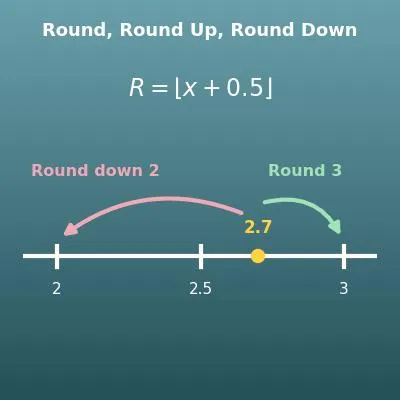
Bags can only be bought whole, so if the division leaves a decimal, always round up (37.312 bags → 38 bags). Rounding to the nearest whole number or rounding down would leave you short. The symbol for this rounding up is \(\lceil\ \rceil\) (the ceiling function). You buy 38 bags × 50 lb = 1,900 lb, so about 1,900 − 1,865.6 = 34.4 lb is left over.
For products sold by volume, such as "0.5 cu ft" bags (common for lightweight stone, mulch and some decorative gravel), divide the volume instead of the weight: 17.6 ft³ ÷ 0.5 ft³ gives \(\lceil 35.2 \rceil = 36\) bags. At this size, a supplier delivering by the cubic yard or ton may be cheaper than bags.
Estimated cost
Standard notation(the usual math form)
In words(symbols replaced with words)
\(T\)
\(=\)
\(u\)
\(\times\)
\(Q\)
③\(T\): estimated cost
\(=\)
①\(u\): unit price
\(\times\)
②\(Q\): quantity
The formula in words
①Multiply the\(u\): unit price (per bag, per ton or per cubic yard)
②by the\(Q\): quantity (bags, tons or cubic yards, to match the price)
③to get the\(T\): estimated cost
Quick example
If you buy 38 bags of crushed stone at $6 per bag, the material cost is
\(T\): estimated cost
\(=\)
unit price ($6 per bag)
\(\times\)
quantity (38 bags)
\(6 \times 38 = 228\)
Key idea
The key is to match the "unit" of the price and the quantity. For a price per bag, multiply by the rounded-up number of bags \(B\); for a price per ton, by the weight with waste \(W\) in tons (lb ÷ 2,000); for a price per cubic yard, by the volume with waste \(V'\) in cubic yards (ft³ ÷ 27). With bags you also pay for the rounded-up part, so for large amounts, bulk delivery by the cubic yard or ton is often cheaper. Landscape fabric, edging, delivery fees and hauling cost extra.
Working backward (area or depth from the bags you have)
Working backward just follows the formulas in reverse. Bags × bag size gives the weight on hand, bulk density turns it back into volume, and removing the waste gives the "usable volume". Then, from "volume = area × depth", choosing a depth gives the area and choosing an area gives the depth.
Use it to check "how far along the walkway will my leftover gravel go?" or "how deep will this many bags be?". For bags sold by volume, bags × bag size (ft³) is the volume on hand directly.
The basic steps for gravel and crushed stone are to find the volume as "area × depth", add a waste factor, convert to weight with the bulk density, and divide by the bag size and round up. Bulk density (lb/ft³) is the bridge between volume and weight, and dividing cubic feet by 27 gives the cubic yards a supplier asks for.
Symbols and terms
Symbols
\(S\)
ess
The area to cover (ft²). Enter it as length × width, directly as an area, or as a circle (from its diameter). It is a common letter for area, said to come from "square" or "surface".
\(l\), \(w\)
ell, double-u
The length and width of a rectangle (ft). From the first letters of "length" and "width".
\(d\)
dee
The diameter of a round area (ft). From the first letter of "diameter". The radius is \(d \div 2\).
\(\pi\)
pi
Pi, about 3.14. The area of a circle is radius × radius × pi.
\(t\)
tee
The depth of the gravel layer (in). From the first letter of "thickness". In the formula it is divided by 12 to turn it into feet (2 in = 2/12 ft).
\(V\)
vee
The net volume (ft³). From the first letter of "volume". Found with \(V = S \times t \div 12\). 1 yd³ = 27 ft³.
\(r\)
ar
The waste factor (%). From the first letter of "rate". It is the extra added to the net amount for settling, compaction and uneven spreading; 10 means 10% more (1.1 times).
\(V'\)
vee prime
The volume with waste (ft³). Found with \(V' = V \times (1 + r \div 100)\). The mark \(\prime\) at the upper right means "a slightly changed version of \(V\)" and is read "prime".
\(\rho\)
rho
The bulk density (lb/ft³). A Greek letter often used for density. For a 50 lb bag that holds 0.5 ft³, it is \(50 \div 0.5 = 100\).
\(W\)
double-u
The weight of the amount needed with waste (lb). From the first letter of "weight". Found with \(W = V' \times \rho\).
\(k\)
kay
The bag size. In lb for bags sold by weight (such as 50 lb bags) and in ft³ for bags sold by volume (such as 0.5 cu ft bags).
\(B\)
bee
The number of bags needed. From the first letter of "bag". Found with \(B = \lceil W \div k \rceil\) (bags by weight) or \(\lceil V' \div k \rceil\) (bags by volume).
\(n\)
en
The number of bags on hand, when working backward. From the first letter of "number".
\(V_{\mathrm{use}}\)
vee sub use
The volume of the gravel on hand that can actually be spread, after removing the waste (ft³).
\(u\)
you
The unit price (per bag, per ton or per cubic yard). From the first letter of "unit price".
\(Q\)
cue
The quantity that matches the unit of the price (bags, weight or volume). From the first letter of "quantity".
\(T\)
tee
The estimated cost (materials only, without delivery, landscape fabric and so on). From the first letter of "total".
\(\lceil x \rceil\)
ceiling of x
The symbol for rounding up to a whole number. (Example - \(\lceil 37.312 \rceil = 38\), \(\lceil 40 \rceil = 40\))
Terms
bulk density
The weight of loose material per unit volume, gaps between the particles included (lb/ft³, or tons per cubic yard). It is lower than for solid rock. Typical values are about 106 lb/ft³ for crushed stone, 100 for gravel and 37 for lightweight stone such as lava rock. Gravel is roughly 1.4 tons per cubic yard.
specific gravity
How many times heavier a material is than the same volume of water. Water is 1 (about 62.4 lb/ft³). Solid rock is about 2.6–2.7, but loose gravel is much lighter per cubic foot because of the gaps between the stones.
cubic yard
The volume of a cube 3 ft on each side. It is the unit for ordering gravel, crushed stone and ready-mix concrete by the truckload, often just called a "yard". 1 yd³ = 27 ft³ (about 0.765 m³).
compaction
Firming up spread gravel or crushed stone by walking on it or pressing it with a plate compactor. The gaps between the particles close up and the volume shrinks, so extra material is prepared for it.
waste factor
The percentage added to the net amount for settling, compaction, uneven spreading and spills. 10–20% is common.
crushed stone
Angular stone made by crushing rock in a machine. The corners lock together and pack down well, so it is used for driveways and as a base under slabs and pavers. Crusher run is stone mixed with fine particles;
decorative gravel
Gravel spread in the yard or around the entrance for its looks, such as marble chips, river rock and colored stone. It is often spread 2–3 in deep over landscape fabric.
lava rock
A light, porous volcanic stone used in landscaping. Its bulk density is much lower than ordinary gravel, so it is often sold by volume (cu ft) rather than by weight.
decomposed granite
Granite that has weathered into small sandy particles (often called DG). It drains well and is used for paths, patios and as a base in the yard.
rounding up
If there is any decimal part, the number goes up to the next whole number. Bags can only be bought whole, so the number of bags is always rounded up.
pi
The number of times the diameter goes into the circumference of a circle, about 3.14. The area of a circle is radius × radius × pi.
Good to know before you start
Here is what helps you use the calculation on this page with real understanding, not just by pressing the button.
Area of rectangles and circles (Grades 3–7)
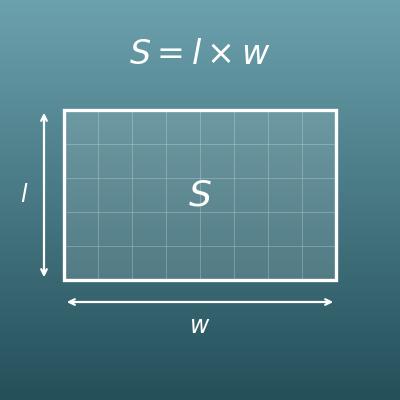
Knowing that the area of a rectangle is "length × width"
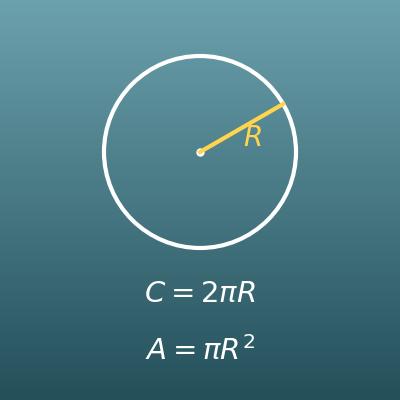
Knowing that the area of a circle is "radius × radius × pi (about 3.14)". If you only know the diameter, halve it to get the radius
Volume of a rectangular prism (Grade 5)
Knowing that volume is "base area × height". On this page, that is "area × depth"
Converting units of length and volume (Grades 4–6)
Knowing that 1 ft = 12 in, and being able to turn a depth of 2 in into 2/12 ft
Knowing that 1 yd³ = 27 ft³ (a cube 3 ft on each side holds 3 × 3 × 3 = 27 cubes 1 ft on each side)
Weight and density (Grades 4–8)
Knowing that 1 US ton = 2,000 lb
Knowing that multiplying a density such as "pounds per cubic foot" (bulk density) by the volume gives the weight
Percentages (Grade 6)
Knowing that "10% more" can be calculated as "× 1.1"
Rounding (Grades 3–4)
Knowing the difference between rounding up, rounding down and rounding to the nearest whole number
Being able to explain in your own words why the number of bags is always rounded up
How to calculate it in Excel
Copy the whole table below and paste it into cell A1 in Excel. It works as is.
Table to find the area (rectangle)
Length (ft)
12
Width (ft)
8
Area (ft²)
=B1*B2
Table to find the area (circle)
Circle diameter (ft)
6
Area (ft²)
=PI()*(B1/2)^2
Table to find the net volume of gravel
Area (ft²)
96
Depth (in)
2
Net volume (ft³)
=B1*B2/12
Table to find the volume with waste
Net volume (ft³)
16
Waste factor (%)
10
Volume with waste (ft³)
=B1*(1+B2/100)
Table to find the weight (lb)
Volume with waste (ft³)
17.6
Bulk density (lb/ft³)
106
Weight (lb)
=B1*B2
Table to find the bags needed
Weight (lb)
1865.6
Bag size (lb)
50
Bags needed
=ROUNDUP(B1/B2,0)
Table to find the estimated cost
Unit price ($)
6
Quantity (bags, tons or yd³)
38
Estimated cost ($)
=B1*B2
Table for working backward (area or depth from the bags on hand)
Bags on hand
10
Bag size (lb)
50
Bulk density (lb/ft³)
100
Waste factor (%)
10
Depth (in)
2
Usable volume (ft³)
=B1*B2/B3/(1+B4/100)
Area you can cover (ft²)
=B6/(B5/12)
Area (ft², for finding the depth)
24
Depth you can get (in)
=B6/B8*12
After pasting, the upper cells in column B are your inputs and the last row is calculated automatically. "ROUNDUP(value, 0)" is the function that rounds up to a whole number (it matches ⌈ ⌉ in the formulas). "PI()" is pi. The third table divides the depth in inches by 12 to turn it into feet before multiplying by the area (B3 shows 16). B3 of the fourth table is 17.6, B3 of the fifth table is 1865.6 and B3 of the sixth table is 38 bags. For bags sold by volume, put the volume with waste in ft³ (17.6) in B1 of the sixth table and the bag size in ft³ (0.5) in B2, and you get 36 bags. In the last table, B7 is the area you can cover (about 27.27 ft²) and B9 is "how deep it will be over the area in B8" (about 2.27 in).
How to calculate it in Google Sheets
Copy the whole table below and paste it into cell A1 in Google Sheets. It works as is.
Table to find the area (rectangle)
Length (ft)
12
Width (ft)
8
Area (ft²)
=B1*B2
Table to find the area (circle)
Circle diameter (ft)
6
Area (ft²)
=PI()*(B1/2)^2
Table to find the net volume of gravel
Area (ft²)
96
Depth (in)
2
Net volume (ft³)
=B1*B2/12
Table to find the volume with waste
Net volume (ft³)
16
Waste factor (%)
10
Volume with waste (ft³)
=B1*(1+B2/100)
Table to find the weight (lb)
Volume with waste (ft³)
17.6
Bulk density (lb/ft³)
106
Weight (lb)
=B1*B2
Table to find the bags needed
Weight (lb)
1865.6
Bag size (lb)
50
Bags needed
=ROUNDUP(B1/B2,0)
Table to find the estimated cost
Unit price ($)
6
Quantity (bags, tons or yd³)
38
Estimated cost ($)
=B1*B2
Table for working backward (area or depth from the bags on hand)
Bags on hand
10
Bag size (lb)
50
Bulk density (lb/ft³)
100
Waste factor (%)
10
Depth (in)
2
Usable volume (ft³)
=B1*B2/B3/(1+B4/100)
Area you can cover (ft²)
=B6/(B5/12)
Area (ft², for finding the depth)
24
Depth you can get (in)
=B6/B8*12
The same formulas as in Excel (including the ROUNDUP and PI functions) work as is. Copy the whole table, paste it into cell A1, and replace the numbers in column B with your own.
How to calculate it in Python
import math

length_ft = 12              # length (ft)
width_ft = 8                # width (ft)
depth_in = 2                # depth (in)
density_lb_per_ft3 = 106    # bulk density (lb/ft³). Typical: crushed stone 106, gravel 100, decorative gravel 94, sand 94
waste_percent = 10          # waste factor (%) for settling and compaction. Use 0 for none
bag_lb = 50                 # bag size (lb)
price_per_bag = 6           # price per bag ($)

area_ft2 = length_ft * width_ft                                # area (ft²)
volume_ft3 = area_ft2 * depth_in / 12                          # net volume (ft³). Depth changed to feet
required_ft3 = volume_ft3 * (1 + waste_percent / 100)          # volume with waste (ft³)
weight_lb = required_ft3 * density_lb_per_ft3                  # weight (lb)
bags_needed = math.ceil(weight_lb / bag_lb)                    # bags needed (rounded up)
cost = bags_needed * price_per_bag                             # estimated cost ($)

print(f"Area: {area_ft2} ft²")
print(f"Net volume: {volume_ft3} ft³ ({volume_ft3 / 27:.3f} yd³)")
print(f"Volume with waste: {required_ft3:.2f} ft³ ({required_ft3 / 27:.3f} yd³)")
print(f"Weight: {weight_lb:.1f} lb ({weight_lb / 2000:.3f} tons)")
print(f"Bags needed: {bags_needed}")
print(f"Estimated cost: ${cost:,.2f}")

# Working backward: area you can cover with the bags on hand (depth 2 in, gravel 100 lb/ft³, 10% waste)
have_bags = 10
usable_ft3 = have_bags * bag_lb / 100 / (1 + 10 / 100)
coverable_area_ft2 = usable_ft3 / (2 / 12)
print(f"Area {have_bags} bags of {bag_lb} lb cover at 2 in deep: {coverable_area_ft2:.2f} ft²")
Runs with the standard library only. math.ceil() rounds up (the ⌈ ⌉ in the formulas). Replace the sizes, bulk density and bag size at the top with your own numbers and run it. For bags sold by volume, divide required_ft3 by the bag size in ft³ instead of weight_lb.
How to write it in LaTeX and other math languages (copy and paste)
Area to cover (rectangle and circle)
S = l × w, S = π × (d ÷ 2)²
S = l \times w,\quad S = \pi \left(\frac{d}{2}\right)^{2}
You are a quantity calculation assistant for landscaping. Do the following calculation by actually running Python code, and base your answer only on the numbers from the execution result (do not answer by mental math or guessing).

I am spreading crushed stone (bulk density 106 lb/ft³) 2 in deep over a 12 ft × 8 ft area. I allow a 10% waste factor for settling and compaction.
Find each of the following:
1. The area (ft²)
2. The net volume (ft³ and cubic yards) and the volume with a 10% waste factor (ft³ and cubic yards)
3. The weight of the volume with waste, using the bulk density (lb and US tons)
4. The number of 50 lb bags needed (rounded up), the total amount bought (bags × 50 lb) and the amount left over
5. If I have only ten 50 lb bags of the same stone, the area I can cover 2 in deep with a 10% waste factor (ft²)

Show the formulas you used and the numbers from the execution result.
How to Use
1
Enter your numbers
Type the numbers you want to calculate with into the input fields
2
Calculate
Press the "Calculate" button
3
Check the result
The result appears on the spot. The same page also explains the idea behind the calculation and the formula
DataChef Features
Easy and Free
Unlimited conversions for free.
No technical knowledge required.
Intuitive and user-friendly operation.
No Registration Required
Available immediately after access.
Can be used without registering personal information.
Safe and Secure
Fully SSL encrypted communication.
Automatic file deletion by clicking "download".
Fast
High-speed site access
and rapid file conversion.
No Watermark
No watermark.
No attribution required.
Commercial Use Available
Free for commercial use.
No need to contact us for commercial use permission.
Related Features
Concrete Calculator (Cubic Yards, Weight and Bags)
Find the volume, weight and number of bags of concrete, which sets hard, rather than a loose gravel base
Area of a Rectangle Calculator (Length × Width)
When the area is made of several rectangles, find each area as length × width
Circle Calculator (Radius, Diameter, Circumference and Area)
Find the area of a circle, such as a round flower bed or the ground around a pond, from its radius or diameter
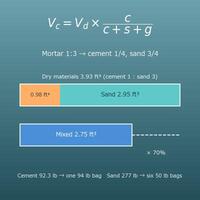
Mortar and Concrete Mix Calculator (Cement, Sand, Gravel, Water and Bags)
Find the amounts of cement, sand, gravel and water when gravel is used as aggregate in a mix
Soil Calculator for Beds, Planters and Pots (Cubic Feet, Cubic Yards, Pounds and Bags)
Find how much soil, sand or potting mix you need for beds, planters and pots, in volume, weight and bags
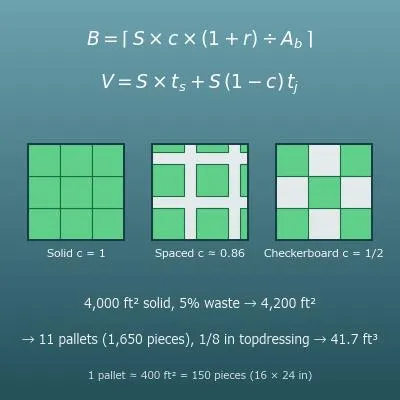
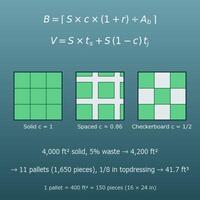
Sod Calculator (Square Feet, Pallets and Topdressing)
Also for yard projects. Find the sod pieces and the topdressing you need from the area to be covered
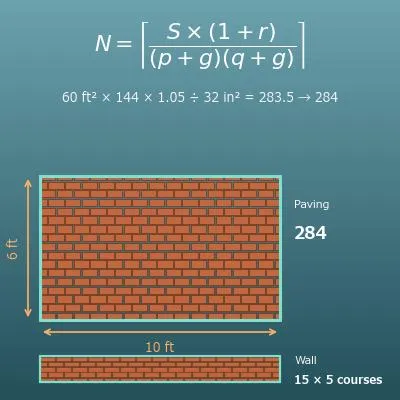
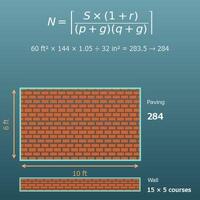
Brick Calculator (Patios, Paths, Garden Edges and Low Walls)
Find the number of bricks, including joints, for a path next to the gravel or the edge of a flower bed
Drain Slope and Pipe Fall Calculator (Inches per Foot, 1/n, Percent)
Find the drop and burial depth of an outdoor drain pipe from its length and slope