Enter the starting amount, deposit each period, number of periods and rate. The calculator finds how much money now plus regular deposits grows to with compound interest (the future value). For a starting amount only, enter 0 for the deposit; for deposits only, enter 0 for the starting amount.
Table of Contents
-
What you can do on this page
-
What is this calculation used for?
-
How to Use
-
Formulas and graphs
-
Symbols and terms
-
Good to know before you start
-
How to calculate it in Excel
-
How to calculate it in Google Sheets
-
How to calculate it in Python
-
How to write it in LaTeX and other math languages (copy and paste)
-
How to have ChatGPT do the calculation
-
DataChef Features
-
Related Features
-
NumberChef Calculators List
What you can do on this page
- Enter a starting amount, a deposit each period, the number of periods and the rate, and see how much the money grows to with compound interest (the future value \(FV\))
- The future value is also broken down into the starting amount, total deposits and total interest, with the share (%) of each. Deposits at the end or the beginning of each period and negative rates (money shrinking each period, for example from fees) are supported, and a period-by-period table appears when the number of periods is a whole number up to 20
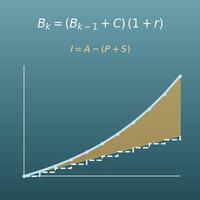
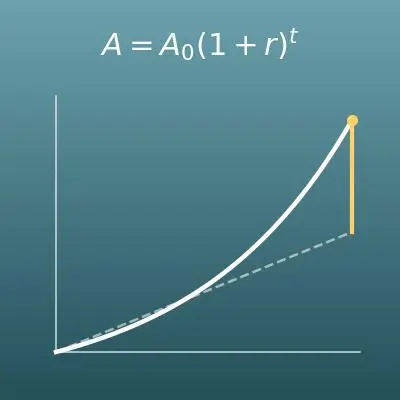
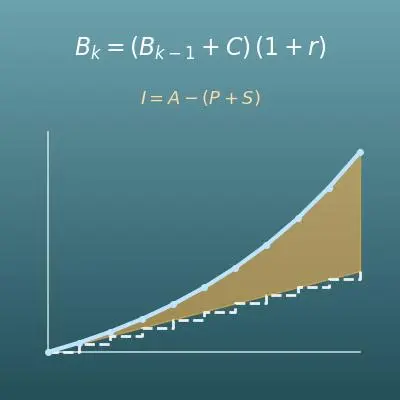
- A graph shows your money growing into the future. The gap between the balance and the line for starting amount + deposits is the interest (save as PNG or SVG)
- All amounts on this page are entered as positive numbers. There is no financial-calculator sign convention (money out is negative), so it is easy even the first time
- A plain-language explanation of the formulas and copy-and-paste formulas for Excel (FV function), Google Sheets and Python are all on this page
What is this calculation used for?
Suppose you save $500 a month for 30 years (360 months) and it earns 0.25% a month (about 3% a year). The future value is about $291,368. You put in $180,000, so about $111,368 is interest.
Seeing "how much a month, for how many years, at what rate, gives how much" in numbers is the starting point for planning retirement savings, such as in a 401(k) or an IRA. Real investments do not earn a fixed rate, can lose money, and have fees and taxes, so treat this number as a guide that assumes the rate stays the same.
Suppose you save $100 a month from a child's birth for 18 years (216 months). At 0% you have exactly what you put in, $21,600; at about 1% a year (about 0.083% a month) you have about $23,655.
You can try different amounts, time periods and rates to see how much you can have by the time college starts. Many families set up automatic monthly deposits into a 529 college savings plan, and running the numbers a few times makes planning easier.
A well-known rule of thumb says that the number of years for money to double with compound interest is about 72 ÷ the rate (%). At 6% a year, 72 ÷ 6 = about 12 years. Try it on this page with a starting amount only (deposit $0), a 6% rate and 12 periods: the growth factor is \(1.06^{12} \approx 2.01\), so the money really does almost double.
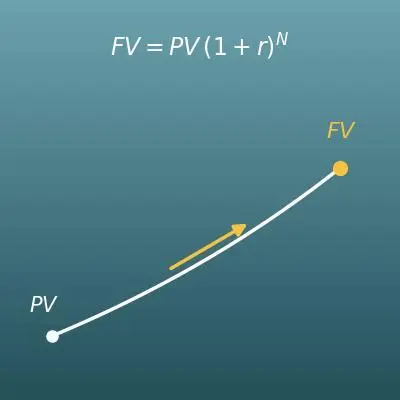
The future value formula \(FV = PV(1+r)^N\) is the calculation behind this rule. Change the rate and check how many years it takes to double, and you will feel the power of compounding.
The same formula works for money that shrinks, not just money that grows. For example, if fees or falling prices take away 3% a year, $2,000 becomes about $1,567 after 8 years (a total "interest" of about −$433), less than you put in.
The same negative-rate calculation also gives a rough idea of how much cash loses in real value when prices rise every year (inflation). The negative rate here is only an assumption; real fee rates and inflation rates differ by product and by year.
Suppose you put $10,000 in a 5-year CD (certificate of deposit) with a 4% APY. Because the APY already includes compounding, you can calculate it as 5 yearly periods at 4%: the value at maturity is about $12,166.53, so about $2,166.53 is interest before tax.
Quickly checking "how much will I actually have?" from an advertised rate is a practical use of this calculation. The interest is taxable income, and early withdrawal penalties may apply, so check the exact terms with your bank.
Formulas and graphs
Symbols and terms
Symbols
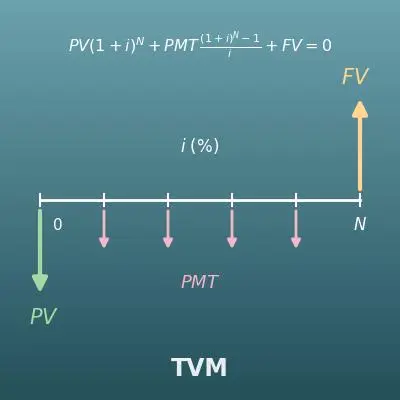
| \(FV\) | F V | Future value. How much money now plus regular deposits will be after \(N\) periods, including interest. This is the value this page finds. |
| \(PV\) | P V | Present value. On this page you enter it as the starting amount, the money you have at the start. |
| \(PMT\) | payment | The deposit each period. The amount you add (pay in) every period. |
| \(N\) | N | The number of periods that earn interest. With interest once a year it equals the number of years: 10 years is \(N = 10\). |
| \(I/Y\) | I over Y | The interest rate per period in % (the name comes from the "interest per year" key on a financial calculator). With interest once a year it is the annual rate itself. |
| \(r\) | r | The interest rate per period as a decimal. For 6%, \(r = 0.06\) (\(I/Y \div 100\)). |
| \((1+r)^N\) | one plus r to the N | How many times money grows in \(N\) periods. At 6% a year for 10 years, it is \(1.06^{10} \approx 1.79\) times. Future value multiplies the starting amount by this factor. |
Terms
| future value | How much money now, or regular savings, will be worth in the future, including interest. For example, at 2% a year, $10,000 today has a future value of $10,200 one year from now. |
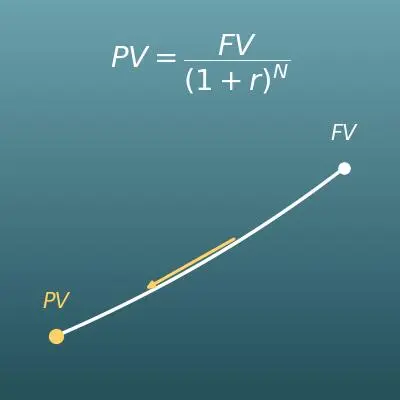
| present value | What future money is worth in today's money. It is the exact counterpart of future value, and you can find it on the sister page "Present Value Calculator". |
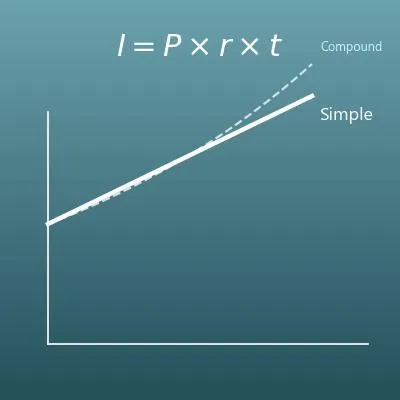
| compound interest | Interest that also earns interest. The \((1+r)^N\) in the future value formula is this compound growth factor, and it snowballs as the number of periods grows. |
| principal | The money that earns interest. On this page, the principal is the starting amount plus the total deposits. |
| interest | The growth you get from saving or investing money. On this page, the total interest is future value − starting amount − total deposits. |
| annuity | In math and finance, a stream of equal payments made (or received) every period. Not only pensions, but also monthly savings deposits have this form. |
| future value annuity factor | The multiple \(\dfrac{(1+r)^{N}-1}{r}\): how much $1 deposited every period grows to. In engineering economics it is the F/A factor, one of the six standard interest factors. You multiply it by the deposit each period. |
| ordinary annuity | Deposits made at the end of each period. Most savings plans work this way. |
| annuity due | Deposits made at the beginning of each period. Each deposit goes in one period earlier than in an ordinary annuity, so the future value is \((1+r)\) times larger. |
| rule of 72 | A rule of thumb: the number of years for money to double with compound interest is about 72 ÷ the rate (%). At 6% a year it is about 12 years (in fact \(1.06^{12} \approx 2.01\) times). |
| loss of principal | When fees or falling prices leave you with less money than you put in. On this page, entering a negative rate shows the money shrinking below what you put in. |
Good to know before you start
Here is what helps you use the calculation on this page with real understanding, not just by pressing the button.
| Percents (Grades 6–7) |
|
| Exponents (Grades 6–8) |
|
| Basics of compound interest ("Compound Interest Calculator" on this site) |
|
| Sum of a geometric sequence (Algebra 2 and precalculus, advanced) |
|
How to calculate it in Excel
| Rate per period (6% = 0.06) | 0.06 |
| Number of periods N | 10 |
| Deposit each period PMT | 100 |
| Starting amount PV | 1000 |
| Future value FV | =-FV(B1,B2,B3,B4,0) |
| Rate per period (6% = 0.06) | 0.06 |
| Number of periods N | 1 |
| Starting amount PV | 10 |
| Future value FV | =-FV(B1,B2,0,B3) |
| Rate per period (5% = 0.05) | 0.05 |
| Number of periods N | 5 |
| Deposit each period PMT | 200 |
| Future value FV | =-FV(B1,B2,B3,0,1) |
The FV function follows the financial-calculator sign convention (if you enter the money you pay in as positive, the answer is negative), so put a minus sign in front, "=-FV(...)", to get the same positive amount as this page.
The first table shows 3,108.93 in B5, the second 10.60 in B4, and the third 1,160.38 in B4. The last argument is the deposit timing: 0 or omitted = end of period, 1 = beginning of period.
How to calculate it in Google Sheets
| Rate per period (6% = 0.06) | 0.06 |
| Number of periods N | 10 |
| Deposit each period PMT | 100 |
| Starting amount PV | 1000 |
| Future value FV | =-FV(B1,B2,B3,B4,0) |
| Rate per period (6% = 0.06) | 0.06 |
| Number of periods N | 1 |
| Starting amount PV | 10 |
| Future value FV | =-FV(B1,B2,0,B3) |
| Rate per period (5% = 0.05) | 0.05 |
| Number of periods N | 5 |
| Deposit each period PMT | 200 |
| Future value FV | =-FV(B1,B2,B3,0,1) |
How to calculate it in Python
starting_amount = 1000    # starting amount PV ($)
payment = 100             # deposit each period PMT ($)
periods = 10              # number of periods N
rate_percent = 6          # rate per period I/Y (%)
is_beginning = False      # True = beginning of period, False = end of period

r = rate_percent / 100

# Future value FV = PV(1+r)^N + PMT[(1+r)^N - 1]/r (beginning of period: deposits x (1+r))
# At a 0% rate there is no interest = PV + PMT x N
if r == 0:
    future_value = starting_amount + payment * periods
else:
    growth = (1 + r) ** periods
    annuity = payment * (growth - 1) / r
    if is_beginning:
        annuity *= (1 + r)
    future_value = starting_amount * growth + annuity

total_deposits = payment * periods
total_interest = future_value - starting_amount - total_deposits
print(f"Future value = {future_value:,.2f}")
print(f"Breakdown: starting amount = {starting_amount:,.2f}")
print(f"Breakdown: total deposits = {total_deposits:,.2f}")
print(f"Breakdown: total interest = {total_interest:,.2f}")
How to write it in LaTeX and other math languages (copy and paste)
FV = PV × (1 + r)ᴺ
FV = PV \cdot (1+r)^{N}
<math xmlns="http://www.w3.org/1998/Math/MathML" display="block">
<mrow>
<mi>FV</mi>
<mo>=</mo>
<mi>PV</mi>
<mo>⋅</mo>
<msup>
<mrow><mo>(</mo><mn>1</mn><mo>+</mo><mi>r</mi><mo>)</mo></mrow>
<mi>N</mi>
</msup>
</mrow>
</math>
FV = PV (1+r)^N
fv = pv (1 + r)^n
fv := pv*(1 + r)^n;
fv = pv*(1 + r)^n;
FV = PV(1+r)^N
FV = PMT × ((1 + r)ᴺ − 1) / r
FV = PMT \cdot \dfrac{(1+r)^{N}-1}{r}
<math xmlns="http://www.w3.org/1998/Math/MathML" display="block">
<mrow>
<mi>FV</mi>
<mo>=</mo>
<mi>PMT</mi>
<mo>⋅</mo>
<mfrac>
<mrow>
<msup>
<mrow><mo>(</mo><mn>1</mn><mo>+</mo><mi>r</mi><mo>)</mo></mrow>
<mi>N</mi>
</msup>
<mo>−</mo>
<mn>1</mn>
</mrow>
<mi>r</mi>
</mfrac>
</mrow>
</math>
FV = PMT ((1+r)^N - 1) / r
fv = pmt ((1 + r)^n - 1)/r
fv := pmt*((1 + r)^n - 1)/r;
fv = pmt*((1 + r)^n - 1)/r;
FV = PMT((1+r)^N-1)/r
FV = PMT × ((1 + r)ᴺ − 1) / r × (1 + r)
FV = PMT \cdot \dfrac{(1+r)^{N}-1}{r} \cdot (1+r)
<math xmlns="http://www.w3.org/1998/Math/MathML" display="block">
<mrow>
<mi>FV</mi>
<mo>=</mo>
<mi>PMT</mi>
<mo>⋅</mo>
<mfrac>
<mrow>
<msup>
<mrow><mo>(</mo><mn>1</mn><mo>+</mo><mi>r</mi><mo>)</mo></mrow>
<mi>N</mi>
</msup>
<mo>−</mo>
<mn>1</mn>
</mrow>
<mi>r</mi>
</mfrac>
<mo>⋅</mo>
<mrow><mo>(</mo><mn>1</mn><mo>+</mo><mi>r</mi><mo>)</mo></mrow>
</mrow>
</math>
FV = PMT ((1+r)^N - 1) / r * (1+r)
fv = pmt ((1 + r)^n - 1)/r (1 + r)
fv := pmt*((1 + r)^n - 1)/r*(1 + r);
fv = pmt*((1 + r)^n - 1)/r*(1 + r);
FV = PMT((1+r)^N-1)/r (1+r)
FV = PV + PMT × N
FV = PV + PMT \cdot N
<math xmlns="http://www.w3.org/1998/Math/MathML" display="block">
<mrow>
<mi>FV</mi>
<mo>=</mo>
<mi>PV</mi>
<mo>+</mo>
<mi>PMT</mi>
<mo>⋅</mo>
<mi>N</mi>
</mrow>
</math>
FV = PV + PMT N
fv = pv + pmt n
fv := pv + pmt*n;
fv = pv + pmt*n;
FV = PV + PMT N
How to have ChatGPT do the calculation
You are a future value calculation assistant. Do the following calculation by actually running Python code, and base your answer only on the numbers from the execution result (do not answer by mental math or guessing).

The rate is a constant 6% per period (r = 0.06), and deposits are made at the end of each period.
Find each of the following:
1. The future value of a $1,000 starting amount invested for 10 years, plus $100 deposited every year: FV = PV(1+r)^N + PMT × ((1+r)^N − 1) / r
2. Its breakdown (starting amount, total deposits PMT×N, total interest FV − PV − PMT×N)
3. The future value of the $1,000 starting amount alone, invested for 10 years with no deposits: FV = PV(1+r)^N

Show the formulas you used and the numbers from the execution result.
How to Use
-
1Enter your numbersType the numbers you want to calculate with into the input fields
-
2CalculatePress the "Calculate" button
-
3Check the resultThe result appears on the spot. The same page also explains the idea behind the calculation and the formula
DataChef Features

No technical knowledge required.
Intuitive and user-friendly operation.

Can be used without registering personal information.

Automatic file deletion by clicking "download".

and rapid file conversion.

No attribution required.

No need to contact us for commercial use permission.
Related Features
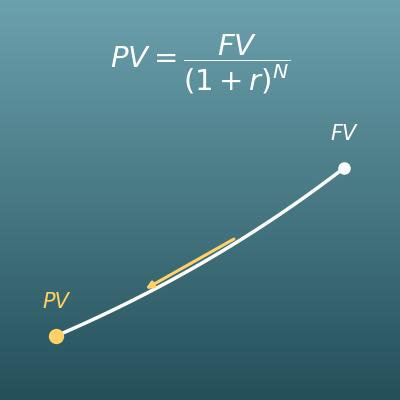
Present Value Calculator (Discounting and Present Value of an Annuity)
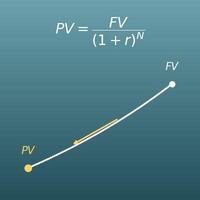
The mirror image of this page. Uses discounting to find what future money is worth today
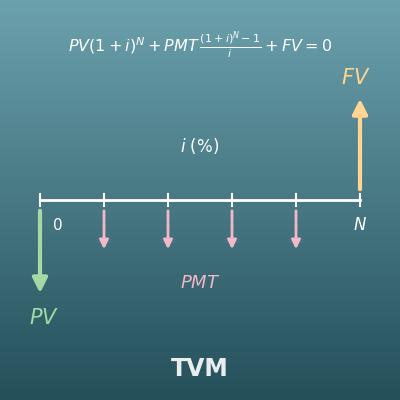
TVM Calculator (Time Value of Money Finance Calculator)
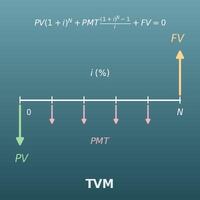
The all-in-one version that solves any of N, I/Y, PV, PMT and FV. It uses the same sign convention as a financial calculator
Interest Calculator (Savings Growth with Regular Contributions)
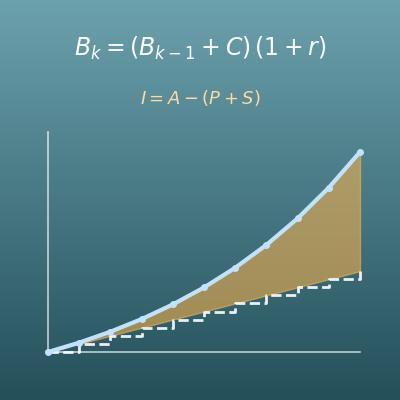
The same "starting amount + deposits" calculation, plus compounding frequency, tax on interest and inflation