

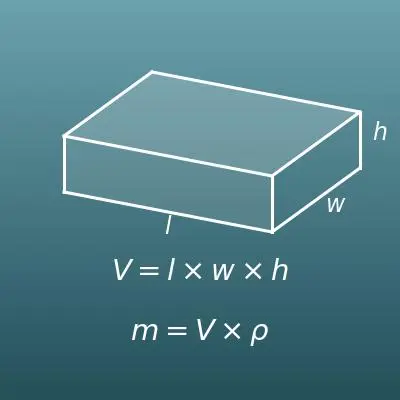
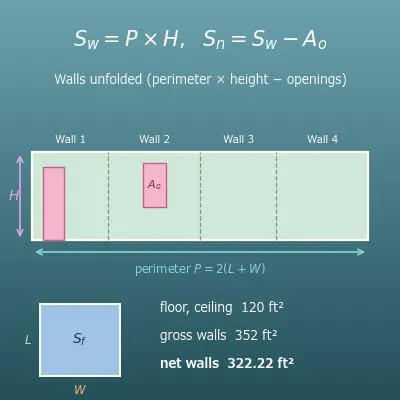
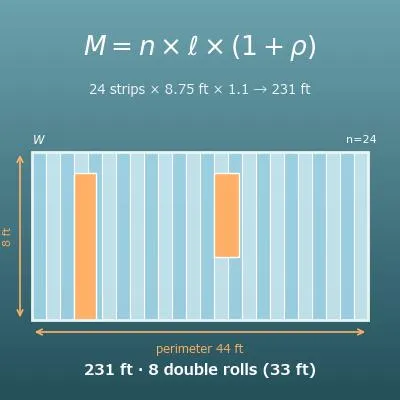
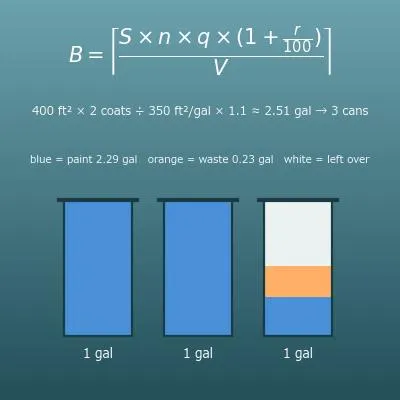
Choose the shape of the space, enter its size and depth, and choose the material. The waste factor and the price can be left blank (then no waste is added and no cost is calculated).
Table of Contents
-
What you can do on this page
-
What is this calculation used for?
-
How to Use
-
Formulas and figures
-
Symbols and terms
-
Good to know before you start
-
How to calculate it in Excel
-
How to calculate it in Google Sheets
-
How to calculate it in Python
-
How to write it in LaTeX and other math languages (copy and paste)
-
How to have ChatGPT do the calculation
-
DataChef Features
-
Related Features
-
NumberChef Calculators List
What you can do on this page
- Enter the size of a bed or garden (length × width, a total area, or the diameter of a round bed) and the depth in inches, and you get the amount of soil, sand or potting mix you need in cubic feet and cubic yards on the spot
- For planters (inside length × width × depth) and pots (choose a pot size to fill in typical top and bottom diameters and depth), you get the soil per container and the total for several
- Choose the material (potting mix, topsoil, akadama, kanuma, leaf mold, decomposed granite, river sand, fill sand or lawn topdressing) to fill in a typical bulk density (lb/ft³) and convert the amount to pounds. You can change the bulk density yourself
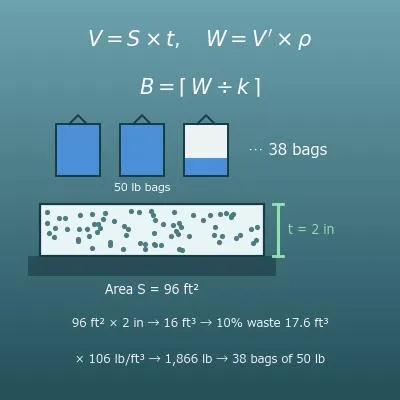
- Enter the bag size, such as 1.5 ft³ or 40 lb, to get the number of bags rounded up, along with the bags before rounding, the amount you buy and the amount left over. A waste factor (%) for settling after watering and for compaction follows "amount needed = net amount × (1 + waste factor)"
- You can also work backward: "what area will my bags cover", "how deep will they fill" and "how many planters or pots will they fill". Enter a price (per bag, ft³, lb or yd³) to get the cost. A plain-language explanation of the formulas and copy-and-paste formulas for Excel, Google Sheets and Python are all on this page
What is this calculation used for?
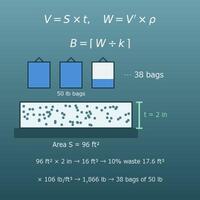
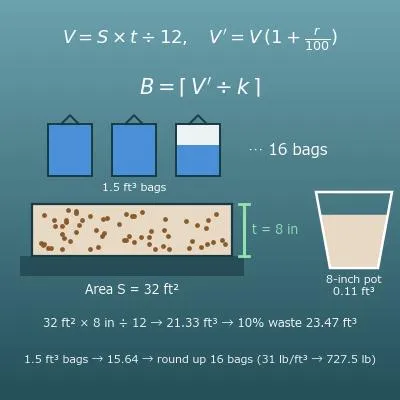
Raised beds are a popular way to grow vegetables, and a 4 ft × 8 ft bed is a classic size. Filled 8 in deep with potting mix, the net amount is \(32 \times 8 \div 12 \approx 21.33\) ft³; with a 10% waste factor it is about 23.47 ft³, or \(\lceil 23.47 \div 1.5 \rceil = 16\) bags of 1.5 ft³.
Each extra inch of depth adds about 2.67 ft³, so decide how deep to fill first, then work out the bags, and you will know how many trips and how much budget you need. That is almost a cubic yard (0.87 yd³), so for several beds, bulk delivery by the cubic yard is often cheaper. If you mix in compost, reduce the potting mix by that amount.
A 24-inch planter may be about 22 in × 8 in inside the rim, but it narrows toward the bottom. Using the size halfway down (20 in × 7 in) and a soil depth of 6 in gives \(20 \times 7 \times 6 \div 1728 \approx 0.486\) ft³ per planter, about half of a 1 ft³ bag. Three planters take about 1.46 ft³, or about 1.53 ft³ with a 5% waste factor, which is 2 bags of 1 ft³ or 2 bags of 1.5 ft³.
Potting mix costs a different amount per cubic foot depending on the bag size, so working out how much each planter needs first helps you choose the bag size and count with the least waste. The weight is shown too, as a guide to how much your balcony can hold or how much you can carry at once.
When repotting houseplants or flowers, people usually move up one or two sizes, and pots are named by the top diameter in inches. A 6-inch pot of standard shape holds about 0.047 ft³ of soil and an 8-inch pot about 0.11 ft³. Repotting four plants into 8-inch pots takes about \(0.113 \times 4 \approx 0.45\) ft³, so one 1 ft³ bag is enough, with about 0.55 ft³ left over.
You can save the leftover for the next repotting. Use the backward mode to check "how many 6-inch pots will one 1 ft³ bag fill" and see how many plants you can repot with the soil you have. The actual soil depends on the pot shape and any drainage layer, so treat the values from the pot size as a guide and use your own measurements if you have them.
Lawns are topdressed once or twice a year with a thin layer of sand or soil to level bumps and protect the roots. The layer is thin, about 1/4 in, but it covers the whole lawn: for 1,000 ft², the net amount is \(1000 \times 0.25 \div 12 \approx 20.83\) ft³ (about 0.77 yd³). At a bulk density of 94 lb/ft³ that is about 1,958 lb, or \(\lceil 1958 \div 50 \rceil = 40\) bags of 50 lb.
"It is so thin, a little will do" often leaves you short. Remember that even 1/4 in takes about 2 ft³ (roughly 200 lb) per 100 ft². Sand is usually sold by weight or by the cubic yard, so the calculation uses bags sold by weight.
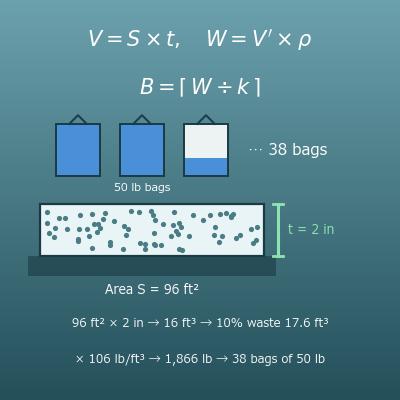
To improve drainage in a yard or to backfill after pipe work or planting a tree, people use decomposed granite, fill sand or fill dirt. Raising a 10 ft × 10 ft area by 4 in takes a net 33.33 ft³; with a 20% waste factor for compaction it is 40 ft³ (about 1.48 yd³), weighing about 3,760 lb (nearly 2 tons). That would be 94 bags of 40 lb, so at this scale bulk delivery by the cubic yard is the usual choice.
Suppliers ask "how many yards?", so you can give them the yd³ value directly. To estimate the cost with a price per cubic yard, set the price unit to "per yd³" (delivery fees are extra).
Gardeners often mix their own soil by volume, such as "3 parts potting mix to 1 part compost". If you need 24 ft³ in total, that is \(24 \times \tfrac{3}{4} = 18\) ft³ of potting mix and \(24 \times \tfrac{1}{4} = 6\) ft³ of compost, and each is divided by its own bag size to get the number of bags.
Mix ratios are by volume, so dividing the cubic feet from this page by the ratio gives the amount of each material. Materials differ a lot in weight (leaf mold about 19 lb/ft³, topsoil about 69), so measure by volume, not by weight.
A landscaping quote may list "topsoil, 243 sq ft at 4 in, 3 cu yd". Area × depth gives \(243 \times 4 \div 12 \div 27 = 3\) yd³, so you can ask the contractor whether any difference from the quoted amount is a waste factor or a deeper layer.
Knowing where the quantities come from lets you separate the material cost (quantity × unit price) from labor and hauling, and makes comparing quotes easier (in a real job, soil conditions and how much it is compacted can increase the amount needed, so the quantity alone does not tell you whether the price is fair).
Formulas and figures
Symbols and terms
Symbols
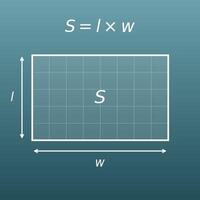
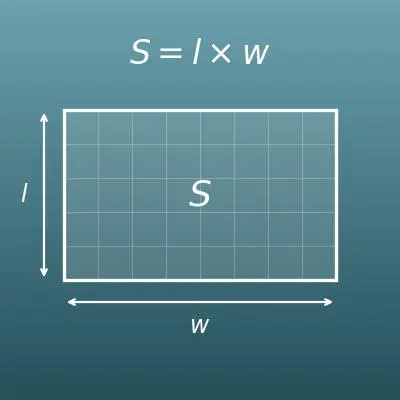
| \(S\) | S | The area of the bed or garden (ft²), set by length × width, a total area or a diameter (for a circle). A common letter for area, said to come from "square" or "surface". |
| \(l\), \(w\) | l, w | The length and width of a rectangle (ft), from "length" and "width". |
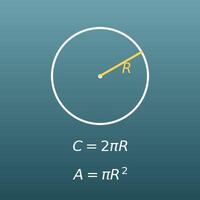
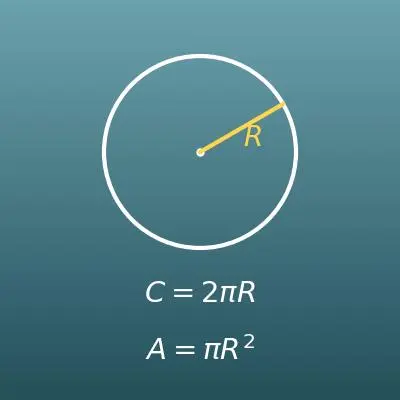
| \(d\) | d | The diameter of a round bed (ft), from "diameter". The radius is \(d \div 2\). |
| \(\pi\) | pi | Pi, about 3.14. It appears in the area of a circle ("radius × radius × pi") and in the volume of a frustum. |
| \(t\) | t | The soil depth (in), from "thickness". For beds, "area × depth ÷ 12" gives cubic feet; for planters and pots, "in³ ÷ 1728" gives cubic feet. |
| \(V\) | V | The net amount (ft³), from "volume". For beds, \(V = S \times t \div 12\); for planters and pots, \(V = V_1 \times\) number of containers. 27 ft³ = 1 yd³. |
| \(a\), \(b\) | a, b | The inside length and width of a planter (in), measured inside where the soil goes. |
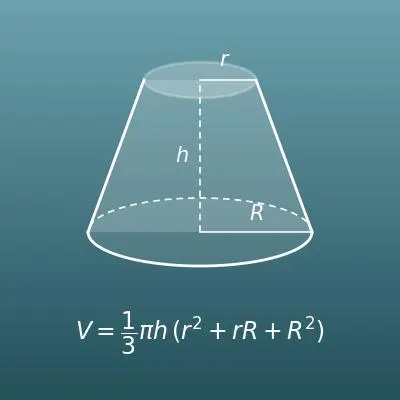
| \(R\) | R | Half the top diameter of a pot (the inside diameter at the rim), which is the top radius (in), from "radius". |
| \(R_{\mathrm{b}}\) | R sub b | Half the bottom diameter of a pot, which is the bottom radius (in). The b stands for "bottom". For a standard pot, about 65% of \(R\). |
| \(V_1\) | V sub 1 | The soil per planter or pot (ft³). The 1 means "for one container". For a planter, \(a \times b \times t \div 1728\); for a pot, the frustum volume formula. |
| \(r\) | r | The waste factor (%), from "rate". The share added to the net amount for settling, compaction and spills; 10 means 10% more (1.1 times). A different quantity from the pot radius \(R\) (capital). |
| \(V'\) | V prime | The amount with waste (ft³). Found with \(V' = V \times (1 + r \div 100)\). The mark "\(\prime\)" means "a slightly changed version of \(V\)", read "prime". |
| \(\rho\) | rho | The bulk density (lb/ft³), a Greek letter often used for density. If a 1.5 ft³ bag weighs about 40 lb, it is \(40 \div 1.5 \approx 27\). |
| \(W\) | W | The weight of the amount needed with waste (lb), from "weight". Found with \(W = V' \times \rho\). |
| \(k\) | k | The bag size: in ft³ for bags sold by volume (such as 1.5 ft³ bags) or in lb for bags sold by weight (such as 40 lb bags). |
| \(B\) | B | The number of bags needed, from "bag". Found with \(B = \lceil V' \div k \rceil\) (by volume) or \(\lceil W \div k \rceil\) (by weight). |
| \(n\) | n | The number of bags you have, when working backward, from "number". |
| \(V_{\mathrm{use}}\) | V sub use | The part of the soil you have that you can actually use after taking out the waste (ft³). |
| \(N\) | N | The number of planters or pots you can fill, when working backward. Found with \(N = \lfloor V_{\mathrm{use}} \div V_1 \rfloor\). |
| \(u\) | u | The unit price (per bag, ft³, lb or yd³), from "unit price". |
| \(Q\) | Q | The quantity that matches the price unit (bags, volume or weight), from "quantity". |
| \(T\) | T | The estimated cost (materials only, without fertilizer, delivery and so on), from "total". |
| \(\lceil x \rceil\) | ceiling of x | The ceiling function: rounds up to the next whole number. (Examples: \(\lceil 15.64 \rceil = 16\), \(\lceil 16 \rceil = 16\)) |
| \(\lfloor x \rfloor\) | floor of x | The floor function: rounds down to a whole number. (Example: \(\lfloor 21.06 \rfloor = 21\)) Used for "containers it will fill" when working backward. |
Terms
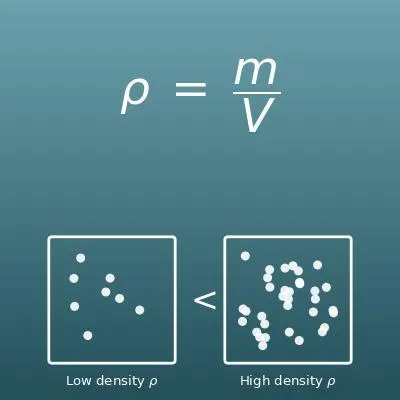
| bulk density | The weight per unit of volume of loose material such as soil, including the gaps and air between the particles (lb/ft³ or kg/L). It is much lower than the density of the mineral particles themselves (about 2.5–2.7 times water). Typical values are about 31 lb/ft³ for potting mix, 44 for akadama and 94 for decomposed granite or sand (about 80–95 dry and 105–110 wet). |
| specific gravity | How many times heavier a material is than the same volume of water. Water is 1, and 1 ft³ of water weighs about 62.4 lb, so a specific gravity of 1 is about 62.4 lb/ft³. |
| cubic yard | The volume of a cube 1 yd (3 ft) on each side, 27 ft³. The unit for ordering topsoil, fill or mulch in bulk by truck. |
| waste factor | The share added to the net amount for settling after watering, compaction and spills (%). 10–20% is common for beds and fill, and 5–10% for planters and pots. |
| potting mix | A ready-to-use mix for containers, usually made of peat or coir, bark, perlite and fertilizer. It is light (about 31 lb/ft³) and sold by volume, such as 1, 1.5 and 2 ft³ bags. |
| topsoil | The dark upper layer of soil, the basic soil for yards and gardens. It holds water well and is used to replace bed soil and as fill. |
| akadama | A granular clay soil from Japan, dried into hard grains. It has no fertilizer and is a basic soil for bonsai, usually mixed with other materials. |
| kanuma | A light, yellowish, granular soil from the Kanuma area of Japan. It drains well and is acidic, and is used for azaleas, rhododendrons, blueberries and bonsai. |
| leaf mold | Decomposed fallen leaves used as a soil amendment. Very light (about 19 lb/ft³), mixed into soil to loosen it. |
| decomposed granite | Granite weathered into sandy, gritty soil (often called DG). It drains well and is used for paths, as a base under yards, for fill, backfill and topdressing. Sold in bags by weight or in bulk by the cubic yard. |
| topdressing | A thin layer (about 1/4 in) of sand or soil spread over a lawn to protect the roots and level bumps. It is thin but covers a large area, so the amount adds up. |
| fill dirt | Soil added on top of the ground to raise it, for example to build up a bed or improve drainage in a yard. Decomposed granite or fill sand is often used, with a larger waste factor for compaction. |
| pot size | How pots are named. In the US, by the top diameter in inches (a 6-inch pot is about 6 in across); in metric countries, by the top diameter in cm. |
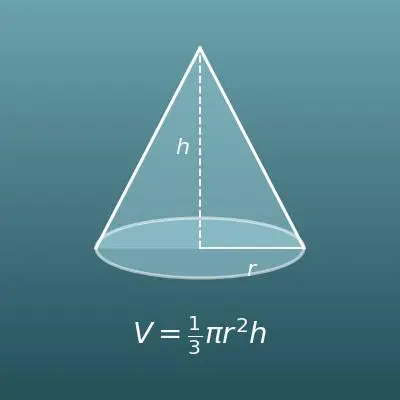
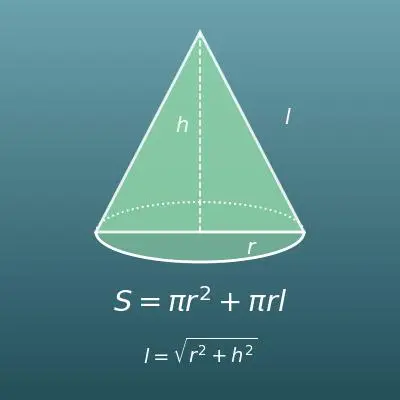
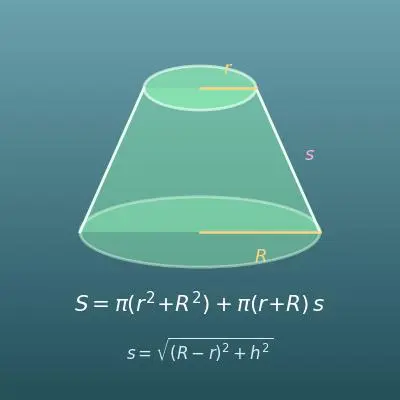
| frustum | A cone with its tip cut off parallel to the base. A pot wider at the top than at the bottom has this shape. Its volume is "pi × height ÷ 3 × (top radius² + top radius × bottom radius + bottom radius²)", found by taking a small cone away from a large one. |
| headspace | The gap of about 1 in left between the rim of a pot and the soil surface, where water collects before it soaks in. The soil depth is shallower than the pot by this amount. |
| drainage layer | Coarse material such as pumice or gravel placed at the bottom of a pot. It takes up room, so there is less soil. Many growers now skip it and use a pot with drainage holes instead. |
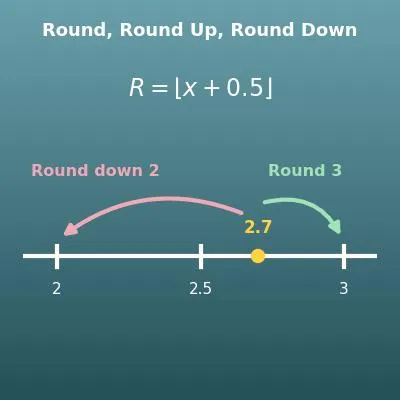
| rounding up | Changing a value with a decimal part to the next whole number. Bags come only whole, so always round up the number of bags. |
| rounding down | Dropping the decimal part to get a whole number. For "how many pots can I fill with the soil I have", the part that is not enough for one more pot is dropped, so round down. |
| pi | The number of times the circumference of a circle goes around its diameter, about 3.14. The area of a circle is "radius × radius × pi". |
Good to know before you start
Here is what helps you use the calculation on this page with real understanding, not just by pressing the button.
| Area of rectangles and circles (Grades 3–7) |
|
| Volume of a rectangular prism (Grade 5) |
|
| Converting units of length and volume (Grades 4–6) |
|
| Volume of cones and frustums (Grade 8 and up) |
|
| Weight and density (Grades 5–8) |
|
| Percentages and ratios (Grades 6–7) |
|
| Rounding (Grades 3–4) |
|
How to calculate it in Excel
| Length (ft) | 8 |
| Width (ft) | 4 |
| Area (ft²) | =B1*B2 |
| Diameter (ft) | 4 |
| Area (ft²) | =PI()*(B1/2)^2 |
| Area (ft²) | 32 |
| Depth (in) | 8 |
| Net amount (ft³) | =B1*B2/12 |
| Inside length (in) | 20 |
| Inside width (in) | 7 |
| Soil depth (in) | 6 |
| Soil per planter (ft³) | =B1*B2*B3/1728 |
| Top diameter (in) | 8 |
| Bottom diameter (in) | 5.2 |
| Soil depth (in) | 5.6 |
| Soil per pot (ft³) | =PI()*B3/3*((B1/2)^2+(B1/2)*(B2/2)+(B2/2)^2)/1728 |
| Net amount (ft³) | 21.33 |
| Waste factor (%) | 10 |
| Amount with waste (ft³) | =B1*(1+B2/100) |
| Amount with waste (ft³) | 23.47 |
| Bulk density (lb/ft³) | 31 |
| Weight (lb) | =B1*B2 |
| Amount with waste (ft³) or weight (lb) | 23.47 |
| Bag size (ft³ or lb) | 1.5 |
| Bags needed | =ROUNDUP(B1/B2,0) |
| Unit price ($) | 12 |
| Quantity (bags, ft³, lb or yd³) | 16 |
| Estimated cost ($) | =B1*B2 |
| Bags you have | 3 |
| Bag size (ft³) | 1.5 |
| Waste factor (%) | 10 |
| Depth (in) | 8 |
| Usable amount (ft³) | =B1*B2/(1+B3/100) |
| Area it will cover (ft²) | =B5/(B4/12) |
| Area (ft², to find the depth) | 32 |
| Depth it will fill (in) | =B5/B7*12 |
| Soil per container (ft³, to find the number) | 0.0475 |
| Containers it will fill | =ROUNDDOWN(B5/B9,0) |
"ROUNDUP(value, 0)" rounds up to a whole number (the ⌈ ⌉ in the formulas), and "ROUNDDOWN(value, 0)" rounds down (the ⌊ ⌋). "PI()" is pi.
The third table turns "ft² × in" into cubic feet with "/12" (B3 shows about 21.33). B4 in the fourth table shows about 0.486, B4 in the fifth about 0.113, B3 in the sixth about 23.46, B3 in the seventh about 727.6 and B3 in the eighth 16 bags.
For bags sold by weight, enter the weight (lb) from the seventh table in B1 of the eighth table, and the pounds per bag in B2.
In the last table, B6 is the area it will cover (about 6.14 ft²), B8 is "how deep it will fill the area in B7" (about 1.53 in), and B10 is "how many containers of the size in B9 it will fill" (86).
How to calculate it in Google Sheets
| Length (ft) | 8 |
| Width (ft) | 4 |
| Area (ft²) | =B1*B2 |
| Diameter (ft) | 4 |
| Area (ft²) | =PI()*(B1/2)^2 |
| Area (ft²) | 32 |
| Depth (in) | 8 |
| Net amount (ft³) | =B1*B2/12 |
| Inside length (in) | 20 |
| Inside width (in) | 7 |
| Soil depth (in) | 6 |
| Soil per planter (ft³) | =B1*B2*B3/1728 |
| Top diameter (in) | 8 |
| Bottom diameter (in) | 5.2 |
| Soil depth (in) | 5.6 |
| Soil per pot (ft³) | =PI()*B3/3*((B1/2)^2+(B1/2)*(B2/2)+(B2/2)^2)/1728 |
| Net amount (ft³) | 21.33 |
| Waste factor (%) | 10 |
| Amount with waste (ft³) | =B1*(1+B2/100) |
| Amount with waste (ft³) | 23.47 |
| Bulk density (lb/ft³) | 31 |
| Weight (lb) | =B1*B2 |
| Amount with waste (ft³) or weight (lb) | 23.47 |
| Bag size (ft³ or lb) | 1.5 |
| Bags needed | =ROUNDUP(B1/B2,0) |
| Unit price ($) | 12 |
| Quantity (bags, ft³, lb or yd³) | 16 |
| Estimated cost ($) | =B1*B2 |
| Bags you have | 3 |
| Bag size (ft³) | 1.5 |
| Waste factor (%) | 10 |
| Depth (in) | 8 |
| Usable amount (ft³) | =B1*B2/(1+B3/100) |
| Area it will cover (ft²) | =B5/(B4/12) |
| Area (ft², to find the depth) | 32 |
| Depth it will fill (in) | =B5/B7*12 |
| Soil per container (ft³, to find the number) | 0.0475 |
| Containers it will fill | =ROUNDDOWN(B5/B9,0) |
How to calculate it in Python
import math

length_ft = 8              # bed length (ft)
width_ft = 4               # bed width (ft)
depth_in = 8               # soil depth (in)
density_lb_per_ft3 = 31    # bulk density (lb/ft³). About 31 for potting mix, 19 leaf mold, 44 akadama, 69 topsoil, 94 decomposed granite
waste_percent = 10         # waste factor (%) for settling and compaction; 0 for none
bag_ft3 = 1.5              # bag size (ft³)
price_per_bag = 12         # price per bag ($)

area_ft2 = length_ft * width_ft                                # area (ft²)
volume_ft3 = area_ft2 * depth_in / 12                          # net amount (ft³); ft² × in ÷ 12 = ft³
required_ft3 = volume_ft3 * (1 + waste_percent / 100)          # amount with waste (ft³)
weight_lb = required_ft3 * density_lb_per_ft3                  # weight (lb)
bags_needed = math.ceil(required_ft3 / bag_ft3)                # bags needed (rounded up)
cost = bags_needed * price_per_bag                             # estimated cost ($)

print(f"Area: {area_ft2} ft²")
print(f"Net amount: {volume_ft3:.2f} ft³ ({volume_ft3 / 27:.2f} yd³)")
print(f"Amount with waste: {required_ft3:.2f} ft³")
print(f"Weight: {weight_lb:.1f} lb")
print(f"Bags needed: {bags_needed}")
print(f"Estimated cost: ${cost:,.2f}")

# soil per pot (frustum): 8-inch pot = top 8 in, bottom 5.2 in, soil depth 5.6 in
top_in, bottom_in, pot_depth_in = 8, 5.2, 5.6
big_r, small_r = top_in / 2, bottom_in / 2
pot_ft3 = math.pi * pot_depth_in / 3 * (big_r ** 2 + big_r * small_r + small_r ** 2) / 1728
print(f"Soil per 8-inch pot: {pot_ft3:.3f} ft³")

# working backward: area three 1.5 ft³ bags cover 8 in deep with 10% waste
have_bags = 3
usable_ft3 = have_bags * bag_ft3 / (1 + 10 / 100)
coverable_area_ft2 = usable_ft3 / (8 / 12)
print(f"Area {have_bags} bags cover 8 in deep: {coverable_area_ft2:.2f} ft²")
print(f"8-inch pots one 1 ft³ bag will fill: {math.floor(1 / pot_ft3)}")
How to write it in LaTeX and other math languages (copy and paste)
S = l × w, S = π × (d ÷ 2)²
S = l \times w,\quad S = \pi \left(\frac{d}{2}\right)^{2}
<math xmlns="http://www.w3.org/1998/Math/MathML" display="block">
<mrow>
<mi>S</mi><mo>=</mo><mi>l</mi><mo>×</mo><mi>w</mi>
<mo>,</mo>
<mi>S</mi><mo>=</mo><mi>π</mi>
<msup>
<mrow><mo>(</mo><mfrac><mi>d</mi><mn>2</mn></mfrac><mo>)</mo></mrow>
<mn>2</mn>
</msup>
</mrow>
</math>
S = l * w, S = pi * (d/2)^2
{l*w, Pi*(d/2)^2}
S := l*w; S := Pi*(d/2)^2;
S = l*w; S = pi*(d/2)^2;
S = l × w, S = π (d/2)^2
V = S × t ÷ 12
V = \frac{S \times t}{12}
<math xmlns="http://www.w3.org/1998/Math/MathML" display="block">
<mrow>
<mi>V</mi><mo>=</mo>
<mfrac><mrow><mi>S</mi><mo>×</mo><mi>t</mi></mrow><mn>12</mn></mfrac>
</mrow>
</math>
V = S * t / 12
s*t/12
V := S*t/12;
V = S*t/12;
V = S × t/12
V₁ = a × b × t ÷ 1728, V₁ = π × t ÷ 3 × (R² + R·Rb + Rb²) ÷ 1728
V_1 = \frac{a \times b \times t}{1728},\quad V_1 = \frac{\pi t \left(R^2 + R R_{\mathrm{b}} + R_{\mathrm{b}}^2\right)}{3 \times 1728}
<math xmlns="http://www.w3.org/1998/Math/MathML" display="block">
<mrow>
<msub><mi>V</mi><mn>1</mn></msub><mo>=</mo>
<mfrac><mrow><mi>a</mi><mo>×</mo><mi>b</mi><mo>×</mo><mi>t</mi></mrow><mn>1728</mn></mfrac>
<mo>,</mo>
<msub><mi>V</mi><mn>1</mn></msub><mo>=</mo>
<mfrac>
<mrow><mi>π</mi><mi>t</mi><mrow><mo>(</mo><msup><mi>R</mi><mn>2</mn></msup><mo>+</mo><mi>R</mi><msub><mi>R</mi><mi>b</mi></msub><mo>+</mo><msubsup><mi>R</mi><mi>b</mi><mn>2</mn></msubsup><mo>)</mo></mrow></mrow>
<mrow><mn>3</mn><mo>×</mo><mn>1728</mn></mrow>
</mfrac>
</mrow>
</math>
V_1 = (a * b * t) / 1728, V_1 = (pi * t * (R^2 + R*R_b + R_b^2)) / (3 * 1728)
{a*b*t/1728, Pi*t*(R^2 + R*Rb + Rb^2)/5184}
V1 := a*b*t/1728; V1 := Pi*t*(R^2 + R*Rb + Rb^2)/5184;
V1 = a*b*t/1728; V1 = pi*t*(R^2 + R*Rb + Rb^2)/5184;
V_1 = (a × b × t)/1728, V_1 = (π t (R^2 + R R_b + R_b^2))/(3 × 1728)
V' = V × (1 + r ÷ 100)
V' = V \left(1 + \frac{r}{100}\right)
<math xmlns="http://www.w3.org/1998/Math/MathML" display="block">
<mrow>
<msup><mi>V</mi><mo>′</mo></msup><mo>=</mo><mi>V</mi>
<mrow><mo>(</mo><mn>1</mn><mo>+</mo><mfrac><mi>r</mi><mn>100</mn></mfrac><mo>)</mo></mrow>
</mrow>
</math>
V' = V * (1 + r/100)
v*(1 + r/100)
Vp := V*(1 + r/100);
Vp = V*(1 + r/100);
V' = V (1 + r/100)
W = V' × ρ
W = V' \times \rho
<math xmlns="http://www.w3.org/1998/Math/MathML" display="block">
<mrow>
<mi>W</mi><mo>=</mo>
<msup><mi>V</mi><mo>′</mo></msup>
<mo>×</mo><mi>ρ</mi>
</mrow>
</math>
W = V' * rho
vp*rho
W := Vp*rho;
W = Vp*rho;
W = V' × ρ
B = ⌈V' ÷ k⌉ (by volume), B = ⌈W ÷ k⌉ (by weight)
B = \left\lceil \frac{V'}{k} \right\rceil,\quad B = \left\lceil \frac{W}{k} \right\rceil
<math xmlns="http://www.w3.org/1998/Math/MathML" display="block">
<mrow>
<mi>B</mi><mo>=</mo>
<mo>⌈</mo><mfrac><msup><mi>V</mi><mo>′</mo></msup><mi>k</mi></mfrac><mo>⌉</mo>
<mo>,</mo>
<mi>B</mi><mo>=</mo>
<mo>⌈</mo><mfrac><mi>W</mi><mi>k</mi></mfrac><mo>⌉</mo>
</mrow>
</math>
B = |~ V' / k ~|, B = |~ W / k ~|
{Ceiling[vp/k], Ceiling[w/k]}
B := ceil(Vp/k); B := ceil(W/k);
B = ceil(Vp/k); B = ceil(W/k);
B = ⌈V'/k⌉, B = ⌈W/k⌉
T = u × Q
T = u \times Q
<math xmlns="http://www.w3.org/1998/Math/MathML" display="block">
<mrow>
<mi>T</mi><mo>=</mo><mi>u</mi><mo>×</mo><mi>Q</mi>
</mrow>
</math>
T = u * Q
u*q
T := u*Q;
T = u*Q;
T = u × Q
V_use = n × k ÷ (1 + r ÷ 100), S = V_use ÷ (t ÷ 12), t = V_use ÷ (S ÷ 12), N = ⌊V_use ÷ V₁⌋
V_{\mathrm{use}} = \frac{n \times k}{1 + \frac{r}{100}},\quad S = \frac{12\,V_{\mathrm{use}}}{t},\quad t = \frac{12\,V_{\mathrm{use}}}{S},\quad N = \left\lfloor \frac{V_{\mathrm{use}}}{V_1} \right\rfloor
<math xmlns="http://www.w3.org/1998/Math/MathML" display="block">
<mrow>
<msub><mi>V</mi><mi>use</mi></msub><mo>=</mo>
<mfrac>
<mrow><mi>n</mi><mo>×</mo><mi>k</mi></mrow>
<mrow><mn>1</mn><mo>+</mo><mfrac><mi>r</mi><mn>100</mn></mfrac></mrow>
</mfrac>
<mo>,</mo>
<mi>S</mi><mo>=</mo><mfrac><mrow><mn>12</mn><msub><mi>V</mi><mi>use</mi></msub></mrow><mi>t</mi></mfrac>
<mo>,</mo>
<mi>t</mi><mo>=</mo><mfrac><mrow><mn>12</mn><msub><mi>V</mi><mi>use</mi></msub></mrow><mi>S</mi></mfrac>
<mo>,</mo>
<mi>N</mi><mo>=</mo><mo>⌊</mo><mfrac><msub><mi>V</mi><mi>use</mi></msub><msub><mi>V</mi><mn>1</mn></msub></mfrac><mo>⌋</mo>
</mrow>
</math>
V_use = (n * k) / (1 + r/100), S = 12 V_use / t, t = 12 V_use / S, N = |__ V_use / V_1 __|
vuse = n*k/(1 + r/100); {12*vuse/t, 12*vuse/s, Floor[vuse/v1]}
Vuse := n*k/(1 + r/100); S_cover := 12*Vuse/t; t_fill := 12*Vuse/S; N_fill := floor(Vuse/V1);
Vuse = n*k/(1 + r/100); S_cover = 12*Vuse/t; t_fill = 12*Vuse/S; N_fill = floor(Vuse/V1);
V_use = (n × k)/(1 + r/100), S = 12 V_use/t, t = 12 V_use/S, N = ⌊V_use/V_1⌋
How to have ChatGPT do the calculation
You are a quantity calculation assistant for gardening and landscaping. Do the following calculation by actually running Python code, and base your answer only on the numbers from the execution result (do not answer by mental math or guessing).

I am filling an 8 ft × 4 ft raised bed 8 in deep with potting mix (bulk density 31 lb/ft³). I allow a 10% waste factor for settling after watering.
Find each of the following:
1. The area (ft²)
2. The net amount (ft³ and yd³) and the amount with the 10% waste factor (ft³)
3. The weight of the amount with waste, using the bulk density (lb)
4. The number of 1.5 ft³ bags to buy (rounded up), the amount bought (bags × 1.5 ft³) and the amount left over
5. If I only have three 1.5 ft³ bags of the same mix, the area they will cover 8 in deep with a 10% waste factor (ft²)
6. The soil per pot for an 8-inch pot, treated as a frustum with a top diameter of 8 in, a bottom diameter of 5.2 in and a soil depth of 5.6 in (ft³)

Show the formulas you used and the numbers from the execution result.
How to Use
-
1Enter your numbersType the numbers you want to calculate with into the input fields
-
2CalculatePress the "Calculate" button
-
3Check the resultThe result appears on the spot. The same page also explains the idea behind the calculation and the formula
DataChef Features

No technical knowledge required.
Intuitive and user-friendly operation.

Can be used without registering personal information.

Automatic file deletion by clicking "download".

and rapid file conversion.

No attribution required.

No need to contact us for commercial use permission.
Related Features
Gravel Calculator (Cubic Yards, Tons and Bags)
For gravel and crushed stone instead of soil (driveways, decorative gravel over landscape fabric), find the volume, weight and bags here
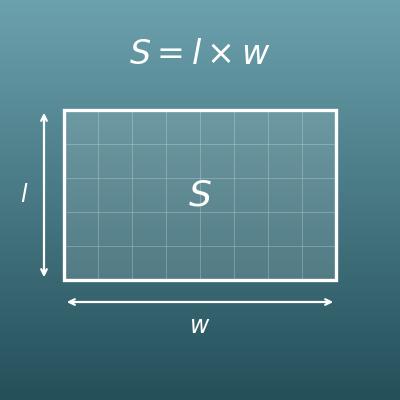
Area of a Rectangle Calculator (Length × Width)
When a bed or garden is made of several rectangles, find the area of each from length × width
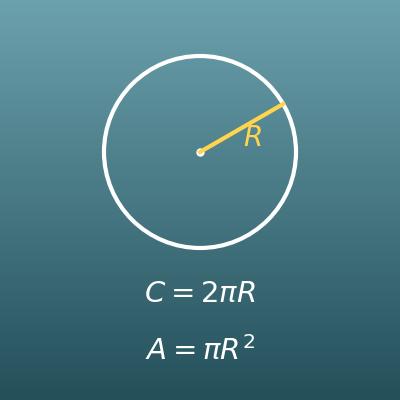
Circle Calculator (Radius, Diameter, Circumference and Area)
Find the area of a circle from its radius or diameter, for round beds and around trees
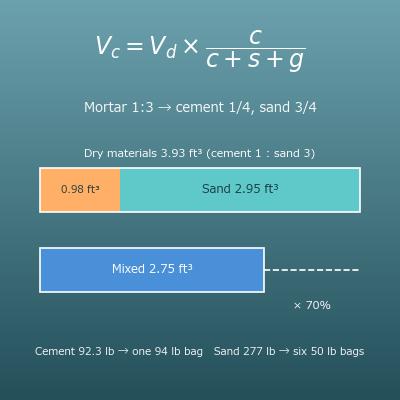
Mortar and Concrete Mix Calculator (Cement, Sand, Gravel, Water and Bags)
When sand goes into mortar, find the amounts of cement, sand and water here
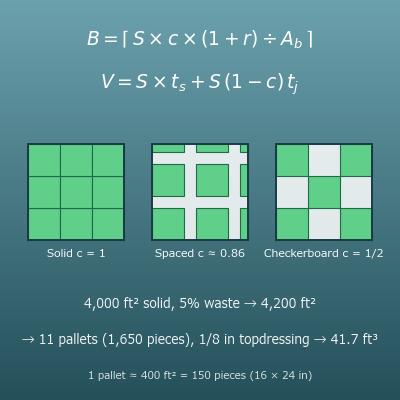
Sod Calculator (Square Feet, Pallets and Topdressing)
Find the sod you need for an area, and the soil for topdressing