









Enter your age, sex, height, weight and activity level. Your daily protein needs are calculated with the US RDA and AMDR, and shown on one number line together with the reference values (the guide for people who exercise and the WHO safe level).
Table of Contents
-
What you can do on this page
-
What is this calculation used for?
-
How to Use
-
Formulas and figures
-
Symbols and terms
-
Good to know before you start
-
How to calculate it in Excel
-
How to calculate it in Google Sheets
-
How to calculate it in Python
-
How to write it in LaTeX and other math languages (copy and paste)
-
How to have ChatGPT do the calculation
-
DataChef Features
-
Related Features
-
NumberChef Calculators List
What you can do on this page
- Enter your age, sex, height, weight and activity level, and you see on the spot how much protein you need per day (g/day)
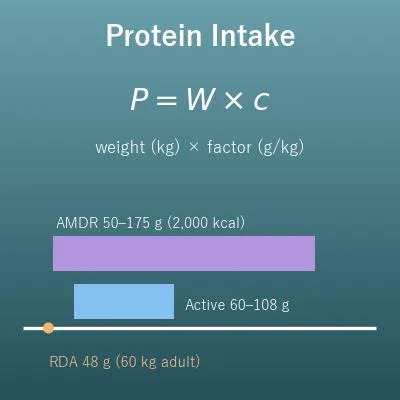
- It uses the two official US standards from the Dietary Reference Intakes (DRI): the RDA (0.8 g of protein per kg of body weight) and the AMDR (10–35% of your daily calories from protein)
- For reference, it also shows a body-weight guide for people who exercise regularly (weight × 1.0–1.8 g/kg) and the safe level of the WHO (World Health Organization)
- All the ranges are drawn as bands on one number line, so you can see your own range at a glance
- The simple rule "body weight × factor (g/kg)" is explained with formulas and figures, so you can do the math yourself
- A plain-language explanation of the formulas and copy-and-paste formulas for Excel, Google Sheets and Python are all on this page
What is this calculation used for?
When you want to build muscle, the usual first step is to set a protein goal with "body weight × factor (g/kg)" and then split the rest of your calories between fat and carbohydrate (this is the idea of counting macros). For example, a 150 lb (about 68 kg) person aiming for 1.6 g/kg needs about \(68 \times 1.6 \approx 109\) g a day.
Personal trainers and sports dietitians use formulas with the same "weight × g/kg" structure. If you change how often you train or what your goal is, you just choose a new factor. That is easy once you understand how the formula works.
When you eat less to lose weight, cutting protein too is thought to make you lose muscle along with fat. Less muscle means a lower BMR, which can make it harder to lose weight and easier to regain it.
While dieting, first set a floor for protein: stay above the RDA (for example, about 46 g/day for a woman who weighs 126 lb) and the WHO safe level (weight × 0.83 g/kg), and get 1.0 g/kg or more if you exercise. Then build the rest of your meals around it. Using numbers this way helps you avoid risky diets.
As people age, they often eat less, and without anyone noticing, they can fall short on protein. This is known to lead to loss of muscle (sarcopenia) and a general decline of body and mind (frailty). Some expert groups suggest 1.0 to 1.2 g/kg a day for adults over 65, which is more than the RDA.
If you know the idea of "estimating a minimum from body weight × g/kg", you can notice unbalanced eating early, such as meals of just toast and coffee. Needs and kidney function differ a lot between older people, so talk with their doctor or a registered dietitian before changing their diet.
Nutrition Facts labels show how much protein a serving has, such as "Protein 20g", but without knowing your own daily need you cannot tell whether that is a lot. The Daily Value used for protein on labels is 50 g, which may not match your own need. If your need is 100 g/day, a snack with 20 g of protein is one-fifth of your day.
Many people eat most of their protein at dinner and little at breakfast. Just splitting your daily need across three meals can change what you choose to eat.
For patients in the hospital and people in long-term care, dietitians and doctors estimate protein needs with the same kind of formula as this page, "grams per kg of body weight". They raise the factor to help heal pressure ulcers (bedsores) or recover from surgery, and lower it when kidney function is reduced.
Adjusting the factor is truly the work of professionals. If you have a health condition, follow your doctor's or registered dietitian's advice on protein, not the estimates on this page.
Formulas and figures
Symbols and terms
Symbols
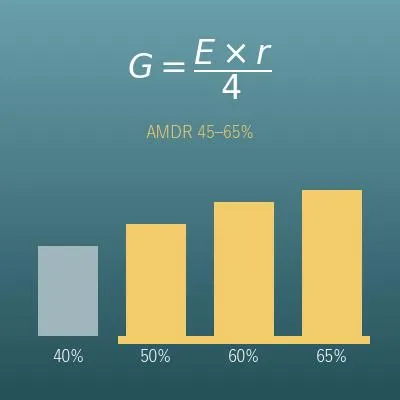
| \(P\) | The daily amount of protein you want to find (g/day), from the first letter of "protein". On this page, formula 1 gives the AMDR range, formula 2 the body-weight guide and formula 3 the RDA. |
| \(W\) | Body weight in kg, from the first letter of "weight". (To convert pounds to kg, divide by about 2.2.) |
| \(c\) | Grams of protein per kg of body weight (g/kg). The guide for people who exercise uses 1.0 to 1.8. |
| \(r\) | The share of your daily calories that comes from protein. The AMDR uses 0.10 to 0.35 (10–35%) for adults. From the first letter of "ratio". |
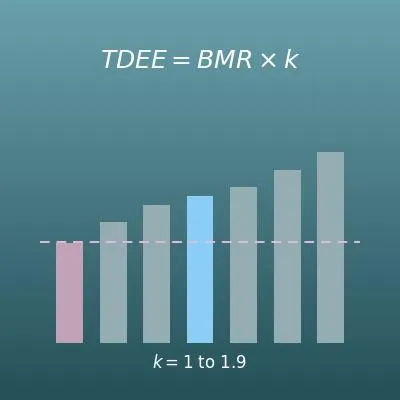
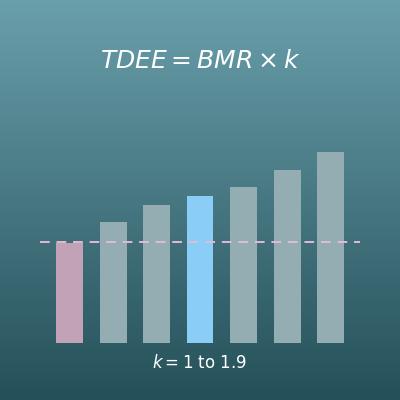
| \(T\) | TDEE, your total daily energy expenditure (kcal/day). This page uses T for "total". |
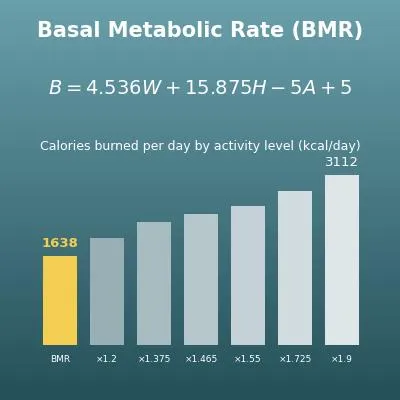
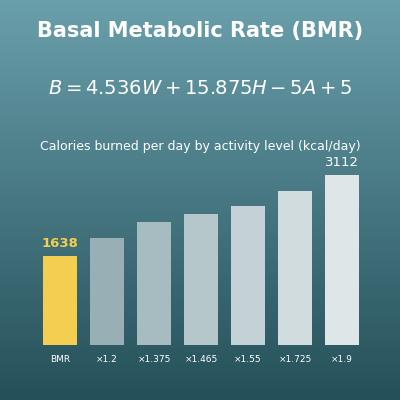
| \(B\) | Basal metabolic rate (BMR), an estimate of the calories you burn in a day even at complete rest (kcal/day). From the first letter of "basal". |
| \(k\) | The activity factor, a multiplier for how many times your BMR you burn in a day. This page uses 1 (no activity) and six levels from 1.2 to 1.9. |
| \(F\) | Body fat percentage written as a decimal (for example, 15% → 0.15). Used in the Katch-McArdle formula. From the first letter of "fat". |
Terms
| protein | A nutrient that builds muscles, organs, skin and hair. In the body it also works as enzymes, hormones and antibodies. Meat, fish, eggs, beans, soy foods and dairy products are rich in it. It is made of amino acids linked together. |
| essential amino acids | The 9 amino acids that the body cannot make in large enough amounts, so they must come from food. This is one reason you need protein every day. |
| RDA (Recommended Dietary Allowance) | In the US Dietary Reference Intakes, the daily amount that meets the needs of almost all (97–98%) healthy people. For protein, it is 0.8 g per kg of body weight for adults 19 and older (0.85 g/kg for ages 14 to 18). |
| AMDR (Acceptable Macronutrient Distribution Range) | In the US Dietary Reference Intakes, the range of calories that can come from each macronutrient while lowering the risk of chronic disease and still getting enough of other nutrients. For protein, it is 10–35% of calories for adults (10–30% for ages 4 to 18). |
| WHO safe level | A level of intake (0.83 g per kg of body weight) from a report of the WHO (World Health Organization). It is set statistically to cover about 97.5% of healthy adults. Being a little below it does not mean you are short right away, but use it as a minimum you should not fall below, not as an ideal amount. |
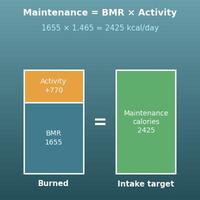
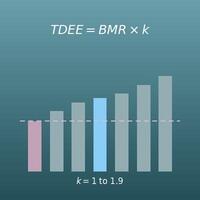
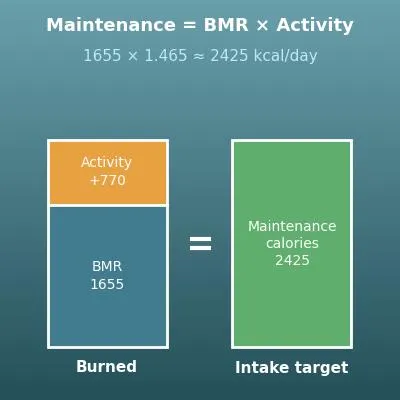
| TDEE (total daily energy expenditure) | The total calories you burn in a day (kcal/day), your BMR plus the calories used for exercise and daily activities. It is estimated as "BMR × activity factor". See the related "TDEE Calculator" page for details. |
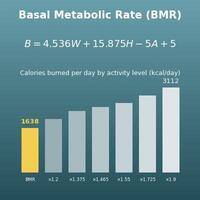
| BMR (basal metabolic rate) | The energy you use just to stay alive, for things like keeping your body temperature, breathing and a beating heart (kcal/day). It is the base of TDEE. On this page it is estimated with a formula (Mifflin-St Jeor or Katch-McArdle). |
| activity factor | A multiplier for how many extra calories you use for exercise and daily activities. Multiply your BMR by it to estimate TDEE. This page uses 1 (no activity) and six levels from 1.2 to 1.9. |
| Atwater factors | The energy per gram of each nutrient - about 4 kcal/g for protein, 9 kcal/g for fat and 4 kcal/g for carbohydrate. They are also used for the calories on US Nutrition Facts labels. The AMDR calculation in this calculator uses 4 kcal/g. |
| DRI (Dietary Reference Intakes) | The set of US and Canadian nutrient reference values published by the National Academies of Sciences, Engineering, and Medicine. It includes the RDA and the AMDR. The protein values on this page come from it. The values can change when the DRI are updated. |
Good to know before you start
Here is what helps you use the calculation on this page with real understanding, not just by pressing the button.
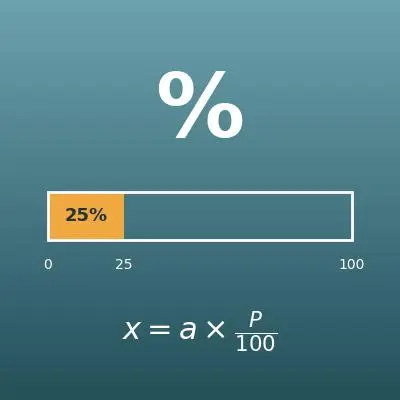
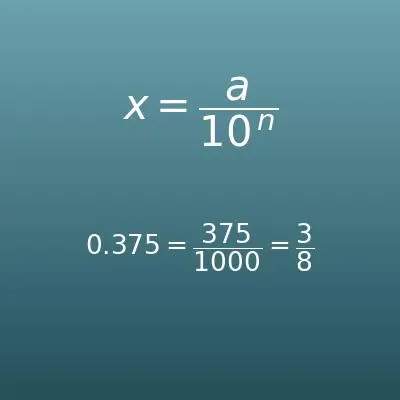
| Multiplying decimals (Grade 5) |
|
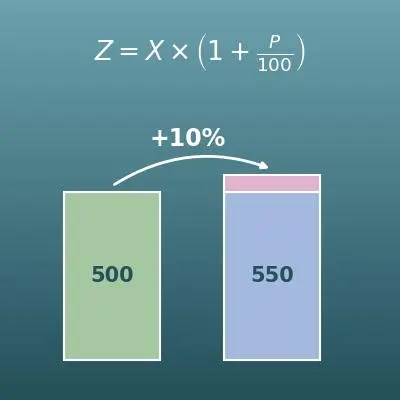
| Percents (Grade 6) |
|
| Unit rates (Grade 6) |
|
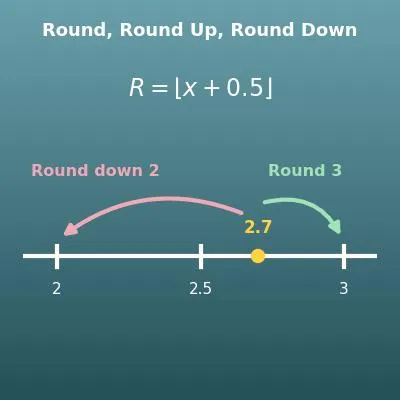
| Rounding (Grades 4–5) |
|
How to calculate it in Excel
| Weight (lb) | 150 |
| Age (years) | 25 |
| RDA (g/day) | =ROUND(B1*0.45359237*IF(B2>=19,0.8,0.85),0) |
| Sex (male or female) | male |
| Weight (lb) | 160 |
| Height (in) | 70 |
| Age (years) | 25 |
| Activity factor | 1.375 |
| BMR (kcal/day) | =4.5359237*B2+15.875*B3-5*B4+IF(B1="male",5,-161) |
| TDEE (kcal/day) | =B6*B5 |
| AMDR low end (g/day) | =ROUND(B7*0.1/4,0) |
| AMDR high end (g/day) | =ROUND(B7*IF(B4>=19,0.35,0.3)/4,0) |
| Weight (lb) | 150 |
| Guide for people who exercise, low end (g/day) | =ROUND(B1*0.454,0) |
| Guide for people who exercise, high end (g/day) | =ROUND(B1*0.816,0) |
| WHO safe level (g/day) | =ROUND(B1*0.376,0) |
In the first table, 0.45359237 turns pounds into kg, and the IF function switches the RDA factor: 0.8 g/kg from age 19, 0.85 g/kg below that. In the second table, the BMR row uses the Mifflin-St Jeor formula in pounds and inches, and its IF function adds 5 if B1 is "male" and subtracts 161 otherwise (female). The last row uses 35% from age 19 and 30% below that.
With the example numbers, the first table gives 54, the second gives a BMR of about 1717, a TDEE of about 2361 and a range of 59 to 207, and the third gives 68, 122 and 56 (the factors 0.454, 0.816 and 0.376 are 1.0, 1.8 and 0.83 g/kg converted to g/lb). Just replace the numbers in column B with your own.
How to calculate it in Google Sheets
| Weight (lb) | 150 |
| Age (years) | 25 |
| RDA (g/day) | =ROUND(B1*0.45359237*IF(B2>=19,0.8,0.85),0) |
| Sex (male or female) | male |
| Weight (lb) | 160 |
| Height (in) | 70 |
| Age (years) | 25 |
| Activity factor | 1.375 |
| BMR (kcal/day) | =4.5359237*B2+15.875*B3-5*B4+IF(B1="male",5,-161) |
| TDEE (kcal/day) | =B6*B5 |
| AMDR low end (g/day) | =ROUND(B7*0.1/4,0) |
| AMDR high end (g/day) | =ROUND(B7*IF(B4>=19,0.35,0.3)/4,0) |
| Weight (lb) | 150 |
| Guide for people who exercise, low end (g/day) | =ROUND(B1*0.454,0) |
| Guide for people who exercise, high end (g/day) | =ROUND(B1*0.816,0) |
| WHO safe level (g/day) | =ROUND(B1*0.376,0) |
How to calculate it in Python
sex = "male"             # "male" or "female"
age = 25                 # age (years)
height_in = 70           # height (inches). 5 ft 10 in = 70 in
weight_lb = 160          # weight (lb)
activity_factor = 1.375  # activity factor (1.2 to 1.9. See the "TDEE Calculator" page for how to choose)

weight_kg = weight_lb * 0.45359237   # pounds to kg

# RDA (US Dietary Reference Intakes): 0.8 g/kg from age 19, 0.85 g/kg at ages 14-18
rda = weight_kg * (0.8 if age >= 19 else 0.85)

# BMR (Mifflin-St Jeor formula in pounds and inches) and TDEE
bmr = 4.5359237 * weight_lb + 15.875 * height_in - 5 * age
bmr = bmr + 5 if sex == "male" else bmr - 161
tdee = bmr * activity_factor

# AMDR: 10-35% of calories (10-30% at ages 14-18), divided by 4 kcal/g to get grams
ratio_max = 0.35 if age >= 19 else 0.30
amdr_min = tdee * 0.10 / 4
amdr_max = tdee * ratio_max / 4

# Reference 1: guide for people who exercise (weight x 1.0-1.8 g/kg)
active_min = weight_kg * 1.0
active_max = weight_kg * 1.8

# Reference 2: WHO safe level (weight x 0.83 g/kg)
who_min = weight_kg * 0.83

print(f"RDA: {round(rda)} g/day")
print(f"AMDR (10-{round(ratio_max * 100)}% of calories): {round(amdr_min)}-{round(amdr_max)} g/day")
print(f"Reference, guide for people who exercise: {round(active_min)}-{round(active_max)} g/day")
print(f"Reference, WHO safe level: {round(who_min)} g/day")
How to write it in LaTeX and other math languages (copy and paste)
P = r × T ÷ 4
P = \dfrac{r T}{4}
<math xmlns="http://www.w3.org/1998/Math/MathML" display="block">
  <mrow>
    <mi>P</mi><mo>=</mo>
    <mfrac>
      <mrow><mi>r</mi><mi>T</mi></mrow>
      <mn>4</mn>
    </mfrac>
  </mrow>
</math>
P = (r T) / 4
r*t/4
P := r*T/4;
P = r*T/4;
P = rT/4
P = W × c
P = W \times c
<math xmlns="http://www.w3.org/1998/Math/MathML" display="block">
<mrow>
<mi>P</mi><mo>=</mo>
<mi>W</mi><mo>×</mo><mi>c</mi>
</mrow>
</math>
P = W xx c
w*c
P := W*c;
P = W*c;
P = W × c
P = W × 0.8
P = 0.8W
<math xmlns="http://www.w3.org/1998/Math/MathML" display="block">
  <mrow>
    <mi>P</mi><mo>=</mo>
    <mn>0.8</mn><mi>W</mi>
  </mrow>
</math>
P = 0.8 W
0.8*w
P := 0.8*W;
P = 0.8*W;
P = 0.8W
T = B × k
T = B \times k
<math xmlns="http://www.w3.org/1998/Math/MathML" display="block">
<mrow>
<mi>T</mi><mo>=</mo>
<mi>B</mi><mo>×</mo><mi>k</mi>
</mrow>
</math>
T = B xx k
b*k
T := B*k;
T = B*k;
T = B × k
How to have ChatGPT do the calculation
You are an assistant for protein intake calculations. Do the following calculation by actually running Python code, and base your answer only on the numbers from the execution result (do not answer by mental math or guessing).

A 25-year-old man is 5 ft 10 in tall, weighs 160 lb and does light exercise 1 to 3 times a week (activity factor 1.375).
1. Find his protein RDA from the US Dietary Reference Intakes (0.8 g per kg of body weight for adults; 1 lb = 0.45359237 kg).
2. Find his BMR with the Mifflin-St Jeor formula (men: BMR = 10 × weight in kg + 6.25 × height in cm − 5 × age + 5), then multiply by the activity factor 1.375 to get his TDEE (total daily energy expenditure).
3. Find his AMDR range for protein (TDEE × 0.10 to 0.35 ÷ 4 kcal/g).
4. For reference, also find the body-weight guide for people who exercise (weight in kg × 1.0 to 1.8 g/kg) and the WHO safe level (weight in kg × 0.83 g/kg).
Round each value to a whole number and put them in a table, one row per standard.

Show the formulas you used and the numbers from the execution result. Also add a note that these are estimates for healthy adults, not medical advice.
How to Use
-
1Enter your numbersType the numbers you want to calculate with into the input fields
-
2CalculatePress the "Calculate" button
-
3Check the resultThe result appears on the spot. The same page also explains the idea behind the calculation and the formula
DataChef Features

No technical knowledge required.
Intuitive and user-friendly operation.

Can be used without registering personal information.

Automatic file deletion by clicking "download".

and rapid file conversion.
No attribution required.

No need to contact us for commercial use permission.
Related Features
TDEE Calculator (Total Daily Energy Expenditure and How to Choose Your Activity Level)
Explains TDEE, the base of the AMDR range on this page, including how to choose an activity factor
Calorie Calculator (Maintenance Calories and Weight Loss or Gain Plans)
Finds a daily calorie target for losing or gaining weight at different rates
BMR Calculator (Basal Metabolic Rate and Daily Calories by Activity Level)
Calculates your basal metabolic rate, the base of TDEE, with three formulas and lists it for six activity levels