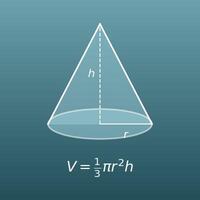


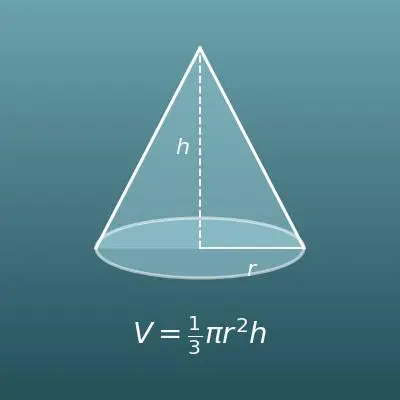
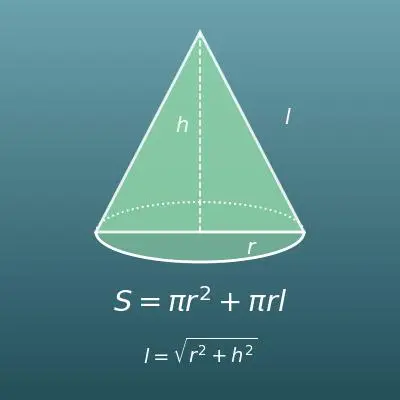












Enter the base radius and the height of the cone. You get the surface area (base area + lateral area), its breakdown into base area and lateral area, and the slant height.
Table of Contents
-
What you can do on this page
-
What is this calculation used for?
-
How to Use
-
Formulas and figures
-
Symbols and terms
-
Good to know before you start
-
How to calculate it in Excel
-
How to calculate it in Google Sheets
-
How to calculate it in Python
-
How to write it in LaTeX and other math languages (copy and paste)
-
How to have ChatGPT do the calculation
-
DataChef Features
-
Related Features
-
NumberChef Calculators List
What you can do on this page
- Enter the base radius and the height, and you get the surface area of the cone on the spot (surface area = base area \(\pi r^2\) + lateral area \(\pi r l\))
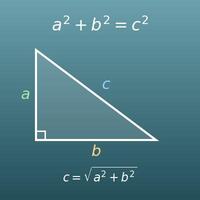
- It also shows the breakdown into base area and lateral area, and the slant height \(l = \sqrt{r^2 + h^2}\)
- The result is also shown as a 3D shape. Turn it around with your mouse to see which length is which
- A plain-language explanation of why the lateral area is \(\pi r l\) and copy-and-paste formulas for Excel, Google Sheets and Python are all on this page
What is this calculation used for?
A party hat or a paper cone for a craft project has only the side, with no base, so the paper you need is the lateral area \(\pi r l\). For a hat with a rim radius of 3 in and a height of 8 in, the slant height is \(\sqrt{3^2 + 8^2} \approx 8.54\,\mathrm{in}\) and the lateral area is \(\pi \times 3 \times 8.54 \approx 80\,\mathrm{in^2}\).
You also need extra for the glue flap and trimming, so prepare a little more paper than this. Being able to estimate materials before you start is what makes this formula handy.
For cone-shaped roofs on turrets, gazebos and silos, the amount of roofing (metal or shingles) is estimated from the lateral area. For a roof with a base radius of 10 ft and a height of 6 ft, the slant height is \(\sqrt{10^2 + 6^2} \approx 11.66\,\mathrm{ft}\) and the lateral area is \(\pi \times 10 \times 11.66 \approx 366\,\mathrm{ft^2}\), or about 3.7 roofing squares (1 square = 100 ft²).
Real jobs need overlaps between pieces and produce offcuts, so roofers add extra to this number when they order. This formula is the starting point of the estimate.
A cone-shaped tent with a single pole in the middle, such as a tipi or a bell tent, uses about the lateral area for its walls and the base area for its floor (the groundsheet). With a radius of 6.5 ft at the bottom and a height of 8 ft, the walls are about \(210\,\mathrm{ft^2}\), the floor is \(\pi \times 6.5^2 \approx 133\,\mathrm{ft^2}\), and the total is about \(343\,\mathrm{ft^2}\).
A real tent has seam allowances and a door, so this is an estimate. Still, it gives you a feel for how heavy the fabric may be, or whether one can of waterproofing spray is enough.
For plating or painting metal parts, the amount of chemicals or paint depends mostly on the surface area, so a cost estimate starts with it. For a cone-shaped part with a radius of 0.75 in and a height of 2 in, the surface area is \(\pi \times 0.75 \times (0.75 + \sqrt{0.75^2 + 2^2}) \approx 6.8\,\mathrm{in^2}\).
For parts made of cylinders and cones, you add up the surface area of each piece with formulas like this one to work out the processing cost and the amount of paint.
An ice cream cone is the classic cone shape. For a cone with a rim radius of 1.25 in and a depth of 6 in, the slant height is \(\sqrt{1.25^2 + 6^2} \approx 6.13\,\mathrm{in}\) and the lateral area is \(\pi \times 1.25 \times 6.13 \approx 24\,\mathrm{in^2}\).
This lateral area is a guide to how much batter to spread for baking a cone, or how large a paper sleeve around the cone needs to be. If you also know that it unrolls into a sector, you can even make a paper pattern.
Formulas and figures
Symbols and terms
Symbols
| \(S\) | ess | A common symbol for area, from "surface". On this page it is the surface area of the cone (some textbooks write SA). |
| \(r\) | ar | The radius of the base circle, from the first letter of "radius". It is the length from the center of the circle to its edge, half the diameter. |
| \(h\) | aitch | The height of the cone, from the first letter of "height". It is measured straight up from the base to the apex, and is not the same as the length along the side (the slant height). |
| \(l\) | ell | The slant height of the cone (some textbooks use \(s\) or \(\ell\)). It is the length along the side from the apex to the edge of the base, and \(l = \sqrt{r^2 + h^2}\). |
| \(r^2\) | r squared | The number \(r\) multiplied by itself (\(r \times r\)). The small 2 at the upper right is an exponent that says "use it as a factor twice". |
| \(\pi\) | pi | The number that tells how many times the circumference of a circle is its diameter. It is about 3.14159… and the decimals never end. You can use 3.14 in a calculation, or keep the symbol \(\pi\) in the answer. |
| \(\sqrt{\phantom{x}}\) | square root (radical sign) | The symbol for a square root. \(\sqrt{25}\) is the positive number whose square is 25, which is 5. It can also be a number whose decimals never end, like \(\sqrt{2}\) (about 1.414). |
| \(\mathrm{in^2}\) | square inch | A unit of area. A square 1 in on each side has an area of 1 in². Do not mix it up with in³ (cubic inch), the unit of volume. |
| \(\mathrm{ft^2}\) | square foot | A unit of area. A square 1 ft on each side has an area of 1 ft². \(1\,\mathrm{ft^2} = 12 \times 12 = 144\,\mathrm{in^2}\) (note that it is not 12). |
Terms
| cone | A solid with a circular base that narrows smoothly to a single point. Ice cream cones, party hats and traffic cones are shaped like cones. |
| right circular cone | A cone whose apex is directly above the center of the base circle. The cones in school textbooks are usually this kind, and this calculator handles it too. A cone whose apex is not above the center is called an oblique cone. |
| surface area | The area of the whole outside of a solid. For a cone, it is the area of the base (a circle) plus the area of the side (a sector). You use it to work out how much is needed to cover a surface, such as the amount of paint or the size of wrapping paper. |
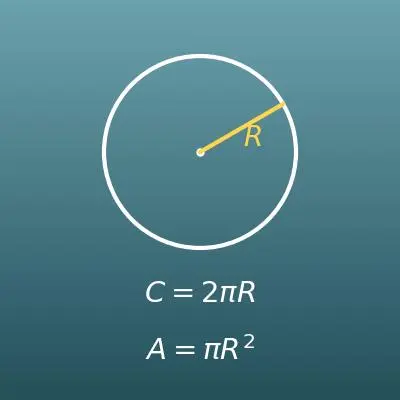
| base area | The area of the face at the bottom of a solid. The base of a cone is a circle, so its base area is \(\pi r^2\) from the area of a circle. |
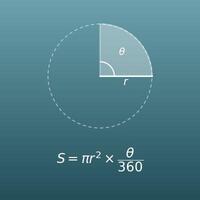
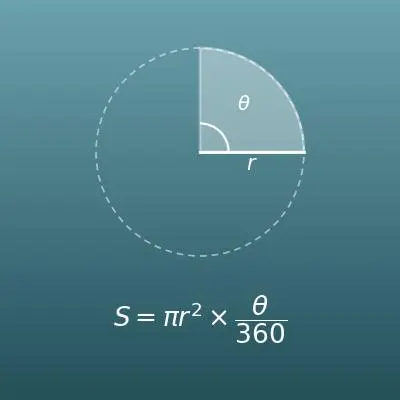
| lateral area | The area of the side of a solid (also called the lateral surface area). The side of a cone unrolls into a sector, and its area is \(\pi r l\) (π × radius × slant height). |
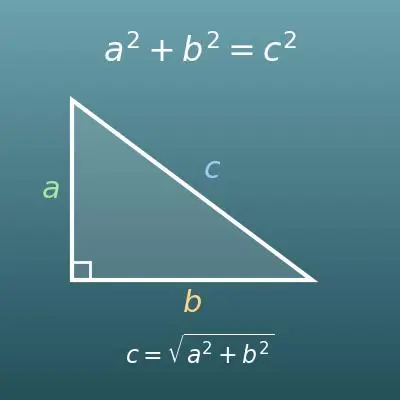
| slant height | The straight length along the side of the cone, from the apex to the edge of the base circle. By the Pythagorean theorem it is \(\sqrt{r^2 + h^2}\). Be careful not to mix it up with the height. |
| net | The flat pattern you get by cutting a solid open and laying it flat. The net of a cone has two pieces, the base circle and a sector for the side. The surface area equals the total area of the net. |
| sector | A slice of a circle cut out by two radii, shaped like a folding fan or a slice of pizza. The side of a cone unrolls into a sector whose radius is the slant height \(l\). |
| arc | The curved edge of a sector (part of a circle). In the sector you get by unrolling the side of a cone, the arc length is exactly the circumference of the base, \(2\pi r\). |
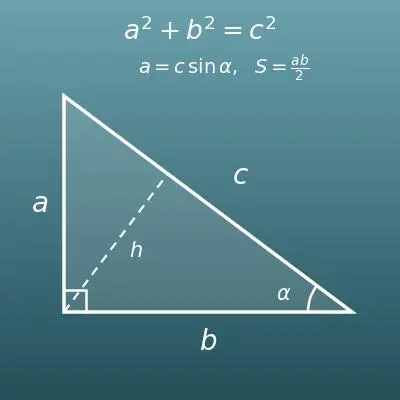
| Pythagorean theorem | The rule that in a right triangle, the square of the hypotenuse equals the sum of the squares of the other two sides. In a cone, the radius, the height and the slant height form a right triangle, so the slant height is \(\sqrt{r^2 + h^2}\). |
| pi | The number that tells how many times the circumference is the diameter (about 3.14). It appears in every calculation for shapes that involve a circle, such as circles, cones and cylinders. |
Good to know before you start
Here is what helps you use the calculation on this page with real understanding, not just by pressing the button.
| Circumference and area of a circle (Grade 7) |
|
| Solid figures and nets (Grades 6–8) |
|
| Expressions with letters and the number π (Grades 6–7) |
|
| Square roots and the Pythagorean theorem (Grade 8) |
|
| Multiplying decimals (Grades 5–6) |
|
How to calculate it in Excel
| Base radius (in) | 3 |
| Height (in) | 4 |
| Base area (in²) | =PI()*B1^2 |
| Lateral area (in²) | =PI()*B1*SQRT(B1^2+B2^2) |
| Surface area, base + lateral (in²) | =B3+B4 |
| Base radius (in) | 3 |
| Height (in) | 4 |
| Slant height (in) | =SQRT(B1^2+B2^2) |
| Base radius (in) | 3 |
| Slant height (in) | 5 |
| Lateral area (in²) | =PI()*B1*B2 |
| Base radius (in) | 3 |
| Height (in) | 4 |
| Surface area (in²) | =PI()*B1*(B1+SQRT(B1^2+B2^2)) |
In a formula, "B1" and "B2" tell the formula to use the number in that cell. "PI()" is π (3.14159…), "SQRT()" is the square root, "^" raises to a power (how many times to multiply) and "*" is multiplication.
In the first table, for example, B3 shows about 28.27 (base area), B4 about 47.12 (lateral area) and B5 about 75.40 (surface area), in in² because the inputs are in inches. The second table shows 5 in B3, the third about 47.12 in B3 and the fourth about 75.40 in B3. Just replace the input numbers with the size of your own cone.
How to calculate it in Google Sheets
| Base radius (in) | 3 |
| Height (in) | 4 |
| Base area (in²) | =PI()*B1^2 |
| Lateral area (in²) | =PI()*B1*SQRT(B1^2+B2^2) |
| Surface area, base + lateral (in²) | =B3+B4 |
| Base radius (in) | 3 |
| Height (in) | 4 |
| Slant height (in) | =SQRT(B1^2+B2^2) |
| Base radius (in) | 3 |
| Slant height (in) | 5 |
| Lateral area (in²) | =PI()*B1*B2 |
| Base radius (in) | 3 |
| Height (in) | 4 |
| Surface area (in²) | =PI()*B1*(B1+SQRT(B1^2+B2^2)) |
How to calculate it in Python
import math

radius = 3   # base radius (inches in this example)
height = 4   # height (same unit as the radius)

slant = math.sqrt(radius ** 2 + height ** 2)     # slant height (Pythagorean theorem)
base_area = math.pi * radius ** 2                # base area (area of the base circle)
lateral_area = math.pi * radius * slant          # lateral area (pi x radius x slant height)
total_area = base_area + lateral_area            # surface area (base area + lateral area)

print(f"Slant height: {slant} in")
print(f"Base area: {base_area} in2")
print(f"Lateral area: {lateral_area} in2")
print(f"Surface area of the cone: {total_area} in2")
How to write it in LaTeX and other math languages (copy and paste)
S = πr² + πrl
S = \pi r^{2} + \pi r l
<math xmlns="http://www.w3.org/1998/Math/MathML" display="block">
<mrow>
<mi>S</mi>
<mo>=</mo>
<mi>π</mi>
<msup><mi>r</mi><mn>2</mn></msup>
<mo>+</mo>
<mi>π</mi>
<mi>r</mi>
<mi>l</mi>
</mrow>
</math>
S = pi r^2 + pi r l
Pi*r^2 + Pi*r*l
S := Pi*r^2 + Pi*r*l;
S = pi*r^2 + pi*r*l;
S = πr^2 + πrl
l = √(r² + h²)
l = \sqrt{r^{2} + h^{2}}
<math xmlns="http://www.w3.org/1998/Math/MathML" display="block">
  <mrow>
    <mi>l</mi>
    <mo>=</mo>
    <msqrt>
      <mrow>
        <msup><mi>r</mi><mn>2</mn></msup>
        <mo>+</mo>
        <msup><mi>h</mi><mn>2</mn></msup>
      </mrow>
    </msqrt>
  </mrow>
</math>
l = sqrt(r^2 + h^2)
Sqrt[r^2 + h^2]
l := sqrt(r^2 + h^2);
l = sqrt(r^2 + h^2);
l = √(r^2 + h^2)
πrl = 1/2 × 2πr × l
\pi r l = \frac{1}{2} \times 2\pi r \times l
<math xmlns="http://www.w3.org/1998/Math/MathML" display="block">
<mrow>
<mi>π</mi><mi>r</mi><mi>l</mi>
<mo>=</mo>
<mfrac><mn>1</mn><mn>2</mn></mfrac>
<mo>×</mo>
<mn>2</mn><mi>π</mi><mi>r</mi>
<mo>×</mo>
<mi>l</mi>
</mrow>
</math>
pi r l = 1/2 xx 2 pi r xx l
Pi*r*l == (1/2)*(2*Pi*r)*l
Pi*r*l = (1/2)*(2*Pi*r)*l;
pi*r*l == (1/2)*(2*pi*r)*l
πrl = (1/2)(2πr)l
S = πr(r + √(r² + h²))
S = \pi r \left( r + \sqrt{r^{2} + h^{2}} \right)
<math xmlns="http://www.w3.org/1998/Math/MathML" display="block">
<mrow>
<mi>S</mi>
<mo>=</mo>
<mi>π</mi>
<mi>r</mi>
<mo>(</mo>
<mi>r</mi>
<mo>+</mo>
<msqrt>
<mrow>
<msup><mi>r</mi><mn>2</mn></msup>
<mo>+</mo>
<msup><mi>h</mi><mn>2</mn></msup>
</mrow>
</msqrt>
<mo>)</mo>
</mrow>
</math>
S = pi r (r + sqrt(r^2 + h^2))
Pi*r*(r + Sqrt[r^2 + h^2])
S := Pi*r*(r + sqrt(r^2 + h^2));
S = pi*r*(r + sqrt(r^2 + h^2));
S = πr(r + √(r^2 + h^2))
How to have ChatGPT do the calculation
You are a math calculation assistant. Do the following calculation by actually running Python code, and base your answer only on the numbers from the execution result (do not answer by mental math or guessing).

A cone has a base radius of 3 in and a height of 4 in (a right circular cone, with its apex directly above the center of the base).
Find each of the following:
1. The slant height (l = √(radius² + height²))
2. The base area (πr²)
3. The lateral area (π × radius × slant height)
4. The surface area of the cone (base area + lateral area)

Show the formulas you used and the numbers from the execution result.
How to Use
-
1Enter your numbersType the numbers you want to calculate with into the input fields
-
2CalculatePress the "Calculate" button
-
3Check the resultThe result appears on the spot. The same page also explains the idea behind the calculation and the formula
DataChef Features

No technical knowledge required.
Intuitive and user-friendly operation.

Can be used without registering personal information.

Automatic file deletion by clicking "download".

and rapid file conversion.
No attribution required.

No need to contact us for commercial use permission.
Related Features
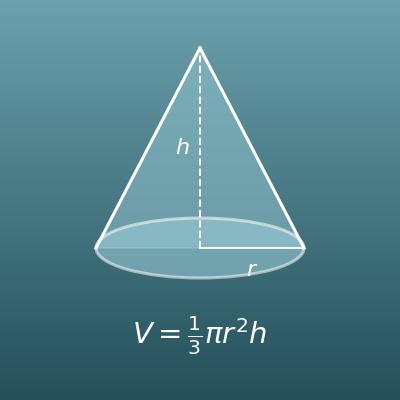
Volume of a Cone Calculator (from Radius and Height)
Calculates how much the same cone holds, its volume (1/3 × π × radius² × height)
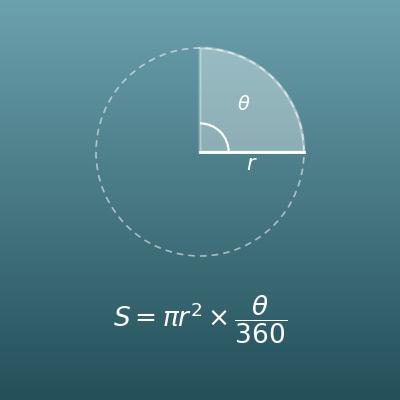
Area of a Sector Calculator (from Radius and Central Angle)
The side of a cone unrolls into a sector. Calculates the area, arc length and central angle of a sector
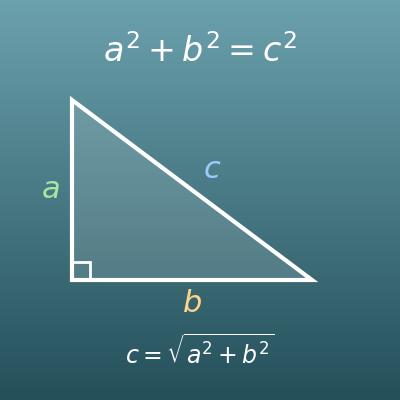
Pythagorean Theorem Calculator (Hypotenuse and Legs of a Right Triangle)
Calculates the Pythagorean theorem, which you use to find the slant height of a cone (√(radius² + height²))