





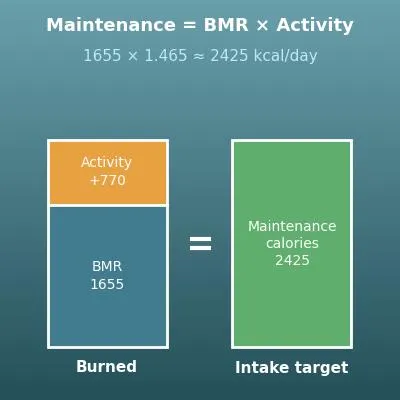
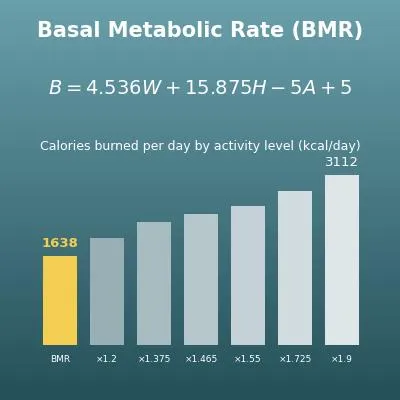







Enter your age, sex, height, weight and activity level. You get your maintenance calories (about how many calories a day keep your current weight), your basal metabolic rate (BMR) and daily calorie targets for losing or gaining weight at different rates.
Table of Contents
-
What you can do on this page
-
What is this calculation used for?
-
How to Use
-
Formula
-
Symbols and terms
-
Good to know before you start
-
How to calculate it in Excel
-
How to calculate it in Google Sheets
-
How to calculate it in Python
-
How to write it in LaTeX and other math languages (copy and paste)
-
How to have ChatGPT do the calculation
-
DataChef Features
-
Related Features
-
NumberChef Calculators List
What you can do on this page
- Enter your age, sex, height, weight and activity level to see your maintenance calories (about how many calories a day keep your current weight) on the spot
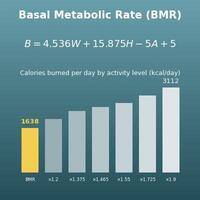
- Your basal metabolic rate (BMR, the calories you burn in a day even at complete rest) is shown at the same time
- Daily calorie targets are worked out for losing or gaining about 0.5 lb, 1 lb or 2 lb a week
- You can choose from three BMR formulas: Mifflin-St Jeor, revised Harris-Benedict and Katch-McArdle
- A plain-language explanation of the formulas and copy-and-paste formulas for Excel, Google Sheets and Python are all on this page
What is this calculation used for?
Instead of "eating a bit less" without a plan, first find your maintenance calories, then eat 250 to 500 kcal a day less. That works out to losing roughly 0.5 to 1 lb a week, based on the common rule of thumb that 1 lb of body fat is about 3,500 kcal.
Very large cuts are thought to lead to muscle loss and weight regain, so a slow pace is often recommended. Having a number as your goal makes everyday food choices easier.
To build muscle, you are thought to need to eat a little more than you burn, along with training. Adding about 250 to 500 kcal to your maintenance calories, a "lean bulk", is a common way to gain weight while limiting the gain in body fat.
When athletes and trainers plan meals, the starting point is also an estimate of maintenance calories (total calories burned).
A deli sandwich might be about 600 Calories and a large bag of chips about 300. The numbers alone do not tell you whether that is a lot or a little. If you know your maintenance calories are 2,400 kcal, you can see at once that "this one sandwich is a quarter of my day" (the Calories on a US food label are kcal).
Having one reference number of your own turns the calories on food labels into numbers you can use, and makes day-to-day eating choices more concrete.
If your doctor suggests losing weight at an annual checkup, an estimate of the calories you burn is a starting point for deciding what to change and by how much. Once you know your maintenance calories, you can estimate the effect of a change in numbers, such as "dropping a 200-Calorie snack cuts about 1,400 kcal a week".
Advice differs from person to person, so use the results as a reference together with guidance from your doctor or a registered dietitian.
Formula
Symbols and terms
Symbols
| \(B\) | bee | Basal metabolic rate (BMR), the estimated calories you burn in a day at complete rest (kcal/day). This page uses B, the first letter of "basal". |
| \(W\) | double-u | Weight, from the first letter of "weight". In the formula card on this page it is in pounds (lb); in the original metric formulas it is in kg. |
| \(H\) | aitch | Height, from the first letter of "height". In the formula card on this page it is your total height in inches (5 ft 10 in = 70 in); in the original metric formulas it is in cm. |
| \(A\) | a | Age in years, from the first letter of "age". The older you are, the lower the estimated BMR. |
| \(F\) | ef | Body fat percentage written as a decimal (for example, 20% → 0.20). It is used in the Katch-McArdle formula. F stands for "fat". |
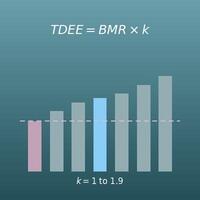
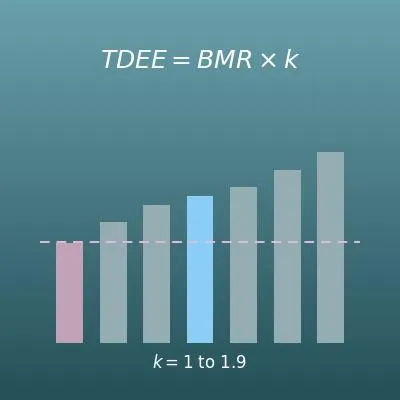
| \(k\) | kay | The activity factor, a multiplier that shows how many times your BMR you burn in a day. In this calculator you choose from 7 levels between 1 and 1.9. |
| \(M\) | em | Maintenance calories, the estimated calories per day that keep your current weight (kcal/day). M stands for "maintenance". |
| \(T\) | tee | The calorie target, the estimated calories per day for a weight loss or weight gain plan. T stands for "target". |
| \(E\) | ee | The daily adjustment (250, 500 or 1,000 kcal), the calories you add to or subtract from your maintenance calories. It sets how fast you lose or gain. |
Terms
| kcal (kilocalorie) | A unit of energy. When food labels and nutrition talk say "calories", they almost always mean kcal. The "Calories" on a US Nutrition Facts label are kcal. 1 kcal is the energy needed to warm 1 liter of water by 1 °C. |
| BMR (basal metabolic rate) | The energy you use just to stay alive, for things like keeping your body warm, breathing and keeping your heart beating (kcal/day). It is thought to make up about 60–70% of the calories you burn in a day. |
| activity factor | A multiplier for the extra calories you use for exercise and daily activities. You multiply your BMR by it to estimate the total calories you burn in a day. |
| maintenance calories | The estimated calories per day at which what you eat and what you burn balance out, so your weight stays the same. Also called total daily energy expenditure (TDEE). |
| body fat percentage | The share of your body weight that is fat (%). You can measure it with a home body composition scale or similar. The Katch-McArdle formula uses it to estimate BMR. |
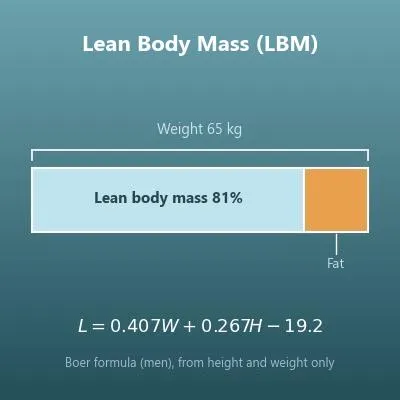
| lean body mass | Your body weight minus the fat (muscle, bone, organs and so on). The Katch-McArdle formula is based on the idea that BMR is roughly proportional to lean body mass. |
| Mifflin-St Jeor equation | A formula for estimating BMR, published in 1990. It is often found to be fairly close to measured values in people today and is widely used, including by dietitians in the US. It is the default formula in this calculator. |
| Harris-Benedict equation | A classic formula for estimating BMR, published in 1919. This page uses the revised version, whose numbers were updated in 1984. |
| Katch-McArdle formula | A formula that estimates BMR from lean body mass. It is considered accurate for people who know their body fat percentage well. Its strength is that it reflects differences in muscle mass. |
Good to know before you start
Here is what helps you use the calculation on this page with real understanding, not just by pressing the button.
| Multiplying decimals (Grades 5–6) |
|
| Percentages (Grade 6) |
|
| Rounding (Grade 4) |
|
| Adding and subtracting larger numbers (Grades 3–4) |
|
How to calculate it in Excel
| Sex (M or F) | M |
| Weight (lb) | 160 |
| Height (in) | 70 |
| Age (years) | 25 |
| BMR (kcal/day) | =4.536*B2+15.875*B3-5*B4+IF(B1="M",5,-161) |
| BMR (kcal/day) | 1717 |
| Activity factor | 1.465 |
| Maintenance calories (kcal/day) | =ROUND(B1*B2,0) |
| Maintenance calories (kcal/day) | 2515 |
| Daily adjustment (kcal) | 500 |
| Weight loss plan (kcal/day) | =B1-B2 |
| Weight gain plan (kcal/day) | =B1+B2 |
The IF function in the first table switches the constant by sex: if B1 is "M" it adds 5, otherwise (F) it subtracts 161. Weight is in pounds and height is your total height in inches (5 ft 10 in = 70). ROUND in the second table rounds to a whole number.
With the example numbers, the first table gives 1717.01, the second 2515, and the third 2015 for weight loss and 3015 for weight gain. Just replace the numbers in column B with your own.
How to calculate it in Google Sheets
| Sex (M or F) | M |
| Weight (lb) | 160 |
| Height (in) | 70 |
| Age (years) | 25 |
| BMR (kcal/day) | =4.536*B2+15.875*B3-5*B4+IF(B1="M",5,-161) |
| BMR (kcal/day) | 1717 |
| Activity factor | 1.465 |
| Maintenance calories (kcal/day) | =ROUND(B1*B2,0) |
| Maintenance calories (kcal/day) | 2515 |
| Daily adjustment (kcal) | 500 |
| Weight loss plan (kcal/day) | =B1-B2 |
| Weight gain plan (kcal/day) | =B1+B2 |
How to calculate it in Python
sex = "male"             # "male" or "female"
age = 25                 # age (years)
height_in = 70           # height (total inches: 5 ft 10 in = 70)
weight_lb = 160          # weight (lb)
activity_factor = 1.465  # activity factor (1 / 1.2 / 1.375 / 1.465 / 1.55 / 1.725 / 1.9)

# BMR (Mifflin-St Jeor equation, pounds and inches)
bmr = 4.536 * weight_lb + 15.875 * height_in - 5 * age
bmr = bmr + 5 if sex == "male" else bmr - 161

maintain = round(bmr * activity_factor)  # maintenance calories (rounded to a whole number)

print(f"BMR: {round(bmr)} kcal/day")
print(f"Maintenance calories: {maintain} kcal/day")
plans = [("Mild weight loss (about 0.5 lb a week)", -250), ("Weight loss (about 1 lb a week)", -500),
         ("Fast weight loss (about 2 lb a week)", -1000), ("Mild weight gain (about 0.5 lb a week)", 250),
         ("Weight gain (about 1 lb a week)", 500), ("Fast weight gain (about 2 lb a week)", 1000)]
for label, adjust in plans:
    print(f"{label}: {maintain + adjust} kcal/day")
How to write it in LaTeX and other math languages (copy and paste)
B = 4.536W + 15.875H − 5A + 5 (men), B = 4.536W + 15.875H − 5A − 161 (women)
B_{m} = 4.536W + 15.875H - 5A + 5, \quad B_{f} = 4.536W + 15.875H - 5A - 161
<math xmlns="http://www.w3.org/1998/Math/MathML" display="block">
<mrow>
<msub><mi>B</mi><mi>m</mi></msub>
<mo>=</mo>
<mn>4.536</mn><mi>W</mi>
<mo>+</mo>
<mn>15.875</mn><mi>H</mi>
<mo>−</mo>
<mn>5</mn><mi>A</mi>
<mo>+</mo>
<mn>5</mn>
<mo>,</mo>
<msub><mi>B</mi><mi>f</mi></msub>
<mo>=</mo>
<mn>4.536</mn><mi>W</mi>
<mo>+</mo>
<mn>15.875</mn><mi>H</mi>
<mo>−</mo>
<mn>5</mn><mi>A</mi>
<mo>−</mo>
<mn>161</mn>
</mrow>
</math>
B_m = 4.536W + 15.875H - 5A + 5, B_f = 4.536W + 15.875H - 5A - 161
{4.536*w + 15.875*h - 5*a + 5, 4.536*w + 15.875*h - 5*a - 161}
Bm := 4.536*W + 15.875*H - 5*A + 5; Bf := 4.536*W + 15.875*H - 5*A - 161;
B_m = 4.536*W + 15.875*H - 5*A + 5; B_f = 4.536*W + 15.875*H - 5*A - 161;
B_m = 4.536W + 15.875H - 5A + 5, B_f = 4.536W + 15.875H - 5A - 161
M = B × k
M = B \times k
<math xmlns="http://www.w3.org/1998/Math/MathML" display="block">
<mrow>
<mi>M</mi><mo>=</mo>
<mi>B</mi><mo>×</mo><mi>k</mi>
</mrow>
</math>
M = B xx k
b*k
M := B*k;
M = B*k;
M = B × k
T = M ± E
T = M \pm E
<math xmlns="http://www.w3.org/1998/Math/MathML" display="block">
<mrow>
<mi>T</mi><mo>=</mo>
<mi>M</mi><mo>±</mo><mi>E</mi>
</mrow>
</math>
T = M +- E
{m - e, m + e}
Tloss := M - E; Tgain := M + E;
T_loss = M - E; T_gain = M + E;
T = M ± E
How to have ChatGPT do the calculation
You are a calorie calculation assistant. Do the following calculation by actually running Python code, and base your answer only on the numbers from the execution result (do not answer by mental math or guessing).

A 25-year-old man is 5 ft 10 in tall and weighs 160 lb.
1. Convert his weight to kg (1 lb = 0.45359237 kg) and his height to cm (1 in = 2.54 cm), then find his BMR with the Mifflin-St Jeor equation (men: BMR = 10 × weight in kg + 6.25 × height in cm − 5 × age + 5).
2. Multiply by an activity factor of 1.465 (moderate exercise 4–5 times a week) and round to the nearest whole number to find his daily maintenance calories.
3. Find the weight loss plans (maintenance calories minus 250, 500 and 1,000 kcal) and the weight gain plans (plus the same amounts).

Show the formulas you used and the numbers from the execution result. Also note that these are estimates from formulas and not medical advice.
How to Use
-
1Enter your numbersType the numbers you want to calculate with into the input fields
-
2CalculatePress the "Calculate" button
-
3Check the resultThe result appears on the spot. The same page also explains the idea behind the calculation and the formula
DataChef Features

No technical knowledge required.
Intuitive and user-friendly operation.

Can be used without registering personal information.

Automatic file deletion by clicking "download".

and rapid file conversion.

No attribution required.

No need to contact us for commercial use permission.
Related Features
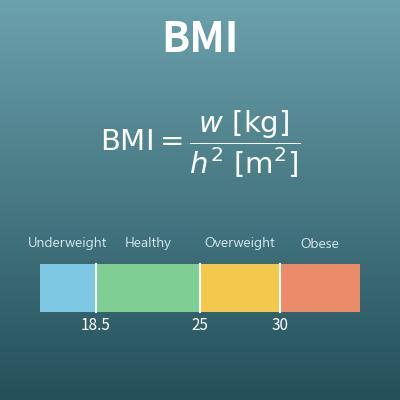
BMI Calculator (Body Mass Index and Healthy Weight Range)
Find your BMI and weight category from your height and weight
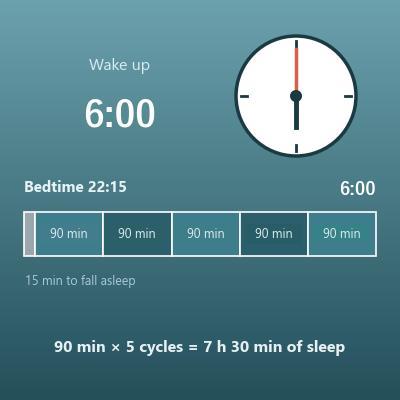
Sleep Cycle Calculator (Bedtime and Wake-Up Time)
Work back from your wake-up time to a bedtime that fits your sleep cycles
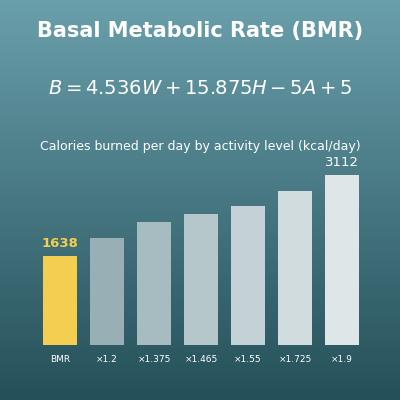
BMR Calculator (Basal Metabolic Rate and Daily Calories by Activity Level)
Estimate your basal metabolic rate and the calories you burn at each activity level from your age, sex, height and weight
TDEE Calculator (Total Daily Energy Expenditure and How to Choose Your Activity Level)
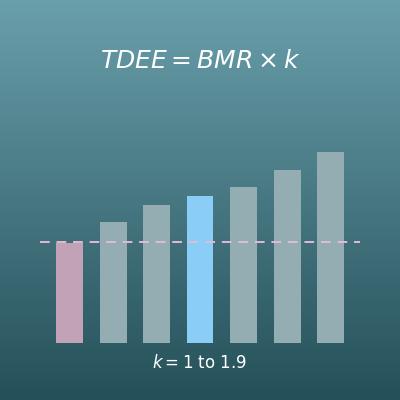
Find your TDEE as BMR × activity factor, with a detailed guide to choosing your activity level