
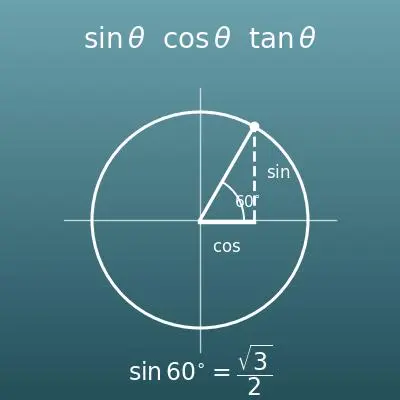





Choose "value from an angle" or "angle from a value" and enter your numbers. The result comes with a unit circle diagram.
Table of Contents
-
What you can do on this page
-
What is this calculation used for?
-
How to Use
-
Formulas and figures
-
Symbols and terms
-
Good to know before you start
-
How to calculate it in Excel
-
How to calculate it in Google Sheets
-
How to calculate it in Python
-
How to write it in LaTeX and other math languages (copy and paste)
-
How to have ChatGPT do the calculation
-
DataChef Features
-
Related Features
-
NumberChef Calculators List
What you can do on this page
- Enter an angle \(\theta\) in degrees and get \(\sin\theta\), \(\cos\theta\) and \(\tan\theta\) all at once. For special angles such as \(30^\circ\), \(45^\circ\), \(60^\circ\) and \(120^\circ\), the answer is shown both as an exact value like \(\dfrac{\sqrt{3}}{2}\) and as a decimal
- You can also go the other way and find the angle from the value of a trig ratio, as in "which angle gives \(\sin\theta = 0.5\)?" (in the range \(0^\circ\) to \(180^\circ\). If two angles match, both are shown)
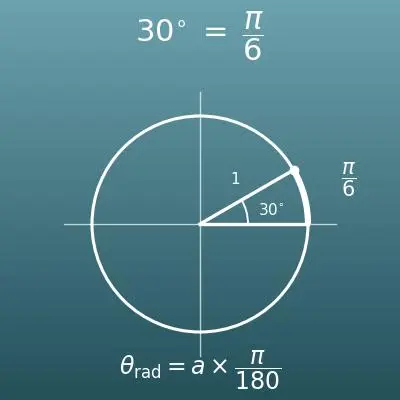
- Negative angles and angles over \(360^\circ\) work too. Angles are given in degrees, with the radian measure shown alongside
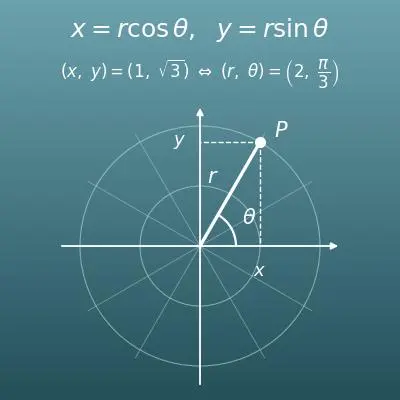
- The result comes with a unit circle diagram, so you can see at a glance which lengths on the circle \(\sin\theta\) and \(\cos\theta\) are
- A plain-language explanation of the formulas and copy-and-paste formulas for Excel, Google Sheets and Python are all on this page
What is this calculation used for?
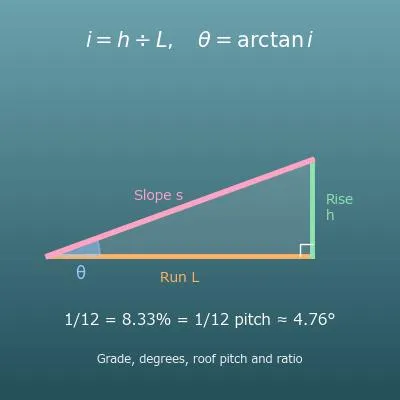
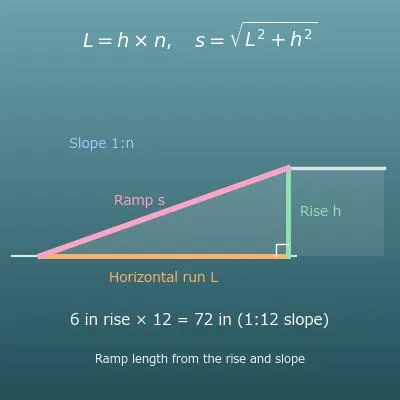
A road sign that warns of a "6% grade" means the road rises 6 feet for every 100 feet across. That is exactly \(\tan\theta = 0.06\) (about \(3.4^\circ\)). The ADA Standards limit wheelchair ramps to a slope of 1:12, which is \(\tan\theta = \dfrac{1}{12}\) (about \(4.8^\circ\)).
The tangent value is easier to use on the job than the angle, because it comes straight from the rise and the run. That is why slopes are labeled with this trig ratio as is.
If you cannot reach the top of something tall with a tape measure, you can find its height from the distance and the angle you look up at it (the angle of elevation): height = distance × \(\tan\theta\). For example, standing 60 feet from a tree with an angle of elevation of \(30^\circ\), the part above your eye level is \(60 \times \tan 30^\circ \approx 34.6\) feet.
Triangulation, used in land surveying and mapmaking, works out distances and positions from measured angles in the same way. Surveying instruments such as total stations also use trig ratios to turn measured angles and distances into coordinates.
Gravity pulls an object on a slope straight down. In physics, this pull is split into two parts: the part that tries to slide the object down the slope (weight × \(\sin\theta\)) and the part that presses it into the slope (weight × \(\cos\theta\)).
On a \(30^\circ\) slope, the force trying to slide the object down is \(\sin 30^\circ = \dfrac{1}{2}\) of its weight, which is half. How well a parking brake holds on a hill, or how fast you slide on a ski run of a given steepness: the physics of slopes always starts from this split.
When a game moves something "at speed \(v\) in the direction of angle \(\theta\)", the computer moves its position by \(v \times \cos\theta\) across and \(v \times \sin\theta\) up or down. The paths of bullets in a shooting game, the corners of a radar chart, the hands of a clock on the screen: every task that turns an angle into a position uses sin and cos.
The unit circle definition itself (\(x = \cos\theta,\ y = \sin\theta\)) is the program for rotation and circular motion on screen.
In US construction, the steepness of a roof is given as a pitch such as "4/12" (it rises 4 inches for every 12 inches across, so \(\tan\theta = \dfrac{4}{12} = \dfrac{1}{3}\), about \(18.4^\circ\)). Once the pitch is set, the length of a rafter is the run ÷ \(\cos\theta\): a 12-foot run needs about \(12 \div \cos 18.4^\circ \approx 12.65\) feet. Water runoff, snow sliding off and the amount of material are all estimated from this value.
Laying out roof angles with a carpenter's framing square also uses the side ratios of a right triangle, which is the idea of trig ratios itself.
Formulas and figures
Symbols and terms
Symbols
| \(\theta\) | theta | A Greek letter often used for angles (there is no settled explanation of why \(\theta\) is used). Besides \(\theta\), \(\alpha\) (alpha) and \(\beta\) (beta) are also used for angles. |
| \(\sin\theta\) | sine theta | The sine of angle \(\theta\): "opposite ÷ hypotenuse" in a right triangle, and the \(y\)-coordinate of the point \(P\) on the unit circle. The name is said to come from the Latin word sinus (a bay or fold). |
| \(\cos\theta\) | cosine theta | The cosine of angle \(\theta\): "adjacent ÷ hypotenuse" in a right triangle, and the \(x\)-coordinate of the point \(P\) on the unit circle. The "co" stands for "complementary": it is the sine of the complementary angle \(90^\circ - \theta\). |
| \(\tan\theta\) | tangent theta | The tangent of angle \(\theta\): "opposite ÷ adjacent" in a right triangle, which is the slope of a line. The name comes from the Latin word for "touching", because it appears as a length on a tangent line to the unit circle. |
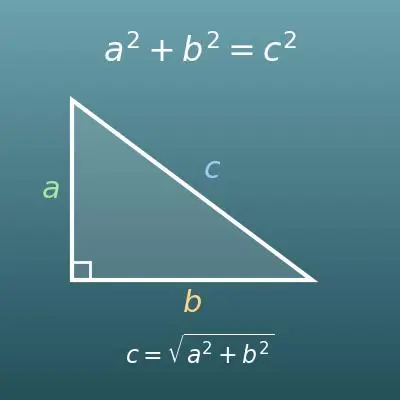
| \(a,\ b,\ c\) | a, b, c | On this page, the three sides of the right triangle: \(a\) is the opposite side (across from angle \(\theta\)), \(b\) is the adjacent side (next to angle \(\theta\)), and \(c\) is the hypotenuse. |
| \(P(x,\ y)\) | P of x, y | The point where the terminal side meets the unit circle. \(P\) stands for "point". Its \(x\)-coordinate is \(\cos\theta\) and its \(y\)-coordinate is \(\sin\theta\). |
| \(O\) | O | The origin (the point \((0, 0)\)), from the first letter of "origin". It is the center of the unit circle and the point the terminal side turns around. |
| \(\sqrt{2},\ \sqrt{3}\) | square root of 2, square root of 3 | The positive numbers whose squares are 2 and 3 (\(\sqrt{2} \approx 1.414,\ \sqrt{3} \approx 1.732\)). They appear in the side ratios of the special right triangles, so they show up often in the exact values of trig ratios for special angles. |
| \(^\circ\) (degrees) | degrees | The unit of angle size in degree measure. One full turn is \(360^\circ\). It is the most familiar way to express angles, also used in everyday life. |
| \(\pi\) | pi | The ratio of a circle's circumference to its diameter (\(\approx 3.14159\)). It is used when angles are given in radians: \(180^\circ = \pi\) radians. The letter is said to come from the first letter of the Greek word for "perimeter". |
Terms
| trigonometric ratio | The ratio of two sides of a right triangle. The three basic ones are sin, cos and tan. Once the angle is fixed, each has one value no matter how big the triangle is. Often shortened to "trig ratio". In the US, it is taught in Geometry and again in Algebra 2 or Precalculus. |
| sine | The full name of sin. Historically it goes back to half of a chord (a segment joining two points on a circle). |
| cosine | The full name of cos. It is short for "complement's sine": the sine of the complementary angle (the angle that adds up to 90°), \(\cos\theta = \sin(90^\circ - \theta)\). |
| tangent | The full name of tan. The name comes from the tangent line to a circle: \(\tan\theta\) can be drawn as a length on the line that touches the unit circle at \((1, 0)\). |
| hypotenuse | The longest side of a right triangle, across from the right angle. In the definitions of sin and cos, it is the number you divide by (the denominator). |
| opposite side | The side across from the angle \(\theta\) you are looking at. Note that which side is the opposite side changes depending on which angle you look at. |
| adjacent side | The side next to the angle \(\theta\) you are looking at (the side of the right angle that touches \(\theta\), not the hypotenuse). Note that which side is the adjacent side changes depending on which angle you look at. |
| unit circle | The circle of radius 1 centered at the origin. With the radius set to 1, the coordinates of a point are directly the values of sin and cos, without dividing by the hypotenuse. It is the tool that extends trig ratios to angles of 90° or more. |
| terminal side | The ray from the origin turned by angle \(\theta\) from the positive \(x\)-axis (the angle is in standard position). It shows the size of the angle on the diagram. |
| obtuse angle | An angle greater than 90° and less than 180°. Trig ratios of an obtuse angle cannot be defined with a right triangle, so the unit circle is used. For obtuse angles, cos and tan are negative. |
| right triangle | A triangle with one right angle (90°). It is where trig ratios were first defined. The other two angles add up to 90°. |
| special right triangles | The 45-45-90 triangle (side ratio \(1 : 1 : \sqrt{2}\)) and the 30-60-90 triangle (side ratio \(1 : \sqrt{3} : 2\)). The exact trig values of the special angles come from the side ratios of these two triangles. They are also the shapes of the two classic drafting triangles (set squares). |
| rationalizing the denominator | Rewriting a fraction so there is no square root in the denominator. Multiplying the top and bottom of \(\dfrac{1}{\sqrt{2}}\) by \(\sqrt{2}\) gives \(\dfrac{\sqrt{2}}{2}\). Both are the same value. US textbooks usually give the rationalized form \(\dfrac{\sqrt{2}}{2}\). |
| degree measure | Measuring angles with one full turn set to 360°. It is the main unit for input and output on this page. The number 360 has many factors (a half, a third, a quarter … of it are all whole numbers), and it has been used since ancient times. |
| radian measure (radians) | Measuring an angle by the length of the arc on a circle of radius 1. \(180^\circ = \pi\) radians, and angles are written as fractions of \(\pi\), such as \(60^\circ = \dfrac{\pi}{3}\). Radians are used from Precalculus on and are the main unit in calculus, so this page shows them too. |
| inverse trigonometric function | A function that works backward from the value of a trig ratio to the angle, as in "which θ gives sin θ = 0.5?". Examples are arcsine (\(\sin^{-1}\), arcsin) and friends. Scientific calculators and Excel have them. The "angle from a value" mode on this page is this calculation. |
| special angle | An angle such as 30°, 45°, 60°, 90° or 120° whose trig ratios can be written as exact values (with fractions and square roots). These are the angles of the special right triangles and angles made from them, such as 180° − θ. |
Good to know before you start
Here is what helps you use the calculation on this page with real understanding, not just by pressing the button.
If you get stuck, going back to these topics is the fastest way forward.
| Ratios and rates (Grade 6) |
|
| The coordinate plane (Grades 5–6) |
|
| Circles (Grade 7) |
|
| Similar triangles (Grade 8 and Geometry) |
|
| The Pythagorean theorem (Grade 8) |
|
| Square roots (Grade 8 and Algebra 1) |
|
How to calculate it in Excel
| Opposite a | 3 |
| Hypotenuse c | 5 |
| sin θ = a ÷ c | =B1/B2 |
| Adjacent b | 4 |
| Hypotenuse c | 5 |
| cos θ = b ÷ c | =B1/B2 |
| Opposite a | 3 |
| Adjacent b | 4 |
| tan θ = a ÷ b | =B1/B2 |
| Angle θ (degrees) | 60 |
| sin θ | =SIN(RADIANS(B1)) |
| cos θ | =COS(RADIANS(B1)) |
| tan θ | =TAN(RADIANS(B1)) |
| Value of sin θ | 0.5 |
| Angle 1 (degrees) | =DEGREES(ASIN(B1)) |
| Angle 2 (degrees) | =180-B2 |
The first three tables use a right triangle with side ratio 3 : 4 : 5. The answers are 0.6, 0.8 and 0.75.
The fourth table uses an angle of 60°: sin θ = 0.8660…, cos θ = 0.5 and tan θ = 1.7320….
The fifth table finds the angles where sin θ = 0.5: Angle 1 is 30 and Angle 2 is 150 (between 0° and 180°, two mirror-image angles have the same sine). For cos, use just one formula, "=DEGREES(ACOS(B1))". For tan, use "=DEGREES(ATAN(B1))" and add 180 if the answer is negative.
How to calculate it in Google Sheets
| Opposite a | 3 |
| Hypotenuse c | 5 |
| sin θ = a ÷ c | =B1/B2 |
| Adjacent b | 4 |
| Hypotenuse c | 5 |
| cos θ = b ÷ c | =B1/B2 |
| Opposite a | 3 |
| Adjacent b | 4 |
| tan θ = a ÷ b | =B1/B2 |
| Angle θ (degrees) | 60 |
| sin θ | =SIN(RADIANS(B1)) |
| cos θ | =COS(RADIANS(B1)) |
| tan θ | =TAN(RADIANS(B1)) |
| Value of sin θ | 0.5 |
| Angle 1 (degrees) | =DEGREES(ASIN(B1)) |
| Angle 2 (degrees) | =180-B2 |
How to calculate it in Python
import math

# Find sin, cos and tan from an angle
angle_degree = 60
angle_radian = math.radians(angle_degree)   # the math module's trig functions take radians
print(f"sin {angle_degree}° = {math.sin(angle_radian)}")
print(f"cos {angle_degree}° = {math.cos(angle_radian)}")
print(f"tan {angle_degree}° = {math.tan(angle_radian)}")

# Find the angle from the value of a trig ratio (0° to 180°)
sin_value = 0.5
angle_first = math.degrees(math.asin(sin_value))   # arcsine; the answer is in radians, so convert to degrees
angle_second = 180 - angle_first                   # sin(180° − θ) = sin θ gives the other angle
print(f"Angles where sin θ = {sin_value}: {angle_first}° and {angle_second}°")
How to write it in LaTeX and other math languages (copy and paste)
sin θ = a/c
\sin\theta = \dfrac{a}{c}
<math xmlns="http://www.w3.org/1998/Math/MathML" display="block">
<mrow>
<mi>sin</mi><mo>⁡</mo><mi>θ</mi>
<mo>=</mo>
<mfrac><mi>a</mi><mi>c</mi></mfrac>
</mrow>
</math>
sin theta = a/c
Sin[30 Degree]
sin(30*Pi/180);
sind(30)
sin θ = a/c
cos θ = b/c
\cos\theta = \dfrac{b}{c}
<math xmlns="http://www.w3.org/1998/Math/MathML" display="block">
<mrow>
<mi>cos</mi><mo>⁡</mo><mi>θ</mi>
<mo>=</mo>
<mfrac><mi>b</mi><mi>c</mi></mfrac>
</mrow>
</math>
cos theta = b/c
Cos[30 Degree]
cos(30*Pi/180);
cosd(30)
cos θ = b/c
tan θ = a/b
\tan\theta = \dfrac{a}{b}
<math xmlns="http://www.w3.org/1998/Math/MathML" display="block">
<mrow>
<mi>tan</mi><mo>⁡</mo><mi>θ</mi>
<mo>=</mo>
<mfrac><mi>a</mi><mi>b</mi></mfrac>
</mrow>
</math>
tan theta = a/b
Tan[30 Degree]
tan(30*Pi/180);
tand(30)
tan θ = a/b
cos θ = x, sin θ = y (point P(x, y) on the unit circle)
\cos\theta = x,\quad \sin\theta = y
<math xmlns="http://www.w3.org/1998/Math/MathML" display="block">
<mrow>
<mi>cos</mi><mo>⁡</mo><mi>θ</mi><mo>=</mo><mi>x</mi>
<mo>,</mo>
<mi>sin</mi><mo>⁡</mo><mi>θ</mi><mo>=</mo><mi>y</mi>
</mrow>
</math>
cos theta = x, sin theta = y
{Cos[120 Degree], Sin[120 Degree]}
evalf([cos(120*Pi/180), sin(120*Pi/180)]);
[cosd(120), sind(120)]
cos θ = x, sin θ = y
How to have ChatGPT do the calculation
You are a math calculation assistant for trigonometric ratios. Do the following calculation by actually running Python code, and base your answer only on the numbers from the execution result (do not answer by mental math or guessing).

1. Find sin 135°, cos 135° and tan 135°. Give each both as an exact value (with fractions and square roots) and as a decimal.
2. For 0° ≤ θ ≤ 180°, find every angle θ where sin θ = 0.5.

In Python, use the math module and convert degrees to radians before calculating. Show the formulas you used and the numbers from the execution result.
How to Use
-
1Enter your numbersType the numbers you want to calculate with into the input fields
-
2CalculatePress the "Calculate" button
-
3Check the resultThe result appears on the spot. The same page also explains the idea behind the calculation and the formula
DataChef Features

No technical knowledge required.
Intuitive and user-friendly operation.

Can be used without registering personal information.

Automatic file deletion by clicking "download".

and rapid file conversion.
No attribution required.

No need to contact us for commercial use permission.
Related Features
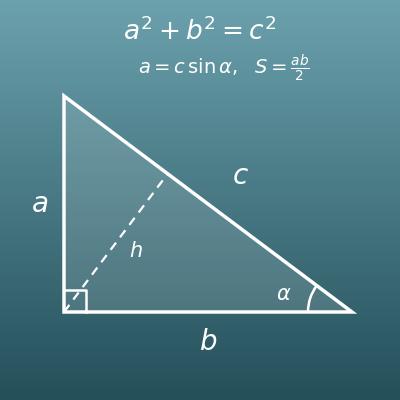
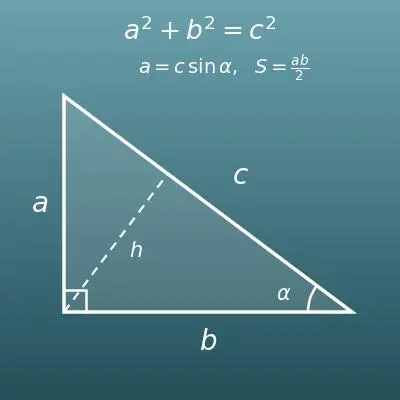
Right Triangle Calculator (Sides, Angles, Area and Height from Any Two Values)
Solves a right triangle from any two known values, finding the other sides, angles, area and height with the Pythagorean theorem and trig ratios
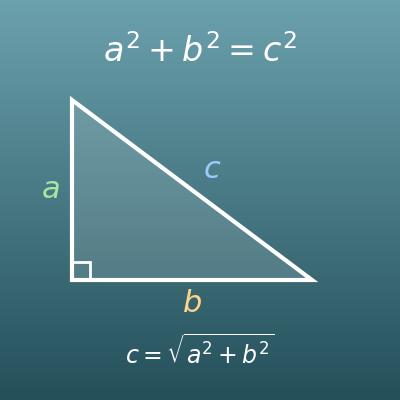
Pythagorean Theorem Calculator (Hypotenuse and Legs of a Right Triangle)
Finds the third side of a right triangle from the other two with a² + b² = c², step by step
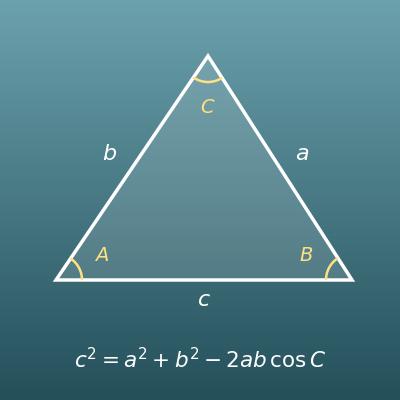
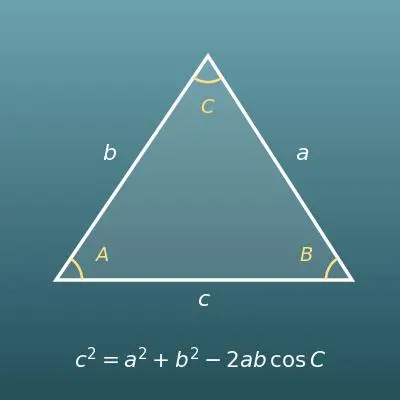
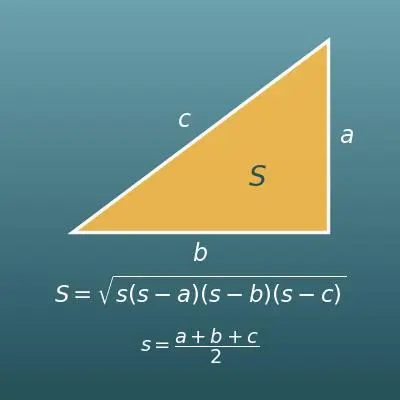
Triangle Calculator (Solve for Sides, Angles, Area and More)
Solves any triangle from three values with the law of cosines and the law of sines, including the area and the inscribed and circumscribed circles
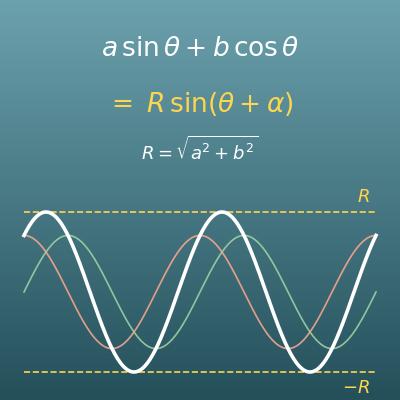
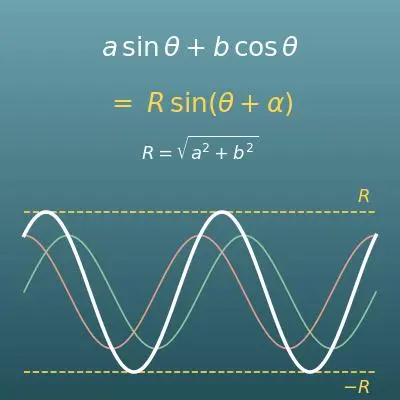
Harmonic Addition Calculator (a sin θ + b cos θ as R sin(θ + α), with Max and Min)
Combines a sin θ + b cos θ into a single sine wave R sin(θ + α), with the exact amplitude R = √(a² + b²), α as a fraction of π, and the maximum and minimum
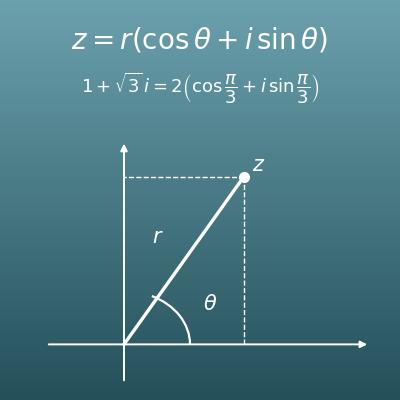
Complex Number to Polar Form Calculator (Modulus, Argument and Quadrant Steps with a Complex Plane Graph)
Converts a + bi to polar form r(cos θ + i sin θ), with the exact modulus and the argument as a fraction of π. Also converts polar form back to rectangular form
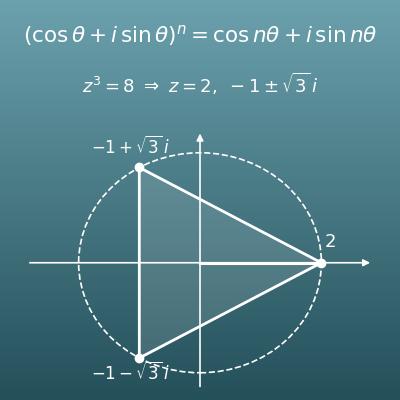
De Moivre's Theorem Calculator (Powers and nth Roots of Complex Numbers with Steps and a Polygon Graph)
Finds powers and nth roots of a complex number with De Moivre's theorem, with steps, and draws the roots as a regular polygon on a circle