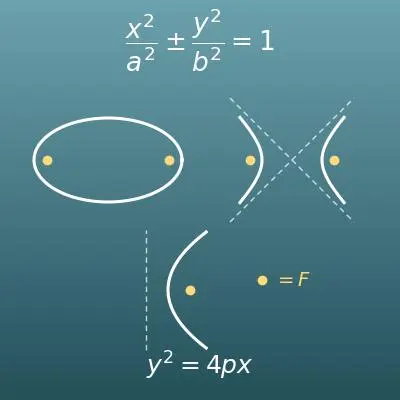
Choose the type of curve and enter the denominators (ellipse or hyperbola) or the coefficient of the linear term (parabola). The calculator finds the foci, vertices and eccentricity, plus the asymptotes of a hyperbola or the directrix of a parabola.
Table of Contents
-
What you can do on this page
-
What is this calculation used for?
-
How to Use
-
Formulas and figures
-
Symbols and terms
-
Good to know before you start
-
How to calculate it in Excel
-
How to calculate it in Google Sheets
-
How to calculate it in Python
-
How to write it in LaTeX and other math languages (copy and paste)
-
How to have ChatGPT do the calculation
-
DataChef Features
-
Related Features
-
NumberChef Calculators List
What you can do on this page
- Enter the denominators or the coefficient, and you get the foci, vertices and eccentricity of the ellipse \(\dfrac{x^{2}}{a^{2}} + \dfrac{y^{2}}{b^{2}} = 1\), the hyperbola \(\dfrac{x^{2}}{a^{2}} - \dfrac{y^{2}}{b^{2}} = \pm 1\) or the parabola \(y^{2} = 4px\) (and \(x^{2} = 4py\)) on the spot
- Answers are shown both as exact values with \(\sqrt{\ }\), such as \(\left(\pm\sqrt{5},\ 0\right)\), and as decimals. You can also see the steps that find the foci from \(c^{2} = a^{2} - b^{2}\)
- For a hyperbola you also get the asymptotes, and for a parabola the directrix. The curve, foci, asymptotes, directrix and vertices are drawn on a graph
- You can check the textbook definitions on the graph: "the sum (or difference) of the distances to the two foci is constant" and "the same distance from the focus and the directrix"
- A plain-language explanation of the formulas and copy-and-paste formulas for Excel, Google Sheets and Python are also on this page
What is this calculation used for?
Planets travel in elliptical orbits with the Sun at one focus (Kepler's first law). Earth's orbit has an eccentricity of about 0.017, very close to a circle, while Halley's Comet follows a long, thin ellipse with an eccentricity of about 0.97 and comes back to the Sun about every 76 years.
The same math is the basis for designing the paths of satellites and space probes, and the shape of an orbit (ellipse, parabola or hyperbola) is classified by its eccentricity. When a probe escapes a planet's gravity and flies away, its path is a hyperbola.
A surface made by spinning a parabola around its axis (a paraboloid) has this property: radio waves or light coming in parallel to the axis all reflect to the focus. A satellite TV dish gathers weak signals from far above into the receiver placed at the focus.
Car headlights and searchlights use it the other way around: light from a source at the focus reflects into a straight beam parallel to the axis. The position of the focus (the \(p\) this page calculates) is the key to the design.
An ellipse has this property: a wave that starts at one focus reflects off the ellipse and gathers at the other focus. Extracorporeal shock wave lithotripsy (ESWL) creates a shock wave at one focus of an elliptical reflector and lines up the other focus with the kidney stone inside the body, breaking the stone without surgery.
Finding the exact position of the foci directly affects how precise the treatment is.
A Cassegrain reflecting telescope combines a paraboloid primary mirror with a hyperboloid secondary mirror. It uses a property of the hyperboloid, "light heading toward one focus reflects and gathers at the other focus", to guide the light to the eyepiece at the back of the tube.
Large radio telescopes and satellite communication antennas mostly use the same design, so the focus properties of ellipses, hyperbolas and parabolas work together inside one device.
Some positioning systems use the very definition of a hyperbola: "the points whose distances to two fixed points differ by a constant". In hyperbolic navigation such as LORAN, a ship or aircraft measured the difference in arrival time of signals from two stations to find which hyperbola it was on, then found its position where that hyperbola crossed another one from a different pair of stations.
GPS has replaced it, but the idea of narrowing down a position from time differences lives on, for example in estimating the location of a cell phone during an emergency call.
Many of the huge cooling towers at power plants have the shape of a hyperboloid, made by spinning a hyperbola. This curved surface can be built just from straight steel members set at an angle, yet it is strong and saves material.
The main cable of a suspension bridge is a parabola when the weight of the deck is spread evenly along the horizontal. (A cable hanging only under its own weight forms a different curve that looks similar, called a catenary.) In design drawings, standard-form equations like the ones on this page define these shapes.
Formulas and figures
Symbols and terms
Symbols
| \(a,\ b\) | a, b | Positive numbers in the denominators of the standard forms of the ellipse and hyperbola (as \(a^{2}\) and \(b^{2}\)). For an ellipse, \(a\) is the radius in the \(x\) direction and \(b\) the radius in the \(y\) direction (each is half the major or minor axis). For a hyperbola, \(a\) is the distance from the center to a vertex. Note: many US textbooks always use \(a\) for the longer half-axis and write a tall ellipse as \(\dfrac{x^{2}}{b^{2}} + \dfrac{y^{2}}{a^{2}} = 1\); on this page, \(a^{2}\) is always the \(x^{2}\) denominator. |
| \(c\) | see | The distance from the center to a focus. The foci are at \((\pm c,\ 0)\) or \((0,\ \pm c)\). It is the third letter after \(a\) and \(b\). For an ellipse, \(c^{2} = a^{2} - b^{2}\); for a hyperbola, \(c^{2} = a^{2} + b^{2}\). |
| \(F,\ F'\) | F, F prime | Names of the foci, from the first letter of "focus". An ellipse or a hyperbola has two foci, and the second one is written \(F'\) (F prime). |
| \(P\) | pee | The name of a point on the curve, from the first letter of "point". It is used to state definitions, as in "for every point \(P\), the sum of the distances is constant". |
| \(PF\) | P F | The length of the segment joining the point \(P\) and the focus \(F\) (the distance from \(P\) to \(F\)). Writing the names of two points side by side for the length of a segment is the usual notation in geometry. |
| \(H\) | H | The name of the foot of the perpendicular from the point \(P\) on the parabola to the directrix (where it meets the directrix). \(H\) is a common letter for the foot of a perpendicular (said to come from "height"). The distance from \(P\) to the directrix is written \(PH\). |
| \(p\) | pee | For the parabola \(y^{2} = 4px\), the number that gives the distance from the vertex to the focus (a negative value gives the opposite direction). The focus is \((p,\ 0)\) and the directrix is \(x = -p\). The letter is said to come from "parameter". |
| \(e\) | e | The eccentricity, from the first letter of "eccentricity". A circle has \(e = 0\), an ellipse \(0 < e < 1\), a parabola \(e = 1\) and a hyperbola \(e > 1\). (It is not the number e ≈ 2.718.) |
| \(\pm\) | plus or minus | A sign that covers both the + case and the − case at once. The foci \((\pm 4,\ 0)\) are the two points \((4,\ 0)\) and \((-4,\ 0)\) written together. |
| \(\sqrt{\ }\) | square root | The sign for the square root (the positive number whose square is the number inside). It is used to get \(c = \sqrt{5}\) from \(c^{2} = 5\). \(\sqrt{5}\) is about 2.236. |
Terms
| conic section | A curve that is the edge you get when you slice a cone (like an ice cream cone) with a plane. Depending on the angle of the cut, the edge is a circle, an ellipse, a parabola or a hyperbola. They are taught in Precalculus. |
| second-degree curve | Another way to describe the conic sections: curves given by an equation of degree 2 in \(x\) and \(y\). Ellipses, hyperbolas, parabolas (and circles) are exactly these curves. |
| ellipse | The set of points whose distances to two foci add up to a constant. It looks like a circle squashed in one direction, and its standard form is \(\dfrac{x^{2}}{a^{2}} + \dfrac{y^{2}}{b^{2}} = 1\). |
| hyperbola | The set of points whose distances to two foci differ by a constant. It is a pair of curves opening left and right (or up and down), and its standard form is \(\dfrac{x^{2}}{a^{2}} - \dfrac{y^{2}}{b^{2}} = \pm 1\). |
| parabola | The set of points at the same distance from a focus and a directrix. It is the shape of the path of a thrown ball. Its standard form is \(y^{2} = 4px\) (or \(x^{2} = 4py\)). |
| focus | A special point that determines the shape of a conic section (plural: foci). An ellipse or a hyperbola has two, and a parabola has one. Foci gather light and radio waves, and the word "focus" comes from the Latin for "hearth" or "fireplace". |
| directrix | The line used to define a parabola. Every point on the parabola is the same distance from the focus as from the directrix. The directrix of \(y^{2} = 4px\) is \(x = -p\). |
| asymptote | A line that a curve gets closer and closer to but never reaches. The hyperbola \(\dfrac{x^{2}}{a^{2}} - \dfrac{y^{2}}{b^{2}} = \pm 1\) has two asymptotes, \(y = \pm\dfrac{b}{a}x\). |
| eccentricity | One number \(e\) that tells how far a curve is from being a circle ("eccentric" comes from "off-center"). With circle \(e = 0\), ellipse \(0 < e < 1\), parabola \(e = 1\) and hyperbola \(e > 1\), this one number sorts all the conic sections. |
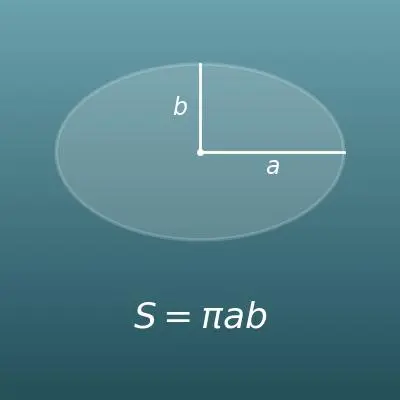
| major axis | The longest line segment across an ellipse through its center. For a wide ellipse its length is \(2a\), and the foci lie on the major axis. |
| minor axis | The shortest line segment across an ellipse through its center. For a wide ellipse its length is \(2b\), and it crosses the major axis at a right angle. |
| vertex | A point where the curve meets an axis of symmetry (plural: vertices). An ellipse has four (the ends of the major and minor axes; some textbooks call only the ends of the major axis vertices and the others co-vertices), a hyperbola has two, and a parabola has one (the origin). |
| standard form | The simplest form of the equation, with the center (for a parabola, the vertex) at the origin, such as \(\dfrac{x^{2}}{a^{2}} + \dfrac{y^{2}}{b^{2}} = 1\). It makes the foci and vertices easy to read. |
| square root | A number whose square is the given number. Getting \(c = 4\) from \(c^{2} = 16\) is "taking the square root". When the square root is not a whole number, the exact way to write it is with the root sign, such as \(\sqrt{5}\). |
Good to know before you start
Here is what helps you use the calculation on this page with real understanding, not just by pressing the button.
If you get stuck, going back to review these topics is the fastest way forward.
| Square roots (Grade 8 and Algebra 1) |
|
| The coordinate plane and the distance formula (Grades 6–8 and Geometry) |
|
| Graphs of quadratic functions (Algebra 1) |
|
| Equations of circles (Geometry and Algebra 2) |
|
| Fractions and ratios (Grades 5–7) |
|
How to calculate it in Excel
| x² denominator a² | 25 |
| y² denominator b² | 9 |
| c² = a² − b² | =B1-B2 |
| Distance to a focus c = √(c²) | =SQRT(B3) |
| Major axis length 2a | =2*SQRT(B1) |
| Minor axis length 2b | =2*SQRT(B2) |
| Eccentricity e = c/a | =B4/SQRT(B1) |
| x² denominator a² | 9 |
| y² denominator b² | 16 |
| c² = a² + b² | =B1+B2 |
| Distance to a focus c = √(c²) | =SQRT(B3) |
| Slope of the asymptotes b/a | =SQRT(B2/B1) |
| Eccentricity e = c/a | =B4/SQRT(B1) |
| x coefficient c | 8 |
| p = c ÷ 4 | =B1/4 |
| Focus x-coordinate (the focus is (p, 0)) | =B2 |
| Directrix x = −p | =-B2 |
The first table is the ellipse x²/25 + y²/9 = 1: c² = 16, c = 4, major axis 10, minor axis 6 and eccentricity 0.8. For a tall ellipse (a² < b²), change the c² formula to "=B2-B1" and the eccentricity to "=B4/SQRT(B2)".
The second table is the hyperbola x²/9 − y²/16 = 1: c² = 25, c = 5, asymptote slope 1.333… (= 4/3) and eccentricity 1.666… (= 5/3).
The third table is the parabola y² = 8x: p = 2, focus (2, 0) and directrix x = −2. For x² = cy (opens up or down), read the focus as (0, p) and the directrix as y = −p.
Excel gives decimal answers, so use the calculator on this page when you need exact values such as √5.
How to calculate it in Google Sheets
| x² denominator a² | 25 |
| y² denominator b² | 9 |
| c² = a² − b² | =B1-B2 |
| Distance to a focus c = √(c²) | =SQRT(B3) |
| Major axis length 2a | =2*SQRT(B1) |
| Minor axis length 2b | =2*SQRT(B2) |
| Eccentricity e = c/a | =B4/SQRT(B1) |
| x² denominator a² | 9 |
| y² denominator b² | 16 |
| c² = a² + b² | =B1+B2 |
| Distance to a focus c = √(c²) | =SQRT(B3) |
| Slope of the asymptotes b/a | =SQRT(B2/B1) |
| Eccentricity e = c/a | =B4/SQRT(B1) |
| x coefficient c | 8 |
| p = c ÷ 4 | =B1/4 |
| Focus x-coordinate (the focus is (p, 0)) | =B2 |
| Directrix x = −p | =-B2 |
How to calculate it in Python
from fractions import Fraction
import math

# Denominators of the ellipse x²/a² + y²/b² = 1 (a fraction such as 3/4 can be written as Fraction(3, 4))
x_denominator = Fraction(25)   # a²
y_denominator = Fraction(9)    # b²

# Ellipse: c² = larger denominator − smaller denominator (for a hyperbola, add them instead)
c_squared = abs(x_denominator - y_denominator)
c = math.sqrt(c_squared)
semi_major = math.sqrt(max(x_denominator, y_denominator))

print(f"c² = {c_squared}")
print(f"c = √{c_squared} = {c}")
if x_denominator >= y_denominator:
    print(f"Foci: (±{c}, 0)")   # wide → foci on the x-axis
else:
    print(f"Foci: (0, ±{c})")   # tall → foci on the y-axis
print(f"Eccentricity e = c ÷ {semi_major} = {c / semi_major}")
How to write it in LaTeX and other math languages (copy and paste)
c² = a² − b²
c^{2} = a^{2} - b^{2}
<math xmlns="http://www.w3.org/1998/Math/MathML" display="block">
<mrow>
<msup><mi>c</mi><mn>2</mn></msup>
<mo>=</mo>
<msup><mi>a</mi><mn>2</mn></msup>
<mo>−</mo>
<msup><mi>b</mi><mn>2</mn></msup>
</mrow>
</math>
c^2 = a^2 - b^2
c = Sqrt[a^2 - b^2]
c := sqrt(a^2 - b^2);
c = sqrt(a^2 - b^2);
c^2 = a^2 - b^2
c² = a² + b²
c^{2} = a^{2} + b^{2}
<math xmlns="http://www.w3.org/1998/Math/MathML" display="block">
  <mrow>
    <msup><mi>c</mi><mn>2</mn></msup>
    <mo>=</mo>
    <msup><mi>a</mi><mn>2</mn></msup>
    <mo>+</mo>
    <msup><mi>b</mi><mn>2</mn></msup>
  </mrow>
</math>
c^2 = a^2 + b^2
c = Sqrt[a^2 + b^2]
c := sqrt(a^2 + b^2);
c = sqrt(a^2 + b^2);
c^2 = a^2 + b^2
y² = 4px
y^{2} = 4px
<math xmlns="http://www.w3.org/1998/Math/MathML" display="block">
  <mrow>
    <msup><mi>y</mi><mn>2</mn></msup>
    <mo>=</mo>
    <mn>4</mn><mi>p</mi><mi>x</mi>
  </mrow>
</math>
y^2 = 4px
y^2 == 4 p x
y^2 = 4*p*x;
y^2 == 4*p*x
y^2 = 4px
e = c/a
e = \dfrac{c}{a}
<math xmlns="http://www.w3.org/1998/Math/MathML" display="block">
  <mrow>
    <mi>e</mi>
    <mo>=</mo>
    <mfrac><mi>c</mi><mi>a</mi></mfrac>
  </mrow>
</math>
e = c/a
e = c/a
e := c/a;
e = c/a;
e = c/a
How to have ChatGPT do the calculation
You are a math assistant for conic sections (Precalculus). Do the following calculation by actually running Python code, and base your answer only on the numbers from the execution result (do not answer by mental math or guessing).

For the ellipse x²/9 + y²/4 = 1, show each of the following:
1. The value of c² = a² − b²
2. The distance c from the center to a focus (both as an exact value with √ and as a decimal)
3. The coordinates of the foci
4. The length of the major axis 2a and the length of the minor axis 2b
5. The eccentricity e = c/a (both as an exact value and as a decimal)

In Python, use sympy (or fractions and math if sympy is not available), and get exact values such as √5 with sympy.sqrt. Show the formulas you used and the numbers from the execution result.
How to Use
-
1Enter your numbersType the numbers you want to calculate with into the input fields
-
2CalculatePress the "Calculate" button
-
3Check the resultThe result appears on the spot. The same page also explains the idea behind the calculation and the formula
DataChef Features

No technical knowledge required.
Intuitive and user-friendly operation.

Can be used without registering personal information.

Automatic file deletion by clicking "download".

and rapid file conversion.
No attribution required.

No need to contact us for commercial use permission.
Related Features
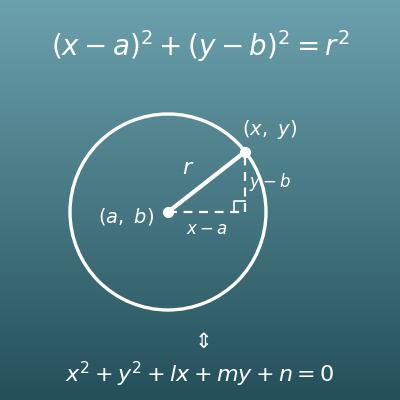
Equation of a Circle Calculator (General and Standard Form, Center, Radius, Circle and Line)
Convert the equation of a circle between general and standard form with completing-the-square steps, and find the center, the radius and how a line meets the circle
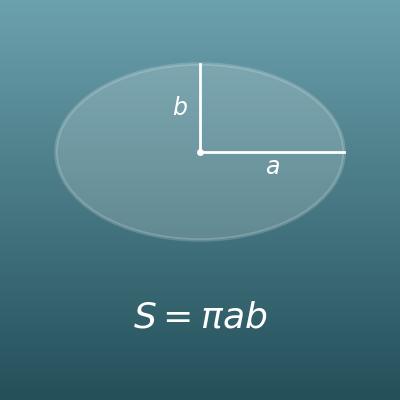
Area of an Ellipse Calculator (π × Semi-Major Axis × Semi-Minor Axis)
Enter the semi-major and semi-minor axes to get the area of an ellipse, also shown in exact form with π (such as 600π)
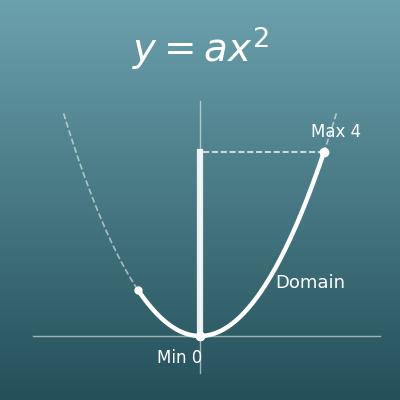
Quadratic Function y = ax² Calculator (Range for a Given Domain and Average Rate of Change)
Find the range, the average rate of change and the value of y for y=ax², with case-by-case steps and a graph of the parabola