













Enter the indoor and outdoor temperatures, then the area and U-factor of each part (choosing a preset fills in a typical U). The ventilation rate, heating hours, COP, electricity rate and improvement comparison can be left blank (those items are then skipped).
Table of Contents
-
What you can do on this page
-
What is this calculation used for?
-
How to Use
-
Formulas and figures
-
Symbols and terms
-
Good to know before you start
-
How to calculate it in Excel
-
How to calculate it in Google Sheets
-
How to calculate it in Python
-
How to write it in LaTeX and other math languages (copy and paste)
-
How to have ChatGPT do the calculation
-
DataChef Features
-
Related Features
-
NumberChef Calculators List
What you can do on this page
- Enter the area and the U-factor \(U\) of each part of the room, such as walls, windows, ceiling (roof), floor and doors, and see right away how much heat escapes through each part (BTU/h) and in total, from the indoor-outdoor temperature difference
- Pick a U-factor from the presets (typical values for single-pane windows, double-pane windows, insulated walls and so on), and change it to the value from an NFRC window label or the plans
- A bar chart shows what percent of the heat escapes through each part, so priorities such as "the window is the weak spot" are clear at a glance
- Enter the ventilation rate (CFM) to add the ventilation heat loss (\(1.08 \times \mathrm{CFM} \times \Delta T\)) and get a guide to the heating capacity needed
- Enter the heating hours, COP and electricity rate for the daily heat (kWh) and electricity cost, and compare improvements such as "how much less heat escapes with low-E windows". A plain-language explanation of the formulas and copy-and-paste formulas for Excel, Google Sheets and Python are also on this page
What is this calculation used for?
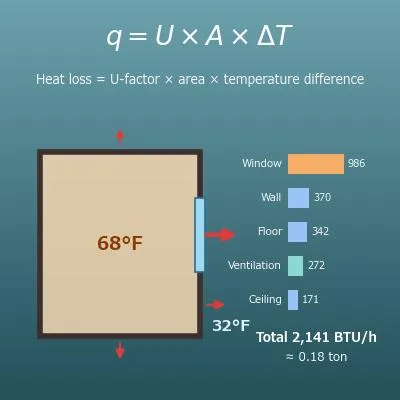
If you suspect the window makes the room cold, this formula can check it. In a 12 × 9 ft room (wall 130 ft² at U 0.079, double-pane window 33 ft² at U 0.83, ceiling and floor 108 ft² at U 0.044 and 0.088) with a 36 °F difference, the parts lose \(369.7 + 986.0 + 171.1 + 342.1 \approx 1869\) BTU/h, and the window, the smallest area, loses more than half of it.
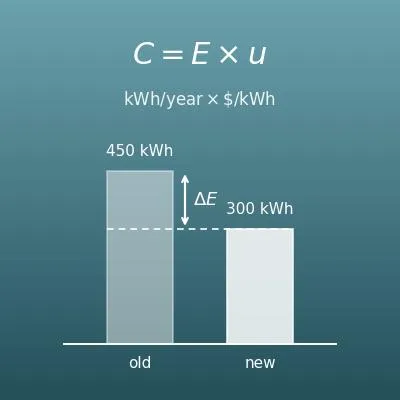
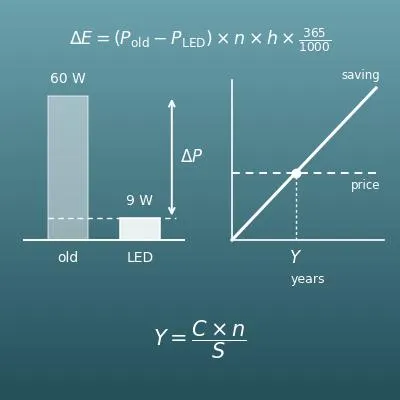
Replacing it with a low-E double-pane vinyl window (about U 0.39) saves \((0.83 - 0.39) \times 33 \times 36 \approx 523\) BTU/h, about 24% of the total with ventilation (2,141 BTU/h). Entering the U-factors from the labels of storm windows or replacement windows lets you compare which job helps most. Real results also depend on installation and air leaks, so treat it as an estimate.
In an old house with no insulation, a room with 215 ft² of wall (about U 0.44), 43 ft² of single-pane window (about U 1.14), 130 ft² of ceiling (about U 0.62) and 130 ft² of floor (about U 0.53), at 68 °F inside and 20 °F outside (48 °F difference), loses \(4541 + 2353 + 3869 + 3307 \approx 14070\) BTU/h through the parts.
The shares are about 32% wall, 27% ceiling, 24% floor and 17% window, so the heat escapes everywhere, not only through the window. That points to priorities such as adding attic insulation or insulating under the floor. The preset values are rough, so use the values from an energy audit or the plans if you have them.
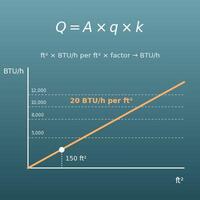
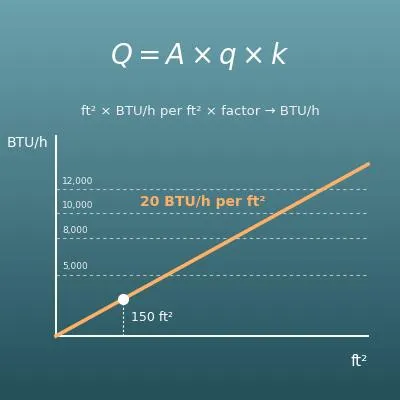
A room with a total heat loss of 2,141 BTU/h needs about 2,100 BTU/h of heat (about 0.63 kW) to hold its temperature. That is the steady-state value. Warming a cold room quickly takes more, and real equipment is chosen with some margin.
Still, the formula tells you that a well-insulated room can get by with a small heater, while the uninsulated room above (about 14,000 BTU/h, over 4 kW) is far beyond a 1,500 W space heater (about 5,100 BTU/h). For a whole house, heating contractors size equipment with an ACCA Manual J load calculation. The "Air Conditioner Size Calculator" and the "Heating Cost Comparison Calculator" help with choosing equipment and comparing running costs.
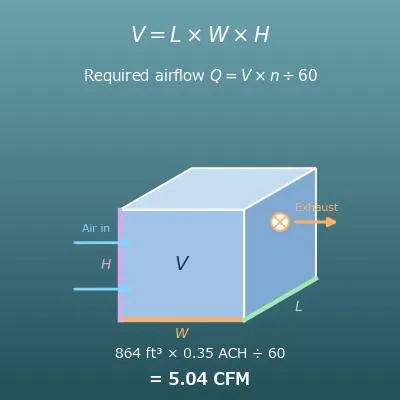
Ventilating a 864 ft³ room at 0.5 air changes per hour is about 7 CFM, and with a 36 °F difference \(1.08 \times 7 \times 36 \approx 272\) BTU/h escapes through ventilation. In a well-insulated room, the loss through the parts is small, so ventilation becomes a bigger share, and in very tight, well-insulated homes it can approach 20% of the total.
Turning off ventilation would cut the loss, but it lets indoor air go stale and can cause condensation. Instead, a heat recovery ventilator (HRV or ERV) can recover the heat, and sealing air leaks cuts unplanned ventilation. The "Room Volume and Ventilation Calculator" finds the ventilation rate.
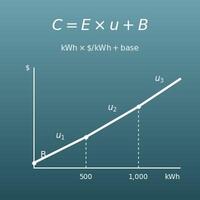
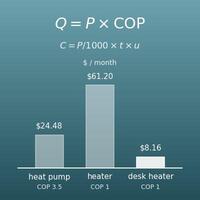
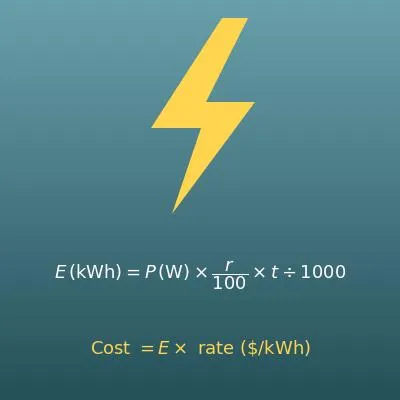
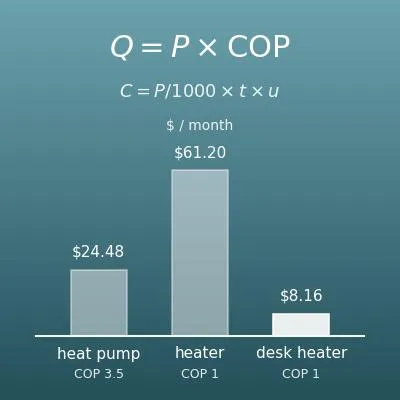
Heating a room with a total heat loss of 2,141 BTU/h for 8 hours a day takes \(2141.1 \times 8 \div 3412.14 \approx 5.02\) kWh of heat a day. With a heat pump of COP 3 that is about 1.67 kWh of electricity, or about $0.28 a day at $0.17/kWh, while a resistance heater (COP 1) would cost about $0.85.
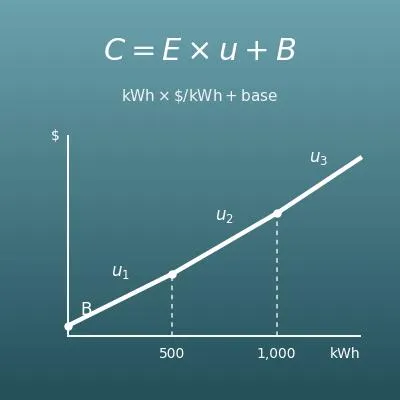
Over a 150-day heating season that is about $43 with the heat pump and about $128 with resistance heat. Because the heat loss saved by an upgrade (BTU/h) turns directly into dollars, you can also get a rough idea of how many years an upgrade takes to pay for itself. The outdoor temperature changes day by day, so use an average winter temperature for cost estimates.
Whole-house tools use the same U × A idea as this formula, summed over the entire building envelope. Code compliance tools such as REScheck compare the envelope's total UA with a code-built house, and an ACCA Manual J load calculation sizes heating and cooling equipment with detailed rules for framing, buffer spaces, infiltration and local design temperatures.
This page is for estimating the heat loss of the room you are in, from areas you can measure and typical U-factors. Entering U-factors from labels or the plans makes it more accurate, but it is not meant for code compliance or official equipment sizing.
Formulas and figures
Symbols and terms
Symbols
| \(\Delta T\) | delta T | The indoor-outdoor temperature difference (°F, or K in metric). \(\Delta\) (delta) is the Greek letter for "difference" and \(T\) is from "temperature". \(\Delta T = T_{in} - T_{out}\). |
| \(T_{in}\) | T sub in | The indoor temperature (°F). The subscript "in" stands for inside. |
| \(T_{out}\) | T sub out | The outdoor temperature (°F). The subscript "out" stands for outside. For parts facing an attic or crawl space, the real temperature there is a little milder than outdoors. |
| \(i\) | i | The number of a part (1, 2, 3 and so on). From "index". "Part \(i\)" stands for "each part". |
| \(U_i\) | U sub i | The U-factor of part \(i\) (BTU/(h·ft²·°F)). The heat that passes through 1 ft² per hour for each °F of difference. The smaller it is, the better the part insulates. U is the customary symbol for it. |
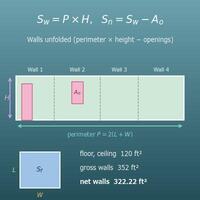
| \(A_i\) | A sub i | The area of part \(i\) (ft²). From "area". For a wall, use the net area without windows and doors. |
| \(q_i\) | q sub i | The heat loss of part \(i\) (BTU/h). A quantity of heat is customarily written \(q\). \(q_i = U_i \times A_i \times \Delta T\). |
| \(c\) | c | The ventilation factor (BTU/(h·CFM·°F)), the heat lost per hour for each CFM and each °F, usually 1.08. It comes from the heat capacity of air (in metric, about 0.34 Wh/(m³·K)). From "capacity". |
| \(V\) | V | The ventilation rate (CFM, ft³ per minute). From "ventilation". Room volume × air changes per hour ÷ 60. |
| \(q_v\) | q sub v | The ventilation heat loss (BTU/h). The subscript v is for ventilation. \(q_v = c \times V \times \Delta T\). |
| \(\sum\) | sigma | The symbol for "add them all up" (capital Greek sigma). \(\sum q_i\) is the sum of \(q_i\) for all the parts. |
| \(Q\) | capital Q | The total heat loss (BTU/h). The heat loss of all the parts plus the ventilation heat loss, which is the heat the heating system must keep putting out. |
| \(p_i\) | p sub i | The share of part \(i\) (%). From "proportion". \(p_i = q_i \div Q \times 100\). |
| \(P\) | capital P | The heating capacity needed (tons). From "power". \(Q\) divided by 12,000 (1 ton = 12,000 BTU/h). |
| \(h\) | h | The heating hours per day. From "hour". |
| \(E\) | E | The heat needed per day (kWh). From "energy". \(E = Q \times h \div 3412.14\). |
| \(\mathrm{COP}\) | C O P | The coefficient of performance of a heater: how many times more heat than electricity it puts out. 1 for a resistance heater and about 2 to 4 for a heat pump. |
| \(u\) | lowercase u | The electricity rate ($/kWh). From "unit price". Not the same as the U-factor \(U\) (capital). |
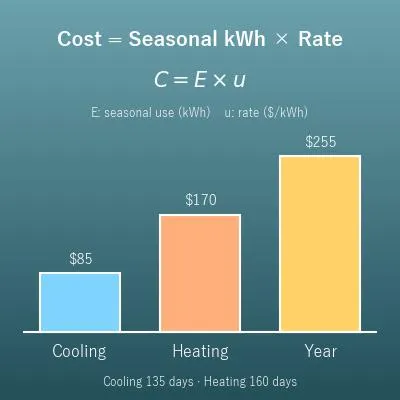
| \(C\) | capital C | The estimated electricity cost per day ($). From "cost". \(C = E \div \mathrm{COP} \times u\). |
| \(R\) | R | The R-value of the materials (h·ft²·°F/BTU). From "resistance". The R-values of the layers add up. |
| \(R_{si}\) | R sub s i | The inside air film resistance. The subscript si stands for surface inside. For walls it is usually about 0.68 h·ft²·°F/BTU. |
| \(R_{se}\) | R sub s e | The outside air film resistance. The subscript se stands for surface exterior. For walls exposed to wind it is usually about 0.17 h·ft²·°F/BTU. |
| \(U'\) | U prime | The U-factor after the improvement (BTU/(h·ft²·°F)). The prime mark customarily marks "the changed value". |
| \(\Delta q\) | delta q | The heat loss saved by an improvement (BTU/h). The difference between the heat loss before and after, \(\Delta q = (U - U') \times A \times \Delta T\). |
| \(\mathrm{W}\) | watt | The metric unit of heat (energy) per second. 1 W = 1 joule per second ≈ 3.412 BTU/h. |
| \(\mathrm{K}\) | kelvin | A unit of temperature used for differences in metric. A difference of 1 K is the same as 1 °C, or 1.8 °F. |
| \(\mathrm{kWh}\) | kilowatt-hour | A unit of energy: 1 kW (1,000 W) for 1 hour, equal to 3,412.14 BTU. Electricity is billed in it. |
Terms
| heat loss | The heat that escapes from a room through the walls, windows, ceiling, floor and ventilation, measured per hour in BTU/h (or per second in watts). A heating system holds the room temperature by putting out as much heat as is lost. |
| U-factor | The heat a wall, window or other part lets through per hour for each square foot and each °F of difference (BTU/(h·ft²·°F)), also called U-value. The smaller it is, the better it insulates. It is 1 divided by the total R-value. Windows and doors show it on the NFRC label. |
| R-value | How well a layer resists heat (h·ft²·°F/BTU), printed on insulation as R-13, R-30 and so on. The larger it is, the better the layer insulates. The R-values of layers add up. |
| thermal conductivity | How easily heat travels through a material, often written as k (BTU·in/(h·ft²·°F)). The smaller it is, the better the material insulates. R-value = thickness ÷ conductivity. |
| air film | The resistance to heat flow between a surface and the air, given as an R-value. For walls, about 0.68 inside and 0.17 outside are usually used. Add them to the R-values of the materials before taking 1 ÷ total for the U-factor. |
| temperature difference | The difference between the indoor and outdoor temperatures. Heat flow is proportional to it, so every calculation on this page starts from it. |
| ventilation rate | The volume of air exchanged, in CFM (ft³ per minute) in the US. Room volume × air changes per hour ÷ 60. |
| air changes per hour | How many times the air in a room is replaced in an hour (ACH). Mechanical ventilation often uses about 0.35 to 0.5 ACH. |
| volumetric heat capacity | The heat needed to warm a unit volume of a material by one degree. For air it is density × specific heat, which gives the ventilation factor 1.08 BTU/(h·CFM·°F) (about 0.34 Wh/(m³·K) in metric). |
| steady state | When the indoor and outdoor temperatures stay constant and heat in and out are in balance. The formulas on this page assume it, so the extra heat to warm up a room and changing weather are not included. |
| heating load | The heat a heating system must put out to hold the room temperature. On this page it is the total heat loss. Detailed design calculations subtract heat from the sun and inside the house. |
| building envelope | The parts that enclose a building (walls, roof, ceiling, floor, windows and doors). A whole house's insulation performance is judged by the heat loss of the whole envelope. |
| UA | The sum of U × A over the whole building envelope (BTU/(h·°F)). Code compliance tools such as REScheck compare it with a code-built house. It covers the whole building, not the single room this page estimates. |
| Manual J | The ACCA (Air Conditioning Contractors of America) standard method for calculating a home's heating and cooling loads, used to size furnaces, heat pumps and air conditioners. It goes into much more detail than this page. |
| thermal bridge | A spot where heat gets through more easily because the insulation is interrupted, such as studs, headers and metal fasteners. Whole-wall U-factors account for the framing. |
| buffer space | An unheated space such as an attic, crawl space or garage that is milder than the outdoors. Detailed calculations use a smaller temperature difference for parts facing it. This page does not, so ceilings and floors come out a little high. |
| attic | The space between the ceiling and the roof. Ceiling insulation is laid here, and heat escaping through the ceiling goes into the attic first, which is a little milder than outdoors. |
| continuous insulation | A layer of rigid insulation over the outside (or inside) of the studs, in addition to the insulation between them. It is not broken by the studs, so it lowers the wall's U-factor a lot. |
| openings | Windows, doors and other openings in a wall. Use the wall area minus the openings, and enter windows and doors as their own parts. |
| single pane | A window with one layer of glass. It insulates poorly, and in an aluminum frame the U-factor is often over 1.1 BTU/(h·ft²·°F). |
| double pane | Two layers of glass with air or gas between them, also called insulated glass. It lets through much less heat than single pane. |
| low-E | A thin metallic coating on window glass that reflects heat. Low-E stands for low emissivity. Low-E double-pane glass in a vinyl frame brings the window U-factor down to about 0.3 to 0.4. |
| vinyl frame | A window frame made of vinyl (PVC). Aluminum conducts heat well, so vinyl or wood frames give a lower whole-window U-factor than aluminum frames. |
| storm window | An extra window added inside or outside an existing window. It is a common way to lower a window's U-factor, and you can use the comparison inputs to see its effect. |
| COP | The coefficient of performance: how many times more heat than electricity a heater puts out. 1 for a resistance heater and about 2 to 4 for a heat pump. It is heating output ÷ power used. |
| heat pump | A system that moves heat from the outside air (or the ground) into the house. It delivers the same heat with less electricity than a resistance heater. |
| solar heat gain | Heat that comes in as sunlight through windows. In winter it offsets some of the heat loss, but this page's estimate does not include it. |
| internal heat gain | Heat from people, appliances and lights. It helps the heating, so design calculations subtract it, but this page's estimate does not include it. |
| infiltration | Air leaking in and out through gaps around windows, doors and other cracks. It causes heat loss by the same formula as ventilation, so in a leaky house, enter a higher ventilation rate to get closer to reality. |
| heat recovery ventilator | A ventilation unit (HRV, or ERV that also moves moisture) that passes heat from the outgoing air to the incoming air. The ventilation heat loss is smaller by the heat it recovers. |
Good to know before you start
Here is what helps to understand before you start, so that you can use the calculations on this page with a clear understanding.
| Multiplying and dividing decimals (Grade 5 to 6) |
|
| Percents (Grade 6) |
|
| Converting units (Grade 6 and middle school science) |
|
| Proportional relationships (Grade 6 to 7) |
|
| Reciprocals (Grade 6) |
|
| How heat moves (elementary and middle school science) |
|
| Power and energy (middle school science) |
|
How to calculate it in Excel
| Indoor temperature (°F) | 68 |
| Outdoor temperature (°F) | 32 |
| Temperature difference ΔT (°F) | =B1-B2 |
| U-factor U (BTU/(h·ft²·°F)) | 0.83 |
| Area A (ft²) | 33 |
| Temperature difference ΔT (°F) | 36 |
| Heat loss q (BTU/h) | =B1*B2*B3 |
| Ventilation factor c (BTU/(h·CFM·°F)) | 1.08 |
| Ventilation rate V (CFM) | 7 |
| Temperature difference ΔT (°F) | 36 |
| Ventilation heat loss qv (BTU/h) | =B1*B2*B3 |
| Wall heat loss (BTU/h) | 369.72 |
| Window heat loss (BTU/h) | 986.04 |
| Ceiling heat loss (BTU/h) | 171.072 |
| Floor heat loss (BTU/h) | 342.144 |
| Ventilation heat loss (BTU/h) | 272.16 |
| Total heat loss Q (BTU/h) | =SUM(B1:B5) |
| Window share (%) | =B2/B6*100 |
| Total heat loss Q (BTU/h) | 2141.136 |
| Heating hours per day h | 8 |
| Heating capacity P (tons) | =B1/12000 |
| Heat per day E (kWh) | =B1*B2/3412.14 |
| Heat per day E (kWh) | 5.02 |
| Heater COP | 3 |
| Electricity rate u ($/kWh) | 0.17 |
| Electricity cost per day C ($) | =B1/B2*B3 |
| Inside air film Rsi (h·ft²·°F/BTU) | 0.68 |
| R-value of the materials R (h·ft²·°F/BTU) | 13 |
| Outside air film Rse (h·ft²·°F/BTU) | 0.17 |
| U-factor U (BTU/(h·ft²·°F)) | =1/(B1+B2+B3) |
| U-factor before U | 0.83 |
| U-factor after U' | 0.39 |
| Area A (ft²) | 33 |
| Temperature difference ΔT (°F) | 36 |
| Heat loss saved Δq (BTU/h) | =(B1-B2)*B3*B4 |
SUM(B1:B5) adds up B1 through B5 (the Σ in the formulas).
B3 in the 1st table is 36, B4 in the 2nd table is about 986.0, B4 in the 3rd table is about 272.2, the 4th table gives about 2,141.1 in B6 and about 46.1 in B7, the 5th table gives about 0.18 in B3 and about 5.02 in B4, B4 in the 6th table is about 0.28, B4 in the 7th table is about 0.072, and B5 in the 8th table is about 522.7. Just replace the numbers in column B with your own. To add parts, add rows to the 4th table and widen the SUM range.
How to calculate it in Google Sheets
| Indoor temperature (°F) | 68 |
| Outdoor temperature (°F) | 32 |
| Temperature difference ΔT (°F) | =B1-B2 |
| U-factor U (BTU/(h·ft²·°F)) | 0.83 |
| Area A (ft²) | 33 |
| Temperature difference ΔT (°F) | 36 |
| Heat loss q (BTU/h) | =B1*B2*B3 |
| Ventilation factor c (BTU/(h·CFM·°F)) | 1.08 |
| Ventilation rate V (CFM) | 7 |
| Temperature difference ΔT (°F) | 36 |
| Ventilation heat loss qv (BTU/h) | =B1*B2*B3 |
| Wall heat loss (BTU/h) | 369.72 |
| Window heat loss (BTU/h) | 986.04 |
| Ceiling heat loss (BTU/h) | 171.072 |
| Floor heat loss (BTU/h) | 342.144 |
| Ventilation heat loss (BTU/h) | 272.16 |
| Total heat loss Q (BTU/h) | =SUM(B1:B5) |
| Window share (%) | =B2/B6*100 |
| Total heat loss Q (BTU/h) | 2141.136 |
| Heating hours per day h | 8 |
| Heating capacity P (tons) | =B1/12000 |
| Heat per day E (kWh) | =B1*B2/3412.14 |
| Heat per day E (kWh) | 5.02 |
| Heater COP | 3 |
| Electricity rate u ($/kWh) | 0.17 |
| Electricity cost per day C ($) | =B1/B2*B3 |
| Inside air film Rsi (h·ft²·°F/BTU) | 0.68 |
| R-value of the materials R (h·ft²·°F/BTU) | 13 |
| Outside air film Rse (h·ft²·°F/BTU) | 0.17 |
| U-factor U (BTU/(h·ft²·°F)) | =1/(B1+B2+B3) |
| U-factor before U | 0.83 |
| U-factor after U' | 0.39 |
| Area A (ft²) | 33 |
| Temperature difference ΔT (°F) | 36 |
| Heat loss saved Δq (BTU/h) | =(B1-B2)*B3*B4 |
How to calculate it in Python
t_in = 68          # indoor temperature (F)
t_out = 32         # outdoor temperature (F)
# each part: (name, U-factor [BTU/(h*ft2*F)], area [ft2]); change the U-factors to values from labels or the plans
parts = [
    ("Wall", 0.079, 130),
    ("Window", 0.83, 33),
    ("Ceiling", 0.044, 108),
    ("Floor", 0.088, 108),
]
ventilation_cfm = 7        # ventilation rate (CFM); 0 if not used
vent_factor = 1.08         # ventilation factor (BTU/(h*CFM*F))
heating_hours = 8          # heating hours per day
cop = 3                    # heater COP (1 for a resistance heater)
price_per_kwh = 0.17       # electricity rate ($/kWh)
improved = ("Window", 0.39)  # improvement: (name of the part, U-factor after U')

delta_t = t_in - t_out                                              # temperature difference (F)
losses = [(name, u * area * delta_t) for name, u, area in parts]    # heat loss of each part q_i (BTU/h)
envelope = sum(q for _, q in losses)                                # heat loss through the parts
vent = vent_factor * ventilation_cfm * delta_t                      # ventilation heat loss q_v (BTU/h)
total = envelope + vent                                             # total heat loss Q (BTU/h)
tons = total / 12000                                                # heating capacity (tons)
energy_kwh = total * heating_hours / 3412.14                        # heat per day E (kWh)
cost = energy_kwh / cop * price_per_kwh                             # electricity cost per day C ($)

print(f"Temperature difference: {delta_t} F")
for name, q in losses:
    print(f"{name}: {q:.1f} BTU/h ({q / total * 100:.1f} %)")
print(f"Ventilation: {vent:.1f} BTU/h ({vent / total * 100:.1f} %)")
print(f"Total: {total:.1f} BTU/h -> heating capacity {tons:.2f} tons")
print(f"Heat per day: {energy_kwh:.2f} kWh, electricity cost per day: ${cost:.2f}")

# improvement: dq = (U - U') x A x dT
for name, u, area in parts:
    if name == improved[0]:
        saved = (u - improved[1]) * area * delta_t
        print(f"Improving the {name} to U={improved[1]} saves {saved:.1f} BTU/h ({saved / total * 100:.1f} % of the total)")
How to write it in LaTeX and other math languages (copy and paste)
ΔT = T_in − T_out
\Delta T = T_{in} - T_{out}
<math xmlns="http://www.w3.org/1998/Math/MathML" display="block">
  <mrow>
    <mi>Δ</mi><mi>T</mi><mo>=</mo>
    <msub><mi>T</mi><mi>in</mi></msub><mo>−</mo><msub><mi>T</mi><mi>out</mi></msub>
  </mrow>
</math>
Delta T = T_(in) - T_(out)
tIn - tOut
DeltaT := T_in - T_out;
DeltaT = T_in - T_out;
ΔT = T_in − T_out
qᵢ = Uᵢ × Aᵢ × ΔT
q_i = U_i \times A_i \times \Delta T
<math xmlns="http://www.w3.org/1998/Math/MathML" display="block">
<mrow>
<msub><mi>q</mi><mi>i</mi></msub><mo>=</mo>
<msub><mi>U</mi><mi>i</mi></msub><mo>×</mo>
<msub><mi>A</mi><mi>i</mi></msub><mo>×</mo>
<mi>Δ</mi><mi>T</mi>
</mrow>
</math>
q_i = U_i xx A_i xx Delta T
u*a*deltaT
q := U*A*DeltaT;
q = U*A*DeltaT;
q_i = U_i × A_i × ΔT
q_v = c × V × ΔT
q_v = c \times V \times \Delta T
<math xmlns="http://www.w3.org/1998/Math/MathML" display="block">
<mrow>
<msub><mi>q</mi><mi>v</mi></msub><mo>=</mo>
<mi>c</mi><mo>×</mo><mi>V</mi><mo>×</mo>
<mi>Δ</mi><mi>T</mi>
</mrow>
</math>
q_v = c xx V xx Delta T
c*v*deltaT
q_v := c*V*DeltaT;
q_v = c*V*DeltaT;
q_v = c × V × ΔT
Q = Σ qᵢ + q_v, pᵢ = qᵢ ÷ Q × 100
Q = \sum_{i} q_i + q_v,\quad p_i = \frac{q_i}{Q} \times 100
<math xmlns="http://www.w3.org/1998/Math/MathML" display="block">
<mrow>
<mi>Q</mi><mo>=</mo>
<munder><mo>∑</mo><mi>i</mi></munder><msub><mi>q</mi><mi>i</mi></msub>
<mo>+</mo><msub><mi>q</mi><mi>v</mi></msub>
<mo>,</mo>
<msub><mi>p</mi><mi>i</mi></msub><mo>=</mo>
<mfrac><msub><mi>q</mi><mi>i</mi></msub><mi>Q</mi></mfrac>
<mo>×</mo><mn>100</mn>
</mrow>
</math>
Q = sum q_i + q_v, p_i = q_i / Q xx 100
{Total[q] + qv, q/(Total[q] + qv)*100}
Q := add(q[i], i = 1 .. n) + q_v; p[i] := q[i]/Q*100;
Q = sum(q) + q_v; p = q / Q * 100;
Q = ∑ q_i + q_v, p_i = q_i/Q × 100
P = Q ÷ 12000, E = Q × h ÷ 3412.14
P = \frac{Q}{12000},\quad E = \frac{Q \times h}{3412.14}
<math xmlns="http://www.w3.org/1998/Math/MathML" display="block">
<mrow>
<mi>P</mi><mo>=</mo><mfrac><mi>Q</mi><mn>12000</mn></mfrac>
<mo>,</mo>
<mi>E</mi><mo>=</mo><mfrac><mrow><mi>Q</mi><mo>×</mo><mi>h</mi></mrow><mn>3412.14</mn></mfrac>
</mrow>
</math>
P = Q / 12000, E = Q xx h / 3412.14
{q/12000, q*h/3412.14}
P := Q/12000; E := Q*h/3412.14;
P = Q/12000; E = Q*h/3412.14;
P = Q/12000, E = Q × h/3412.14
C = E ÷ COP × u
C = \frac{E}{\mathrm{COP}} \times u
<math xmlns="http://www.w3.org/1998/Math/MathML" display="block">
<mrow>
<mi>C</mi><mo>=</mo>
<mfrac><mi>E</mi><mi>COP</mi></mfrac>
<mo>×</mo><mi>u</mi>
</mrow>
</math>
C = E / COP xx u
e/cop*u
C := E/COP*u;
C = E/COP*u;
C = E/COP × u
U = 1 ÷ (R_si + R + R_se)
U = \frac{1}{R_{si} + R + R_{se}}
<math xmlns="http://www.w3.org/1998/Math/MathML" display="block">
  <mrow>
    <mi>U</mi><mo>=</mo>
    <mfrac><mn>1</mn><mrow>
      <msub><mi>R</mi><mi>si</mi></msub><mo>+</mo><mi>R</mi><mo>+</mo><msub><mi>R</mi><mi>se</mi></msub>
    </mrow></mfrac>
  </mrow>
</math>
U = 1 / (R_(si) + R + R_(se))
1/(rSi + r + rSe)
U := 1/(R_si + R + R_se);
U = 1/(R_si + R + R_se);
U = 1/(R_si + R + R_se)
Δq = (U − U') × A × ΔT
\Delta q = (U - U') \times A \times \Delta T
<math xmlns="http://www.w3.org/1998/Math/MathML" display="block">
<mrow>
<mi>Δ</mi><mi>q</mi><mo>=</mo>
<mrow><mo>(</mo><mi>U</mi><mo>−</mo><msup><mi>U</mi><mo>′</mo></msup><mo>)</mo></mrow>
<mo>×</mo><mi>A</mi><mo>×</mo><mi>Δ</mi><mi>T</mi>
</mrow>
</math>
Delta q = (U - U') xx A xx Delta T
(u - uNew)*a*deltaT
Delta_q := (U - U_new)*A*DeltaT;
Delta_q = (U - U_new)*A*DeltaT;
Δq = (U − U') × A × ΔT
How to have ChatGPT do the calculation
You are an assistant for home heat loss calculations. Do the following calculation by actually running Python code, and base your answer only on the numbers from the run (do not answer from mental math or guesses).

A room is kept at 68 °F with the outdoor temperature at 32 °F. The U-factor U and area A of each part are:
Wall: 'U = 0.079 BTU/(h·ft²·°F), A = 130 ft² / Window: U = 0.83, A = 33 ft² / Ceiling: U = 0.044, A = 108 ft² / Floor: U = 0.088, A = 108 ft²'
The ventilation rate is 7 CFM (ventilation factor 1.08 BTU/(h·CFM·°F)), the heating time is 8 hours a day, the heater COP is 3, and the electricity rate is $0.17/kWh.
Find each of the following.
1. The temperature difference ΔT and the heat loss of each part q = U × A × ΔT (BTU/h)
2. The ventilation heat loss 1.08 × CFM × ΔT (BTU/h)
3. The total heat loss (BTU/h) and the share of each part and of ventilation (%)
4. The heating capacity in tons (total ÷ 12,000), the heat per day in kWh (total × hours ÷ 3,412.14), and the electricity cost per day from the COP and rate ($)
5. The heat loss saved (BTU/h) by improving the window to U = 0.39, and its share of the total (%)

Show the formulas you used and the numbers from the run.
How to Use
-
1Enter your numbersType the numbers you want to calculate with into the input fields
-
2CalculatePress the "Calculate" button
-
3Check the resultThe result appears on the spot. The same page also explains the idea behind the calculation and the formula
DataChef Features

No technical knowledge required.
Intuitive and user-friendly operation.

Can be used without registering personal information.

Automatic file deletion by clicking "download".

and rapid file conversion.

No attribution required.

No need to contact us for commercial use permission.
Related Features
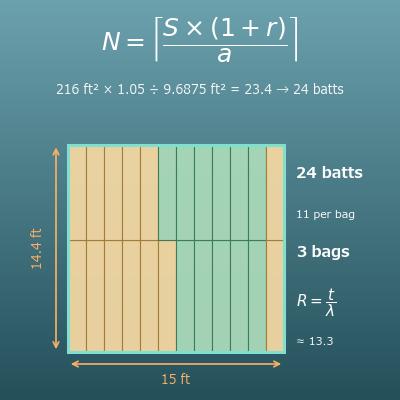
Insulation Calculator (Area, Batts, Bags and R-Value)
Find the R-value from insulation thickness. It is what the U-factor on this page comes from
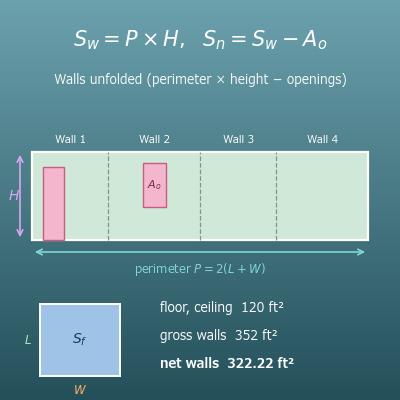
Wall Area Calculator (Wall, Ceiling and Floor Square Footage, with Doors, Windows, Perimeter and Volume)
Find the area of each part first (walls minus openings, ceiling and floor), then enter it here
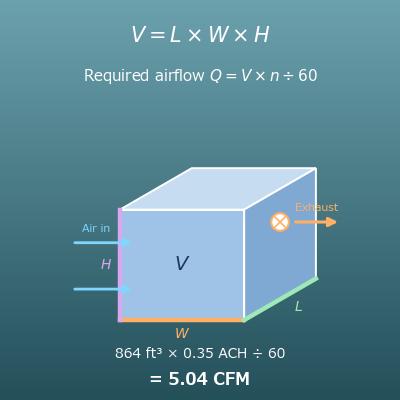
Room Volume and Ventilation Calculator (Air Changes per Hour, CFM)
Find the ventilation rate (CFM) for the ventilation heat loss from the room volume and air changes per hour
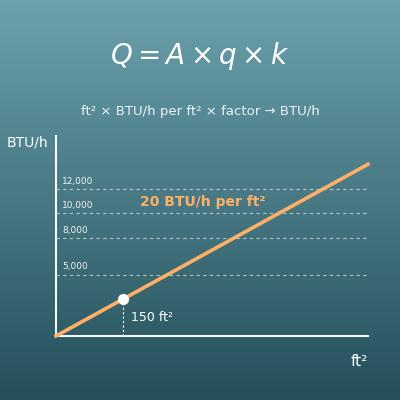
Air Conditioner Size Calculator (BTU per Square Foot)
Once you know the heating capacity needed, see how to size an air conditioner or heat pump
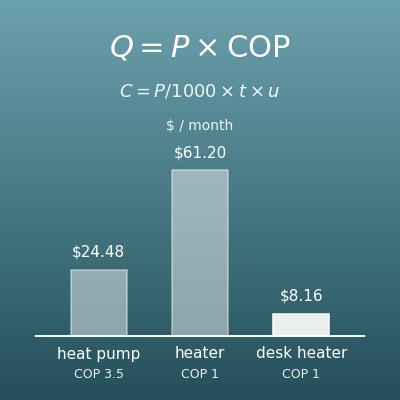
Heating Cost Comparison Calculator (Heat Pump, Space Heater, Electric Blanket)
Compare the heat output, COP and running cost of heaters side by side, and learn about COP
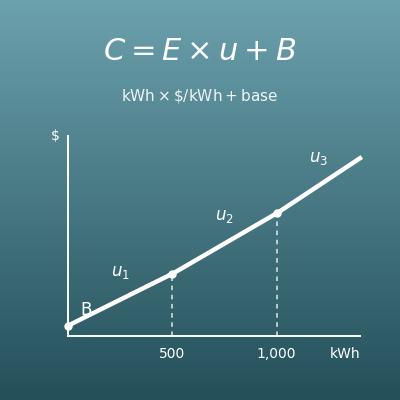
Electric Bill Calculator (kWh to Cost and Back)
Once you know the daily kWh, work out the cost for a month or a whole season