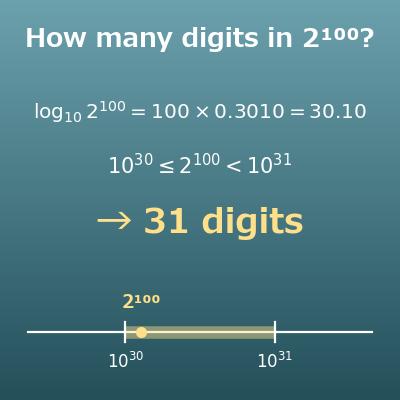

Fill in only the two you know out of base a, exponent n and result y. The third is calculated for you (to find "a to the nth power", fill in the base and the exponent). The equation below is linked to the fields, so you can also type the base, exponent or result right into it.
Table of Contents
-
What you can do on this page
-
What is this calculation used for?
-
How to Use
-
Formula
-
Power (\(a\) to the \(n\)th power)
-
Negative exponent (\(a\) to the power \(-n\))
-
Fractional and decimal exponents (\(a\) to the power \(\frac{1}{n}\))
-
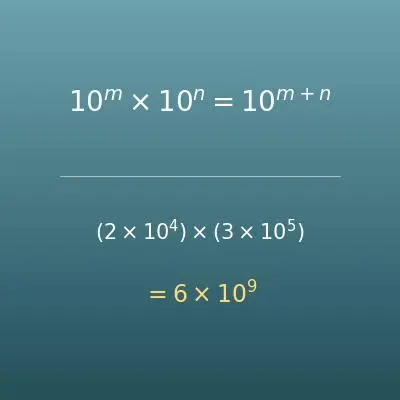
Law of exponents (multiplying adds the exponents)
-
Solving for the exponent (what power? logarithms)
-
Solving for the base (the number whose \(n\)th power is \(y\), a root)
-
-
Symbols and terms
-
Good to know before you start
-
How to calculate it in Excel
-
How to calculate it in Google Sheets
-
How to calculate it in Python
-
How to write it in LaTeX and other math languages (copy and paste)
-
How to have ChatGPT do the calculation
-
DataChef Features
-
Related Features
-
NumberChef Calculators List
What you can do on this page
- Enter the base \(a\) and the exponent \(n\), and the power \(a^n\) (\(a\) to the \(n\)th power) appears on the spot
- Negative exponents (\(2^{-3}\)), decimal exponents (\(4^{0.5}\)) and negative bases (\((-2)^5\)) work too. To use Euler's number as the base, just type "e"
- It also works backward: "2 to what power is 1024?" (solve for the exponent) or "what number cubed is 125?" (solve for the base)
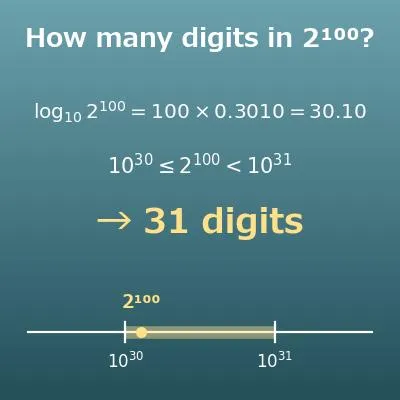
- Large results such as \(2^{60} = 1152921504606846976\) are shown with every digit, not rounded off
- A plain-language explanation of the formulas and copy-and-paste formulas for Excel, Google Sheets and Python are all on this page
What is this calculation used for?
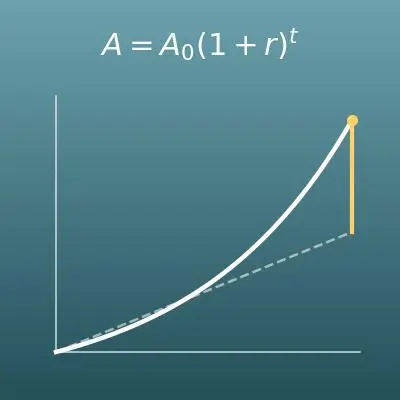
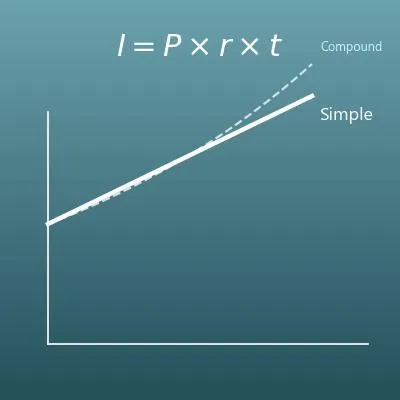
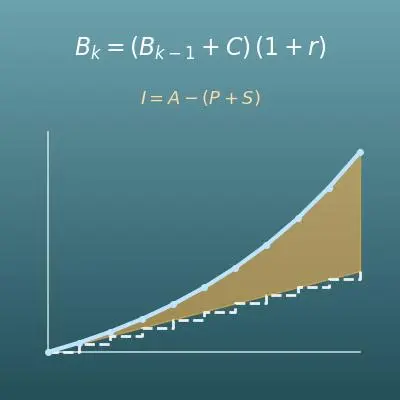
At 3% interest a year, after 10 years your money grows to \(1.03^{10} \approx 1.344\) times the original (about 1.34 times). Compound interest, where interest earns more interest, is exactly a power: the same growth factor multiplied again and again.
A loan or credit card balance grows by the same formula. This is the power you meet most often in everyday life, and it helps you plan your money with numbers instead of guesses.
Under good conditions, some bacteria divide about once every 20 minutes. In 3 hours that is 9 divisions, so 1 bacterium becomes \(2^{9} = 512\) (a rough guide under ideal food and temperature conditions).
This explosive growth of a power is the reason food should not be left out at room temperature.
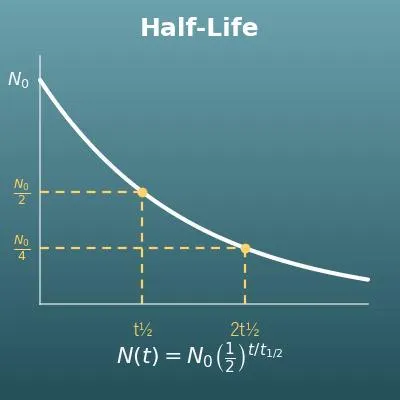
The amount of a medicine in the body halves with each half-life. After 5 half-lives, \(0.5^{5} = 0.03125\) (about 3%) is left (the real rate differs from person to person and with health).
Radioactive decay follows exactly the same formula. It is the basis for estimating "how much is left" in medicine and emergency planning.
Computers work with combinations of two choices, 0 and 1 (bits), so powers of 2 appear everywhere. 1 KB has traditionally been \(2^{10} = 1024\) bytes (by the SI standard it is 1000 bytes), 32 bits can store \(2^{32} = 4294967296\) (about 4.3 billion) patterns, and a full-color image has \(2^{24}\) (about 16.78 million) colors.
Engineers and game developers use these powers every day.
An earthquake 1 magnitude higher releases \(10^{1.5} \approx 31.6\) times (about 32 times) the energy, and one 2 magnitudes higher releases \(10^{3} = 1000\) times.
Powers show why a magnitude 8 is far more destructive than a magnitude 7, even though the numbers differ by only 1. This helps you read disaster news correctly.
Formula
Symbols and terms
Symbols
| \(a\) | a (the base) | The number that is multiplied by itself (the base). (Example - in 2 to the 5th power, it is 2) |
| \(n\) | n (the exponent) | How many times to multiply (the exponent). It is written small at the upper right of the number. (Example - in 2 to the 5th power, it is 5) |
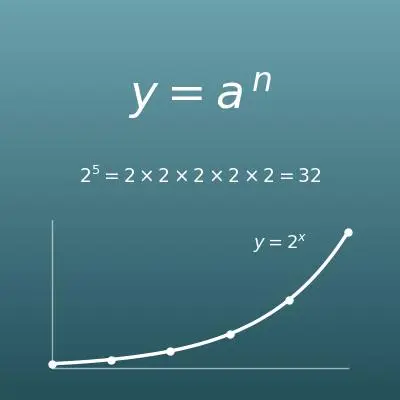
| \(a^n\) | a to the nth power (a to the n) | \(a\) multiplied by itself \(n\) times (a power). (Example - \(2^5 = 2 \times 2 \times 2 \times 2 \times 2 = 32\)) |
| \(y\) | y | On this page, the result of the power. |
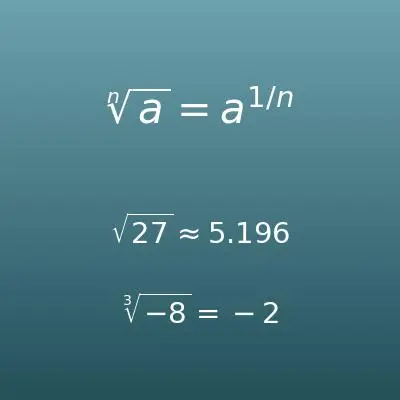
| \(\sqrt[n]{a}\) | the nth root of a | The number that gives \(a\) when raised to the \(n\)th power (a root). With an exponent, it is the same as \(a^{1/n}\). |
| \(\ln y\) | natural log of y | The logarithm with base \(e\) (Euler's number). It tells you "\(e\) to what power gives \(y\)", and is used to solve for an exponent. |
| \(e\) | e (Euler's number) | A special constant, about 2.71828. It describes continuous growth (the limit of compound interest) and appears all over calculus and statistics. On this calculator you can enter "e" as the base. |
Terms
| power (exponentiation) | Multiplying the same number by itself several times. The operation is called exponentiation, and its result is called a power. "2 to the 3rd power" and "2 raised to the power of 3" say the same thing. |
| base | The number that is multiplied by itself in a power. It is the \(a\) in \(a^n\). |
| exponent | The small number at the upper right that tells how many times to multiply. It is the \(n\) in \(a^n\). Its meaning is extended to zero, negative and fractional exponents. |
| law of exponents (laws of exponents, exponent rules) | The set of rules for working with powers, such as \(a^n \times a^m = a^{n+m}\) (multiplying adds the exponents). The rules that the power 0 gives 1 and a negative exponent gives the reciprocal are chosen so that they agree with these laws. |
| root (nth root) | A number that gives the original number when raised to the \(n\)th power. Square roots and cube roots are examples. It is the same as a fractional or decimal exponent (the power \(1/n\)). |
| reciprocal | 1 divided by the number (the number you multiply by to get 1). The reciprocal of 2 is 1/2. A negative exponent gives the reciprocal of the power. |
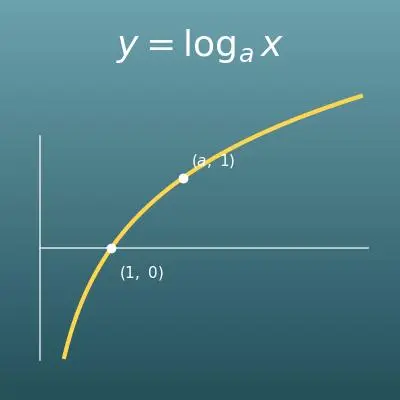
| logarithm (log) | The number that tells "what power of the base gives the target number". It is the tool for working backward to the exponent of a power. |
| Euler's number | The special constant \(e = 2.71828\ldots\). It is the base of the natural logarithm and shows up wherever there is continuous growth, such as the limit of interest compounded continuously. |
Good to know before you start
Here is what helps you use the calculation on this page with real understanding, not just by pressing the button.
| Multiplication (Grade 3) |
|
| Decimals and fractions (Grades 5–6) |
|
| What exponents are (Grade 6) |
|
| Square roots (Grade 8) |
|
| Extending exponents and the laws of exponents (Grade 8 and Algebra 2) |
|
| Logarithms (Algebra 2) |
|
How to calculate it in Excel
| Base a | 2 |
| Exponent n | 5 |
| Power a^n | =B1^B2 |
| Base a | 2 |
| Exponent n (to use as -n) | 3 |
| Power -n: a^(-n) | =B1^(-B2) |
| Same value as the reciprocal 1/a^n | =1/B1^B2 |
| Base a | 4 |
| Exponent (as a decimal) | 0.5 |
| a^0.5 (same as the square root) | =B1^B2 |
| Check with SQRT | =SQRT(B1) |
| Base a | 2 |
| Exponent n | 3 |
| Exponent m | 4 |
| a^n × a^m | =B1^B2*B1^B3 |
| a^(n+m) (same value) | =B1^(B2+B3) |
| Base a | 2 |
| Result y | 1024 |
| Exponent n (a to what power is y) | =LOG(B2,B1) |
| Exponent n | 3 |
| Result y | 125 |
| Base a (y to the power 1/n) | =B2^(1/B1) |
"^" is the power symbol, so "=B1^B2" multiplies the value in B1 by itself B2 times. To solve for an exponent, use the LOG function (=LOG(number, base)).
For example, B3 shows 32 in the first table and 10 in the fifth table. Just replace the input numbers with your own.
How to calculate it in Google Sheets
| Base a | 2 |
| Exponent n | 5 |
| Power a^n | =B1^B2 |
| Base a | 2 |
| Exponent n (to use as -n) | 3 |
| Power -n: a^(-n) | =B1^(-B2) |
| Same value as the reciprocal 1/a^n | =1/B1^B2 |
| Base a | 4 |
| Exponent (as a decimal) | 0.5 |
| a^0.5 (same as the square root) | =B1^B2 |
| Check with SQRT | =SQRT(B1) |
| Base a | 2 |
| Exponent n | 3 |
| Exponent m | 4 |
| a^n × a^m | =B1^B2*B1^B3 |
| a^(n+m) (same value) | =B1^(B2+B3) |
| Base a | 2 |
| Result y | 1024 |
| Exponent n (a to what power is y) | =LOG(B2,B1) |
| Exponent n | 3 |
| Result y | 125 |
| Base a (y to the power 1/n) | =B2^(1/B1) |
How to calculate it in Python
base = 2       # base (the number multiplied)
exponent = 5   # exponent (how many times to multiply)

power = base ** exponent   # power (base to the exponent)
print(f"{base} to the power of {exponent}: {power}")

# --- To work backward (logarithms and roots), use the math module ---
import math

n = math.log(1024, 2)   # solve for the exponent: 2 to what power is 1024
a = 125 ** (1 / 3)      # solve for the base: the number whose cube is 125 (cube root)
print(f"2 to what power is 1024: {n}")
print(f"The number whose cube is 125: {round(a, 10)}")
How to write it in LaTeX and other math languages (copy and paste)
y = aⁿ
y = a^{n}
<math xmlns="http://www.w3.org/1998/Math/MathML" display="block">
  <mrow>
    <mi>y</mi>
    <mo>=</mo>
    <msup><mi>a</mi><mi>n</mi></msup>
  </mrow>
</math>
y = a^n
a^n
y := a^n;
y = a^n;
y = a^n
a⁻ⁿ = 1/aⁿ
a^{-n} = \frac{1}{a^{n}}
<math xmlns="http://www.w3.org/1998/Math/MathML" display="block">
<mrow>
<msup><mi>a</mi><mrow><mo>−</mo><mi>n</mi></mrow></msup>
<mo>=</mo>
<mfrac><mn>1</mn><msup><mi>a</mi><mi>n</mi></msup></mfrac>
</mrow>
</math>
a^(-n) = 1/a^n
a^(-n)
y := 1/a^n;
y = 1/a^n;
a^(-n) = 1/a^n
a^(1/n) = ⁿ√a
a^{1/n} = \sqrt[n]{a}
<math xmlns="http://www.w3.org/1998/Math/MathML" display="block">
  <mrow>
    <msup><mi>a</mi><mrow><mn>1</mn><mo>/</mo><mi>n</mi></mrow></msup>
    <mo>=</mo>
    <mroot><mi>a</mi><mi>n</mi></mroot>
  </mrow>
</math>
a^(1/n) = root(n)(a)
Surd[a, n]
y := surd(a, n);
y = nthroot(a, n);
a^(1/n) = √(n&a)
aⁿ × aᵐ = aⁿ⁺ᵐ
a^{n} \times a^{m} = a^{n+m}
<math xmlns="http://www.w3.org/1998/Math/MathML" display="block">
<mrow>
<msup><mi>a</mi><mi>n</mi></msup>
<mo>×</mo>
<msup><mi>a</mi><mi>m</mi></msup>
<mo>=</mo>
<msup><mi>a</mi><mrow><mi>n</mi><mo>+</mo><mi>m</mi></mrow></msup>
</mrow>
</math>
a^n xx a^m = a^(n+m)
a^n*a^m
y := a^n*a^m;
y = a^n*a^m;
a^n × a^m = a^(n+m)
n = ln y ÷ ln a
n = \frac{\ln y}{\ln a}
<math xmlns="http://www.w3.org/1998/Math/MathML" display="block">
<mrow>
<mi>n</mi>
<mo>=</mo>
<mfrac>
<mrow><mi>ln</mi><mo>⁡</mo><mi>y</mi></mrow>
<mrow><mi>ln</mi><mo>⁡</mo><mi>a</mi></mrow>
</mfrac>
</mrow>
</math>
n = ln(y)/ln(a)
Log[a, y]
n := log[a](y);
n = log(y)/log(a);
n = ln(y)/ln(a)
a = y^(1/n) = ⁿ√y
a = y^{1/n} = \sqrt[n]{y}
<math xmlns="http://www.w3.org/1998/Math/MathML" display="block">
  <mrow>
    <mi>a</mi>
    <mo>=</mo>
    <msup><mi>y</mi><mrow><mn>1</mn><mo>/</mo><mi>n</mi></mrow></msup>
    <mo>=</mo>
    <mroot><mi>y</mi><mi>n</mi></mroot>
  </mrow>
</math>
a = y^(1/n) = root(n)(y)
Surd[y, n]
a := surd(y, n);
a = nthroot(y, n);
a = y^(1/n) = √(n&y)
How to have ChatGPT do the calculation
You are a calculation assistant for powers and exponents. Do the following calculations by actually running Python code, and base your answer only on the numbers from the execution result (do not answer by mental math or guessing).

1. Find 2 to the 5th power.
2. Find the power of 2 that gives 1024 (the exponent).
3. Find the number whose cube is 125 (the base).

Show the formulas you used and the numbers from the execution result for each.
How to Use
-
1Enter your numbersType the numbers you want to calculate with into the input fields
-
2CalculatePress the "Calculate" button
-
3Check the resultThe result appears on the spot. The same page also explains the idea behind the calculation and the formula
DataChef Features

No technical knowledge required.
Intuitive and user-friendly operation.

Can be used without registering personal information.

Automatic file deletion by clicking "download".

and rapid file conversion.

No attribution required.

No need to contact us for commercial use permission.
Related Features
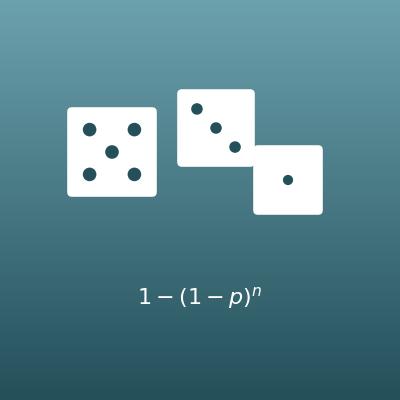
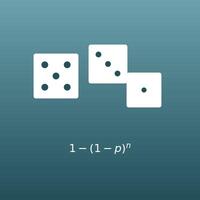
Probability of Repeated Trials (n in a Row, At Least Once)
Raises the probability of one try to the nth power to find the chance of n in a row or at least once
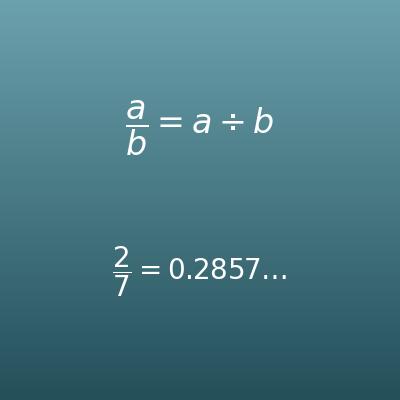
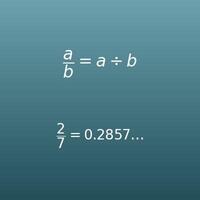
Fraction to Decimal Calculator (Numerator ÷ Denominator, Repeating Decimals)
Converts a fraction to a decimal. Handy for turning a fractional exponent (such as 1/2) into a decimal before you enter it
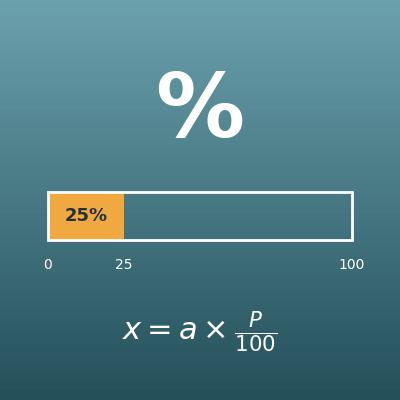
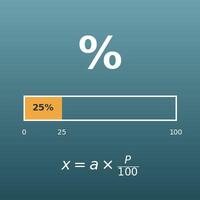
Percentage Calculator (Percent, Part and Whole)
Finds the percent, the part or the whole from the other two
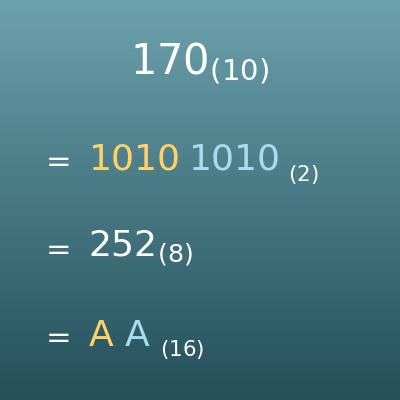
Number Base Converter (Binary, Octal, Decimal and Hexadecimal)
Converts between binary, octal, decimal and hexadecimal, using powers of 2 and 16 as place values