





Choose the type of calculation and enter the inside dimensions of the storage or the book thickness. Measure the inside dimensions. For book thickness and box size, you can pick a typical value and then change the number.
Table of Contents
-
What you can do on this page
-
What is this calculation used for?
-
How to Use
-
Formulas and figures
-
Symbols and terms
-
Good to know before you start
-
How to calculate it in Excel
-
How to calculate it in Google Sheets
-
How to calculate it in Python
-
How to write it in LaTeX and other math languages (copy and paste)
-
How to have ChatGPT do the calculation
-
DataChef Features
-
Related Features
-
NumberChef Calculators List
What you can do on this page
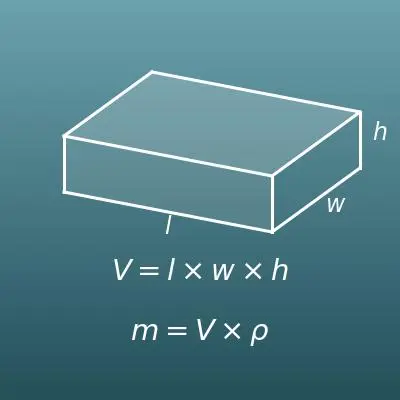
- Just enter the inside width, depth and height of a cabinet, closet or shelf (in inches or feet) to get its volume in cubic feet (ft³) and cubic inches (in³)
- Enter the number and thickness of the shelf boards to get the number of shelves, the clear height of each shelf with the boards evenly spaced, and the effective volume left for contents
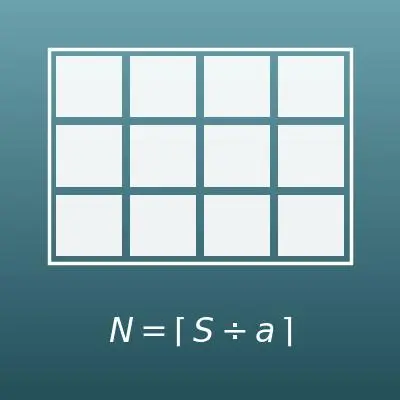
- Enter the outside size of a storage tote, bin or file box (or pick a common size) to find how many fit, as "number across × number deep × number high × number of shelves". If turning the box 90° or laying it down fits more, that orientation is used
- From the inside width of a bookcase shelf and the book thickness (typical values for paperbacks, hardcovers and magazines are available), find the books per shelf, the total number of books and the width left over
- You can also work backward from "I want 150 hardcovers on 4 shelves" to the shelf width needed, or find how many garments fit on a closet rod of a given length
What is this calculation used for?
Bookcase listings often give only the outside size, such as "36 in wide × 72 in high", so you have to work out how many books fit yourself. If the inside width is 34 in and there are 5 shelves, paperbacks averaging 1.25 in thick fit \(\lfloor 34 \div 1.25 \rfloor = 27\) per shelf, or 135 in all.
Count your books first, and you can tell before buying whether one 36 in bookcase is enough or you need two. Using the average thickness of your own books makes the count more accurate.
Measure the inside width, depth and height of the closet when you view a new place, and you can check with the formula how many of your storage totes will fit. On a closet floor 60 in wide × 24 in deep × 30 in high, totes 24 × 16 × 12 in fit 3 across × 1 deep × 2 high = 6 when turned 90° flat.
The mistake of moving the totes in and finding the closet is not deep enough shows up in this formula as 0 boxes in the depth direction, so you notice it in advance.
Storage totes are often labeled by capacity, such as "18 gallons", while freezers and storage units are sized in cubic feet. Turn the inside size of your shelf into cubic feet, and you can compare on the same scale: an 18-gallon tote holds about 2.4 ft³ (1 ft³ ≈ 7.48 gal), so first see how many cubic feet the whole shelf offers.
Capacity only compares volume, though. Whether a tote really fits must be checked on each of the three sides. The "how many boxes fit" formula (rounding down each of the three divisions) is the calculation for that.
When you cut boards to build shelves, the height of each shelf is set by "(inside height − number of boards × thickness) ÷ number of shelves". Two 3/4 in boards in a 36 in high cabinet give shelves of 11.5 in each, so a large art book 12 in tall will not stand up on them.
Decide the number of boards to match the height of what you want to store first, and you avoid finding out after cutting that the shelves are too low.
When organizing a closet or planning storage in a new home, estimate the number of garments from the rod length. A 58 in rod holds 38 light shirts (about 1.5 in each) or 23 heavy coats (about 2.5 in each).
If that is not enough for your clothes, you can weigh options with numbers, such as adding a second rod below or moving the heavy coats to another closet.
When you pack books into boxes or take them to a used bookstore, knowing "how many feet of shelf 300 paperbacks take up" helps you estimate the number of boxes or the room in your car. 300 paperbacks 1 in thick make a row 300 in = 25 ft long, and a book box 16 in long holds one row of about 16 books.
The working-back formula (number of books × thickness) is also useful like this, to turn a number of books into a length.
Formulas and figures
Symbols and terms
Symbols
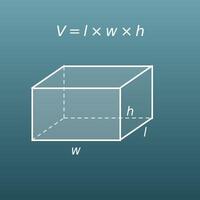
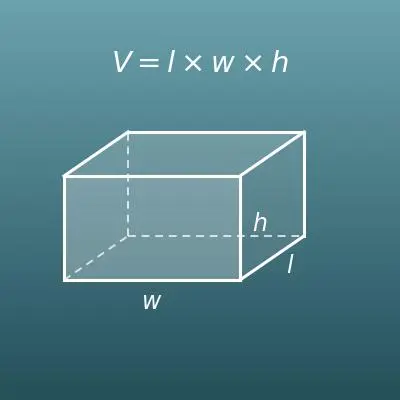
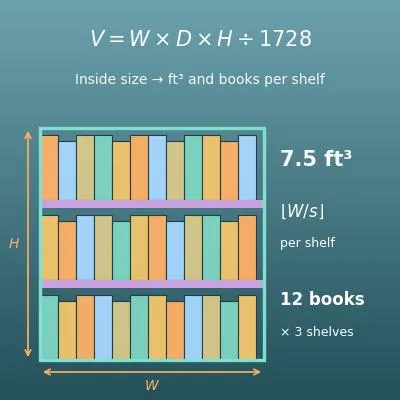
| \(V\) | V | The volume of the storage (ft³), from the first letter of "volume". It is found with \(V = W \times D \times H \div 1728\). |
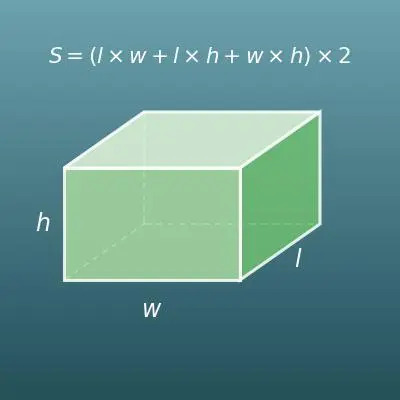
| \(W\) | W | The inside width of the storage or shelf (in), from the first letter of "width". Measure from the inside of one side panel to the inside of the other. When working back from a number of books, it is the value found (the shelf width needed). |
| \(D\) | D | The inside depth of the storage (in), from the first letter of "depth". It is the length from the front to the back panel. |
| \(H\) | H | The inside height of the storage (in), from the first letter of "height". Measure from the top of the bottom panel to the underside of the top panel. |
| \(n\) | n | The number of shelf boards, from the first letter of "number". With no boards, it is 0. |
| \(t\) | t | The thickness of one shelf board (in), from the first letter of "thickness". As a guide, about 5/8 in for flat-pack furniture and 3/4 in for plywood or 1×12 boards; measuring the real board is best. |
| \(k\) | k | The number of shelves. With \(n\) shelf boards, there are \(k = n + 1\) shelves (the boards are dividers, so there is one more shelf than boards). |
| \(h\) | lowercase h | The clear height of each shelf with the boards evenly spaced (in), found with \(h = (H - n \times t) \div k\). It is lowercase to tell it apart from the height \(H\). |
| \(w,\ d,\ b\) | w, d, b | The outside width, depth and height of the box or bin to put in (in). They are lowercase to tell them apart from the inside dimensions of the storage (capitals), and the height uses b, from "box". |
| \(N\) | capital N | The number of boxes that fit in the storage, found with \(N = \lfloor W/w \rfloor \times \lfloor D/d \rfloor \times \lfloor h/b \rfloor \times k\). |
| \(s\) | s | The thickness of one book (the width of the spine, in), from the first letter of "spine". |
| \(B\) | capital B | The total number of books, from the first letter of "books". In "How many books fit" it is the value found; when working back to the shelf width, it is the number of books you enter. |
| \(B_1\) | B sub 1 | The number of books per shelf. In "How many books fit" it is \(\lfloor W/s \rfloor\) (rounded down); when working back to the shelf width, it is \(\lceil B/k \rceil\) (rounded up). |
| \(L\) | L | The length of the closet rod (in), from the first letter of "length". |
| \(c\) | c | The width one garment on a hanger takes up along the rod (in), from the first letter of "clothes". |
| \(C\) | capital C | The number of garments that fit on the closet rod, found with \(C = \lfloor L/c \rfloor\). |
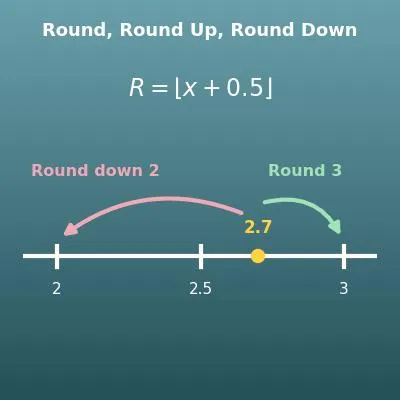
| \(\lfloor\ \rfloor\) | floor | The sign of the floor function (rounding down). It gives the number inside rounded down to a whole number (example - \(\lfloor 20.66 \rfloor = 20\)). "How many fit" is always rounded down like this. |
| \(\lceil\ \rceil\) | ceiling | The sign of the ceiling function (rounding up). It gives the number inside rounded up to a whole number (example - \(\lceil 37.5 \rceil = 38\)). Working back to "how much you need" is rounded up like this. |
Terms
| inside dimension | The size measured on the inside of furniture or storage. It is the width, depth and height of the space you can actually use, without the thickness of the panels. Every calculation on this page uses inside dimensions. Catalogs often list outside dimensions, so be careful. |
| outside dimension | The size measured over the outside of furniture or storage, including the thickness of the panels. Use it to check whether the furniture fits the space where it goes. When putting a box into storage, compare the outside dimensions of the box with the inside dimensions of the storage. |
| capacity | The size of the space inside a container. It is the same idea as volume, but "capacity" is used for how much a container can hold. Units include cubic inches, cubic feet, gallons and liters. |
| cubic foot | A unit of volume: a cube 12 in × 12 in × 12 in, which is 1,728 in³. It holds about 7.48 US gallons. Storage units, freezers and moving trucks are often sized in cubic feet (ft³), while plastic totes are often labeled in gallons or quarts. |
| shelf board | A board that divides the storage into levels. Each extra board adds one more shelf, but the height left for contents gets smaller by the board's thickness. |
| clear height | The height on one shelf that you can actually use, without the board thickness. With the boards evenly spaced, it is "(inside height − number of boards × thickness) ÷ number of shelves". |
| effective volume | The volume you can actually fill, without the space taken by the shelf boards. With sizes in inches, "width × depth × (height − number of boards × thickness) ÷ 1728" gives it in cubic feet. |
| rounding down | Dropping the decimal part to get a whole number: 20.66… → 20. "How many fit" is always counted by rounding down, because a part that is too small does not fit. In math it is written with the floor function \(\lfloor x \rfloor\). |
| rounding up | Going up to the next whole number if there is any decimal part: 37.5 → 38. When the leftover items also need space, such as when splitting books over shelves, round up. In math it is written with the ceiling function \(\lceil x \rceil\). |
| layout | Deciding how to arrange items of a set size in a space of a set size. This page counts with the simplest layout, with everything facing the same way. |
| storage tote | A plastic storage box with a lid, often labeled by capacity in gallons or quarts. Stackable drawer units are similar, but they cannot be turned on their side, so only turn them flat. |
| trim size | The page size of a book. Common sizes include mass-market paperbacks (about 4.25 × 7 in), trade paperbacks (about 5.5 × 8.5 in or 6 × 9 in) and hardcovers (about 6 × 9 in, with the cover a little larger). Use the trim size to check that books fit the height and depth of the shelf. |
| paperback | A book with a soft cover. Mass-market paperbacks are small (about 4.25 × 7 in) and trade paperbacks are larger. Thickness depends on the number of pages; this page uses about 1 in as a typical value. |
| hardcover | A book with a stiff cover, usually around 6 × 9 in. This page uses about 1.5 in as a typical thickness. |
| closet rod | The bar in a closet where hangers go. The number of garments that fit is the rod length divided by the width per garment. |
Good to know before you start
Here is what helps you use the calculation on this page with real understanding, not just by pressing the button.
| Volume of a rectangular prism (Grade 5) |
|
| Units of volume (Grades 5–6) |
|
| Converting units of length (Grade 4) |
|
| Division with remainders (Grades 3–4) |
|
| Rounding down and rounding up (Grade 4) |
|
| Multiplying and dividing decimals (Grades 5–6) |
|
How to calculate it in Excel
| Inside width (in) | 30 |
| Inside depth (in) | 12 |
| Inside height (in) | 36 |
| Volume (in³) | =B1*B2*B3 |
| Volume (ft³) | =B4/1728 |
| Inside height (in) | 36 |
| Number of shelf boards | 2 |
| Shelf board thickness (in) | 0.75 |
| Number of shelves | =B2+1 |
| Clear height of each shelf (in) | =(B1-B2*B3)/B4 |
| Inside width (in) | 60 |
| Inside depth (in) | 24 |
| Clear height of each shelf (in) | 30 |
| Number of shelves | 1 |
| Box width (in) | 16 |
| Box depth (in) | 24 |
| Box height (in) | 12 |
| Number of boxes | =INT(B1/B5)*INT(B2/B6)*INT(B3/B7)*B4 |
| Inside shelf width (in) | 31 |
| Thickness of one book (in) | 1.5 |
| Number of shelves | 3 |
| Books per shelf | =INT(B1/B2) |
| Total books | =B4*B3 |
| Number of books to store | 150 |
| Number of shelves | 4 |
| Thickness of one book (in) | 1.5 |
| Books per shelf | =ROUNDUP(B1/B2,0) |
| Shelf width needed (in) | =B4*B3 |
| Rod length (in) | 58 |
| Width per garment (in) | 1.5 |
| Garments that fit | =INT(B1/B2) |
The first table multiplies width × depth × height to get cubic inches (12960 in B4) and divides by 1728 to get cubic feet (7.5 in B5). The second table has 2 boards, so 3 shelves (B4), and the clear height is (36 − 2 × 0.75) ÷ 3 = 11.5 (B5).
"INT" in the third, fourth and sixth tables rounds down to a whole number, so INT(31/1.5) = INT(20.66…) = 20 counts how many fit. The third table gives 3 × 1 × 2 × 1 = 6 boxes and the fourth 20 × 3 = 60 books.
"ROUNDUP(…,0)" in the fifth table rounds up to a whole number: 150 ÷ 4 = 37.5 → 38 books per shelf, and 38 × 1.5 = 57 in is the shelf width needed. The sixth table gives INT(58/1.5) = 38 garments.
How to calculate it in Google Sheets
| Inside width (in) | 30 |
| Inside depth (in) | 12 |
| Inside height (in) | 36 |
| Volume (in³) | =B1*B2*B3 |
| Volume (ft³) | =B4/1728 |
| Inside height (in) | 36 |
| Number of shelf boards | 2 |
| Shelf board thickness (in) | 0.75 |
| Number of shelves | =B2+1 |
| Clear height of each shelf (in) | =(B1-B2*B3)/B4 |
| Inside width (in) | 60 |
| Inside depth (in) | 24 |
| Clear height of each shelf (in) | 30 |
| Number of shelves | 1 |
| Box width (in) | 16 |
| Box depth (in) | 24 |
| Box height (in) | 12 |
| Number of boxes | =INT(B1/B5)*INT(B2/B6)*INT(B3/B7)*B4 |
| Inside shelf width (in) | 31 |
| Thickness of one book (in) | 1.5 |
| Number of shelves | 3 |
| Books per shelf | =INT(B1/B2) |
| Total books | =B4*B3 |
| Number of books to store | 150 |
| Number of shelves | 4 |
| Thickness of one book (in) | 1.5 |
| Books per shelf | =ROUNDUP(B1/B2,0) |
| Shelf width needed (in) | =B4*B3 |
| Rod length (in) | 58 |
| Width per garment (in) | 1.5 |
| Garments that fit | =INT(B1/B2) |
How to calculate it in Python
from fractions import Fraction
import math

# Inside dimensions of the storage space (in)
width_in = Fraction("30")
depth_in = Fraction("12")
height_in = Fraction("36")
shelf_count = 2                        # number of shelf boards
shelf_thickness_in = Fraction("0.75")  # shelf board thickness (in)

volume_in3 = width_in * depth_in * height_in            # volume V = W x D x H
print(f"Volume: {float(volume_in3):.1f} in³ = {float(volume_in3 / 1728):.2f} ft³")

rows = shelf_count + 1                                  # number of shelves k = n + 1
row_height_in = (height_in - shelf_count * shelf_thickness_in) / rows   # clear height per shelf h
print(f"Shelves: {rows}, clear height per shelf: {float(row_height_in):.2f} in")

# How many boxes (outside size in inches) fit: storage totes on a closet floor (inside 60 x 24 x 30 in, one shelf)
space_w, space_d, space_h = Fraction("60"), Fraction("24"), Fraction("30")
box_w, box_d, box_h = Fraction("24"), Fraction("16"), Fraction("12")
best = 0
for w, d in [(box_w, box_d), (box_d, box_w)]:            # also try the box turned 90° flat, keep the larger count
    count = math.floor(space_w / w) * math.floor(space_d / d) * math.floor(space_h / box_h)   # ⌊W/w⌋×⌊D/d⌋×⌊h/b⌋ (× 1 shelf)
    best = max(best, count)
print(f"Boxes: {best}")

# How many books fit
shelf_width_in = Fraction("31")
book_thickness_in = Fraction("1.5")
book_rows = 3
per_row = math.floor(shelf_width_in / book_thickness_in)   # per shelf ⌊W/s⌋
print(f"{per_row} per shelf, {per_row * book_rows} in total, {float(shelf_width_in - per_row * book_thickness_in):.2f} in left over per shelf")

# Shelf width needed for a number of books
book_count = 150
per_row_needed = math.ceil(book_count / 4)                  # split over 4 shelves: ⌈B/k⌉
print(f"Shelf width needed: {float(per_row_needed * book_thickness_in):.2f} in ({per_row_needed} per shelf)")

# How many garments fit on a closet rod
rod_in = Fraction("58")
per_hanger_in = Fraction("1.5")
print(f"Garments: {math.floor(rod_in / per_hanger_in)}")
How to write it in LaTeX and other math languages (copy and paste)
V = W × D × H ÷ 1728
V = \frac{W \times D \times H}{1728}
<math xmlns="http://www.w3.org/1998/Math/MathML" display="block">
<mrow>
<mi>V</mi>
<mo>=</mo>
<mfrac>
<mrow><mi>W</mi><mo>×</mo><mi>D</mi><mo>×</mo><mi>H</mi></mrow>
<mn>1728</mn>
</mfrac>
</mrow>
</math>
V = (W * D * H) / 1728
V = W*depth*H/1728
V := W*depth*H/1728;
V = W*D*H/1728;
V = (W × D × H)/1728
k = n + 1, h = (H − n × t) ÷ k
k = n + 1,\quad h = \frac{H - n t}{k}
<math xmlns="http://www.w3.org/1998/Math/MathML" display="block">
<mrow>
<mi>k</mi><mo>=</mo><mi>n</mi><mo>+</mo><mn>1</mn>
<mo>,</mo>
<mi>h</mi><mo>=</mo>
<mfrac>
<mrow><mi>H</mi><mo>−</mo><mi>n</mi><mo>×</mo><mi>t</mi></mrow>
<mi>k</mi>
</mfrac>
</mrow>
</math>
k = n + 1, h = (H - n * t) / k
k = n + 1; h = (H - n*t)/k
k := n + 1; h := (H - n*t)/k;
k = n + 1; h = (H - n*t)/k;
k = n + 1, h = (H − n × t)/k
N = ⌊W/w⌋ × ⌊D/d⌋ × ⌊h/b⌋ × k
N = \left\lfloor \frac{W}{w} \right\rfloor \times \left\lfloor \frac{D}{d} \right\rfloor \times \left\lfloor \frac{h}{b} \right\rfloor \times k
<math xmlns="http://www.w3.org/1998/Math/MathML" display="block">
<mrow>
<mi>N</mi><mo>=</mo>
<mo>⌊</mo><mfrac><mi>W</mi><mi>w</mi></mfrac><mo>⌋</mo>
<mo>×</mo>
<mo>⌊</mo><mfrac><mi>D</mi><mi>d</mi></mfrac><mo>⌋</mo>
<mo>×</mo>
<mo>⌊</mo><mfrac><mi>h</mi><mi>b</mi></mfrac><mo>⌋</mo>
<mo>×</mo>
<mi>k</mi>
</mrow>
</math>
N = floor(W/w) * floor(D/d) * floor(h/b) * k
Nbox = Floor[W/w]*Floor[depth/d]*Floor[h/b]*k
Nbox := floor(W/w)*floor(depth/d)*floor(h/b)*k;
N = floor(W/w)*floor(D/d)*floor(h/b)*k;
N = ⌊W/w⌋ × ⌊D/d⌋ × ⌊h/b⌋ × k
B₁ = ⌊W/s⌋, B = B₁ × k
B_1 = \left\lfloor \frac{W}{s} \right\rfloor,\quad B = B_1 \times k
<math xmlns="http://www.w3.org/1998/Math/MathML" display="block">
<mrow>
<msub><mi>B</mi><mn>1</mn></msub><mo>=</mo>
<mo>⌊</mo><mfrac><mi>W</mi><mi>s</mi></mfrac><mo>⌋</mo>
<mo>,</mo>
<mi>B</mi><mo>=</mo>
<msub><mi>B</mi><mn>1</mn></msub><mo>×</mo><mi>k</mi>
</mrow>
</math>
B_1 = floor(W/s), B = B_1 * k
B1 = Floor[W/s]; B = B1*k
B1 := floor(W/s); B := B1*k;
B1 = floor(W/s); B = B1*k;
B_1 = ⌊W/s⌋, B = B_1 × k
B₁ = ⌈B/k⌉, W = B₁ × s
B_1 = \left\lceil \frac{B}{k} \right\rceil,\quad W = B_1 \times s
<math xmlns="http://www.w3.org/1998/Math/MathML" display="block">
<mrow>
<msub><mi>B</mi><mn>1</mn></msub><mo>=</mo>
<mo>⌈</mo><mfrac><mi>B</mi><mi>k</mi></mfrac><mo>⌉</mo>
<mo>,</mo>
<mi>W</mi><mo>=</mo>
<msub><mi>B</mi><mn>1</mn></msub><mo>×</mo><mi>s</mi>
</mrow>
</math>
B_1 = ceil(B/k), W = B_1 * s
B1 = Ceiling[B/k]; W = B1*s
B1 := ceil(B/k); W := B1*s;
B1 = ceil(B/k); W = B1*s;
B_1 = ⌈B/k⌉, W = B_1 × s
C = ⌊L/c⌋
C = \left\lfloor \frac{L}{c} \right\rfloor
<math xmlns="http://www.w3.org/1998/Math/MathML" display="block">
<mrow>
<mi>C</mi><mo>=</mo>
<mo>⌊</mo><mfrac><mi>L</mi><mi>c</mi></mfrac><mo>⌋</mo>
</mrow>
</math>
C = floor(L/c)
Cn = Floor[L/c]
C := floor(L/c);
C = floor(L/c);
C = ⌊L/c⌋
How to have ChatGPT do the calculation
You are a calculation assistant for storage and furniture sizes. Do the following calculation by actually running Python code, and base your answer only on the numbers from the execution result (do not answer by mental math or guessing).

1. Find the volume of a storage space 30 in wide × 12 in deep × 36 in high inside, in cubic inches and in cubic feet (1 ft³ = 1,728 in³).
2. Two shelf boards 0.75 in thick are placed evenly inside it. Find the number of shelves and the clear height of each shelf (in inches, to 2 decimal places).
3. Storage totes with an outside size of 24 in wide × 16 in deep × 12 in high are lined up, all facing the same way, on a closet floor 60 in wide × 24 in deep × 30 in high inside (no shelf boards). How many fit? Calculate both as entered and turned 90° flat, and give the larger number (round each direction's count down).
4. Hardcovers 1.5 in thick are lined up on 3 shelves, each 31 in wide inside. How many fit per shelf and in total (round down)?
5. To fit 150 hardcovers 1.5 in thick on 4 shelves, what inside shelf width is needed (round the books per shelf up)?

Show the formulas you used and the numbers from the execution result.
How to Use
-
1Enter your numbersType the numbers you want to calculate with into the input fields
-
2CalculatePress the "Calculate" button
-
3Check the resultThe result appears on the spot. The same page also explains the idea behind the calculation and the formula
DataChef Features

No technical knowledge required.
Intuitive and user-friendly operation.

Can be used without registering personal information.

Automatic file deletion by clicking "download".

and rapid file conversion.
No attribution required.

No need to contact us for commercial use permission.
Related Features
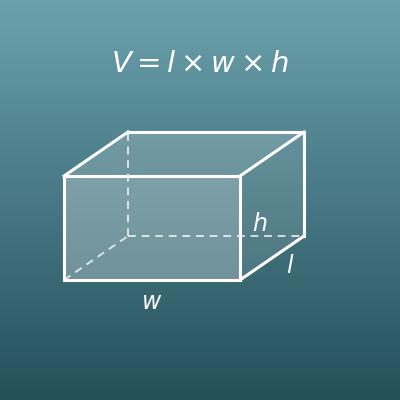
Rectangular Prism Volume Calculator (Length × Width × Height)
For the volume "length × width × height" of any box, with unit conversions such as in³ and ft³
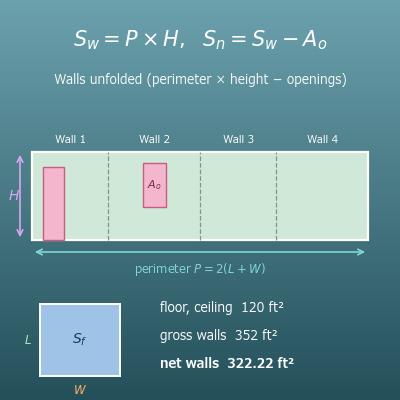
Wall Area Calculator (Wall, Ceiling and Floor Square Footage, with Doors, Windows, Perimeter and Volume)
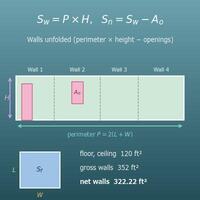
For the area and volume of the room itself (the first step for estimating wallpaper or paint)
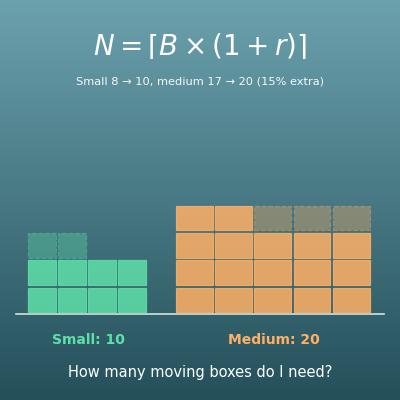
Moving Box Calculator (How Many Boxes Do I Need?)
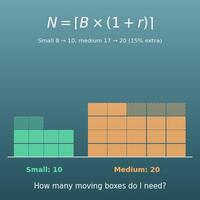
Estimate how many moving boxes you need to pack what is in your storage
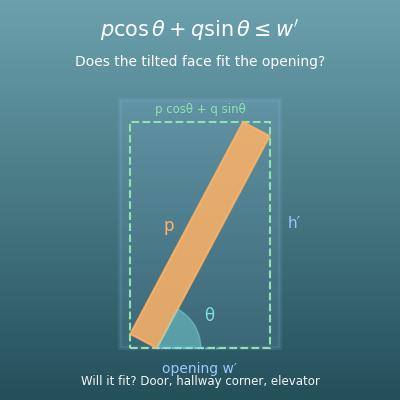
Furniture Fit Calculator (Through a Door, Around a Hallway Corner, Into an Elevator)
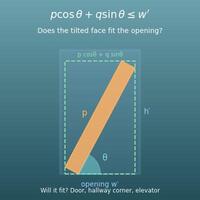
Check from the sizes whether the storage furniture itself fits through doors and hallways
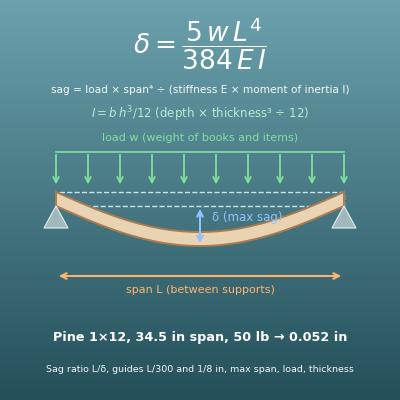
Shelf Sag and Load Calculator (Deflection from Material, Thickness, Span and Load; Maximum Span, Load and Thickness)
Once you know how many books go on a shelf, check how much the shelf sags under their weight and whether it is thick enough