

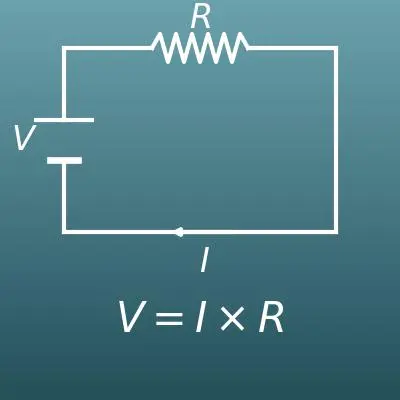








Enter the two values you know out of power P (W), voltage V (V) and current I (A). The third is calculated. Choose a voltage preset (120 V / 240 V) and the voltage is filled in for you.
Table of Contents
-
What you can do on this page
-
What is this calculation used for?
-
How to Use
-
Formula
-
Symbols and terms
-
Good to know before you start
-
How to calculate it in Excel
-
How to calculate it in Google Sheets
-
How to calculate it in Python
-
How to write it in LaTeX and other math languages (copy and paste)
-
How to have ChatGPT do the calculation
-
DataChef Features
-
Related Features
-
NumberChef Calculators List
What you can do on this page
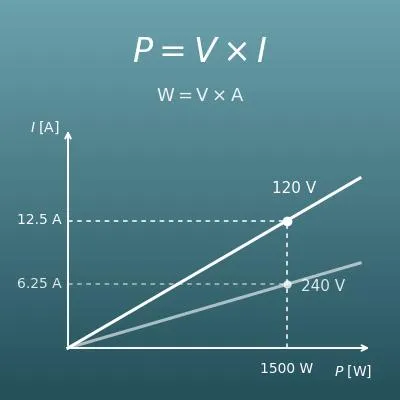
- Enter any two of power \(P\) (W), voltage \(V\) (V) and current \(I\) (A), and the third is calculated (for example, how many amps a 1500 W appliance draws on 120 V)
- Pick the voltage from the "120 V" and "240 V" presets, or type in any other voltage. The graph shows that doubling the voltage halves the current for the same power
- Enter a power factor (1 by default) to handle devices such as motors and air conditioners, where voltage × current is not the same as the power used. Both real power (W) and apparent power (VA) are shown
- This is the basic calculation for comparing appliance watts with the rating of an extension cord or power strip (such as "13 A, 1625 W") or with the size of a circuit breaker (A)
- A plain-language explanation of the formulas and copy-and-paste formulas for Excel, Google Sheets and Python are all on this page
What is this calculation used for?
A common light-duty extension cord is rated "13 A, 1625 W", and a heavier one "15 A, 1875 W". Add up the watts of everything you plug in and check that the total does not go over the rating. For example, a 1200 W hair dryer (10 A) and a 600 W coffee maker (5 A) on the same cord at the same time make 1800 W and 15 A, which is over a 13 A rating.
"Convert the watts to amps and compare with the rating." This one small step is the basis for preventing an overheated cord and a fire.
Most outlets in a US home are on 15 A or 20 A branch circuits, and the breaker trips when the total current on the circuit goes over its rating. A 1200 W microwave (10 A), a 900 W toaster (7.5 A) and a 1000 W coffee maker (about 8.3 A) running at the same time on one kitchen circuit add up to 3100 W, or about 25.8 A, so a 20 A breaker is likely to trip.
Motors also draw extra current for a moment when they start, so this calculation is only a rough guide. For new circuits or a service upgrade, talk to a licensed electrician.
A Level 2 EV charger that uses 7200 W draws \(7200 \div 240 = 30\) A on a 240 V circuit. On 120 V it would draw \(7200 \div 120 = 60\) A, far more than an ordinary outlet and its wiring can handle. That is why EV chargers, clothes dryers and electric ranges run on 240 V (the actual wire size and breaker are chosen by an electrician).
"For the same power, the higher the voltage, the lower the current." This property of the formula is why high-power appliances use 240 V (and why power lines use very high voltages).
The capacity of a generator or a UPS (uninterruptible power supply) is often given as apparent power, such as "1500 VA", while appliances list their power in watts. A space heater with a power factor of 1 uses 1500 W = 1500 VA, but a motor-driven device with a power factor of 0.8 needs \(1000 \div 0.8 = 1250\) VA of capacity for just 1000 W.
If you add up W and VA as if they were the same when choosing equipment for a power outage, you may end up short on capacity. Knowing how the power factor works helps you estimate the capacity you really need.
A car's accessory outlet and an RV's house battery are 12 V. A 100 W device draws \(100 \div 12 \approx 8.3\) A, about 10 times the current it would draw at 120 V at home (about 0.83 A). The larger the current, the thicker the cable and the larger the fuse you need, so in car and RV wiring "divide the watts by 12 to get the amps" is where choosing the wiring starts.
The same relationship, where a lower voltage gives a larger current, holds for DC systems with solar panels and batteries too.
Electricians calculate the current on each circuit to choose the wire size and breaker. For example, a 4500 W water heater on 240 V draws \(4500 \div 240 = 18.75\) A. A water heater counts as a continuous load, so the circuit is sized for 125% of that, about 23.4 A, so it gets a 30 A circuit. The formula \(I = P \div (V \times \cos\varphi)\) is used every time, both in design and in testing.
Power, voltage, current and power factor problems are also standard on electrician licensing exams.
Formula
Symbols and terms
Symbols
| \(P\) | P | Power (real power). The electrical energy actually used per second; the wattage listed for an appliance is this value. It comes from the first letter of "power". The unit is W (watt). |
| \(V\) | V | Voltage. How strongly the source pushes current through a circuit. The unit is also V (volt), so the symbol for the quantity and the unit are the same letter (for example, \(V = 120\) V). |
| \(I\) | I | Current. The amount of electricity flowing through a circuit. The letter comes from the French word "intensité" (intensity), and current is written \(I\) in English too. The unit is A (ampere, or amp). |
| \(\cos\varphi\) | cosine phi | Power factor. The share of voltage × current (apparent power) that is actually used (real power). In AC, the voltage and current waves can be out of step by an angle \(\varphi\) (phi), and the cosine (\(\cos\)) of that angle is the power factor, hence the symbol. It is greater than 0 and at most 1, and it is 1 for resistive loads. |
| \(S\) | S | Apparent power. Voltage × current itself, the "apparent" power before the power factor is applied. \(S\) is the standard symbol for apparent power. The unit is VA (volt-ampere). |
| W | watt | The unit of power (real power). Using energy at a rate of 1 joule per second is 1 W. You see it on appliance labels (for example, a 1200 W hair dryer). The kW (kilowatt), 1000 times larger, is also common. |
| V | volt | The unit of voltage. In US homes, standard outlets are 120 V and circuits for dryers, ranges and EV chargers are 240 V. An AA battery is 1.5 V and a car battery is 12 V. (Many other countries use 230 V at the outlet.) |
| A | ampere (amp) | The unit of current. The "15 A" and "20 A" on household circuit breakers, the "200 A" on a main breaker and the "13 A" rating on an extension cord are in this unit. |
| VA | volt-ampere | The unit of apparent power. It is simply "volts (V) × amps (A)" used as a unit, and it keeps apparent power separate from watts. The capacity of generators, UPS units (uninterruptible power supplies) and transformers is usually given in VA (or kVA). |
Terms
| real power | The amount of electrical energy actually used per second. The unit is W (watt). The wattage listed for an appliance is this value, and power multiplied by time of use gives energy in kWh (the amount on your electric bill). In AC it is called "real power" to keep it separate from apparent power, which is before the power factor is applied. |
| apparent power | The "apparent" power found by simply multiplying voltage by current. The unit is VA (volt-ampere). The current in wiring, circuit breakers and generators depends on this apparent power, so it is the basis for thinking about equipment capacity. |
| power factor | The share of apparent power (VA) that becomes real power (W), found as "real power ÷ apparent power". It is a number greater than 0 and at most 1. It is 1 for resistive loads such as space heaters, incandescent bulbs and hair dryers, and below 1 (about 0.6 to 0.95) for devices with coils such as motors, air conditioners, refrigerators and fluorescent lights. Strictly, besides the part from the offset between the voltage and current waves (\(\cos\varphi\)), there is also a part from distorted current waveforms in inverter devices and computer power supplies; on this page you enter an overall power factor that covers both. If the specs do not list a power factor, keep in mind that treating it as 1 when finding the current from watts and volts gives a current that may be too low. |
| reactive power | The part of apparent power that does not become real power. It only flows back and forth between coils or capacitors and the source, and it is not used up. The unit is var (volt-ampere reactive). This page does not calculate it, but apparent power, real power and reactive power form the three sides of a right triangle (apparent power is the hypotenuse). |
| resistive load | A device that turns electricity straight into heat or light, such as a space heater, an electric kettle, an incandescent bulb or the heater in a hair dryer. Its power factor is 1, so "power = voltage × current" holds exactly. |
| 120 V circuit | The standard circuit for ordinary outlets and lights in US homes. Most are protected by a 15 A or 20 A circuit breaker. It uses one of the two "hot" wires and the neutral wire of the home's 120/240 V split-phase supply. |
| 240 V circuit | A dedicated circuit in US homes for large appliances such as clothes dryers, electric ranges, water heaters, central air conditioners and EV chargers. It uses both hot wires of the split-phase supply. For the same power, the current is half of what it would be at 120 V, which suits high-power appliances. |
| three-phase power | A way of supplying electricity used in factories, stores and elevator motors (208 V and 480 V are common in the US). It sends power over three wires, and the power formula is \(P = \sqrt{3} \times V \times I \times \cos\varphi\), with \(\sqrt{3}\) (about 1.732) added. The formulas in this calculator are for single-phase power, so they cannot be used for three-phase as is. |
| rating | The limit set by the maker for safe use of a product, such as "13 A, 1625 W" on an extension cord or the rated power of an appliance. Using more total current or power than the rating can cause overheating and fire, so avoid it. |
| service size | The largest total current the electrical service of a home is built for, shown on the main breaker (100 A, 150 A, 200 A and so on). Converting appliance watts to amps and adding them up gives a rough idea of whether the total load fits. Upgrading the service is a job for the utility company and a licensed electrician. |
| circuit breaker | A device that cuts off the power when more current flows than a circuit is designed for. Converting appliance watts to amps and adding them up tells you roughly whether a breaker is likely to trip. Changes to the wiring are a job for a licensed electrician. |
| RMS value | The usual way to state the size of an AC voltage or current. AC keeps changing its direction and size like a wave, so it is stated as the DC value that would produce the same heat. The "120 V" of a US outlet is an RMS value, and all formulas on this page use RMS values. |
Good to know before you start
Here is what helps you use the calculation on this page with real understanding, not just by pressing the button.
If you get stuck, going back over these topics is the quickest way forward.
| Current, voltage and their units (middle school physical science) |
|
| Electric power (middle school physical science) |
|
| Multiplying and dividing decimals (Grades 5–6) |
|
| Percents and decimals (Grade 6) |
|
| AC and power factor (high school physics, electrician training) |
|
How to calculate it in Excel
| Power P (W) | 1500 |
| Voltage V (V) | 120 |
| Power factor cos φ | 1 |
| Current I (A) | =B1/(B2*B3) |
| Voltage V (V) | 120 |
| Current I (A) | 8 |
| Power factor cos φ | 0.8 |
| Real power P (W) | =B1*B2*B3 |
| Power P (W) | 4800 |
| Current I (A) | 20 |
| Power factor cos φ | 1 |
| Voltage V (V) | =B1/(B2*B3) |
| Voltage V (V) | 120 |
| Current I (A) | 8 |
| Apparent power S (VA) | =B1*B2 |
"*" is multiplication and "/" is division. "=B1/(B2*B3)" divides B1 by the product of B2 and B3.
The first table (1500 W, 120 V, power factor 1) shows 12.5 (A) in B4. The second (120 V, 8 A, power factor 0.8) shows 768 (W) in B4. The third (4800 W, 20 A, power factor 1) shows 240 (V) in B4. The fourth (120 V, 8 A) shows 960 (VA) in B3. If you do not know an appliance's power factor, enter 1.
How to calculate it in Google Sheets
| Power P (W) | 1500 |
| Voltage V (V) | 120 |
| Power factor cos φ | 1 |
| Current I (A) | =B1/(B2*B3) |
| Voltage V (V) | 120 |
| Current I (A) | 8 |
| Power factor cos φ | 0.8 |
| Real power P (W) | =B1*B2*B3 |
| Power P (W) | 4800 |
| Current I (A) | 20 |
| Power factor cos φ | 1 |
| Voltage V (V) | =B1/(B2*B3) |
| Voltage V (V) | 120 |
| Current I (A) | 8 |
| Apparent power S (VA) | =B1*B2 |
How to calculate it in Python
power_watts = 1500      # power P (W)
voltage_volts = 120     # voltage V (V)
power_factor = 1.0      # power factor cos phi (1.0 for resistive loads and DC)

# current I = P / (V x cos phi)
current_amps = power_watts / (voltage_volts * power_factor)
# apparent power S = V x I
apparent_power_va = voltage_volts * current_amps

print(f"Current: {current_amps} A")
print(f"Apparent power: {apparent_power_va} VA")

# check: P = V x I x cos phi gives back the original power
power_check = voltage_volts * current_amps * power_factor
print(f"Check (power): {power_check} W")
How to write it in LaTeX and other math languages (copy and paste)
P = V × I × cosφ
P = V I \cos\varphi
<math xmlns="http://www.w3.org/1998/Math/MathML" display="block">
<mrow>
<mi>P</mi>
<mo>=</mo>
<mi>V</mi>
<mo>⁢</mo>
<mi>I</mi>
<mo>⁢</mo>
<mi>cos</mi>
<mo>⁡</mo>
<mi>φ</mi>
</mrow>
</math>
P = V I cos(phi)
v*i*Cos[phi]
p := v*i*cos(phi);
P = V*I*cos(phi);
P = VI cos φ
I = P ÷ (V × cosφ)
I = \dfrac{P}{V \cos\varphi}
<math xmlns="http://www.w3.org/1998/Math/MathML" display="block">
<mrow>
<mi>I</mi>
<mo>=</mo>
<mfrac>
<mi>P</mi>
<mrow><mi>V</mi><mo>⁢</mo><mi>cos</mi><mo>⁡</mo><mi>φ</mi></mrow>
</mfrac>
</mrow>
</math>
I = P/(V cos(phi))
p/(v*Cos[phi])
i := p/(v*cos(phi));
I = P/(V*cos(phi));
I = P/(V cos φ)
V = P ÷ (I × cosφ)
V = \dfrac{P}{I \cos\varphi}
<math xmlns="http://www.w3.org/1998/Math/MathML" display="block">
<mrow>
<mi>V</mi>
<mo>=</mo>
<mfrac>
<mi>P</mi>
<mrow><mi>I</mi><mo>⁢</mo><mi>cos</mi><mo>⁡</mo><mi>φ</mi></mrow>
</mfrac>
</mrow>
</math>
V = P/(I cos(phi))
p/(i*Cos[phi])
v := p/(i*cos(phi));
V = P/(I*cos(phi));
V = P/(I cos φ)
S = V × I
S = V I
<math xmlns="http://www.w3.org/1998/Math/MathML" display="block">
<mrow>
<mi>S</mi>
<mo>=</mo>
<mi>V</mi>
<mo>⁢</mo>
<mi>I</mi>
</mrow>
</math>
S = V I
v*i
s := v*i;
S = V*I;
S = VI
How to have ChatGPT do the calculation
You are an assistant for converting between power, voltage and current. Do the following calculation by actually running Python code, and base your answer only on the numbers from the execution result (do not answer by mental math or guessing).

A 1500 W space heater (power factor 1) is plugged into a 120 V outlet.
Using the power formula P = V × I × cos φ, find each of the following:
1. The current it draws (A)
2. The apparent power (VA)
3. The current the same heater would draw on 240 V (A)
4. The current (A) and apparent power (VA) of a 1000 W motor-driven device with a power factor of 0.8 on 120 V

Show the formulas you used and the numbers from the execution result.
How to Use
-
1Enter your numbersType the numbers you want to calculate with into the input fields
-
2CalculatePress the "Calculate" button
-
3Check the resultThe result appears on the spot. The same page also explains the idea behind the calculation and the formula
DataChef Features

No technical knowledge required.
Intuitive and user-friendly operation.

Can be used without registering personal information.

Automatic file deletion by clicking "download".

and rapid file conversion.

No attribution required.

No need to contact us for commercial use permission.
Related Features
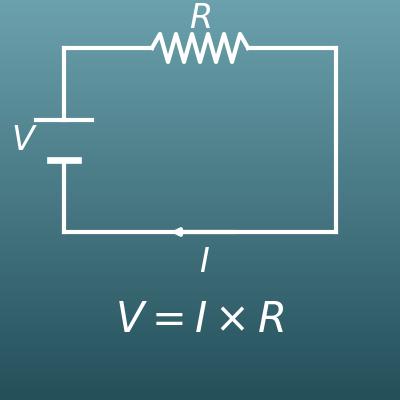
Ohm's Law Calculator (Voltage, Current, Resistance and Power)
Enter two of voltage, current, resistance and power to find the other two. Use this one for physics and electronics calculations that include resistance (Ω)
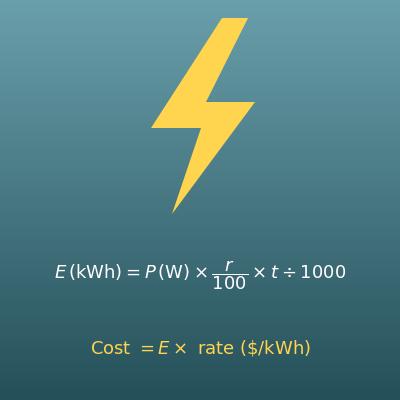
Electricity Cost Calculator (Appliance Energy Use and Cost)
Calculates energy use (kWh) and electricity cost from power (W) and hours of use. Use this one to find out how much the same watts cost you
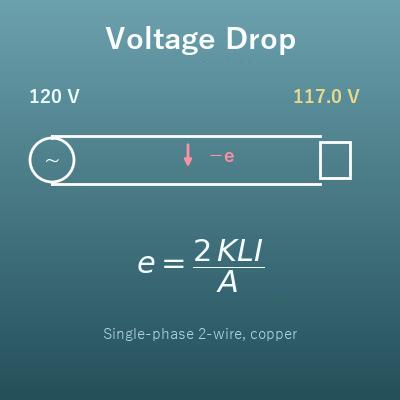
Voltage Drop Calculator (Wire Size, Length and Current)
Calculates the voltage drop in a wire from its size, length and current. Use the current (A) found on this page to check the voltage drop in an extension cord or a circuit